highlike

Seohyo – Tidal Tessellation – South Korea

TIDAL TESSELLATION

Seohyo


FILE SÃO PAULO 2026: Inter-creativity – Art and Technology – Randomic Dimension
Electronic Language International Festival


Tidal Tessellation – South Korea

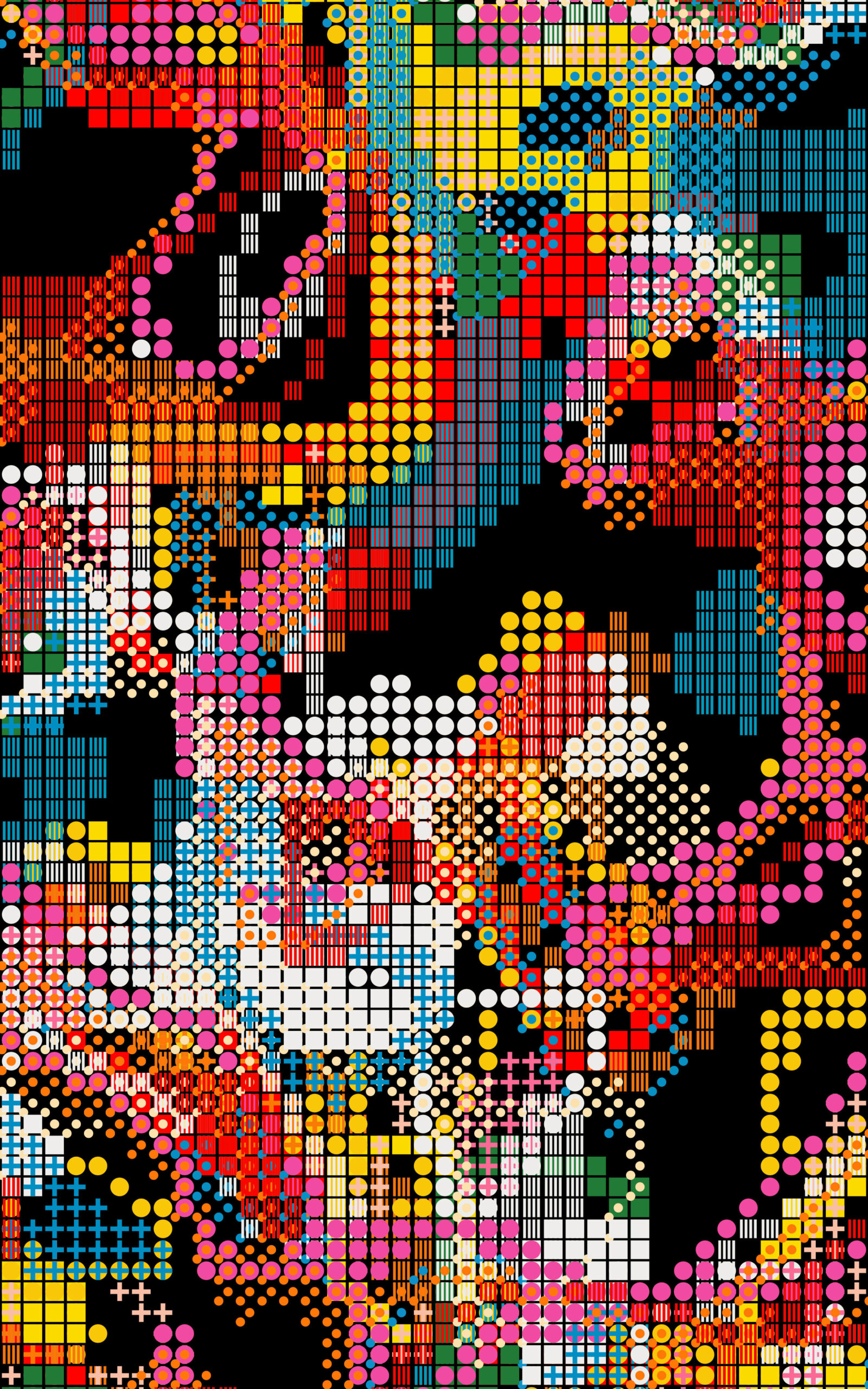
Tidal Tessellation is a generative animation reinterpreting urban flow as fluid movement. The artist projects the energy of city crowds onto the ebb and flow of tides. Using Perlin noise, geometric grids deform according to organic rules, overlaying natural rhythms onto rigid architecture. This work transforms static LED screens into breathing canvases where natural order permeates everyday life, harmonizing the city’s pulse with algorithmic vitality.

BIO

Seohyo  is a generative artist and educator exploring the intersection of algorithmic order and randomness. She expands public art by utilizing urban LED screens as canvases for code-based abstractions. Rather than focusing on static outputs, she emphasizes the generative process to let art naturally permeate everyday life, capturing the living pulses of the city through data and logic.
Chris Barber – Confetti – United States

CONFETTI

Chris Barber


FILE SÃO PAULO 2026: Inter-creativity – Art and Technology – Randomic Dimension
Electronic Language International Festival


Confetti – United States

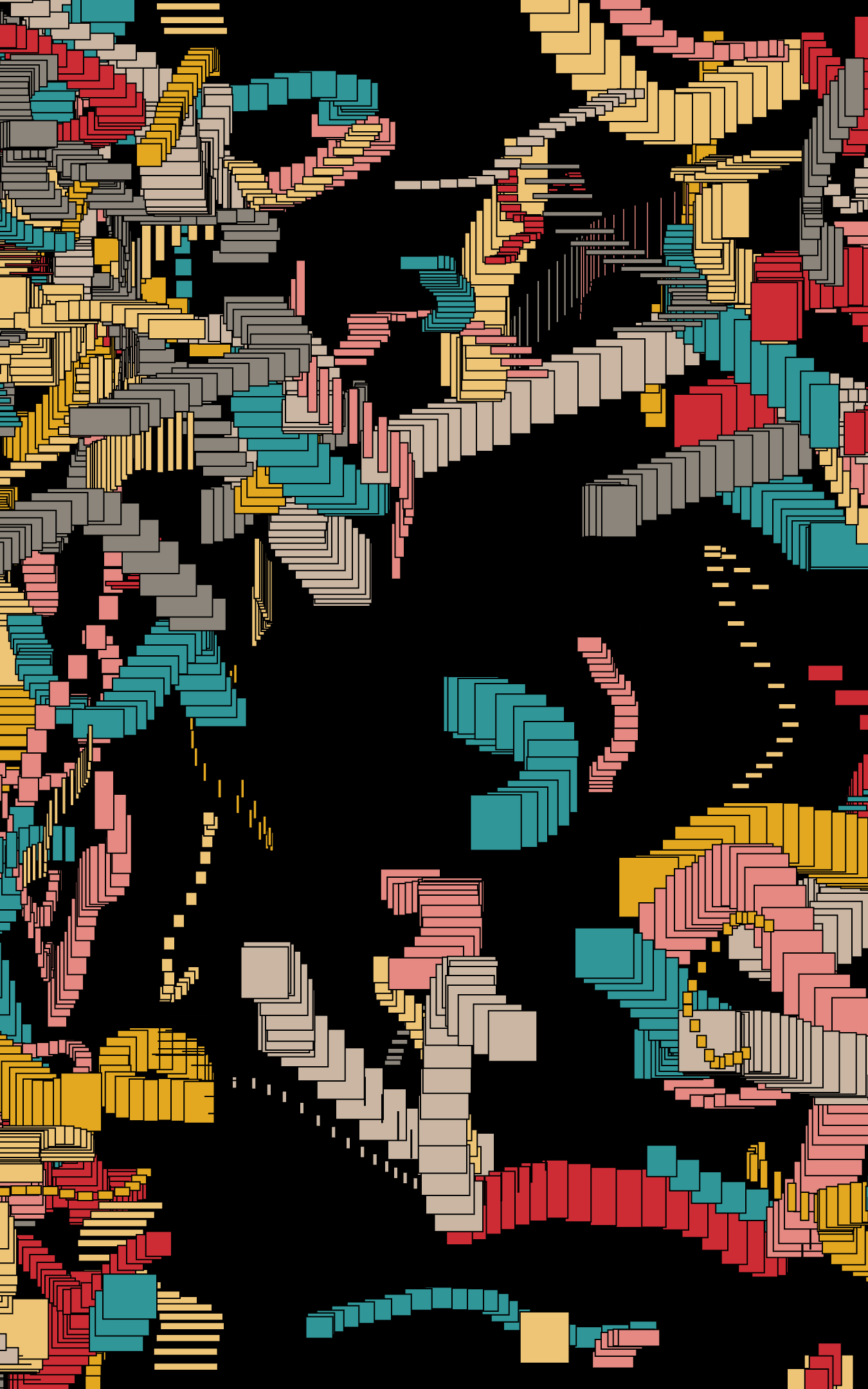
Confetti is a generative composition built from a swarm of random walkers, particles that move step by step in unpredictable directions, each trailing a ribbon of bright, saturated squares. Their motion is shaped by Perlin noise, a smooth, natural-feeling randomness often used to simulate organic phenomena, pairing fluid movement with crisp geometric form. With every refresh the field reorganizes itself, never repeating, never still: a celebration of color and structured chance.

BIO

Chris Barber is a generative artist working at the intersection of code and creativity. Using tools like p5.js and openFrameworks, he brings algorithms to life as dynamic, animated digital art. By combining technology, randomness, and a sharp visual sensibility, his work generates unique compositions with every refresh—known for its vibrant palettes, fluid motion, and mesmerizing patterns.

Raven Kwok

Derivations
“A collaboration with Symmetry Labs at Gray Area Foundation for the Arts in San Francisco. Derivatives of multiple generative rules I designed in the past were adapted to an interactive LED floor. The video demo includes 6 visual sets and transitions in between. Set 01 is an adaption of 1DFBD, which was also used in a couple of projection mapping tests in 2014. Set 03 is derived from an untitled turbulence piece created in 2014 as well. Similar to Set 03, all agents in Set 04 are driven by 3D Perlin Noise flow field. However, instead of being an emitter spawning agents, each dot functions as an attractor intervening in the flow, same way as it did in 2BCD.”Raven Kwok

GIUSEPPE RANDAZZO

Джузеппе Рандаццо
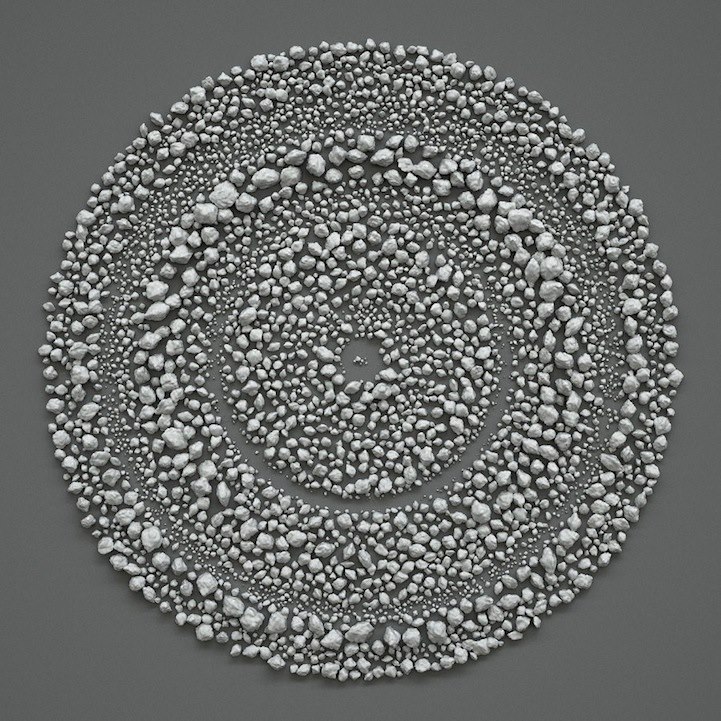
stone fields (Using computer algorithms)

This project has started from a search for a 3d-objects optimal packing algorithm over a surface, but evolved in something rather different. I love the work by Richard Long, from which this project takes its cue. The way he fills lonely landscapes with arcaic stones patterns and its eroic artistic practice, in his monumental vision, is in strong contrast with this computational approach that – ironically – allows virtual stones creation and sorting in a non physical, mental way, a ‘lazy’ version, so to speak. The virtual stones created from several fractal subdivision strategies, find their proper position within the circle, with a trial and error hierarchical algorithm. A mix of attractors and scalar fields (some with Perlin noise) drives the density and size of the stones. The code is a C++ console application that outputs a OBJ 3d file.