highlike

Timothy Weaver & Xavier Barriga-Abril – contrapuntoEnteógeno – Ecuador / United States

CONTRAPUNTOENTEÓGENO

Timothy Weaver & Xavier Barriga-Abril


FILE SÃO PAULO 2026: Inter-creativity – Art and Technology – MUSIC
Electronic Language International Festival


contrapuntoEnteógeno – Ecuador / United States

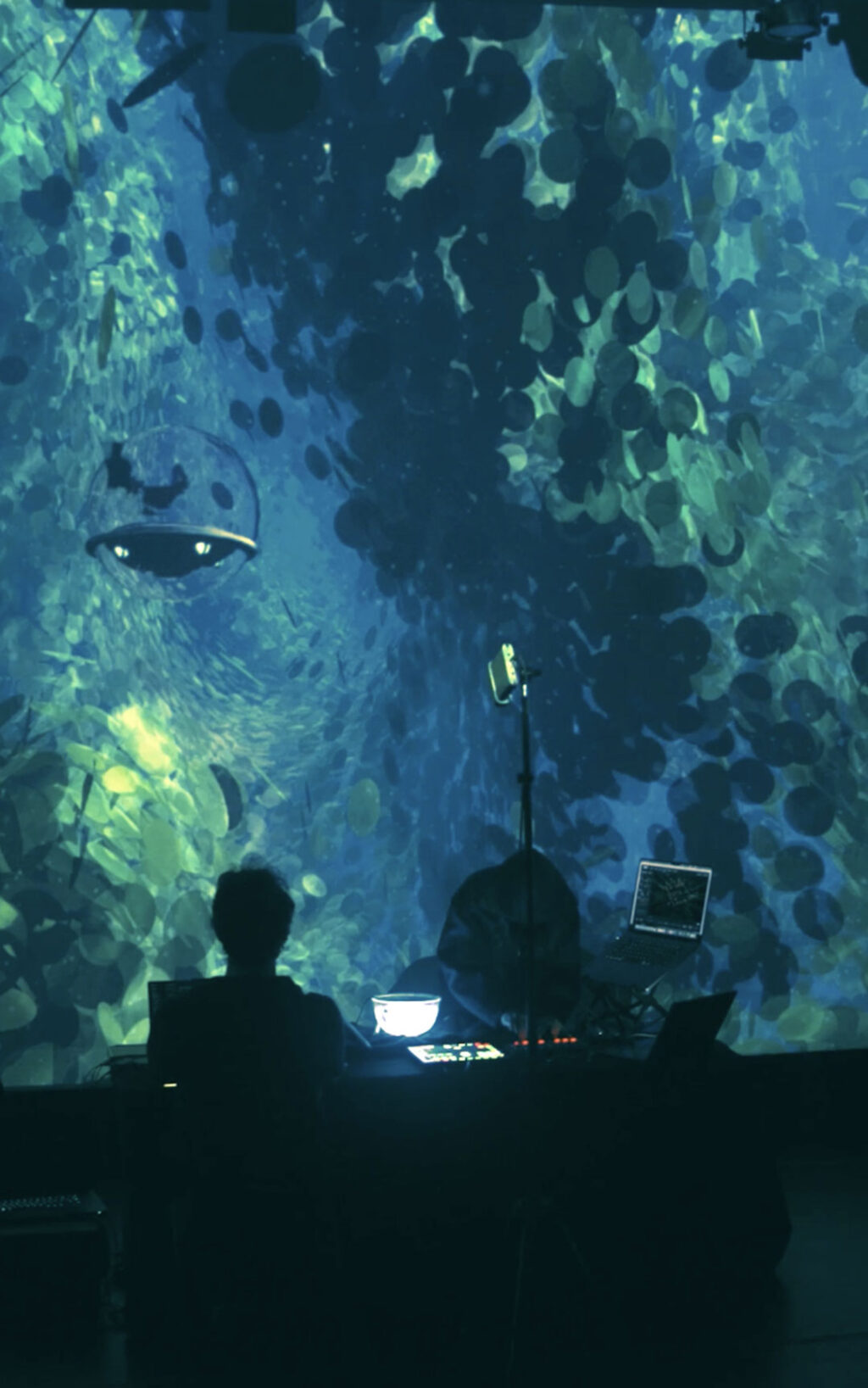
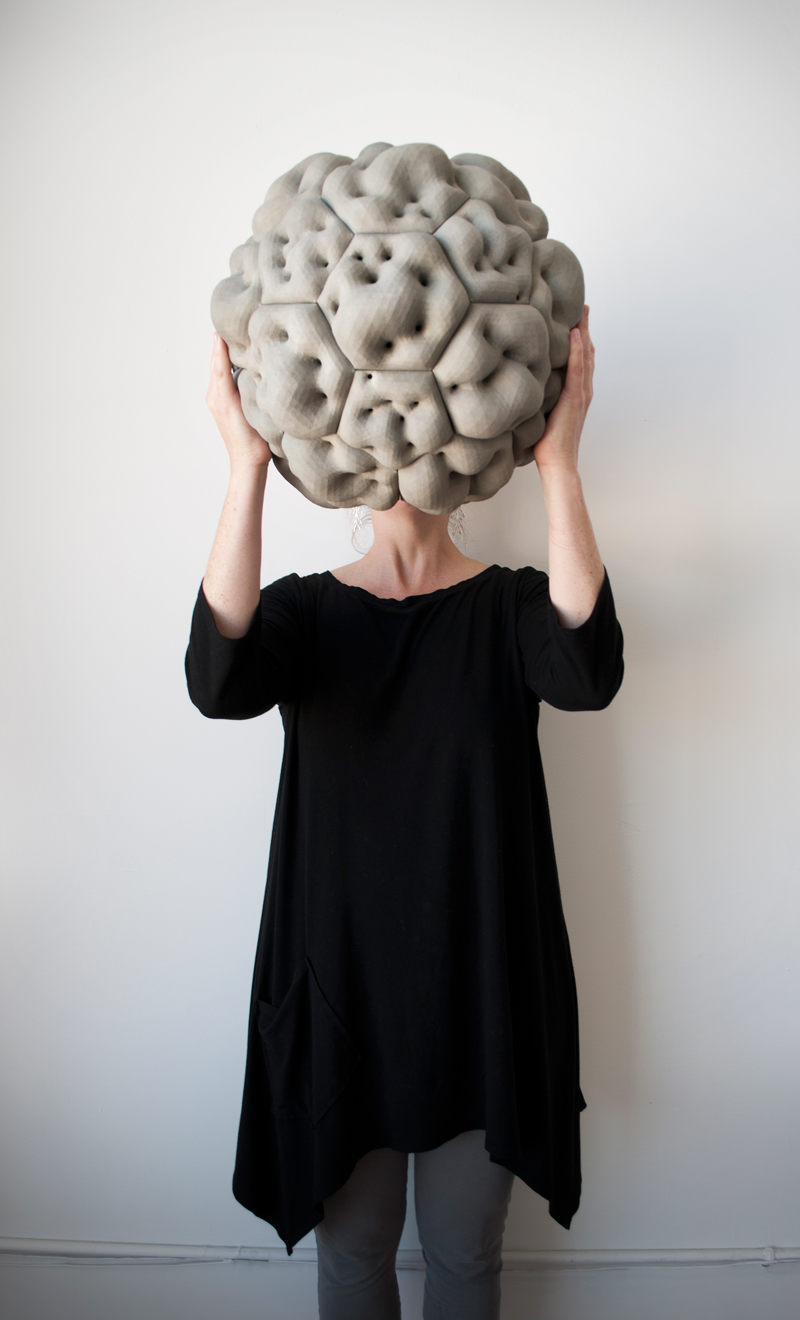
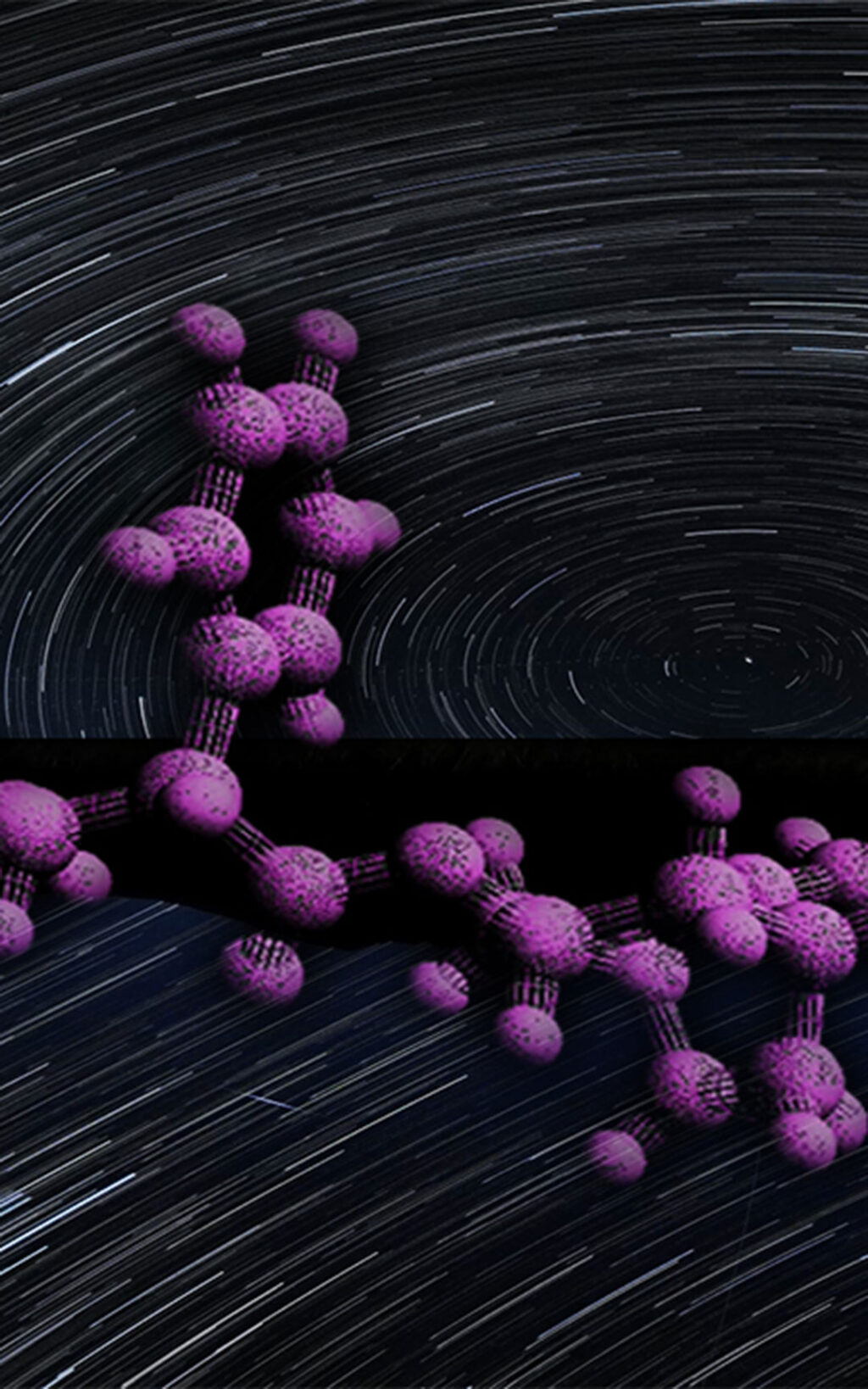
contrapuntoEnteógeno is an entheogenic plant biosonification composed in counterpoint from North & South American ecosystems. Brugmansia arborea (Andean cloud forest) and Datura innoxia (New Mexican desert) generate bioimpedances and scopolamine entheogens under celestial influences. In situ, Eurorack analog synthesis transmediates bioelectrical plant signals into ecogenerated electroacoustic sound, negotiating agencies between human and beyond-human/plant expression.

BIO

Timothy Weaver is a biomedia artist, microbiologist and bioenvironmental engineer focused on restoring ecological memory through speculative inquiry at the art-science interface. He is Professor Emeritus of Emergent Digital Practices at the University of Denver.
Xavier Barriga Abril is an Equatorian designer/artist/researcher exploring posthuman interactive systems through creative coding and electronic fabrication.


IN MEMORIAM

Tribute to Timothy Wayne Weaver: A Life Dedicated to Art, Science, and Knowledge

FILE—Electronic Language International Festival—honors the legacy of Timothy Wayne Weaver, artist, researcher, and professor whose career fostered a meaningful dialogue between art, science, and technology, inspiring artists, researchers, and audiences alike. 

Throughout his career, Timothy developed an interdisciplinary practice that brought together art, science, and environmental responsibility. His work explored the complex relationships between human beings, nature, and technology, guided by experimentation, rigorous research, and a deep commitment to the creation and dissemination of knowledge.

FILE is grateful for Timothy’s intellectual generosity, enduring curiosity, and dedication to building new dialogues across disciplines, contributions he also shared with our audiences and our community. His work and legacy will continue to resonate in the memory of the festival and in the lives of all those touched by his practice.
Richard McCormick – GeoSonic – United Kingdom

GEOSONIC

Richard McCormick


FILE SÃO PAULO 2026: Inter-creativity – Art and Technology – MUSIC
Electronic Language International Festival


GeoSonic – United Kingdom

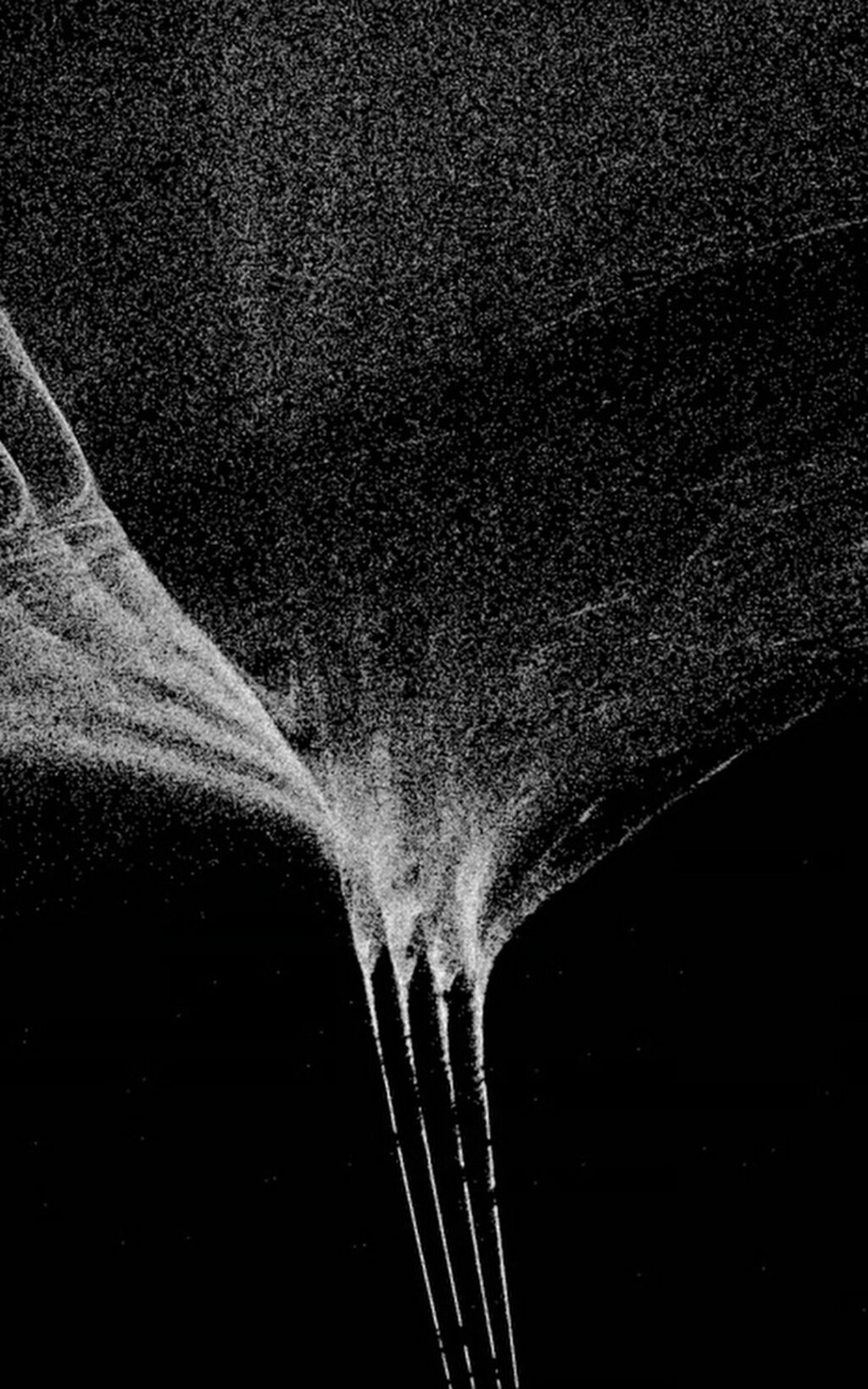
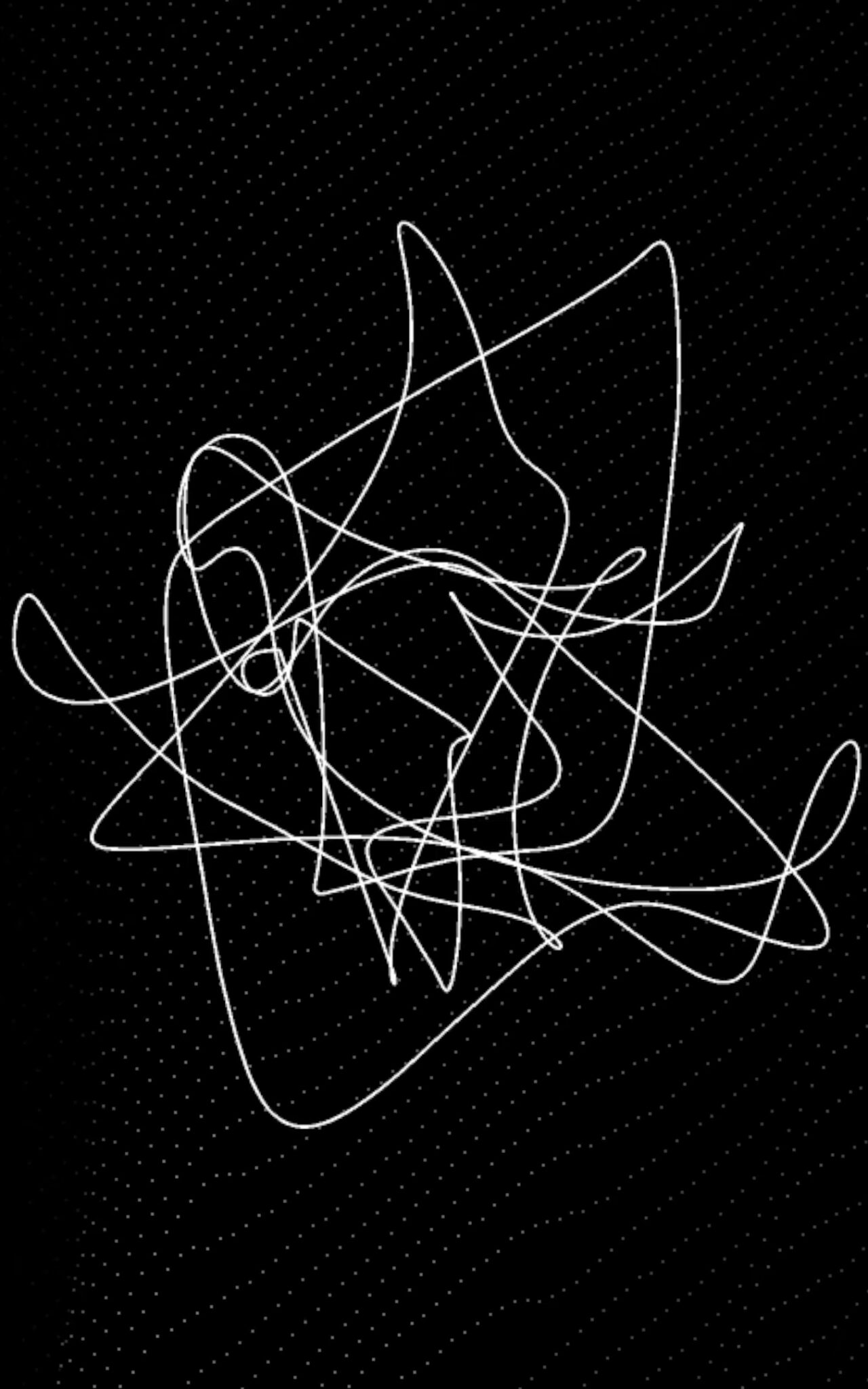
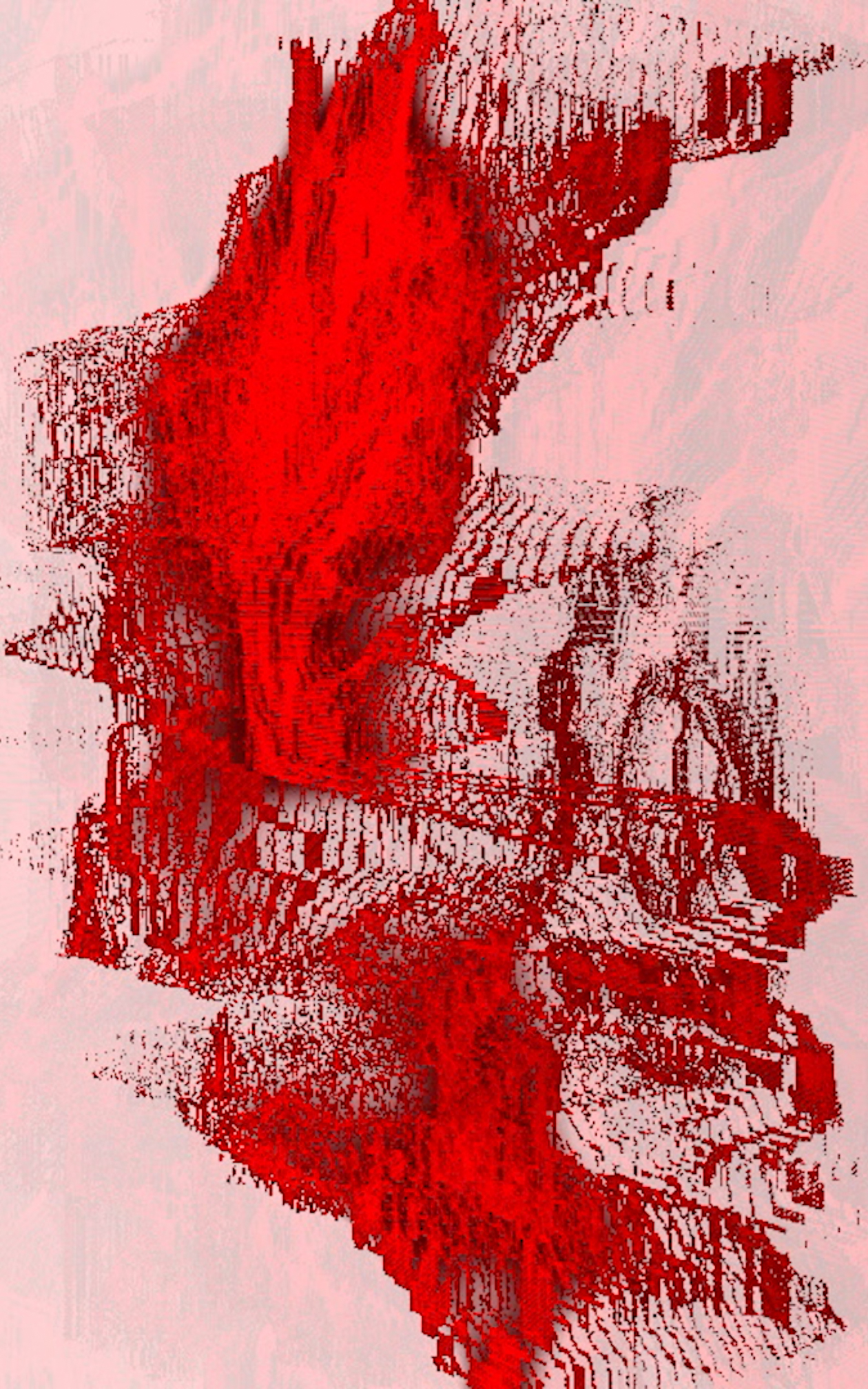
GeoSonic is an audiovisual piece that takes sound from the earth, and other materials and creates visual representations of them with the use of an oscilloscope. Conceptually, the piece is aimed to highlight the fragile nature of the Earth, how each day more and more erodes away. There is a point at which each section breaks or fades to nothing. This is an intentional choice to emphasise the scale of what we are losing and have already lost.

BIO

Richard McCormick is a composer, visual artist and sound designer with previous work ranging from film scores, electroacoustic, audiovisual and his own electronic music. Having studied a Masters in Music Composition at Sheffield University, Richard’s work expanded and developed exponentially under the tutelage of Adrian Moore.

Bowen Wu – Mixobloodify – England

MIXOBLOODIFY

Bowen Wu


FILE SÃO PAULO 2026: Inter-creativity – Art and Technology – MUSIC
Electronic Language International Festival


Mixobloodify – England

Mixobloodify originates from research on hybridizing the traditional Chinese pipa with electronic music to form a new digital language. Through this process, the artist became interested in broader ideas of hybridity, including cross-cultural identity, cultural conflict and self-acceptance. The work follows Homi Bhabha’s notion of the “third space”, treating artistic creation as a site where different cultural backgrounds meet and transform.

BIO

Bowen Wu is a Glasgow-based composer and audiovisual artist working with sound art, electroacoustic music, moving image and live electronics, often using archival material and spatial listening. His works have been presented internationally. He holds an MSc from the University of Edinburgh and is currently a PhD researcher at the University of Glasgow.

An-Ting Chang & Ian Gallagher – Underwater – England / Taiwan

UNDERWATER

An-Ting Chang & Ian Gallagher


FILE SÃO PAULO 2026: Inter-creativity – Art and Technology – MUSIC VIDEO PERFORMANCE
Electronic Language International Festival


Underwater – England / Taiwan

Have you heard that fish talk? Do you know the underwater world is super noisy, like a market full of life and communications? Underwater is a new live performance project that explores the acoustic world of marine life by composer An-Ting and creative technologist Ian Gallagher. We want to share with people the vibrancy and mystery of the natural world, and reconnect them through a collective experience with the non-human communications that our “civilized” society might have made us numb to.

BIO

An-Ting (composer) and Ian Gallagher (creative technologist) are collaborators specializing in blending cutting-edge arts and technology. Their collaborations include every dollar (2021), winner of Arts Council England’s Digital Culture Award for Storytelling, and HOME X (2023), which premiered at the Barbican with a sold-out run and was nominated for the UK Theatre Awards’ Digital Innovation.

Tassio Caetano – Linha Tênue – Brazil

LINHA TÊNUE

Tassio Caetano


FILE SÃO PAULO 2026: Inter-creativity – Art and Technology – VIDEO ART SHORT
Electronic Language International Festival


Linha Tênue – Brazil

Linha Tênue is an audiovisual work that transforms the line into the protagonist, revealing its ambiguity and ability to unfold between form, gesture, and autonomy. Each stroke moves, connects, dissolves contours, creates figures, and establishes temporal relationships flowing between image and sound. The work invites viewers to experience the tension between structure and freedom, perceive details multiplying through continuous movement, and immerse themselves in a sensory universe.

BIO

Born in Brasília, the artist graduated in Composition from the University of Brasília and is currently pursuing postgraduate studies at UNESPAR. His recent research focuses on electroacoustic, visual, and multimedia composition, with works presented at festivals in Brazil, Latin America, Europe, and the United States.

Gerald Trimmel – GARGANTUA (20250302) – Austria

GARGANTUA (20250302)

Gerald Trimmel


FILE SÃO PAULO 2026: Inter-creativity – Art and Technology – VIDEO ART SHORT
Electronic Language International Festival


GARGANTUA (20250302) – Austria

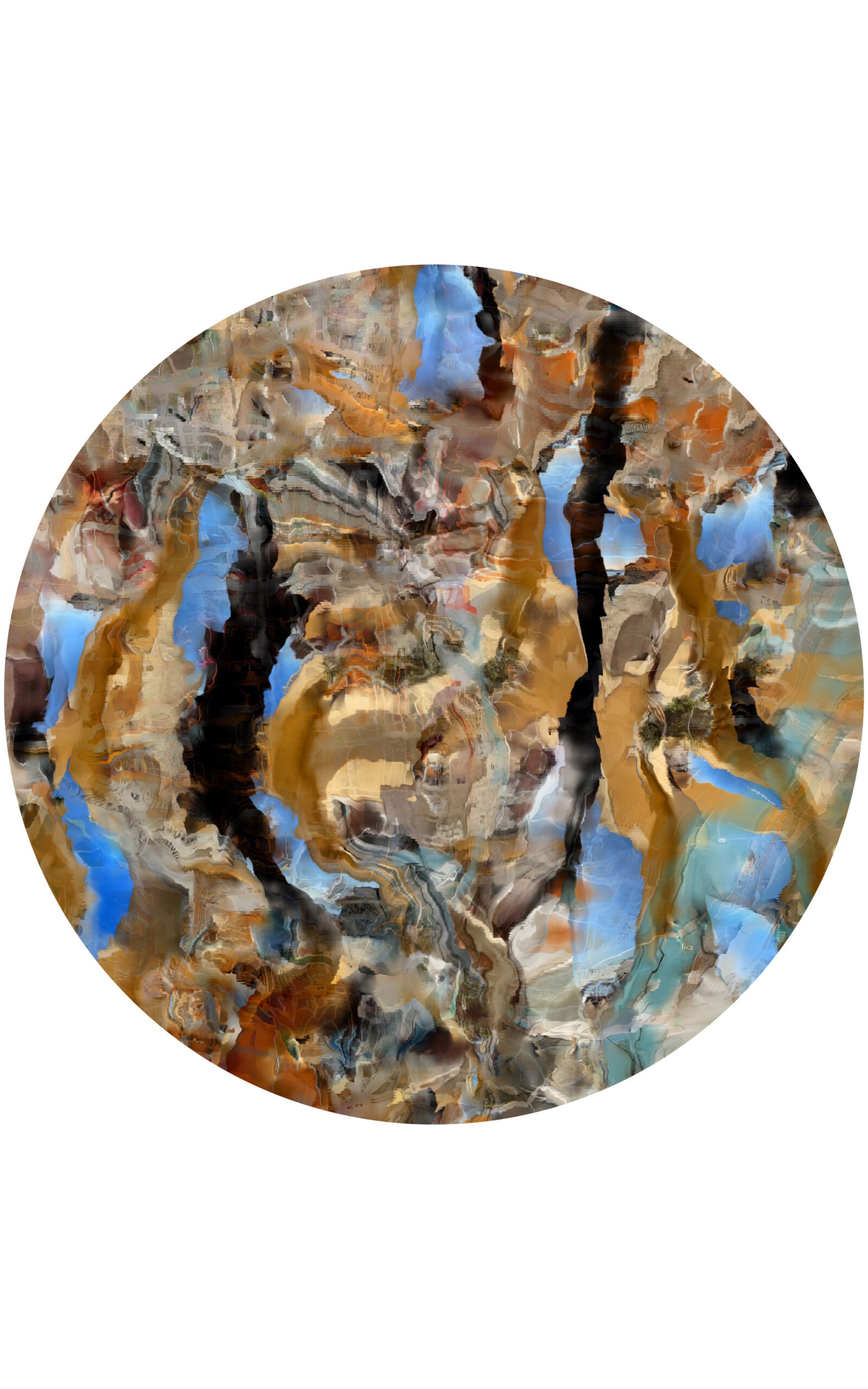
GARGANTUA (20250302) is a dynamic Cybernetic Canvas exploring AI-based image transformation as a metabolic process. Hybrid source materials—osmotic paintings, scans, chemical micro-scenarios, and dismantled diagrams—are processed through algorithmic recombination into a continuously shifting circular field. The work stages an unstable dialogue between visual matter and electroacoustic sound, forming a dense system of feedback, drift, and perceptual unrest.

BIO

Gerald Trimmel is a Vienna-based media artist, composer, and art therapist. His work explores transformation processes between analog material, digital systems, and AI-based image generation, often in circular audiovisual formats (Cybernetic Canvas). Recent presentations include Chongqing (China), ArteScienza Festival (Rome), and The Wrong Biennale (São Paulo | online).

Alvaro Collar – Rorschach’s Garden – Spain

RORSCHACH’S GARDEN

Alvaro Collar


FILE SÃO PAULO 2026: Inter-creativity – Art and Technology – VIDEO ART SHORT
Electronic Language International Festival


Rorschach’s Garden – Spain

Rorschach’s Garden examines embodiment at quantum scales—identity as superposition, both observer and observed. Degraded video and AI animation create a secret garden of crypto-fauna: organisms flickering between states, trembling with unrealized forms.

The work interrogates bodily multiplicity through quantum uncertainty. Garden biota exists as probability clouds—here/not-here, collapsed/uncollapsed—embodying hybrid physical-digital existence.

BIO

Experimental filmmaker and video artist working at the intersection of low-resolution aesthetics, contemporary moving image, and computational creativity. Founding member of Haz! collective; AVAM associate.

Work exhibited internationally at Ars Electronica (Austria), Hanshan Art Museum (China), Medialab Madrid (Spain), Ibrida Festival (Italy), and NYC Electroacoustic Music Festival, amongs others.

FLORIAN HECKER

فلوريان هيكر
フロリアン·ヘッカー
Sound Installation

Event, Stream, Object

In his installations, live performances and publications, Florian Hecker deals with specific compositional developments of post-war modernity, electroacoustic music as well as other, non-musical disciplines. He dramatizes space, time and self-perception in his sonic works by isolating specific auditory events in their singularity, thus stretching the boundaries of their materialization.
Their objectual autonomy is exposed while simultaneously evoking sensations, memories and associations in an immersive intensity. Some of his works incorporate psycho-acoustic phenomena, disorienting listeners’ spatial perceptions and expanding their conception about sound. Hecker’s most recent recording, Speculative Solution ( Editions Mego, 2011), brings together Hecker’s sonic practice and psychoacoustic experimentation with philosopher Quentin Meillassoux’s concept of ‘hyperchaos’ – the absolute contingency of the laws of nature.
During his residency at MIT, Florian Hecker will research a new sound piece that takes the concept of the “auditory chimera” as point of departure. Originally developed at MIT by Bertrand Delgutte, senior research scientist at the MIT Research Laboratory of Electronics, the concept of the auditory chimera inspires an exploration of the relationship between pitch perception and sound localization. Hecker will create a text and sound piece that incorporates the recordings of material read by students. Using an anechoic chamber he will work with students to explore the experiential nature of psycho-acoustic practice.
REFIK ANADOL

Augmented Structures v1 Acoustic Formations
Istiklal Street


“Augmented Structures v1.1 : Acoustic Formations/Istiklal Street” is an augmented data structure, a data installation by Refik Anadol and Alper Derinboğaz which is created through the use of innovative parametric architecture and audiovisual techniques. The projects deals with a new mediated space: How to translate the logic of media into architecture? In this first experiment field recordings of Istiklal Street will be transformed in to parametric architectural structure. The sound data recordings were made by Kerim Karaoglu who also used these recordings to create an electro-acoustical composition. The project seeks interactions between space, sound, visual, data and light. A similar connection between architecture and media has been experienced in Philips Pavilion of Le Courbusier in 1958.

FILE SÃO PAULO 2025: SYNTHETIKA – Juan Manuel Escalante

Music for Control Panels

Juan Manuel Escalante

FILE SÃO PAULO 2025: SYNTHETIKA – Art and Technology – Video Art
Electronic Language International Festival


Music for Control Panels – Mexico

Music for Control Panels is an audiovisual exploration inspired by the aesthetics of machines and control rooms. In the tradition of electronic ambient music, sporadic acoustic events and drones guide the viewer through a contemplative journey. The visual component features a generative graphic score echoing projections of computer terminals, printers, and fax machines. The overall composition pays homage to the early computer systems using contemporary techniques.

BIO

Escalante is an artist and educator working with computer code, modular synthesizers, and analog drawings. His work has been shown in major festivals and exhibitions worldwide. Escalante holds a Ph.D. in Media Arts & Technology (University of California, Santa Barbara).

FILE SÃO PAULO 2025: SYNTHETIKA – Edwin van der Heide

Spiral of Time — Amazonas Brazil — UFAM

Edwin van der Heide

Interact with Spiral of Time — Amazonas Brazil — UFAM via FILE ARCHIVE


FILE SÃO PAULO 2025: SYNTHETIKA – Art and Technology – Installations
Electronic Language International Festival


Spiral of Time — Amazonas Brazil — UFAM – Netherlands

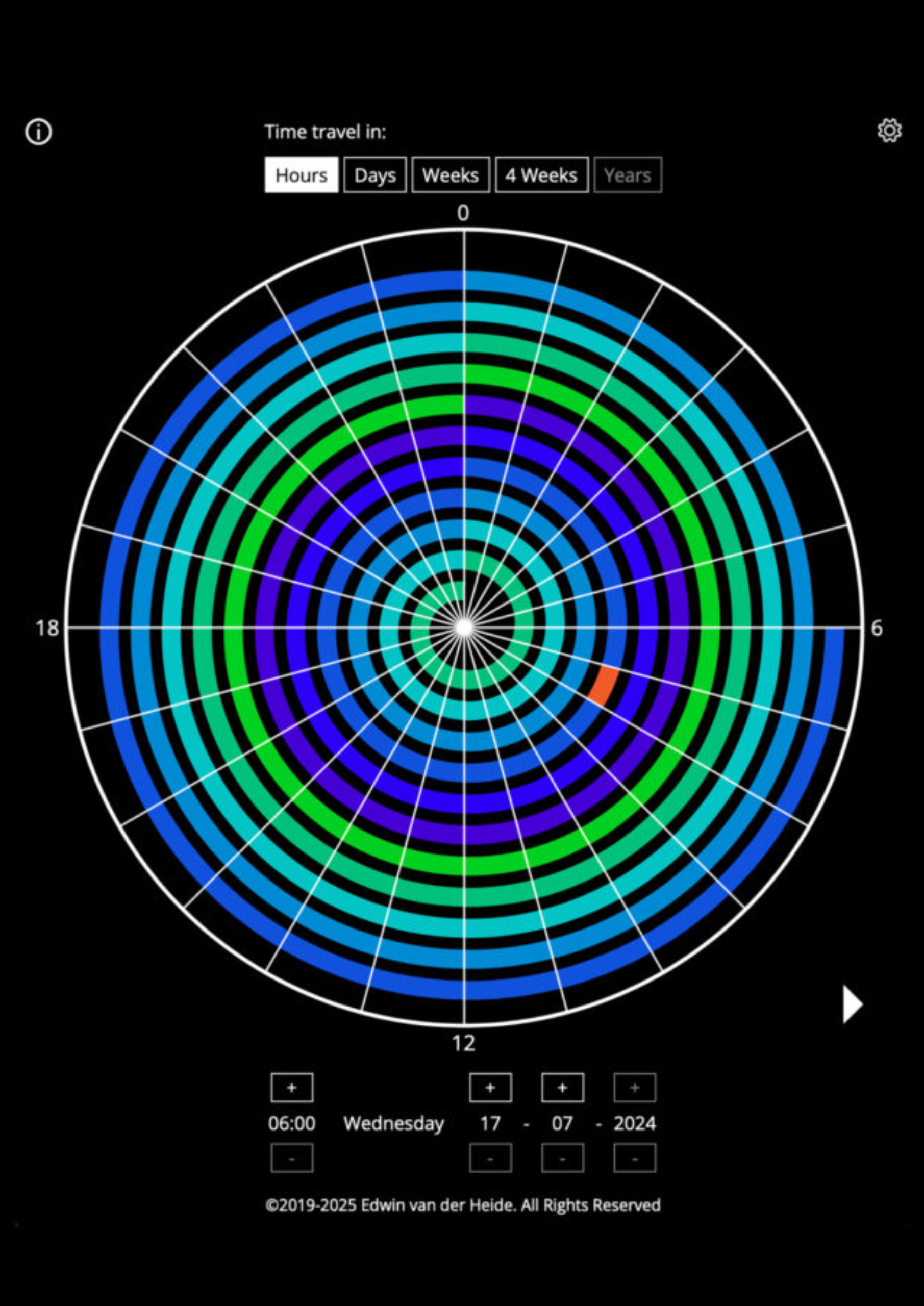
Spiral of Time captures and stages the diverse soundscape of a specific location over the course of several years. By documenting the unique natural, cultural, spatial, and temporal dynamics of a place, the work honors the contributions of all its actors. Every hour, a one-minute recording is made, resulting in a vast sonic archive over time. It is accessible online through a spiral-shaped interface, allowing listeners to explore the cyclical patterns revealed by navigating the material across different time intervals. 


Since July 17th, 2024, the artist has been recording the sounds of the square in front of MACBA (Museum of Contemporary Art of Barcelona). It is a very interesting, diverse, and vibrant urban space. The work is accessible online via https://www.macba.cat/en/spiral-of-time-placa-dels-angels/ and will also be presented physically in the museum starting July 10th, 2025.


Edwin is expanding the project to include other recording locations around the world—not only in urban contexts (dominated by humans) but also in areas governed by nature. The artist dedicated himself to a recording site in the Amazon region. Since February 11th, 2025 Spiral of Time has been installed at the Amazon Rainforest surrounding The UFAM (Federal University of Amazonas) in Manaus. It is home to one of the world’s largest urban forest fragments. Completely surrounded by the dense urban matrix of Manaus, this forest has been isolated since the late 1980s. The forest retains rich ecological features, including areas of mature terra-firme forest, late-stage secondary vegetation, and small patches of white-sand forests. This unique setting offers a rare opportunity to study tropical forest dynamics within a metropolitan environment. 

Spiral of Time-UFAM immerses the listeners in the acoustic life of one of the most biodiverse ecosystems on the planet. This contrast between the natural rhythms of the forest and the human-made patterns of the city enriches the broader narrative of the Spiral of Time, offering a deeper reflection on coexistence, change, and continuity across different environments.

BIO

Edwin van der Heide is an artist, composer, and researcher focused on sound, space, and interaction. His work pushes the boundaries of musical composition toward spatial, interactive, and interdisciplinary directions. He creates installations, performances, and immersive environments where the audience is placed at the center, encouraged to engage sensorially and investigatively.


Ryoji Ikeda

micro | macro
micro | macro transforms Hall E in the MuseumsQuartier into an oversized world of moving images and sounds. In his immersive installation, multimedia artist Ryoji Ikeda creates a field of imagination between quantum physics, empirical experimentation and human perception. In collaboration with nuclear scientists at CERN, Ikeda has translated complex physical theories into a sensory experience. The Planck scale is used by scientists to denote extremely small lengths or time intervals. Concepts like space and time lose their meaning beyond this scale, and contemporary physics has to rely on speculative theories. And on art. Visitors to micro | macro enter a world of data, particles, light and sound that makes the extremes of the universe perceptible to the eye and ear. In the micro world we penetrate the smallest dimensions of the unrepresentable, while in the macro world we take off into cosmic expanses that allow us to experience the infinite space beyond the observable universe. In this maelstrom of data, an acoustic and visual firework bridges the gap between theoretical understanding and sensual perception.

DI MAINSTONE AND TIM MURRAY-BROWNE

Serendiptichord

The result of a cross-disciplinary investigation spanning fashion, technology, music and dance, the Serendiptichord is a wearable musical instrument that invites the user (or movician) to explore a soundscape through touch and movement. This curious device is housed in a bespoke box and viewed as part of a performance. Unpacked and explored on and around the body, the Serendiptichord only reveals its full potential through the intrepid curiosity of its wearer. Adhering to the body like an extended limb, this instrument is best described as choreophonic prosthetic. Referencing the architectural silhouette of a musical instrument and the soft fabrication of fashion and upholstery, it is designed to entice the movician to explore its surface through touch, physical manipulation and expressive movement. Although this acoustic device can be mastered alone, it also holds subtle openings for group interaction.

Jacqueline Hen

Light High
The installation LIGHT HIGH is aimed at guiding the perception through targeted acoustic and visual phenomena into border areas in which ambivalent experiences set in and the habitual experience of space is abolished.[…] A mirrored ceiling together with a thin reflecting surface of water on the ground and a grid arrangement of lights are creating the spatial illusion of an infinite vertical space of light and darkness. By traversing a small bridge, the visitor can cautiously discover the immersing endlessness beneath his/her feats and above his/her head.

Baumgartner + Uriu Architecture

Supermassive Black Holes
Supermassive Black Holes is an acoustic ceiling installation for the main lobby of the Los Angeles Chamber of Commerce. The design is part of a series of projects in which we work with small primitives that are aggregated into a larger whole. In this case, there are over 10,000 felt cones stitched together into three gigantic, 20’ tall, hanging felt vortexes that that absorb sound through its materiality and geometry. The thousands of cone shape parts trap and disperse sound waves while softening the overall acoustic quality of the space.

Kutin | Kindlinger

ROTOЯ
The Rotor is equipped with a four channel speakersystem and a 360° camera. The artists control the speed of it’s rotation which directly influences the projected video-images as well as the sound-characteristics and the perception of the object itself. Acceleration & deceleration become main parameters, which enables the artists to compose an otherworldly piece that seems to follow it’s own logic. A strange communication between audio, video, object and light establishes itself and seduces the audience. There is the hypnotic movement of the sculpture while inevitable auditory and visual feedback is used as a central aesthetic element: The rotating speakers are amplified by static microphones, provoking complex feedback loops and patterns, that trigger psychoacoustic sensations.

YUNCHUL KIM

CHROMA III
Kim ist bekannt für seine mechanischen Skulpturen, die wissenschaftliche und mathematische Theorien einbeziehen, und auch als Komponist elektroakustischer Musik. Für diese Triennale präsentiert Kim Chroma III, das die Knotentheorie in der Mathematik anwendet, um Hunderte von Polymerzellen […]
.
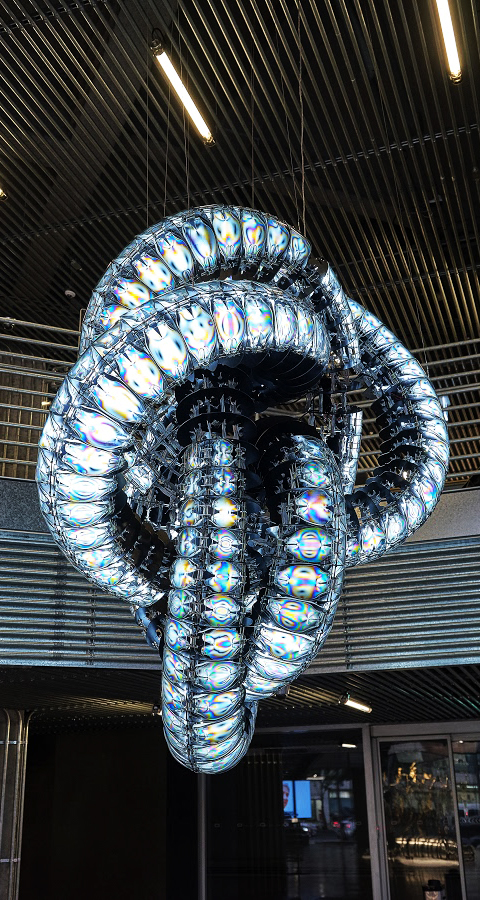
Kim is known for his mechanical sculptures that incorporate scientific and mathematical theories and also as a composer of electroacoustic music. For this Triennale, Kim presents Chroma III, which applies knot theory in mathematics to structure hundreds of polymer cells […]

UVA United Visual Artists

Great Animal Orchestra
The Fondation Cartier invited United Visual Artists to collaborate on The Great Animal Orchestra, exhibition that celebrates the work of musician, bio-acoustician and scientist Bernie Krause. Krause has been recording animals for 45 years and has amassed a collection of more than 5,000 hours of sounds  recording of over 15,000 individual species in their natural habitats from all over the world. UVA’s creative approach linked together the various exhibition content elements throughout the basement space — soundscapes, spectrograms and art works — into a cohesive, immersive experience that three-dimensionalises Krause’s recordings and suggests scenes from the natural world. The spectrograms form an abstract landscape, an interpretation of the various global locations and times of day that Krause made the original recordings in a way that envelops the audience and encourages them to linger in the space.

Maki Namekawa

Pianographique
Pianographique is a series of collaborations of real time visual artist Cori O’Lan and Maki Namekawa. The visualisations are not videos that are more or less synchronous to the music and it is also not the musician’s playing to prefabricated material, they are jointly created together in the moment of the performance. As with most of Cori O’Lan’s visualizations, all graphic elements are derived directly from the acoustic material, i.e. the sound of the music. For this purpose, the piano is picked up with microphones and these signals are then transformed by the computer into a multitude of information about frequency, pitch, volume, dynamics, etc… This information, in turn, is used to control the graphics computer, create graphical elements or modify them in many ways. Since these processes take place in real time, there is a direct and expressive connection between the music and visual interpretation. The visualization is actually not “created” by the computer but much more by the music itself – the computer is rather the instrument, the brush operated, played by the music.

Thom Kubli

Brazil Now
BRAZIL NOW is a composition that addresses increasing militarization and surveillance within urban areas. Its geographical and acoustic reference is São Paulo, the largest megacity in Latin America. The piece is based on field recordings that capture the symptoms of a Latin American variant of turbo-capitalism with its distinctive acoustic features. Eruptive public demonstrations on the streets are often accompanied by loud, carnivalesque elements. These are controlled by a militarized infrastructure, openly demonstrating a readiness to deploy violence. The sonic documents are analyzed by machine learning algorithms searching for acoustic memes, textures, and rhythms that could be symptomatic for predominant social forces. The algorithmic results are then used as a base for a score and its interpretation through a musical ensemble. The piece drafts a phantasmatic auditory landscape built on the algorithmic evaluation of urban conflict zones.

Michele Spanghero

Dià
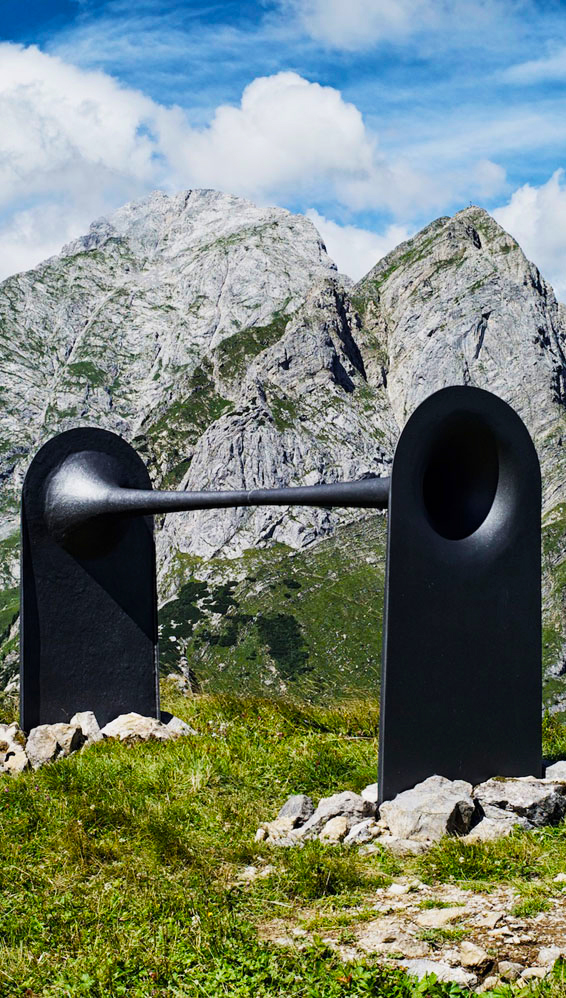
Dià (from greek διά, through) is a sculpture installed on a piece of no man’s land on the top of mount Pal Piccolo on the border between Italy and Austria, where World War I was fought. The double-trumpet shaped sculpture symbolically connects, both visually and acoustically, the first lines’ trenches. Two arched doors, that refer to the entrance of the shelters and trenches, turn into cavities to listen or observe the surrounding landscape. The work, conceived as a symbolic link between the two fronts, combines the dimensions of silence and sound: dià is indeed a device that invites audience to interact with the two cavities as a megaphone or a peephole, to start an intimate dialogue through the sculpture.

Stelarc

Re-Wired / Re-Mixed: Event for Dismembered Body
“Re-Wired / Re-Mixed: Event for Dismembered Body” was a five-day, six-hour a day internet enabled performance, that explores the physiological and aesthetic experience of a fragmented, distributed, de-synchronized, distracted and involuntary body – wired and under surveillance. The artist wears a HUD (head up display) that enables him to see with the “eyes” of someone in London, whilst hearing with the “ears” of someone in New York. The body is also augmented by an 8 degrees-of-freedom exoskeleton so that anyone anywhere can generate involuntary movement of his right arm, using an online interface. The artist becomes optically and acoustically de-synchronized and performs partly involuntarily.

Jelle Mastenbroek

The Robin Who Wondered If He Was a Nightingale
Various members of orchestra perform impressive improvisations based on your identity and the natural environment. The flutes combine their sounds with the rhythm of the percussion. The special acoustics of the forest played an important role. Every time an attempt is made to deliver the highest quality of improvisation and to achieve more than perfectly played notes. This creates a magical and unforgettable experience. Musicians: Nightingale, Cuckoo, Moorhen, Pigeon, Curlew, Black-billed Cuckoo, House Sparrow, Little Owl, Woodcock, Green Woodpecker, Great Spotted Woodpecker, Middle Spotted Woodpecker, Lesser Spotted Woodpecker.

Jonas Pequeno

Foley
Huxley-Parlour gallery presents a solo exhibition of new audiovisual and installation works by the London-based artist Jonas Pequeno. Comprising of three works, a kinetic sound installation Foley, a CGI video Ocean Scene Composite and a photographing print, and the act of appearing, the exhibition considers incongruity in digital fictional constructs. The title of the exhibition, /ˈfəʊli/, is a phonetic transcription of the word foley, a film-making technique used to manually mimic everyday sound effects in post-production when props do not acoustically match their real life counterparts. Influenced by the concept of foley, Pequeno’s work features an audiovisual installation that incorporates microphones and balloons swayed by a fan, replicating the sound of crashing ocean waves.

MONOCOLOR

Latent Space
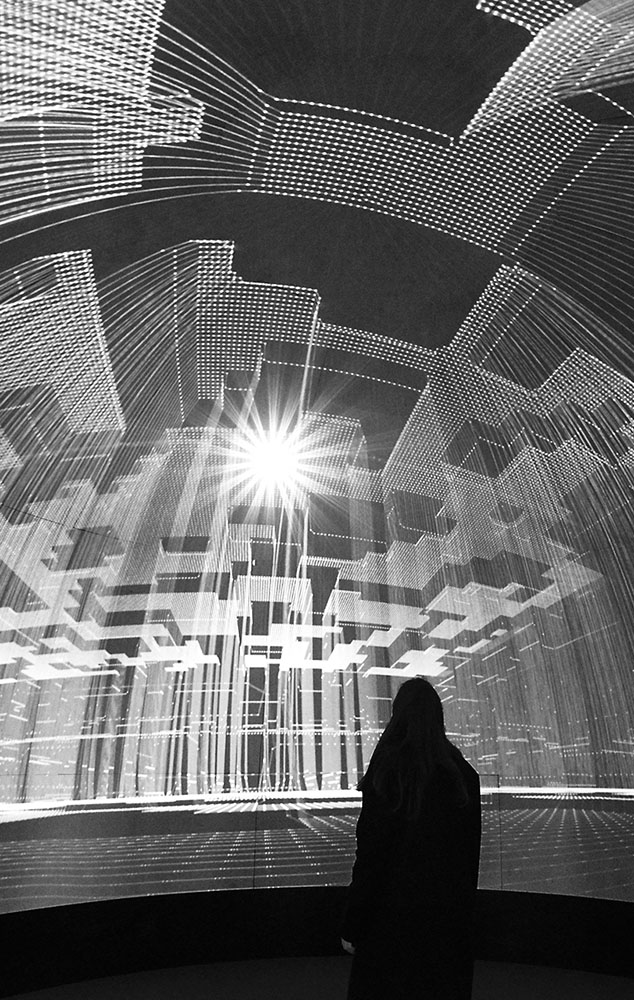
In Latent Space fine lines weave virtual spaces around the viewers. The architecture that manifests is highly fragile — the space grows, shrinks, collapses. The acoustic dimension is also deeply spatial — slowly morphing soundscapes float around the dome, enveloping the observers in sound and image. The omnipresence of the virtual realm is transposed into the physical space of the dome to unmask the often proclaimed boundlessness of digital space. The work tests and investigates the spatial effects of the dome, which serves as a metaphor for the virtual net that always surrounds us.

Ray Kunimoto

REI – Listening to Silence
This work consists of a jet-black sphere containing 16 speaker units, six loudspeakers suspended from the ceiling, and a cubic structure. It creates an acoustic space by reverberating the sound of water from the sphere and the surrounding environment using four omnidirectional micro- phones installed on both the structure and the loudspeakers. The oceans evaporate, rain falls, and rivers continue to flow forever without any kind of consciousness. REI moves from the conscious to the subconscious by superimposing the sound echoing from one’s own body and the sound of water echoing from the sphere, which is a metaphor for this world.

Miyu Hosoi

Lenna
Focusing on the orientation and dispersion of sound images, this spatial musical work was made using multiple audio channels, and only the human voice as a sound source. It represents at once an attempt to encourage the creation of multichannel acoustic contents, and the theoretical and practical development of audiovisual environments.

JORG NIEHAGE

Samplingplong
File Festival

Randomly selected, acoustically usable finds (electronic junk, relays, plastic toys,compressed air valves, pneumatically operated components) are combined with cables and tubes. Via a device controlled by computer, they are turned into interactive instruments. An improvised ensemble evolves, from which – per mouse-over and mouse-click -short miniature compositions of dense rhythmic clicks, hisses, whirs, hums and crackles can be elicited. A tapestry of sound bursts forth from the floral-like web of cables and tubes. The installation can be used by the projected mouse-cursor: rolling over the improvised instruments causes small sound events. Activating the installation by rolling over its parts enables the user to play spontaneous improvisations. Clicking these objects starts short programs of loop-like compositions. Small “techno-compositions en miniature”, rhythmic patterns of analog (or real) sounds; a physical low-tech simulation of electronic, digital music, perhaps an ironic comment on interactivity.

Roberto Pugliese

Equilibrium Variant
This work has the purpose of exploring the occurrence of the Larsen effect (also known as feedback) through the use of mobile devices in a three-dimensional space. The distinctive screech of the Larsen effect typically occurs when a microphone catches the sound emitted by a speaker. It engages when the microphone is located too close to the speaker, and gets in the way of its frequency. The microphone amplifies and reproduces the speaker’s frequency with an ever-increasing width, virtually unlimited, in practice stopped by the amplifier’s clip. On a ground support, two mechanical arms are located. At the end of one arm there is a microphone, and on the end of the other there is a speaker. A software, created with this specific purpose, manages the position of the arms in a dynamic way, and provides that the distance between the microphone and the speaker never causes the amplifier to clip. This way, the system tends to reach an equilibrium that is physically impossible to attain. The struggle to balance creates an acoustic and visual dimension that is never the same: the frequency of feedback and the movements of the mechanical arms are always different and change in real time.

Raster-Noton

White Circle
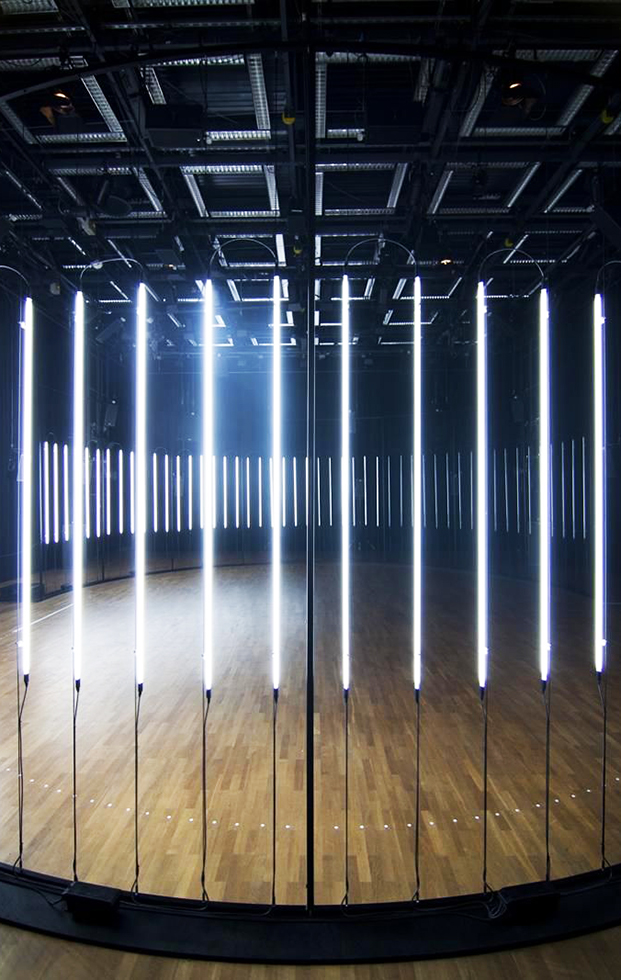
»White Circle« consists of fluorescent tubes that respond to musical impulses and illuminate the room. Five dedicated compositions by alva noto, byetone, frank bretschneider, and kangding ray playing in a continuous loop (one set takes ca. 45 minutes) model the interrelation between sound, light, and architecture in different ways. Each piece represents an independent and self-contained conceptual proposal by the respective composer. All tracks are multichannel compositions based on the idea of creating a vivid immediate experience of auditory space and visual stimuli. With acoustic material routed to twentyseven speakers placed throughout the gallery, sound itself takes on a threedimensional and indeed sculptural quality.

Christoph De Boeck

Staalhemel

The intimate topography of the brain is laid out across a grid of 80 steel ceiling tiles as a spatialized form of tapping. The visitor can experience the dynamics of his cognitive self by fitting a wireless EEG interface on his head, that allows him to walk under the acoustic representation of his own brain waves.The accumulating resonances of impacted steel sheets generates penetrating overtones. The spatial distribution of impact and the overlapping of reverberations create a very physical soundspace to house an intangible stream of consciousness.‘Staalhemel’ (‘steel sky’, 2009) articulates the contradictory relationship we entertain with our own nervous system. Neurological feedback makes that the cognitive focus is repeatedly interrupted by the representation of this focus. Concentrated thinking attempts to portray itself in a space that is reshaped by thinking itself nearly every split second.

Natura Machina

Soundform No.1
“Soundform No.1” is a minimalistic soundscape and kinetic art installation that transforms heat energy into a poetically evolving, spatiotemporal composition. All the sound in this installation is created thermo acoustically by activating heating elements inside quartz glass tubes hung in the space. As the glass warms, a nickel-titanium spring reacts instantly, pulling the cylinder upright. At the correct angle, airflow becomes unrestricted, and a thermo acoustic phenomenon, known as a Rijke effect (named for the professor who discovered the phenomenon in 1859), creates an audible tone.

Signe Lidén and Espen Sommer Eide

Vertical Studies
Vertical Studies: Acoustic Shadows and Boundary Reflections; Water Tower Sint Jansklooster In their new collaborative work, Vertical Studies: Acoustic Shadows and Boundary Reflections, Signe Lidén and Espen Sommer invite participants on a journey to a 46-metre-high abandoned water tower in Sint Jansklooster. The tower has been re-imagined as a vertical field-lab where Lidén and Sommer discuss their ongoing research into connections between sound, history, wind and weather. To this end they have constructed a range of special instruments to record and playback sounds in the vertical dimension. The participants on this journey will experience live outdoor vertical studies and a vertical soundscape shaped by Eide and Lidén that ascends the tower’s spiral staircase.

FABIO ANTINORI AND ALICJA PYTLEWSKA

Contours
London-based creative laboratory Bare Conductive was invited to team up with designers Fabio Antinori and Alicja Pytlewska in order to develop a large-scale metaphor for the idea of breathing life into a collection of responsive textile skins. ‘Contours’ is at the core of the interactive tapestry installation; a series capacitive sensors are applied to the suspended fabric substrates using conductive paint. These sensors react to the presence of a person within the vicinity and track their movements, outputting a constantly modulated ambient soundscape reminiscent of medical research environments. The abstract geometric ornamentation connects the tapestries’ individual sensors to form giant panels, serving as an acoustic feedback loop that alludes to the relationship between science and the body.

Adam Basanta

the sound of empty space
The sound of empty space explores relationships between microphones, speakers, and surrounding acoustic environments through controlled, self-generating microphone feedback. Amplifying and aestheticizing the acoustic inactivity between technological “inputs” and “outputs” – stand-ins for their corporeal correlates, the ear and mouth – the notion of a causal sound producing object is challenged, and questions are posed as to the status of the ʻamplifiedʼ. By building flawed technological systems and nullifying their intended potential for communication, the ear is turned towards the empty space between components; to the unique configurations of each amplifying assemblage.

KITE & LASLETT

CANDESCENCE
Candescence is a performative light sculpture. Acoustically responsive spheres are activated by sound and touch, designed to inhabit and alter perceptions of architectural space. The installation consists of one or multiple spheres, acting in a spatial dialogue with the audience. Human interaction triggers an ascendance of vision, light and sound in a cyclic loop of which the individual is integral.

Christine Ödlund

The Admiral’s Garden
Christine Ödlund’s work explores the borders of our knowledge of the world around us, connecting such themes as the chemical communication of plants, synaesthesia and theosophy. She works in a variety of media, including drawing, sculpture, video, watercolour and sound works.
Stress Call of the Stinging Nettle: When a plant reacts to a butterfly larvae feeding on its leaves, it releases chemical substances, or compounds. The characteristics of these compounds have been analyzed in collaboration with the Ecological Chemistry Research Group at the Royal Institute of Technology in Stockholm, and then transposed into amplitude and intensity of sinus tones, recorded at EMS (Electroacoustic Music in Sweden), Stockholm. Thus these beautiful graphic score and soundtrack by Swedish artist Christine Ödlund are direct transpositions of “the plant’s life, struggle and death”.

DANIEL PALACIOS

Waves
FILE FESTIVAL
A long piece of rope generates 3D waves floating in space by the physical action of its movement: the rope which creates the visual waves also simultaneously creates the sound by cutting through the air, making up a single element. The installation is affected by those who watch it. When the audience moves around it they influence the movements of the rope, generating visual and acoustic sound waves from harmonic patterns to complex ones.

KITE & LASLETT

P A N O P T I C
For platform79 – the berlin project Kite & Laslett produced two artistic interventions. The first, Panoptic, is a physical mobile-installation situated in Courtyard IV of the former Kantstraße Women’s Prison, exploring visual space. In contrast, Klangzelle, a sound installation, examines solely aural space and the acoustic energy of the prison interior. The two works stand in relative juxtaposition to one another, both architecturally and in conception.

Andrew Kudless

p_ball
This project investigates the self-organization of two materials, plaster and elastic fabric, to produce evocative visual and acoustic effects. Inspired by the work of the Spanish architect Miguel Fisac and his experiments with flexible concrete formwork in the 1960-70s, p_wall attempts to continue this line of research and add to it the ability to generate larger and more differentiated patterns. Starting from an image, a cloud of points is generated based on the image’s grayscale values.

matthias koenig

The Sun never sets
His work is defined in sculptures, installations, drawings and music, but most of the time it‘s a symbiosis of these elements. His artistic practice is based on the creation of compositions with a specific acoustic and physical interaction, where form and sound coexist. The playful, unpredictable aspects of this interaction has his main interest. The specific qualities of music like tone, dynamics, rhythm, timbre and its swiftly immateriality create the poetic counterpart of the physical and visual.

TAO Dance Theater

6&8
In 6, his six dancers move in dynamic and hypnotising unison, in a shifting landscape of light created by Swedish lighting designer Ellen Ruge. His latest work 7 continues Tao Ye’s fascination with pattern, precision and ritual, and is distinguished by a sound track of acoustic effects generated by the seven dancers’ own bodies. Both 6 & 7 will be accompanied by specially commissioned music from Chinese indie folk composer Xiao He.

Christoph De Boeck

Black Box
‘Black Box’ presents a black wooden volume that is suspended in the exhibition space. The base of the object shows a hollow in the shape of a skull. When the visitor enters this cavity with his head, the status of the object switches into that of an interface. This device contains eight transducers which transfer spatialized audio onto the skull when in contact. The audio is invasive: the acoustic environment is rearranged across the limited space of one’s head in such a way that after a while nothing lasts but two milliseconds of the original realtime sample. What is left is a click that will hop across the inner side of your skull.

AGOSTINO DI SCIPIO

أغوستينو دي سكيبيو
stanze private
Stanze Private – Private Rooms” amplifies the noise inside these small rooms, these few jugs and glass ampoules, transparent. And it amplifies the noise in the surrounding environment, in the largest room where the installation is placed. It produces sound from the audience. We as listeners can not only be part of this small ecosystem, our physical presence alters the acoustics of the surrounding space, altering the dynamic. Listening thus interferes on listening, the listening is never something objective, is always something that changes the listening itself.

panGenerator

Apparatum
Created by panGenerator, Apparatum is a custom made apparatus with digital interface that emits purely analogue sound. It is inspired by the heritage of the Polish Radio Experimental Studio – one of the first studios in the world producing electroacoustic music.more…

Jacqueline Kiyomi Gordon

It Only Happens All of the Time

Constructed by Jacqueline Kiyomi Gordon within San Francisco’s Yerba Buena Center for the Arts (YBCA) new exhibition series Control: Technology in Culture, It Only Happens All of the Time is an installation that shapes sound, movement, and perception. Architectural in ambition, the installation tasks visitors with exploring a room lined with a droning 11.1.4 surround sound system and custom sound-dampening acoustic panels in order to foreground what the artist describes as the “the exchange between moving within the sound, moving within the sculpture, moving with someone else” and yielding an “intimacy” in the process. Borrowing the materials and geometries of the acoustic panels used in anechoic chambers and acoustic testing labs, Gordon’s immersive sonic environment deploys clinical sound design to engender exploration and interaction.Positioned in the centre of Gordon’s space is “Love Seat”, a pair of adjoined enclosures where visitors can sit and listen. While sharing a common sightline—but physically separated—listeners can enjoy a moment together, each within (relative) acoustic isolation. In the essay accompanying the exhibition, Control: Technology in Culture curator Ceci Moss succinctly describes Gordon’s approach as “sound modulating mood” to “both commune and command” those entering the space.As would be expected, Gordon went to great lengths to sculpt the acoustics within It Only Happens All of the Time and the exhibition saw her working closely with specialists at Meyer Sound Laboratories. She touches on her process briefly in the video below and the Creator’s Project post on the project is worth delving into, as it provides some worthwhile ‘making of’ details as well as comments from collaborators Jon Leidecker (aka Wobbly) and Zackery Belanger.

Aernoudt Jacobs

PHOTOPHON

photophon #1 is an installation based on intensive acoustic research of the photoacoustic effect. The photoacoustic effect is based on the phenomena of radiant energy. A strong light source can be converted into a sound wave due to absorption and thermal excitation. This causes sound waves due to pressure variations. The photoacoustic effect was discovered in the 19th by Alexander Graham Bell. He then used candlelight, sunlight, and the first forms of electricity in order to amplify sound.