highlike

EMMANUELLE MOUREAUX

ايمانويل مورو
toki

“toki” (which means “time” in Japanese) project investigates the universal element of time, expressed through the work composed of an array of sticks presented in various hues.
Each stick moves in circular motion through the implementation of magnets, which is an abstract representation of time.

Urs Fischer

CHAOS #501
Introducing CHAOS, 501 original works in the form of unique digital sculptures. Each NFT in CHAOS consists of two unique objects (an array of familiar objects to people today) that have been 3D scanned. They are set on a colliding course in motion and orbit. The sculptures, operating as an archeology of the present, are intended to manifest in any format that is capable of displaying, playing or showing a 3D sculpture in motion. The culmination of the project is CHAOS #501, a single entity NFT uniting all one-thousand objects represented in #1-#500.

Olafur Eliasson

Your uncertain shadow
Five coloured spotlights, directed at a white wall, are arranged in a line on the floor: a green light positioned next to another green light, followed by a magenta light, an orange light, and, finally, a blue light. These colours combine to illuminate the wall with a bright white light. When the visitor enters the space, her projected shadow, by blocking each coloured light from a slightly different angle, appears on the wall as an array of five differently coloured silhouettes.

DOUG AITKEN

ダグエイケン
道格·艾特肯
new horizon
Doug Aitken was born in California in 1968. He lives and works in Los Angeles and New York. Widely known for his innovative fine art installations, Doug Aitken is at the forefront of 21st century communication. Utilizing a wide array of media and artistic approaches, his eye leads us into a world where time, space, and memory are fluid concepts.

Walid Raad

The Atlas Group

In the late 1990s Raad created a fictional foundation called The Atlas Group in order to accommodate and contextualise his growing output of works documenting the Lebanese Civil Wars, generally dated 1975–1990. Within Atlas Group Raad produces artworks, addressing the infrastructural, societal, and psychic devastation wrought by the wars, which he then re-dates and attributes to an array of invented figures who in turn are said to have donated these works directly or by proxy to The Atlas Group archive. Regardless of original medium of the documents, Raad processes and outputs all of his work digitally consciously adding another layer of documentary intervention to his overarching fictional conceit.

Kasuga

DMX Linear Actuator Slim
The motion study with the DMX Linear Actuator Slim demonstrates a synchronized kinetic sculpture with 25 components (vertical and horizontal mount) and a sphere fixture (black and white). Controlled by the DMX LA Designer software, multiple motion sequences, pattern generators and text and image contents are transferred onto the array. Furthermore, interaction with the kinetic sculpture is made possible via the Leap Motion Sensor, the Kinect Sensor and other mobile devices via the OSC protocol.

Field.io

Spectra-3
The piece is the latest instalment of their ongoing Spectra series, a merging of physical and virtual sculptures that take inspiration from space, technology, and our relationships to them, to provide elegant and sensory experiences using sound, light, and reflection. Spectra-3’s design and movement is inspired by the radio telescopes of the Very Large Array (VLA) located on the Plains of San Agustin in New Mexico. The piece combines computer-aided design with real-time input from the public’s movements, to inform its physical actions as it rotates on motors, augmenting the space with the enchanting hues and patterns of reflected light and spatialized sound.

sarah oppenheimer

N-01

The artist creates an unprecedented visuospatial system that transforms the historical museum and its viewers alike.Visitors are kindly invited to touch and move the black metal and glass elements of the artwork.The built environment is inhabited through an array of inputs and outputs. Our bodies set in motion invisible chains of cause and effect. Enter a room: lights turn on. Turn a handle:a door opens. This relay is modulated through system controllers, devices programmed to respond to moving bodies and aural commands. Buried within walls, floors and ceilings, building networks are a black box.

localStyle (Marlena Novak & Jay Alan Yim) in collaboration with Malcolm MacIver

Scale
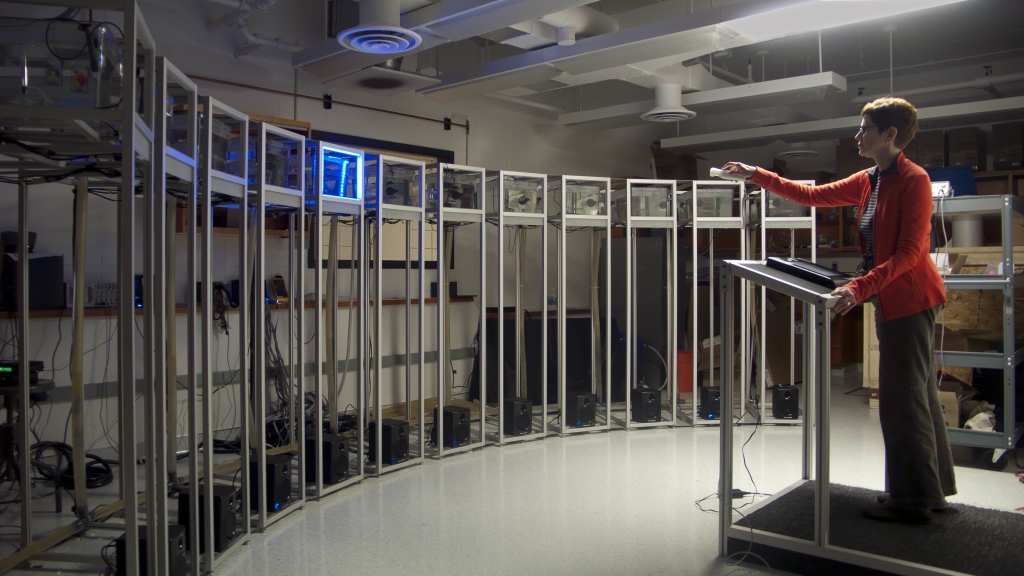
‘scale’ is an interspecies art project: an audience-interactive installation that involves nocturnal electric fish from the Amazon River Basin. Twelve different species of these fish comprise a choir whose sonified electrical fields provide the source tones for an immersive audiovisual environment. The fish are housed in individual tanks configured in a custom-built sculptural arc of aluminum frames placed around a central podium. The electrical field from each fish is translated into sound, and is thus heard — unprocessed or with digital effects added, with immediate control over volume via a touchscreen panel — through a 12-channel surround sound system, and with LED arrays under each tank for visual feedback. All software is custom-designed. Audience members interact as deejays with the system. Amongst the goals of the project is our desire to foster wider public awareness of these remarkable creatures, their importance to the field of neurological research, and the fragility of their native ecosystem.The project leaders comprise visual/conceptual artist Marlena Novak, composer/sound designer Jay Alan Yim, and neural engineer Malcolm MacIver. MacIver’s research focuses on sensory processing and locomotion in electric fish and translating this research into bio-inspired technologies for sensing and underwater propulsion through advanced fish robots. Novak and Yim, collaborating as ‘localStyle’, make intermedia works that explore perceptual themes, addressing both physical and psychological thresholds in the context of behavior, society/politics, and aesthetics.

Pablo Valbuena

Array [wave]
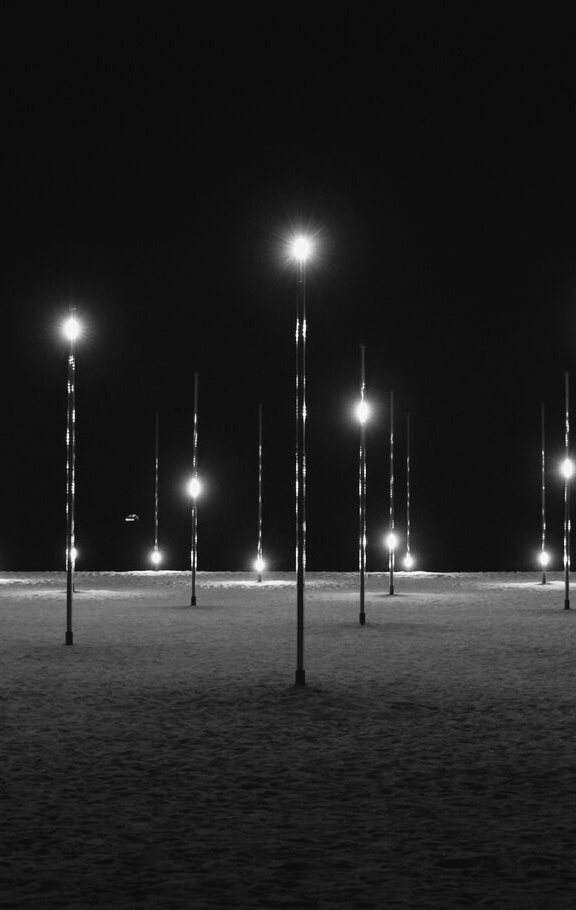
Wave depicts a sculptural volume unfolding over time – the Shape of Light seized in perpetual movement. It uses ephemeral and intangible materials – light and sound – and can be traversed by the observer, immersing them into the shapes cast by the undulating light columns. The work creates a malleable experience of scale: it shifts between object and environment depending on the observer’s position inside, outside, or at the boundary of the installation.

Gmunk

Telestron DTLA
Conceptually, at its foundation, the installation was an exploration of the absence and presence of light and how it defines a space. The team wanted to play with dramatic scale, and to do so they employed two Quantec KR150s as Robotic Conductors, wielding large, fabricated geometric shades to manipulate the various light sources and cast brilliant arrays of graphic shadow work throughout the space. They upgraded the show for The Row to be more immersive, adding more synchronized lighting fixtures and laser projectors around the perimeter of the space to embellish the ambient lighting states, and as a result amplified the user experience even further – creating a more sculptural and geometric installation for the masses.

Guy Ben-Ary

CellF
“CellF is the world’s first neural synthesiser. Its “brain” is made of biological neural networks that grow in a Petri dish and controls in real time it’s “body” that is made of an array of analogue modular synthesizers that work in synergy with it and play with human musicians. It is a completely autonomous instrument that consists of a neural network that is bio-engineered from my own cells that control a custom-built synthesizer. There is no programming or computers involved, only biological matter and analogue circuits; a ‘wet-analogue’ instrument.”Guy Ben-Ary

Kimchi and chips

Halo
99 robotic mirrors continuously move throughout the day to follow the sun like sunflowers. These mirrors, arrayed across two 5 meter tall towers and one 15 meter long track, each emit a beam of sunlight into a cloud of water mist. The beams are computationally aligned so that together they draw a bright circle in the air. Dependent entirely on the presence of the sun for its completion, the work explores the possibilities and limitations of technology to capture what is out of reach, to harness nature and bring the sun down to earth. Collaborating with the natural fluctuations in the climate, Halo appears only for moments when the wind, sun, water, and technology coincide, creating a form which exists between the material and immaterial.

Onformative

True/False
True/False is a kinetic sculpture composed of arrays of circular black metal segments set in mechanical columns. Interlocking and rotating around fluorescent light tubes, the cylinders cover or expose the light to display an endless number of patterns. The transformation of the sculpture is based on the shifting elements and their correlation to each other. As the segments do not move independently, for any of the cylinders on a column to change, the segments affected must work in unison to achieve the command. Reminiscent of devices originally used for calculations, such as Turing machines, the sound originates from the mechanical movement of the moving parts thus making the algorithm audible. The rhythm of »true/false« is captivating as variations in the visual choreography result in distinctive changes in its soundscape. Through the generation of algorithmic patterns and the repetition of endless tasks, »true/false« transforms itself into something more than the sum of its elements to reveal the beauty hidden within a basic algorithm.

Adam Ferriss

Glitch art
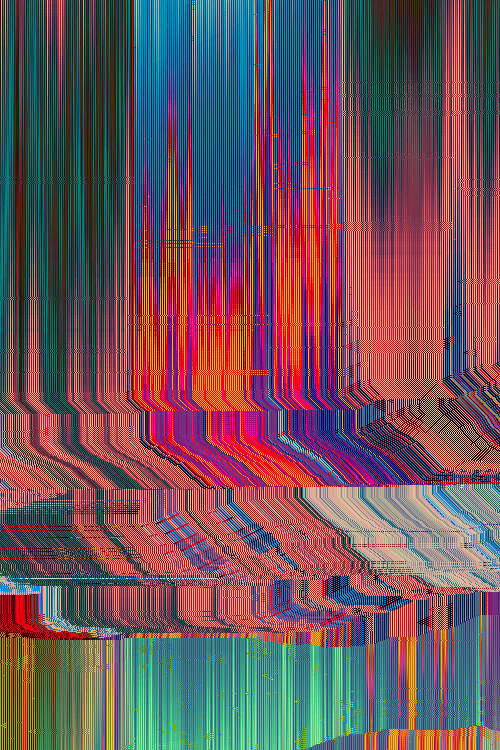
Finding his own niche between new media arts and conceptualism, Adam Ferriss creates unique digital coding that manipulates, distorts, and engineers images into psychedelic terrains. At times, his technicolor abstractions feel organic despite their technological roots – an ambiguous craft born of the RGB Tricolor separation process and pixel sorting algorithms he so carefully employs. Using these “procedural mechanisms,” Ferriss initiates iterative changes in light and pixel structure of his given source material – creating a literally infinite array of compositional possibilities that grapple with human perception during an era of ubiquitous manufacture.

daniel von sturmer

electric-light
Electric Light presents a scenography of forms borrowed from the world-behind-the-scenes of lens based image production. Backdrops, stands, flats, flags and bounces populate the gallery space, illuminated by a changing array of coloured lights. A moving light animates the space with changing forms, shapes and colours, adding another layer of dynamic activity. This new work brings light to the foreground and renders the gallery as an unfolding set.

CRAIG GREEN

Paris Fashion Week Fall/Winter 2020
The collection’s first half was staunchly buffered by outerwear resembling that of protective armor, with contemporary suiting and shirting turned upside down by boxy and robust puffer-like additives […] These qualities were furthered in an array of pieces that look like camping tents with ladders hanging from the front and even in pieces that resembled wire mesh attached to the body, emitting cage-like qualities that tie into Green’s continued themes surrounding the dissection of the male psyche.

christopher bauder

skalar

SKALAR is a large-scale art installation that explores the complex impact of light and sound on human perception. Light artist Christopher Bauder and musician Kangding Ray give an audio-visual narration of radiant light vector drawings and multi-dimensional sound inside the pitch-dark industrial space of Kraftwerk Berlin. By combining a vast array of kinetic mirrors, perfectly synchronized moving lights and a sophisticated multi-channel sound system, SKALAR reflects on the fundamental nature and essence of basic human emotions.

HALO

SEMICONDUCTOR
HALO is a large scale immersive artwork which embodies Semiconductor’s ongoing fascination with how we experience the materiality of nature through the lens of science and technology. Taking the form of a large cylinder, the structure houses a 360-degree projection of scientific data while an array of 384 vertical wires are played by the same data, to produce the sound. The work draws the viewer into its centre in order to inhabit the results of particle-collisions, produced by experiments taking place at CERN, in Geneva, Switzerland.

Richard Quinn

Fall 2018
Even though he was only given a few days’ notice of the royal’s attendance, Quinn lived up to the expectations. He maintained his focused vision, shining the spotlight on his impressive printwork and flair for standout, dramatic silhouettes. An array of abstracted floral prints — all created in-house at the designer’s print studio in Peckham — were mashed up on loose halterneck dresses, delicately pleated chiffon skirts and oversize bomber jackets, to create a visual feast of color and pattern.

DOUG AITKEN

ダグエイケン
道格·艾特肯
sonic fountain

A large round hole—if it were a hot tub, it would be comfortably orgy-sized—has been gouged roughly out of the slick concrete floor of 303 Gallery and filled with milky gray water. Attached to the black duct-work and girders of the ceiling directly above it is a square of pipe surrounded by a speaker array. In the center of the square and at each of its corners is a computer-controlled spigot, dripping, spitting or jetting out, in a rhythmically complex 15-minute cycle, milky water pumped up from the pit in a closed circuit. This is Doug Aitken’s Sonic Fountain.

Well Well Designers

Pixel geante
Well Well Designers are a couple that set up a business creating lights out of paper. I like the idea of having a pop up lamp, I think it is really creative and is perfect for modern apartments. I would like to look at ways of creating my own pop up lamps that give off an array of shadows, different ones for different moods.

George Balanchine

The Nutcracker
Waltz of the Flowers
New York City Ballet

“You don’t think of choreographers as mathematicians — yet group dances involve arithmetic and geometry. Nobody mastered those aspects of the art more brilliantly than George Balanchine.
See what he does with the “Waltz of the Flowers” in “The Nutcracker,” as in this short detail:As it begins, 14 women, arrayed in four rows, face front. The two demi-soloists start: They dance from our right to left, with two turning jumps at the end of the phrase. Then a row of four women behind them take up the same phrase — but now the first two women repeat the phrase in the opposite direction, from left to right.It’s like seeing screens sliding in opposite directions. Then the next row takes it up; then the next; suspense and excitement build. It’s an accumulating canon — not spread out across the stage but at close quarters”. Alastair Macaulay

gary hill

Bottle with the Image of Its Own Making
Gary Hill (b. 1951, Santa Monica, CA) has worked with a broad range of media – including sculpture, sound, video, installation and performance – since the early 1970’s, producing a large body of single-channel videos, mixed-media installations, and performance work. His longtime work with intermedia continues to explore an array of issues ranging from the physicality of language, synesthesia and perceptual conundrums to ontological space and viewer interactivity.

Jean Nouvel

National Museum of Qatar
The building’s dramatic shape is inspired by the desert rose – a mineral formation created when minerals crystallise below the surface of a salt basin into an array of flat plates resembling rose petals.

Marnix de Nijs

15 Minutes of Biometric Fame
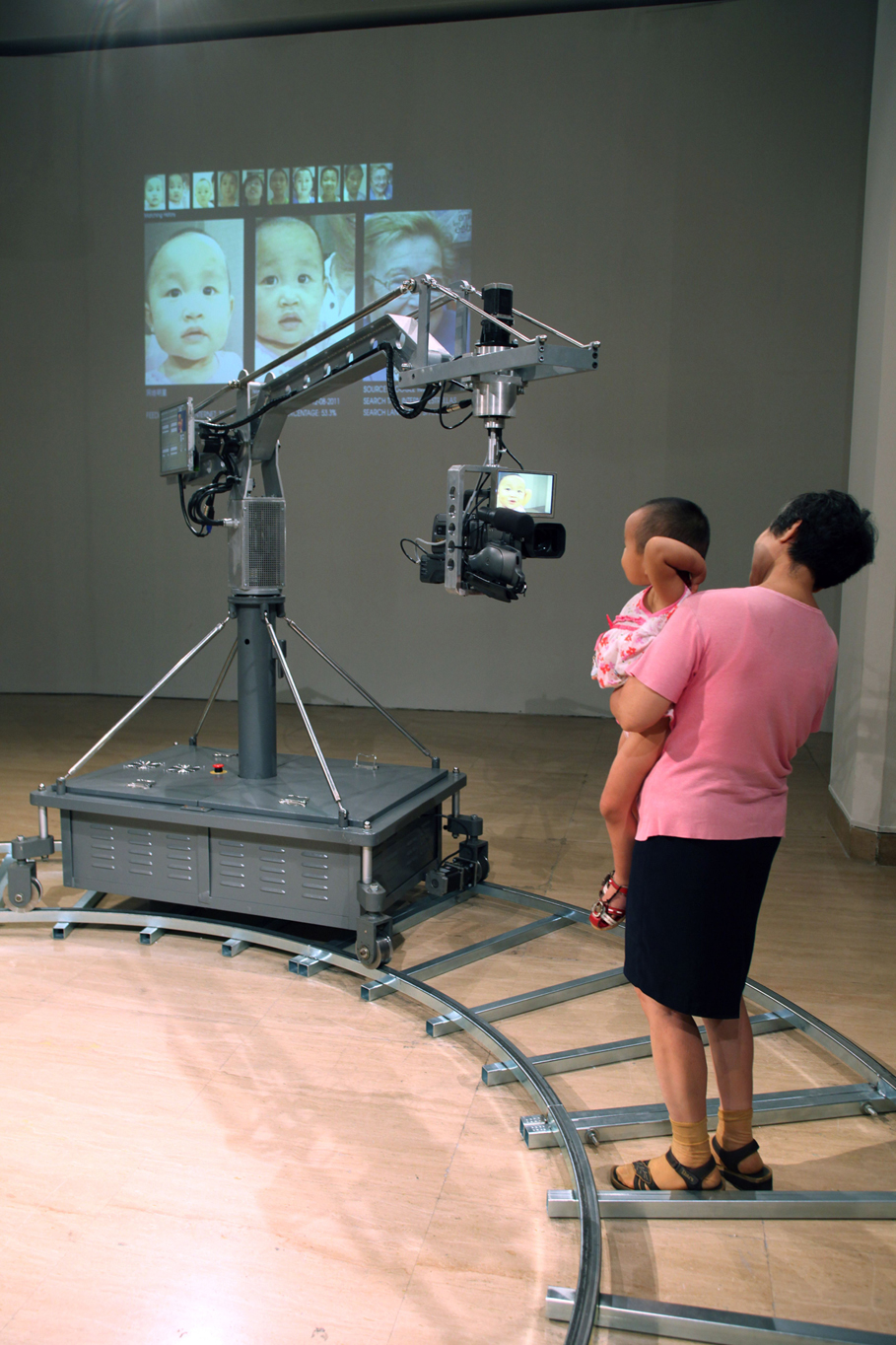
The design of the installation 15 Minutes of Biometric Fame is inspired by the camera dollies employed in the television and cinema industries. A camera crane moves autonomously over a large circular track. In a rather intimidating manner, it points the camera at visitors in the exhibition space and scans each visitor’s facial features, comparing them to those of a vast array of preselected persons in a database.

HENNING LARSEN ARCHITECTS

ヘニング·ラーセン·アーキテクト
헤닝 라슨 건축가
亨宁·拉森建筑师
المهندسين المعماريين هينينغ لارسن
Wave in Vejle

In 1959, Henning Larsen founded his own architectural practice, where he was active for more than 50 years. Henning Larsen designed a vast array of important works of architecture in Denmark and abroad. He was often described as the “Master of Light”.

JENNY MORGAN

WITH NEW EYES
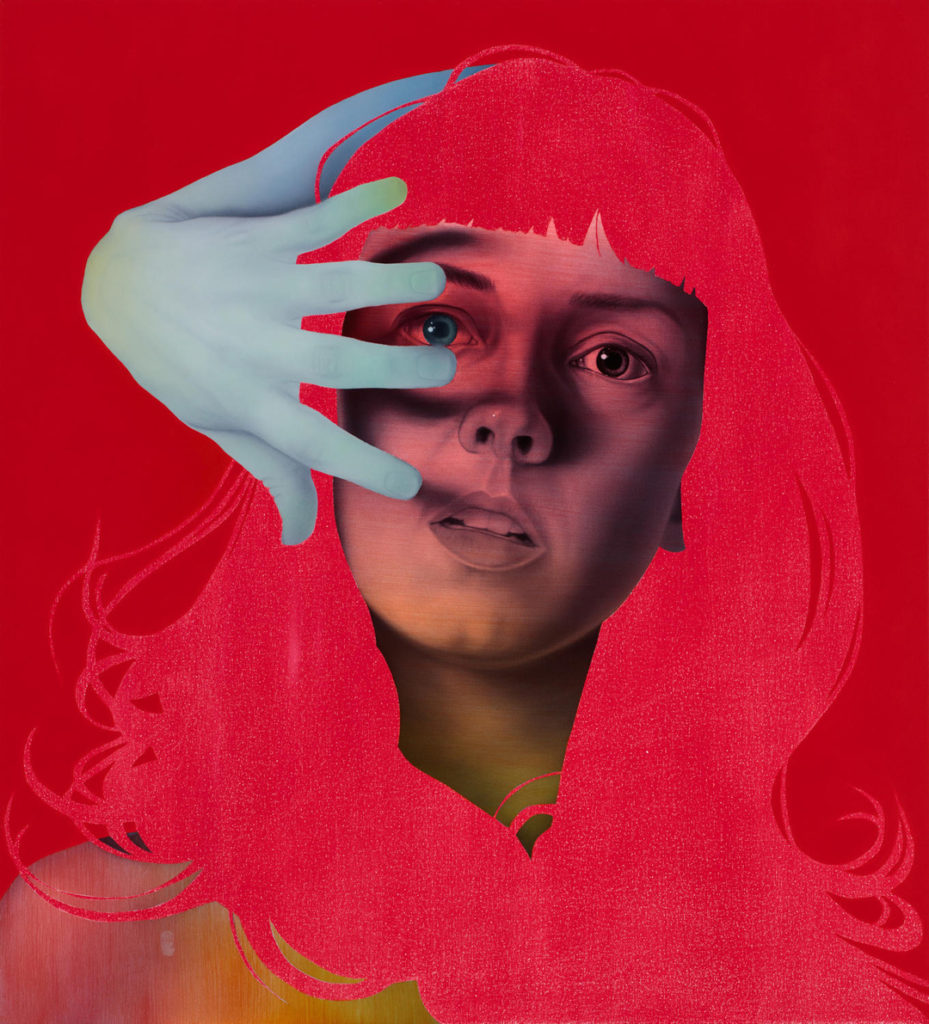
This new series of paintings present amorphous, yet graphically stark figures rendered in a richly saturated prismatic array of colors. Centered on themes of life, death, and rebirth, Morgan’s works question how we relate to our past and challenge us to live in the present.more…

Peter Flemming

Canoe
The work here in Dawson is like an old vehicle in which I’ve put a new engine. Entitled Canoe, it consists of an approximately 20 foot long trough of water, that resembles some kind of boat. This provides a means for a gunwales tracking mechanism to slowly, endlessly paddle its way back and forth. It was first constructed in 2001 in a studio beside Halifax harbour. It draws visual inspiration from the bridges and water vessels of this port. Conceptually, it grew from an interest in technological obsolescence: how things (like canoes) make shifts from utility to leisure.
It has experienced several major rebuilds since 2001. Most of them have been practical, but for Dawson I’ve opted for an experimental configuration that changes significantly the nature of the work. Previously, Canoe has only ever been shown indoors. Normally in runs on rechargeable batteries, with a continuous, smooth motion. In Dawson, it is shown outdoors, alongside the Yukon river, showing up in an absurd way the paleness of its artificial river. Here, the primary source of power is sunlight.
Making use of the long northern day, solar panels receive light, storing energy in an array of super-capacitor cells. At this time, Canoe remains still. A custom circuit monitors the amount of charge, and when a predetermined trigger point is reached, it is dumped into Canoe’s electric motor in a burst, allowing it to make a few strokes. Then Canoe rests, while the charging cycle begins again. Motion is intermittent, entirely dependent on the amount and intensity of sunlight. It ranges from near standstill in overcast conditions to perhaps 1 or 2 strokes every minute in full light. The technical term for this type of circuit is a relaxation oscillator. I like this term because, if you remove it from its technical context, it points back to ideas about leisure and utility.

Mo H. Zareei

Rasper
Rasping Music is an audiovisual installation in appreciation of the ignored aural/visual phenomena surrounding our daily lives. It involves new mechatronic instruments that employ some everyday objects of the urban life, shifting the medium in which they normally exist, and formalizing them through patterns of a rhythmic grid. In these instruments, DC motors and actuators are detached from the realm in which they are tools to help run our machines––where their noise is merely the aural artifact of the urban technology––, and turned into amedium for sound/music. In contrast to their everyday location, i.e., hidden inside black boxes of our machines, their bodily existence is fully exposed, flaunting the physicality of their noise. This physicality is further highlighted in arrays of white light, which––unlike the florescent lights of our offices––are not there to help us see things, but to be seen themselves.

Matthias Zwicker, Wojciech Matusik, Fredo Durand, and Hanspeter Pfister

Automultiscopic 3D displays
Automultiscopic 3D displays allow a large number of viewers to experience 3D content simultaneously without the hassle of special glasses or head gear. This display uses a dense array of 216 video projectors to generate images with high angular density over a wide field of view. As users move around the display, their eyes smoothly transition from one view to the next. The display is ideal for displaying life-size human subjects, as it allows for natural personal interactions with 3D cues such as eye-gaze and spatial hand gestures.

MIKE O’TOOLE, ANDREW RATCLIFF, IAN CHARNAS AND ANDREW WITTE

the Waterfall Swing

Towering steel swing set holding arrays of mechanical solenoids that create a water plane falling in the path of its riders. Formed from a tangent of ideas raised from the study of interactions of water as space, the swing is the first in a series that play with interaction in rides and installations. Riders pass through openings in a waterfall created by precisely monitoring their path via axel-housed encoders, creating the thrill of narrowly escaping obstacles.

MICHAL MACIEJ BARTOSIK TENSEGRITY

lights

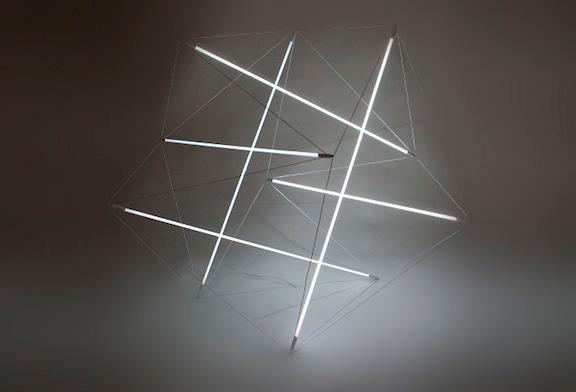
The tensegrity space frame light is comprised of a four strut lamp module whose geometry is the derivative of a cube. It affords a stable platonic structure with the ability to orthogonally tessellate in the x,y.z axes without change to its orientation to produce generic architectural elements such as: columns, roofs, walls and beams. Because tensegrity yields a system of structural correlation, moment force is eliminated and makes way for a high strength to weight ratio; as the system’s surface area increases, to a greater extent so too does its rigidity, allowing for generous spans and cantilevers. When arrayed, each consecutive module is pinned to the latter using its lamp connector to fasten to the mid point of an adjacent electrical tendon. The uniform array produces two distinct patterns of lamp and lattice. Where the lamps produce a luminous weave that at times resembles an orthogonal grid of offset lines, the lattice generates a sequential pattern of two distinct squares rotated at 45 degrees, one four times the size of the other.

RAFAEL LOZANO-HEMMER

Рафаэль Лозано-Хеммер
拉斐尔·洛萨诺 – 亨默
ラファエル·ロサノ=ヘメル
라파엘 로자노
רפאל לוזאנו, המר
Voice Array

JOSHUA KIRSCH

约书亚·基尔希
Джошуа Кирш
An amazing interactive light sculpture entitled Concentricity 96 by the New Jersey artist Joshua Kirsch. “Concentricity is an interactive light sculpture series. Each of the three works presents an illuminated white handle which the viewer is invited to move in any direction. Reed switches located within the sculpture’s circuitry sense the movements of a magnet contained in the handle and translate that information into LED light. For Concentricity 96, omnidirectional movement of the center handle is facilitated by twelve hinged pantagraph-type mechanisms. 96 red/white LED arrays as well as LED-lit acrylic circuit boards respond to the viewer’s movements.