highlike

NTSCconcept – Resonancias – Argentina

RESONANCIAS

NTSCconcept


FILE SÃO PAULO 2026: Inter-creativity – Art and Technology – MUSIC
Electronic Language International Festival


Resonancias – Argentina

Resonancias is a generative audiovisual work that emerged from a real-time performance where artificial intelligence, modular synthesizers, and body movement operate within a single system. The image is continuously transformed through diffusion models powered by audio-rhythmic structures, creating a feedback loop between body, sound, and algorithm.

BIO

NTSCconcept is an Argentinian audiovisual duo founded in 2001 by Sebastián Ferreyra and Laury Moulia. They integrate modular synthesis, generative systems, and artificial intelligence into real-time audiovisual performances. They have presented their work at festivals and electronic art spaces in Latin America and Europe, and released music on international labels.
Roberto Musanti – Shadowless – Italy

SHADOWLESS

Roberto Musanti


FILE SÃO PAULO 2026: Inter-creativity – Art and Technology – VIDEO ART SHORT
Electronic Language International Festival


Shadowless – Italy

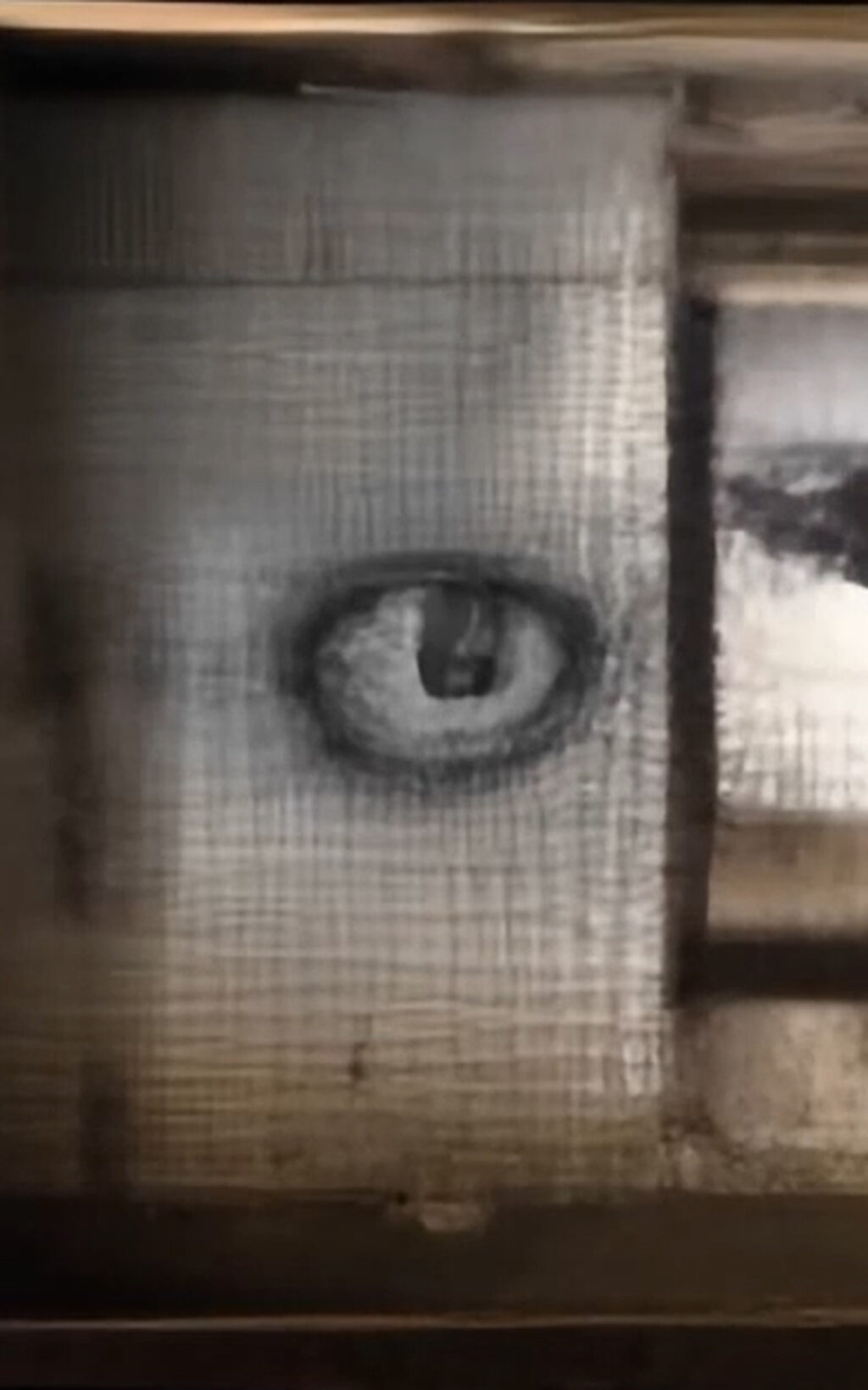
Shadowless is an audiovisual work that explores the perceptual limits of the human mind in the age of digital image overproduction. Through the combination of electronic music and continuously generated visuals, the piece reflects on the loss of meaning caused by the endless circulation of images, where memory becomes blurred and the boundary between lived experience and mediated vision progressively dissolves.

BIO

Roberto Musanti is an electronic music composer, audiovisual artist and educator based in Cagliari. Active since the early 1980s, he works in electronic and multimedia art, creating audiovisual performances, video works and interactive installations presented at international festivals. He holds degrees in Electronic Music and teaches multimedia and computer music.

Moonth – Perception Vortex – Russia

PERCEPTION VORTEX

Moonth


FILE SÃO PAULO 2026: Inter-creativity – Art and Technology – VIDEO ART SHORT
Electronic Language International Festival


Perception Vortex – Russia

Perception Vortex is an attempt to visualize the processes of perception. Memories create an ever-changing environment where perception continuously evolves. The source material consists of my old photographs of flowers and abstract objects. Time distorts them in my memory; they dissolve, giving rise to new forms. The texture and color of the original images are transformed within the three-dimensional space of the digital environment, which is conceptualized as the materiality of memory.

BIO

Moonth is a new media artist Michael Mesiats based in Saint Petersburg, Russia. Since 2016 he has been working as a self-taught new media artist focusing on creating abstract systems with their own internal logic. His works have been shown at Creative Code Festival in New York, Athens Digital Arts Festival, CTM Cyberia in Berlin and other festivals and exhibitions.

Michael Lyons – Circles and Squares – United Kingdom/Japan

CIRCLES AND SQUARES

Michael Lyons


FILE SÃO PAULO 2026: Inter-creativity – Art and Technology – VIDEO ART SHORT
Electronic Language International Festival


Circles and Squares – United Kingdom/Japan

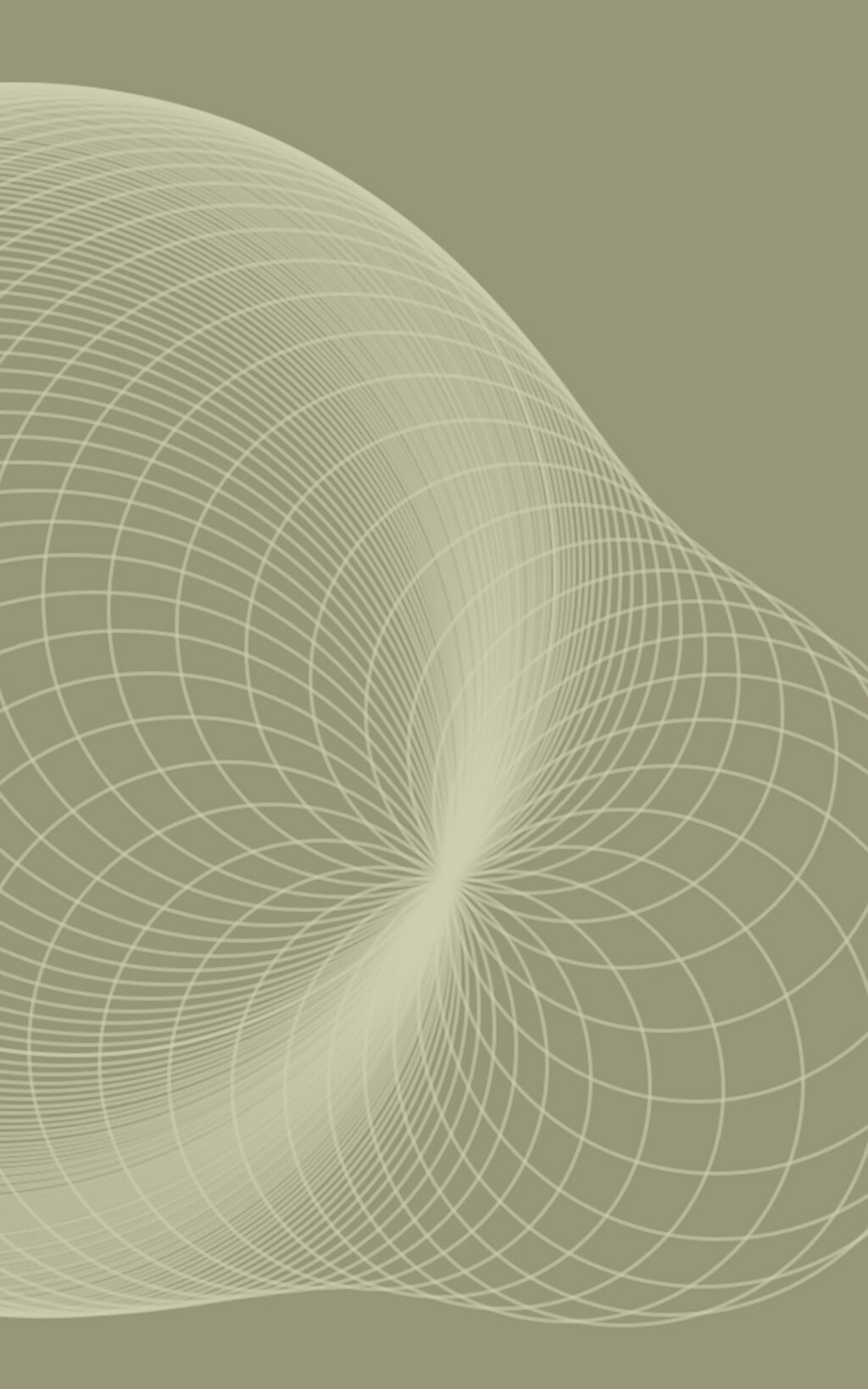
Circles & Squares is an audiovisual work structured around the interaction of geometric motion and sound. Circular forms intersect and recede in continuously shifting configurations, generating patterns of (a)symmetry, interference, and temporal tension. The animation operates as a visual score, organizing the square-wave tones of the soundtrack through evolving spatial relations. Free of narrative or representation, the work foregrounds rhythm, recurrence, and perceptual transformation.

BIO

Michael Lyons (UK, Canada) is an artist and researcher based in Kyoto, Japan. He is currently Professor of Image Arts and Sciences at Ritsumeikan University.

Gerald Trimmel – GARGANTUA (20250302) – Austria

GARGANTUA (20250302)

Gerald Trimmel


FILE SÃO PAULO 2026: Inter-creativity – Art and Technology – VIDEO ART SHORT
Electronic Language International Festival


GARGANTUA (20250302) – Austria

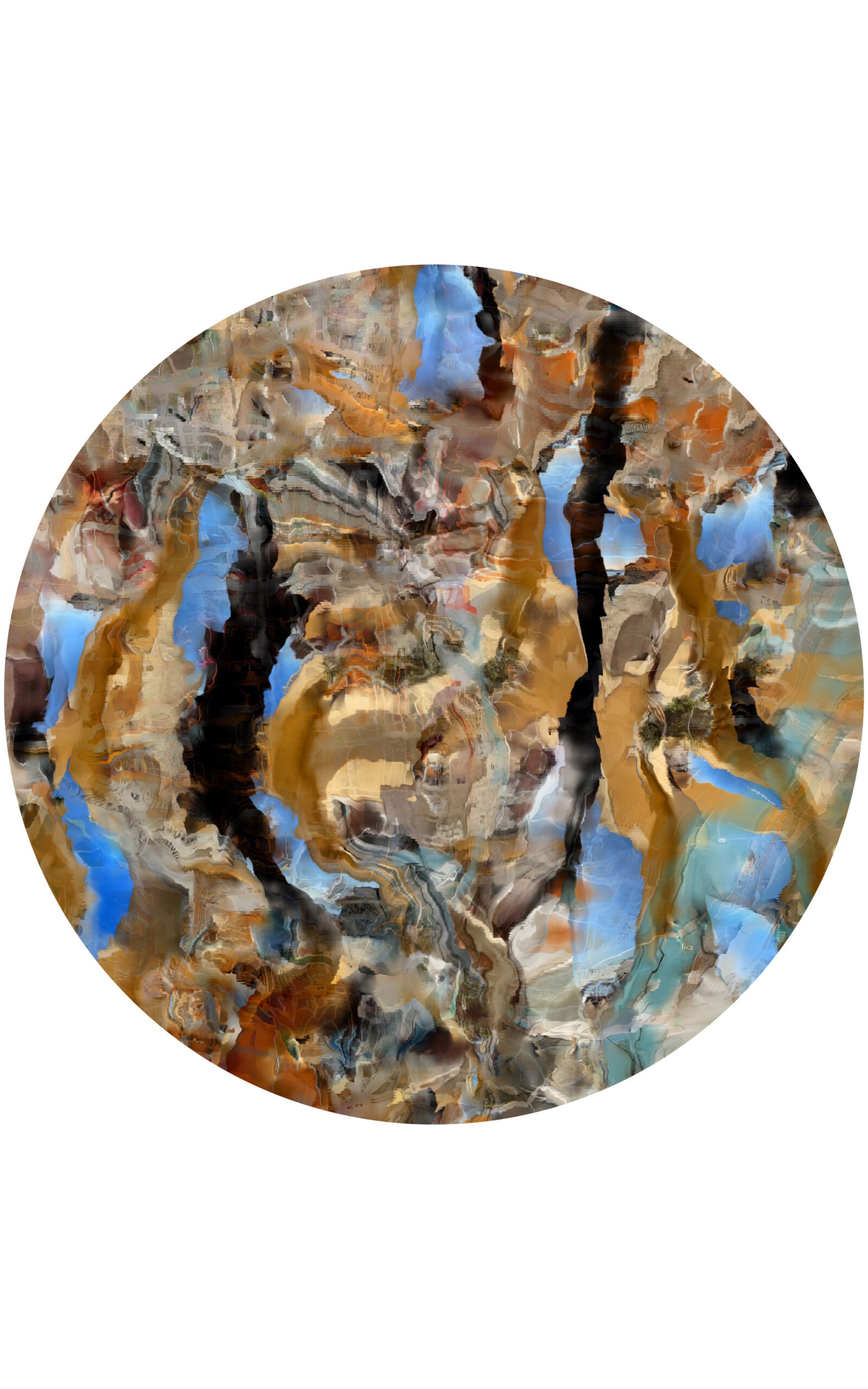
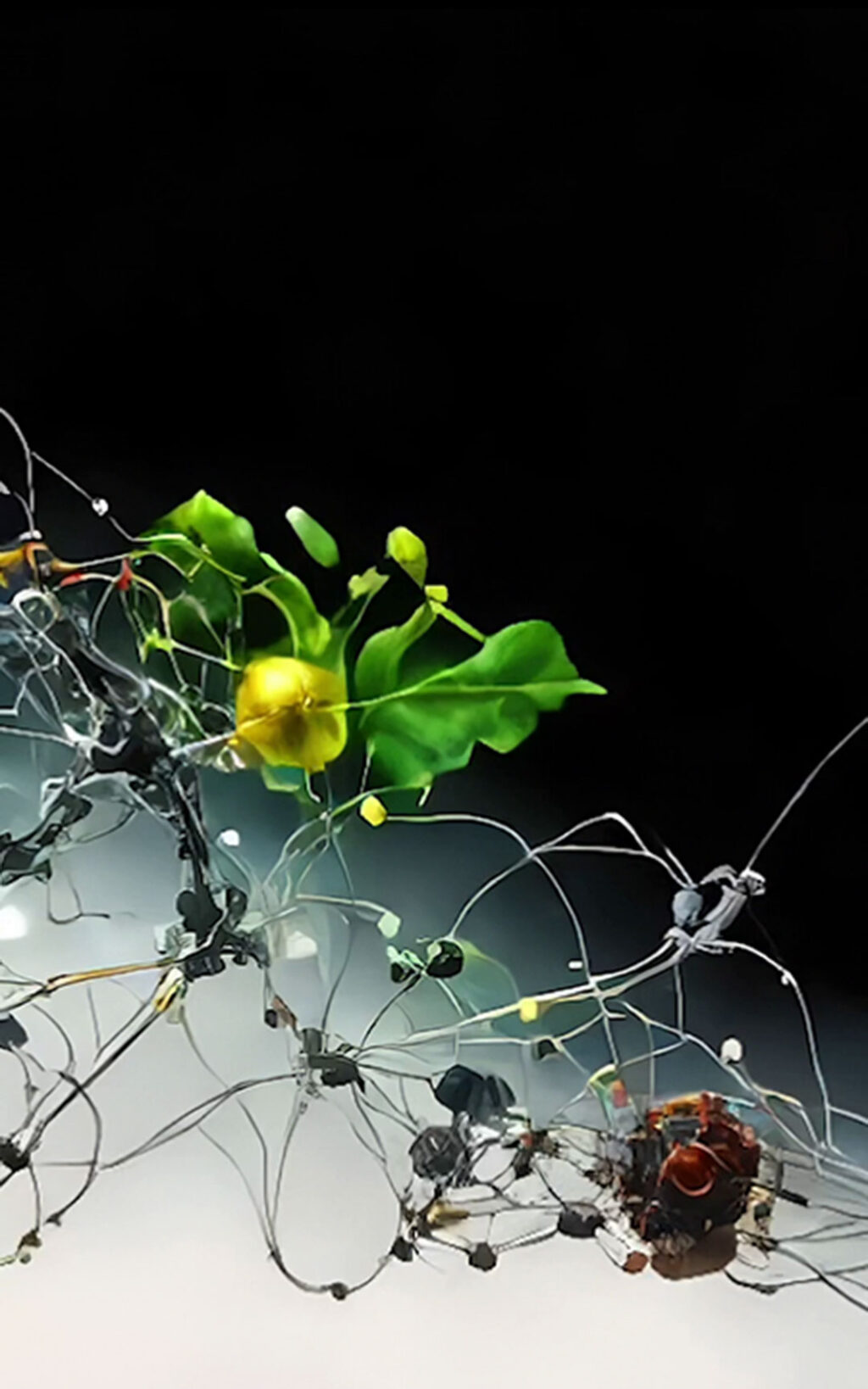
GARGANTUA (20250302) is a dynamic Cybernetic Canvas exploring AI-based image transformation as a metabolic process. Hybrid source materials—osmotic paintings, scans, chemical micro-scenarios, and dismantled diagrams—are processed through algorithmic recombination into a continuously shifting circular field. The work stages an unstable dialogue between visual matter and electroacoustic sound, forming a dense system of feedback, drift, and perceptual unrest.

BIO

Gerald Trimmel is a Vienna-based media artist, composer, and art therapist. His work explores transformation processes between analog material, digital systems, and AI-based image generation, often in circular audiovisual formats (Cybernetic Canvas). Recent presentations include Chongqing (China), ArteScienza Festival (Rome), and The Wrong Biennale (São Paulo | online).

Kaoru Tanaka – Reborn – Japan

REBORN

Kaoru Tanaka


FILE SÃO PAULO 2026: Inter-creativity – Art and Technology – Randomic Dimension
Electronic Language International Festival


Reborn – Japan

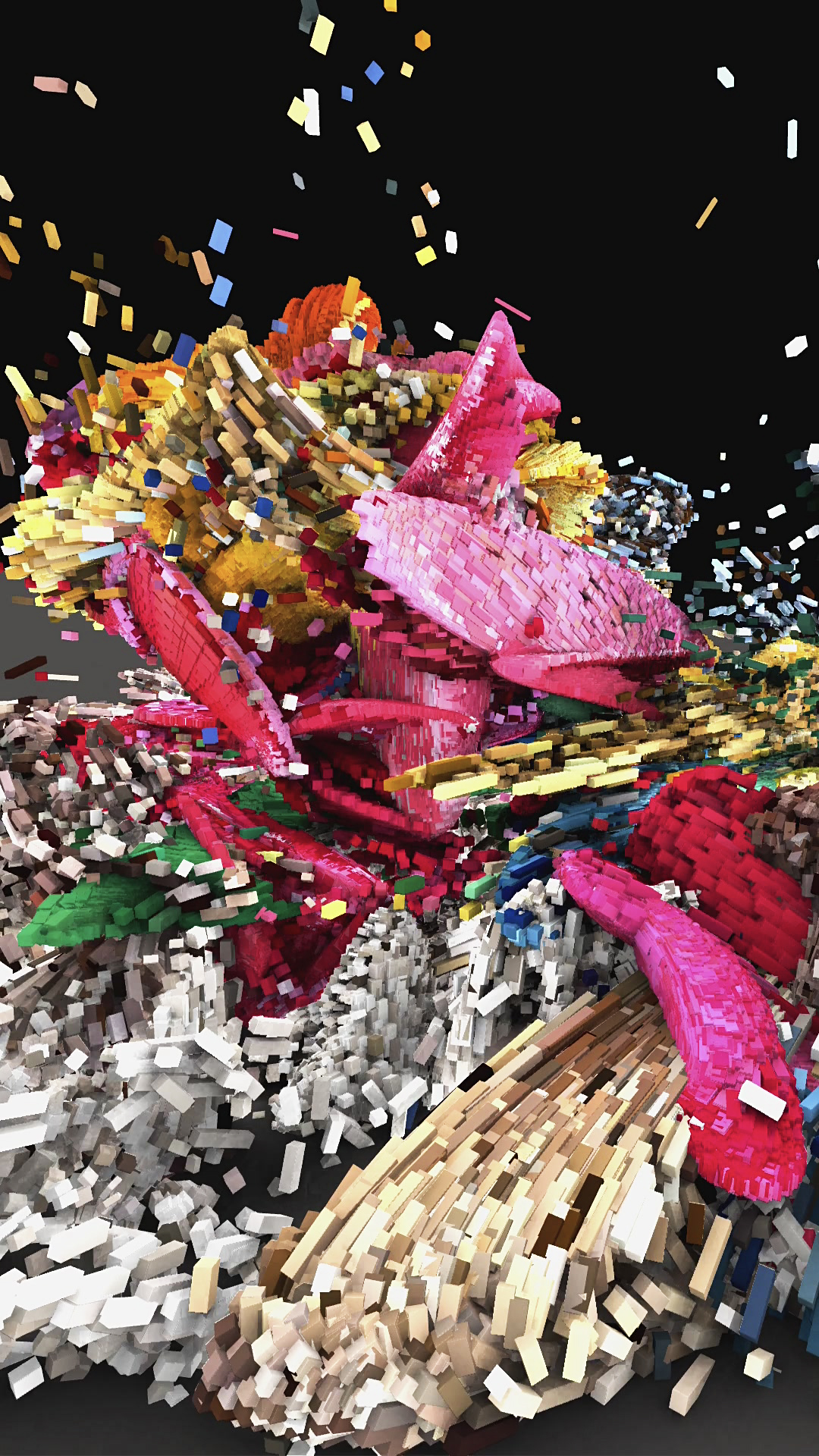
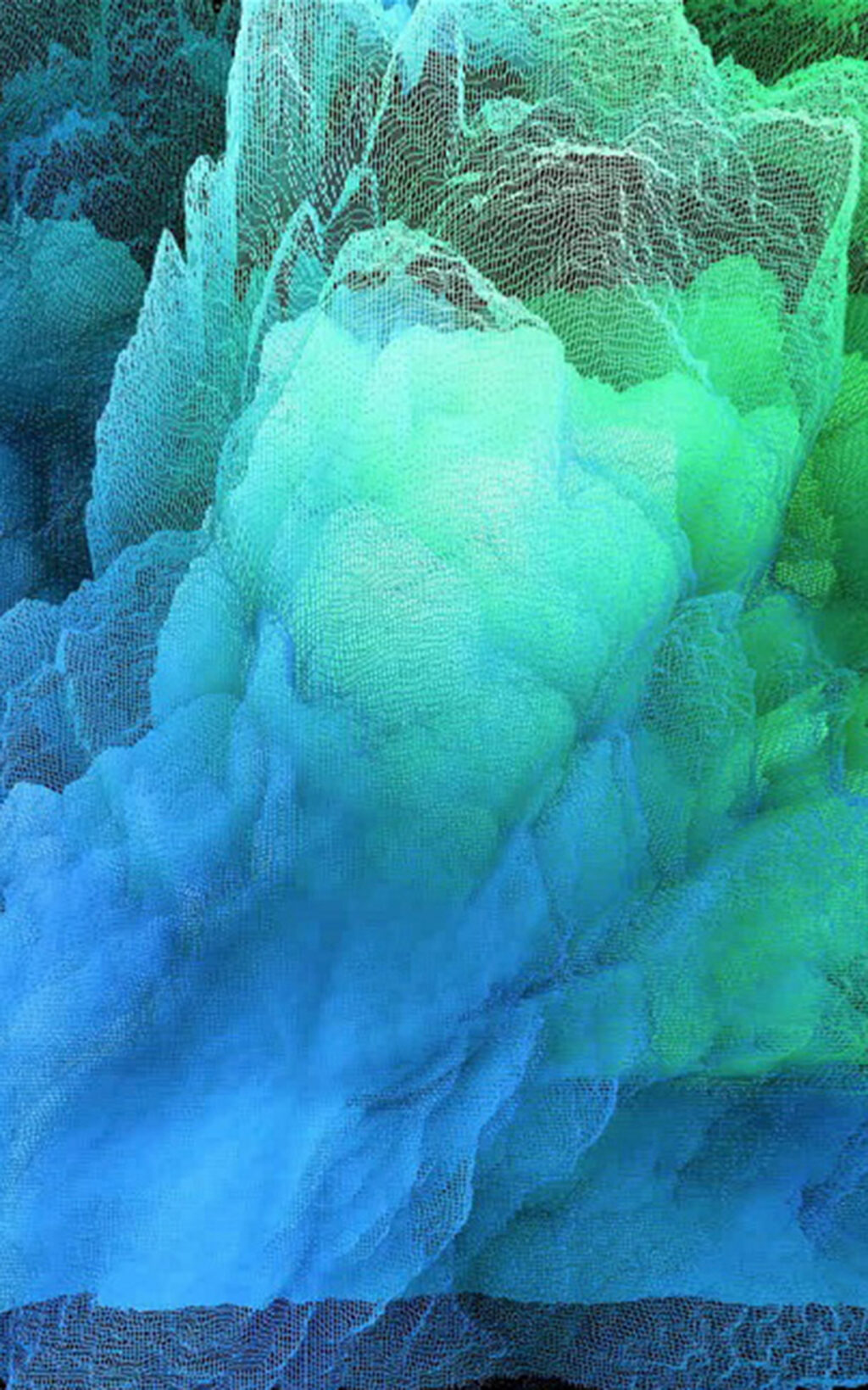
Reborn is a generative artwork created from real point cloud data. The piece depicts a playground slide, a symbolic fragment of childhood memory, continuously deconstructing and reconstructing itself in space. Fragments scatter, collapse, and reconnect over time, reflecting the unstable nature of memory and how experiences are constantly reinterpreted and given new meaning. Through transforming accumulated data into shifting structures, the work explores remembrance, perception, and reconstruction.

BIO

Kaoru Tanaka is a Japanese generative artist who creates real-time digital artworks and installations using computational processes. Inspired by nature, memory, dreams, and perception, her works explore transformation through particles, light, and evolving structures. Her works have been exhibited internationally in museums, public spaces, and digital art festivals.

Non-Linear – Transmissions into the Void – India

TRANSMISSIONS INTO THE VOID

Non-Linear


FILE SÃO PAULO 2026: Inter-creativity – Art and Technology – Installations
Electronic Language International Festival


Transmissions into the Void – India

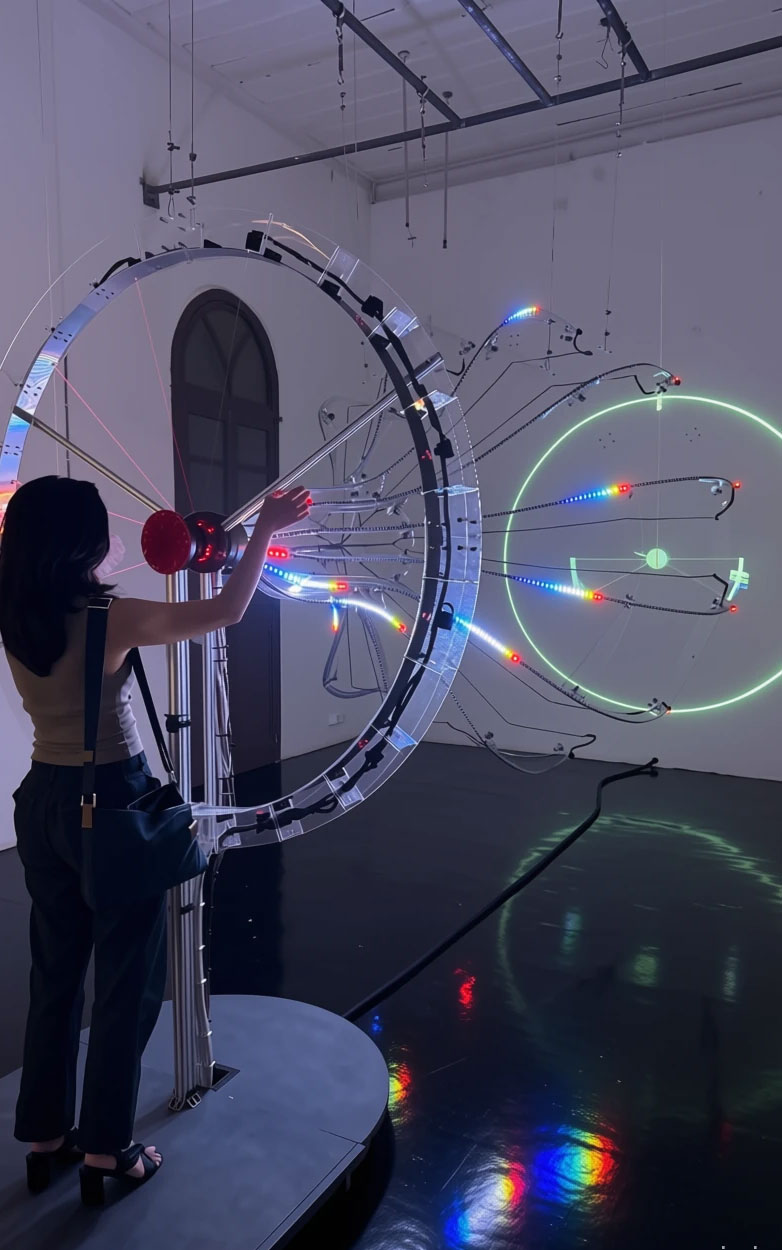
Transmissions into the Void explores the temporal nature of improvisation and the inevitable decay of information, transforming the space into an immersive sound and light machine. Influenced by science fiction and the modular design principles of modern engineering, the room becomes a dynamic interface between viewer and technology. Ultimately, the piece serves as a meditation on the temporal fragility of all information and data—whether biological, digital, or analog—and how time irreversibly erodes it.

BIO
Non-Linear is the creative project of Dennis Peter, an interaction designer and artist redefining the intersection of technology, nature, and creative expression. With a background in architecture and an ever-evolving curiosity, his work spans kinetic installations, generative art, and algorithmic music. From hacking old calculators as a child to crafting immersive, interactive experiences, Dennis continuously expands the boundaries of digital creativity.

Jennifer Steinkamp

From, the Future
The art is about waiting, something the entire world population knows since the onslaught of Covid-19. The title was also inspired by a dream where I told a scientist I was from the future and he believed me. My interpretation of the dream relates to my interest in the luminous thoughts of the 13th-century Persian poet Rumi, he clearly describes what our souls really are, beautiful, sacred, beyond time. I am fascinated by the existential impermanence of beauty. Beauty offers us a deep connection to the experience of life. The animation consists of cut flowers continuously falling from the sky, it can be seen by looking up to the ceiling. The title infers the signature on the note of a gift.

Peter Eötvö

Peter Eötvös

Multiversum

Multiversum is written for two solo instruments and orchestra, for two instruments of the same family: the traditional organ with its rich but static colours and the modern Hammond, which can continuously change colours. It was very important for me that the sound of the two organs could completely wrap around the audience, like we imagine the cosmos envelops us. The traditional organ sounds from the front, the Hammond from the back. If we visualise the two organs as our galaxy, then the different groups of the orchestra can represent different galaxies. That’s how the “Universe” becomes the “Multiversum”.

Kimchi and Chips

Difference and Repetition
The title references Deleuze’s thesis ‘Difference and Repetition’ – his attempt to understand reality without referring to identities. The artists aim to ‘unidentify’ the audience – to criticize the bubbles of reality which technology has helped us to build around ourselves. By allowing ourselves to remove our identity occasionally, we can better understand the thoughts of those we disagree with and therefore better work together to build a combined reality. Difference (in both senses) is generated by the motion control system which continuously changes the pose of the mirrors relative to the viewer. This movement disrupts space itself, creating a transformation similar to that of a Lorentz transformation when one travels close to the speed of light. This causes space itself to compress, twist and break, giving the viewer a tool for observing the non-absolute nature of time.

Art+com

Chronos XXI
Chronos the god of time, permanently destroys and recreates. He who symbolises evanescence and return, was the thematic point of departure for the creation of the kinetic media installation Chronos XXI. The piece is a ‘finger exercise on antiquity’ by our Creative Director Joachim Sauter and was created during his residency at Villa Massimo in Rome. A pendulum continuously swings in front of a monitor. This motion controls the slow synthesis and destruction of depictions of Chronos on the monitor. Chronos appears in various interpretations by painters of the late Renaissance, Baroque and Classicism – as a man who disrobes Veritas, as a performer of volatile music, or docking Cupid’s wings, or as children and crop eating, a scythe and an hour glass carrying, beardy and winged old man.
video

Thom Kubli & Prof. Hiroshi Ishii

Orbiting
Orbiting features floating, machine-generated sculptures. The 3-D-printed objects — made from an ultra-light material — are injected with helium and released into the air as they become buoyant. As the ascending sculptures rise toward the ceiling, they enter the flow of a thermal stream and begin their gentle orbit. While floating, these ethereal objects participate in a continuously changing series of celestial movements.

Troika

Thixotropes
They’re called Thixotropes. Compositions comprised of eight illuminated mechanized structures create choreographies of lighting effects that alternate form warm to cold light. Designed by London based design firm Troika, these suspended systems merge technology with art and explore the realm in which rational observations intersect with the metaphysical and surreal. Each of the structures is shaped as a composition of intersecting angular and geometric forms, made of thin tensed banding lined with rows of LED’s. The constructions continuously revolve around their own axis thereby materializing the path of the light and dissolving the spinning structures into compositions of aerial cones, spheres and ribbons of warm and cold light while giving life and shape to an immaterial construct.

Kerstin Ergenzinger

Wanderer Spacetime Poetry
Wanderer Spacetime Poetry is a continuously evolving installation series. Wanderers are small modified and individually programmed thermal printers that roam along paper strips that are stretched in different constellations across a space. On their journeys the Wanderers leave traces behind, a line, a dot or words. Like a snail with its trail the units dynamically create a poetic drawing over the course of an exhibition.

Stefan Tiefengraber

TH-42PH10EK x 5
Five screens were installed by the artist as pendulums that swing continuously. As soon as all five have come to a standstill, they are pulled back into their original positions with the help of cable winches and are made to swing again – triggered by pulling a rip cord, a performative act that cannot take place without human intervention and which involves the exhibition supervisor in the installation. Each cycle, which lasts approximately 45 minutes, ends as soon as all five screens have come to a standstill and no more sound is produced by their movement. The sound is produced by the amplification of the friction to which the joints of the moving pendulum are subjected. Multiplication thus creates five oscillating loops that merge into one another with a time offset.

Ani Liu

Untitled: (A Search for Ghosts in the Meat Machine)
What does it mean to be human? At first glance a simple question, the idea of being human is an unstable construct, continuously recrafted. Recent technological innovations allow us to redesign ourselves profoundly— from networked prosthetics and artificial intelligence, to the genetic code of life itself. Can our behaviors be reduced to algorithms? Can our bodies be upgraded with nonorganic integrations? Can sentience itself by manufactured in a lab? This set of nine sculptures examines personhood from anatomical, psychological, genetic, biochemical, behavioral, algorithmic, personal narrative and memory. In many ways, this installation is an emotional confrontation with being quantifiable.

Mathias Gartner & Vera Tolazzi

THE TRANSPARENCY OF RANDOMNESS
“The Transparency of Randomness” gives insight into the world of randomness. In this interactive installation, visitors can directly experience the significance of the complex interplay of randomness and stochastics in current mathematical and physical research. 27 transparent boxes, floating in space, continuously generate random numbers by using the well-known medium of the dice.The process of random number generation is influenced by the complexity of nature and its structures, using a variety of natural materials. The ensemble of all generated random numbers forms the basis of a real-time calculation and comprehensibly demonstrates the impressive role in scientific research.

Patrick Monte & Brian Questa

Anomy, for U.S.and Mexican News
Anomy, for U.S.and Mexican News uses news media RSS feeds in real time in combination with data sanitization and sound synthesis algorithms in order to create visual displacement and generate a non-linear musical score. Through immersion, adjacency, perpetuity, uncertainty, and content in real time, it offers a contemplative experience with mass media, censorship, and language in contemporary society. Information containing the letter “e” in news briefs from eleven different sources in English and Spanish will be redacted—each triggering a musical note. Inspired by lipogrammatic literature and concrete poetry, this piece uses the lipogram to call attention to subjectivity and control in mainstream news media. The result is both a rhythmically diverse sound piece and a visual document that continuously evolves along with the flow of information published by Mexican and American news outlets.

MARCELA ARMAS

I-Machinarius
In I-Machinarius, Mexican artist Marcela Armas presents a map of her native country, which takes the form of machinery whose belts are continuously lubricated by oil. In front of the map, presented here in an inverted form, the black liquid flows towards the “north”, acting as a symbol of Mexico’s economic dependence on the United States.

Kimchi and chips

Halo
99 robotic mirrors continuously move throughout the day to follow the sun like sunflowers. These mirrors, arrayed across two 5 meter tall towers and one 15 meter long track, each emit a beam of sunlight into a cloud of water mist. The beams are computationally aligned so that together they draw a bright circle in the air. Dependent entirely on the presence of the sun for its completion, the work explores the possibilities and limitations of technology to capture what is out of reach, to harness nature and bring the sun down to earth. Collaborating with the natural fluctuations in the climate, Halo appears only for moments when the wind, sun, water, and technology coincide, creating a form which exists between the material and immaterial.

So Kanno

Lasermice
“Lasermice” is a swarm robotic installation that consists of 60 small robots, which inspired by synchronous behavior from insects like fireflies. Normally network of swarm is invisible, But in this case those robots creates visible network via laser light – photodetector communication. As a result, they generates rythme that continuously changing. The generated rhythm is made audible by solenoid which strikes floor. Combination of visible network and audible rhythm are deployed spatially.

RUAIRI GLYNN

루아리 글린
Performative Ecologies
Each one of the four crude and very technically appearing devices is fitted with a punctually attached, luminous rod of fibreglass, which moves back and forth arrhythmically and freely. This installation’s poetry lies in the choreography of the little robots. They continuously try to gain the observers attention and impress him by waving their luminous tails. They recognise the reactions and movements of their human audience, learn from failure and share their experience with their robotic neighbours – a social structure of humans and machines.
.

ANDREI MOLODKIN

CRUDE

Crude oil, in all of its manifestations as energy, petroleum, natural gas, plastics, medicine, asphalt, fertilizers, and pesticides, is the principle industrial commodity and the world’s most valuable natural resource. An ancient substance, crude oil is continuously reborn in its applications and implementations. Molodkin’s incorporation of crude oil into his works provokes an open dialogue on how culture and geopolitical systems are influenced by oil. In one of his constructions, Molodkin analyzes the concept of democracy through the universal vernacular of oil.

Stefan Bassing

Spacestream
The project uses generative computational strategies to generate series of special stream paths within 3D space frame, giving it structural stiffness and aesthetic values. The generative algorithm is based on use of multi-agent systems, shortest path calculation, lattice stigmergy and structural analysis. The goal is to create continuously thickened bundle paths within the fuzzy 3D space frame structure, where the bundles double as camouflage and reinforcement for the joints/seams between the welded components, allowing for fabrication of large scale structures, mediating between the discreet components and continuous system.Space Stream is a student project which aims to explore influence of rule-based design systems on low-tech fabrication technique of welding. The research concentrates on wireframe structures, which are strengthened through subdivision of basic geometrical units and bundling and reinforcing of the main structural strands. The custom software used for this project is centered on Dijkstra’s shortest path algorithm in combination with agent-based modeling techniques.

Alex Schweder and Ward Shelley

Counterweight project
Tethered to either end of a single rope that goes over the top of this tall thin building, movement in this vertical house for two depends on using the body mass of one’s roommate as a counter weight to aid ascent or slow descent. When one occupant wishes to go up to the kitchen at the top level, the other must go down to the bathroom at the bottom. Between these two rooms are two private sleep / work rooms on levels two and four, and a common room at level three where the ends of the rope meet. Counterweight Roommate was continuously inhabited for five full days of Scope Basel in 2011 by performance-architecture artists Alex Schweder and Ward Shelley, and acquired in 2015 by New York’s Museum of Modern Art.

IRIS VAN HERPEN

Айрис Ван Эрпен
イリス ヴァン ヘルペン

Iris van Herpen is a Dutch fashion designer who is widely recognized as one of fashion’s most talented and forward-thinking creators who continuously pushes the boundaries of fashion design. Since her first show in 2007 van Herpen has been preoccupied with inventing new forms and methods of sartorial expression by combining the most traditional and the most radical materials and garment construction methods into her unique aesthetic vision.

MARIA HSU

TranStructures
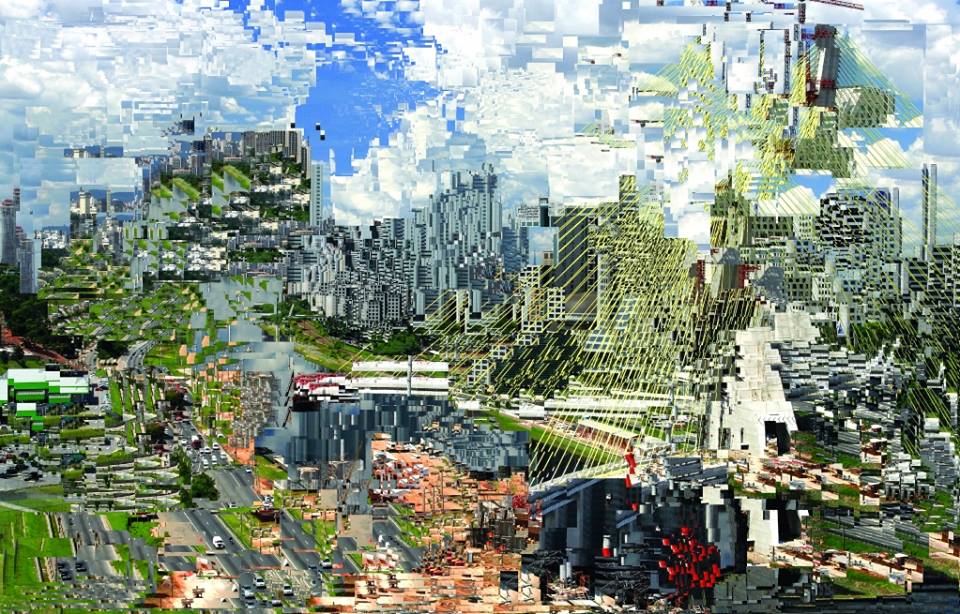
TranStructures Big cities are unceasingly in motion: growth, decay, changes. São Paulo is the source of my look and thoughts on metropolis. Recompose, redo continuously, from the probable to the improbable, allow us to try infinite possibilities that can lead us from sublime to disaster. Billions of hyperexpressions are induced always at random. The mechanisms that regulate the normal, the pre-established, rupture allowing the appearance of the possible others.

gabriel pulecio

Saturn Submerged

Saturn Submerged is part of an ongoing series of infinite boxes that creates an expanded infinite space within itself. The sculpture is composed of multiple mirrored surfaces and LEDs, which are fused to create the illusion of infinite depth and imagery. Mirrors include convex domes and walls; LEDs are programmed to continuously change in randomized combinations of almost infinite colors and sequences based on several variables.

JAMES CLAR

ДЖЕЙМС КЛАР
freefall

James Clar creates work that is a fusion of technology, popular culture, and visual information. His work explores the limitations of various communication mediums and it’s effect on the individual and society. Clar is a great artist, particularly for his attention to precision, and his experimental approach, which allows his concepts and executions to continuously stretch the boundaries of his studio practice.

BILL VIOLA

比尔•维奥拉
빌 비올라
ביל ויולה
ビル·ヴィオラ
Билл Виола
An Ocean Without a Shore

First displayed in the deconsecrated church of San Gallo during the 2007 Biennale of World Art held in Venice, Italy, Ocean Without A Shore is comprised of over 240 minutes of high-definition content displayed on 65″ and 103″ plasma displays. The work is displayed in a fully synchronous yet constantly evolving format, as individuals continuously transition through a remarkable world of Viola’s creation.

Joseph DeLappe

circle drawing surveillance system
A train locomotive travels continuously in a circle harnessed with electro-mechanical appendages, including a drawing arm holding black compressed charcoal to paper. The train rides on the first rail, while the two inner rails function, respectively, to power the mini-video camera mounted on the train while the other sends the real-time video signal from the camera to the projector[…]

JEAN-PIERRE GAUTHIER

Stressato – Samurai Serpents
File Festival
Samurai Serpents” resembles Jean-Pierre Gauthier’s drawing machines (such as Marqueurs d’incertitude). Like many of the artist’s creations, the work emphasizes graphic quality and the movement of a line in space. On a large panel covered by an “action painting” (that is reminiscent of the textured and dark surfaces of a Borduas, Soulages or Kline), which looks like a (drawing?) table, cables are activated by an approaching viewer and begin to wiggle all over the place, twisting and intertwining in a surprising way – as though they were actually reacting to a threat. In moving about in this way, these silver lines on a black ground continuously change the “painting’s” composition and transform it into an animated image. Like a musical improvisation, the line’s disorganized movements create sounds that vary each time.

Tom Hull

hyperbolic cube
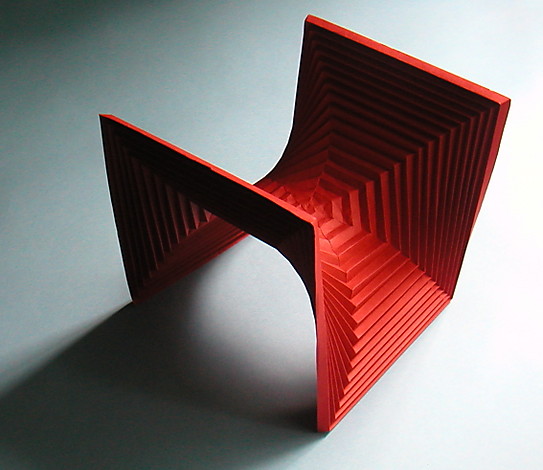
Departing from the Hyperbolic Cube (Thomas C. Hull, 2006), a regular octagon symmetrically folded, we produced origami studies of octagonal and cubic volumes in order to understand the spatial qualities of classic hyperbolic paraboloid shapes. The geometric principle is a folded octagon that traces the outline of a cube, creating an internal, vaulted space. After several iterations we achieved the intended balance: the asymmetry of the structure enhances the visual properties of the basic form, the duplicity between the strong orthogonal geometry and the curvilinear forms continuously altering from different viewpoints. It reveals itself in a constant, visual shift as one navigates towards and around it.

video

CONTRAPTION PAINTING MACHINE

françois xavier saint-georges
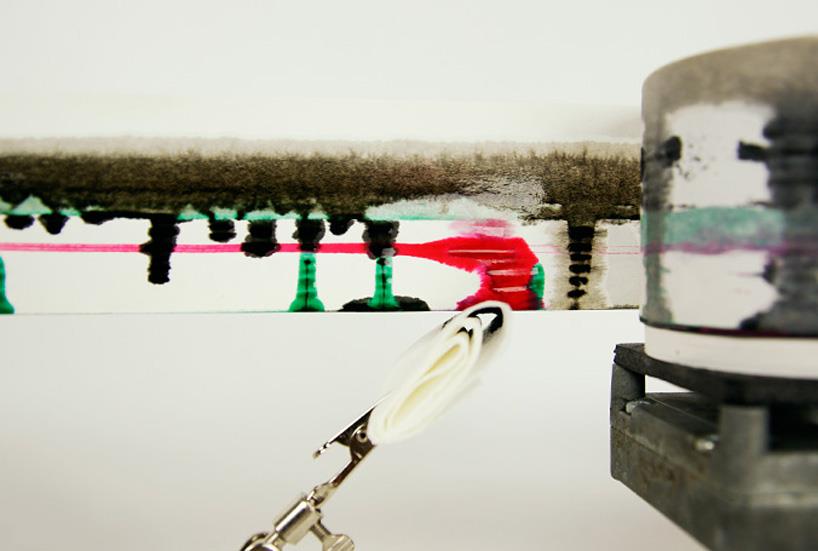
Assembled from chinese brushes and medical equipment, the low-tech automata creates ‘endless line’ ink paintings. Created by canadian designer François Xavier Saint Georges, ‘contraption’ is an autonomous painting machine, capable of creating a ‘never-ending line’ of paint. The low-tech device is composed of medical equipment like syringes and tubing, chinese brushes, and paper with an electric motor, that together continuously run a roll of paper along the wall, to be ‘painted’ upon by ink pumped into the set of brushes. Random variations in the ink’s consistency and viscosity at a given moment produce different effects on the paper, and different colours can be fed into the unit or layered on top of previous ‘paintings’. We will show you more projects from this guy, so if you like it you will see more about him. Enjoy it!