highlike

Claude – Protoform – South Korea

PROTOFORM

Claude


FILE SÃO PAULO 2026: Inter-creativity – Art and Technology – LED SHOW
Electronic Language International Festival


Protoform – South Korea

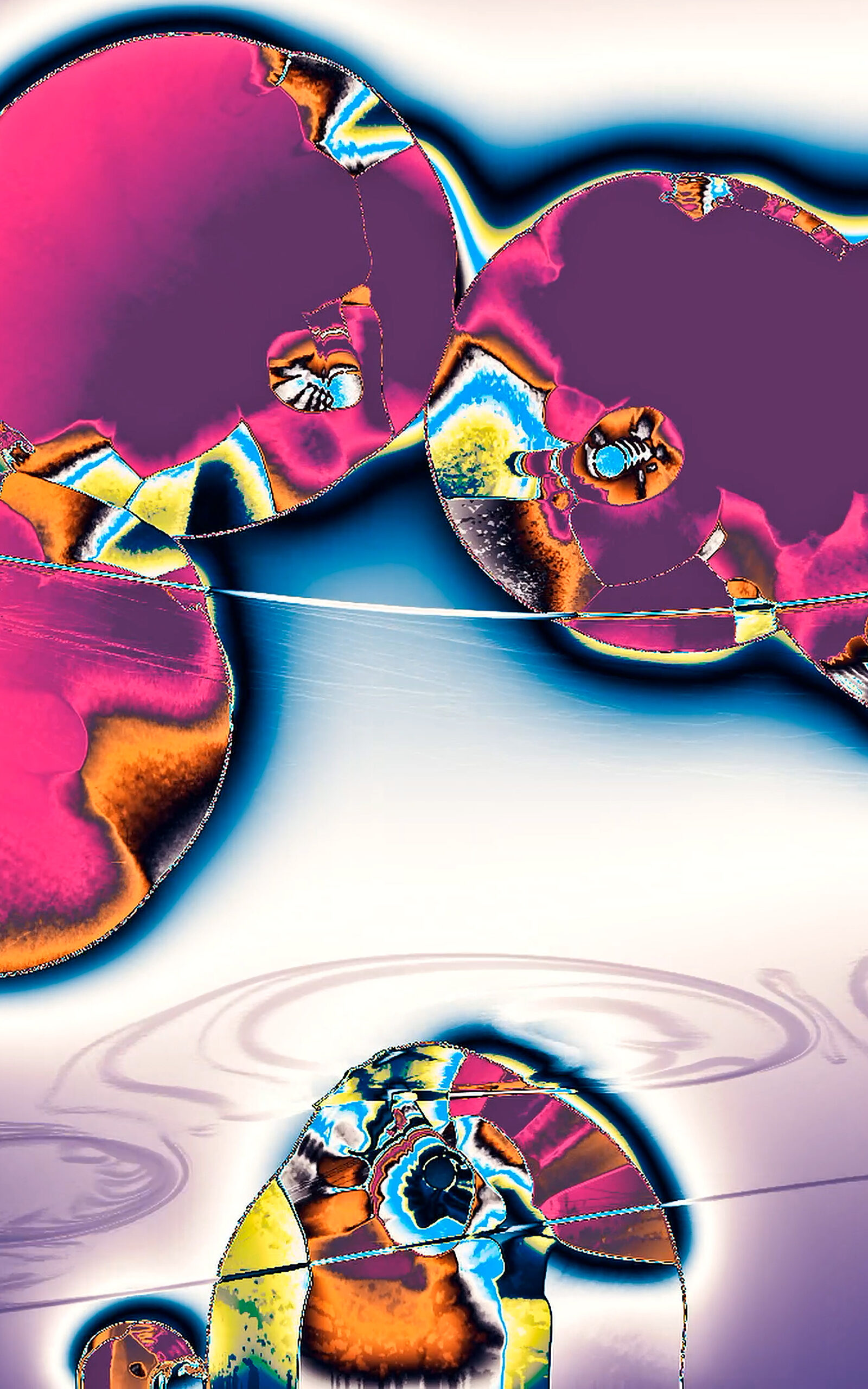
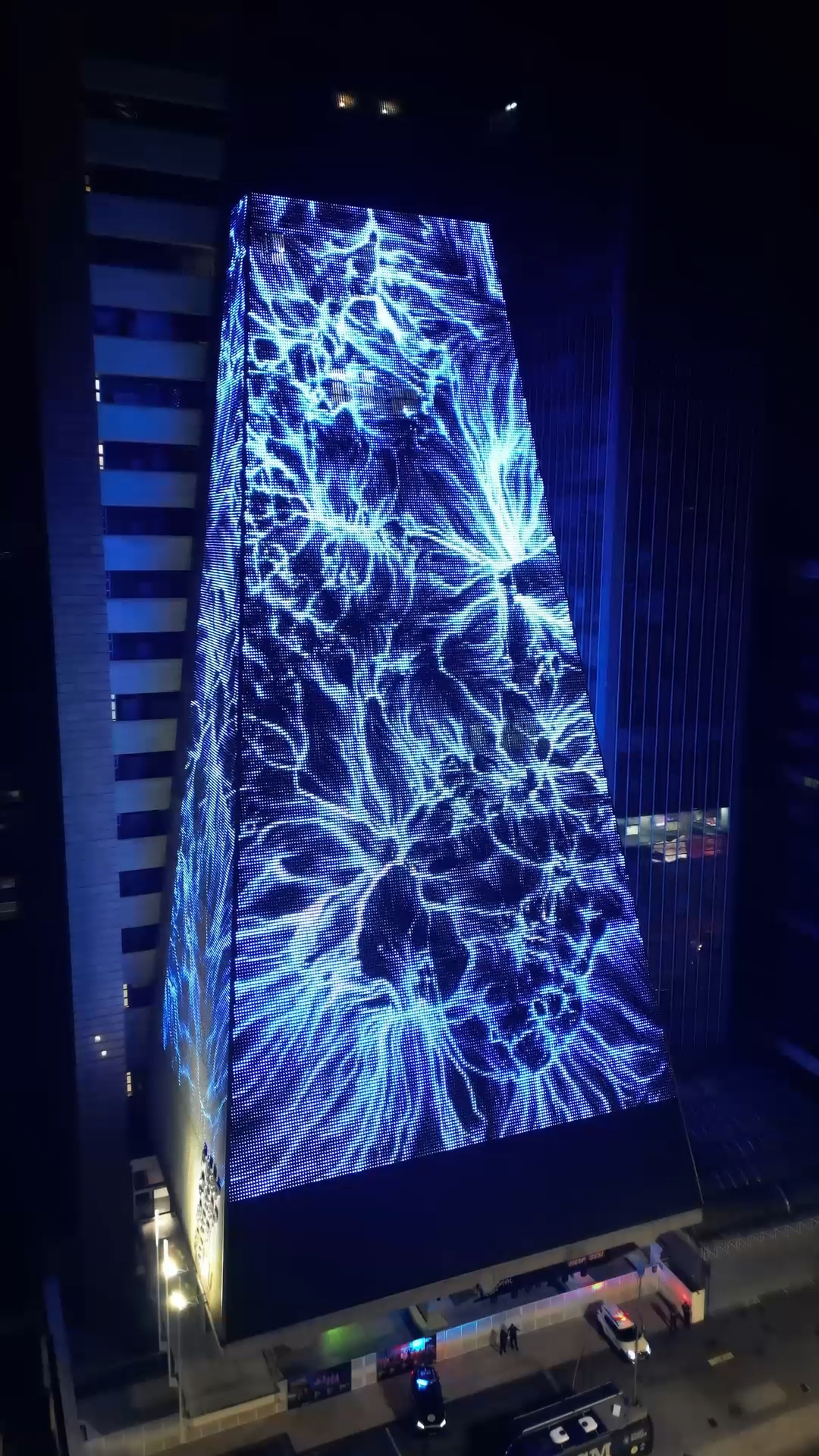
Protoform explores the primal structure from which all forms emerge. Composed of drifting particles, the work visualizes microscopic elements colliding and coalescing into a living sphere, echoing the formation of cells and molecules. Through continuous transformation and expansion, it reveals the invisible order underlying nature, capturing the moment where form remains fluid and becoming is infinite.

BIO

Soon Cho (CLAUDE) is a Seoul-based new media artist creating immersive, data-driven artworks inspired by nature’s fundamental structures. Through particles and generative systems, he explores abstract beauty and the invisible dynamics that shape life and matter.

Eylul Alıcı – The Black Hole – Turkey

THE BLACK HOLE

Eylul Alıcı


FILE SÃO PAULO 2026: Inter-creativity – Art and Technology – LED SHOW
Electronic Language International Festival


The Black Hole – Turkey

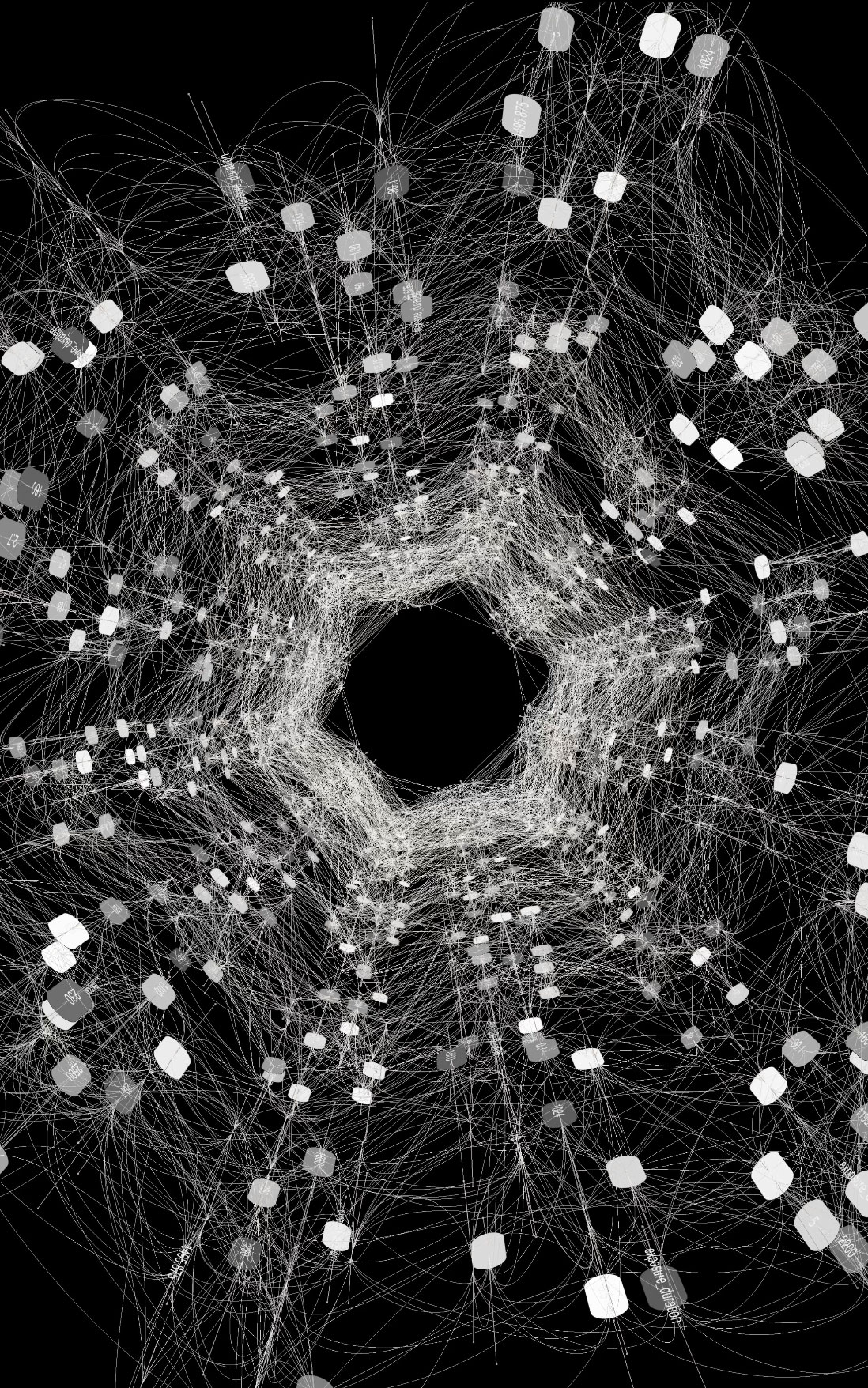
Black Hole is a data-driven artwork created using over 73,000 data points that represent the dynamics of black holes. These data include parameters such as black hole masses, locations, distances, spin rates, merger angles, and gravitational wave signals. 

The project’s data were sourced from institutions such as the NASA Hubble Legacy Archive, the European Gravitational Observatory, LIGO Hanford, LIGO Livingston, and Virgo, which are ground-based gravitational wave detectors.

BIO

With over fifteen years at the intersection of art and science, Eylul Duranagac Alıcı is an award-winning new media artist and creative director exploring AI, machine learning, and data-driven systems as creative agents. A faculty member at Yıldız Technical University, her internationally exhibited work spans institutions such as NASA, CERN, MoMA, and Ars Electronica.

Yoshi Sodeoka – Spike – Japan / United States

SPIKE

Yoshi Sodeoka


FILE SÃO PAULO 2026: Inter-creativity – Art and Technology – Randomic Dimension
Electronic Language International Festival


Spike – Japan / United States

A collaboration between Max Cooper and Yoshi Sodeoka, Spike pairs polyrhythmic electronic sound with generative visuals inspired by reaction-diffusion systems. Abstract, organism-like forms emerge, mutate, and self-organize through feedback processes, moving between control and unpredictability. The work explores growth, transformation, and the dynamics of evolving systems.

BIO

Yoshi Sodeoka is a New York-based artist working across video, animation, and sound. His practice explores generative systems, video feedback, and diagrammatic visual languages. Drawing from nature, mathematics, and computation, his work examines evolving structures and perceptual experience through immersive installations and moving image. Music by Max Cooper.

FILE SÃO PAULO 2025: SYNTHETIKA – Edwin van der Heide

Spiral of Time — Amazonas Brazil — UFAM

Edwin van der Heide

Interact with Spiral of Time — Amazonas Brazil — UFAM via FILE ARCHIVE


FILE SÃO PAULO 2025: SYNTHETIKA – Art and Technology – Installations
Electronic Language International Festival


Spiral of Time — Amazonas Brazil — UFAM – Netherlands

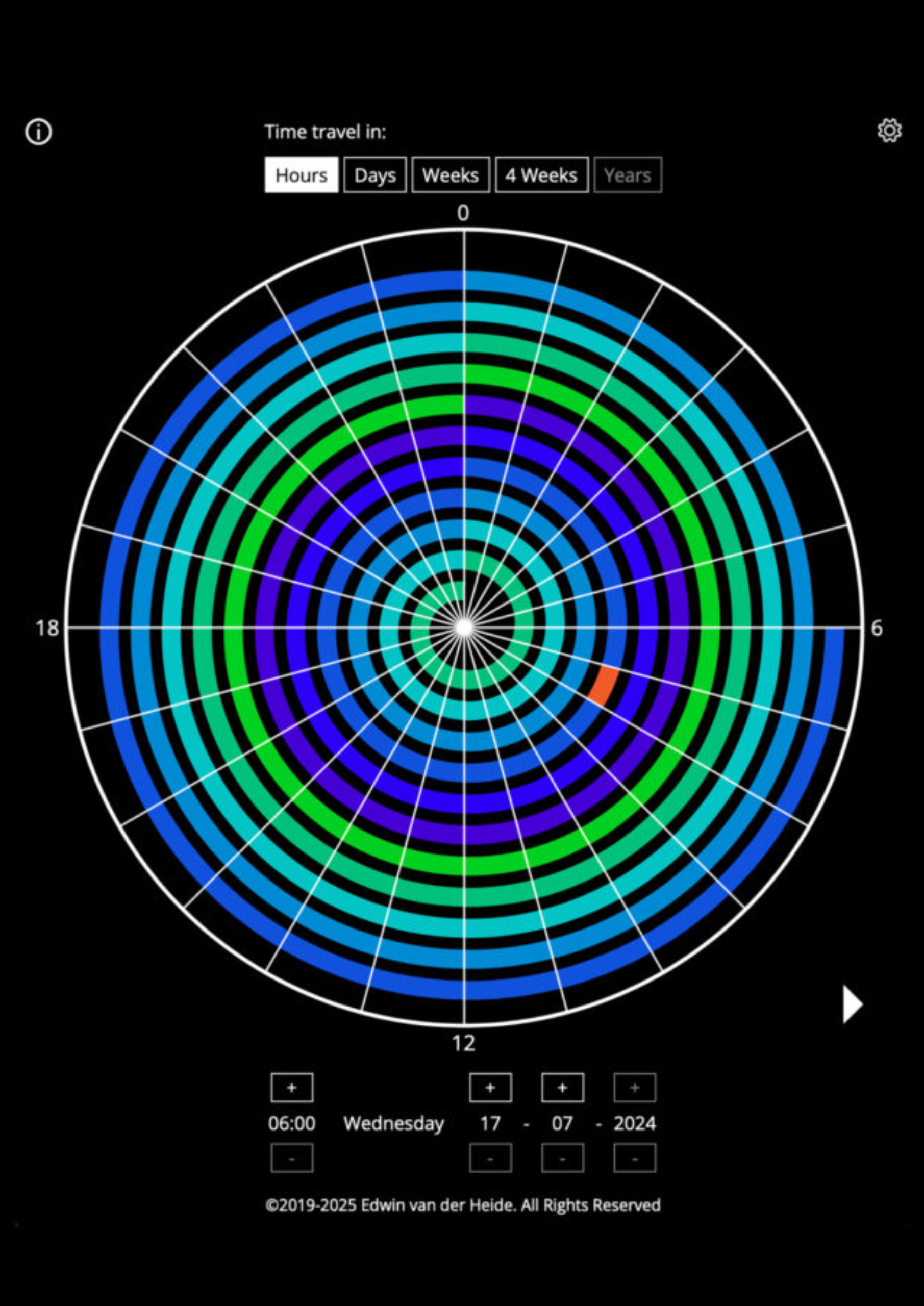
Spiral of Time captures and stages the diverse soundscape of a specific location over the course of several years. By documenting the unique natural, cultural, spatial, and temporal dynamics of a place, the work honors the contributions of all its actors. Every hour, a one-minute recording is made, resulting in a vast sonic archive over time. It is accessible online through a spiral-shaped interface, allowing listeners to explore the cyclical patterns revealed by navigating the material across different time intervals. 


Since July 17th, 2024, the artist has been recording the sounds of the square in front of MACBA (Museum of Contemporary Art of Barcelona). It is a very interesting, diverse, and vibrant urban space. The work is accessible online via https://www.macba.cat/en/spiral-of-time-placa-dels-angels/ and will also be presented physically in the museum starting July 10th, 2025.


Edwin is expanding the project to include other recording locations around the world—not only in urban contexts (dominated by humans) but also in areas governed by nature. The artist dedicated himself to a recording site in the Amazon region. Since February 11th, 2025 Spiral of Time has been installed at the Amazon Rainforest surrounding The UFAM (Federal University of Amazonas) in Manaus. It is home to one of the world’s largest urban forest fragments. Completely surrounded by the dense urban matrix of Manaus, this forest has been isolated since the late 1980s. The forest retains rich ecological features, including areas of mature terra-firme forest, late-stage secondary vegetation, and small patches of white-sand forests. This unique setting offers a rare opportunity to study tropical forest dynamics within a metropolitan environment. 

Spiral of Time-UFAM immerses the listeners in the acoustic life of one of the most biodiverse ecosystems on the planet. This contrast between the natural rhythms of the forest and the human-made patterns of the city enriches the broader narrative of the Spiral of Time, offering a deeper reflection on coexistence, change, and continuity across different environments.

BIO

Edwin van der Heide is an artist, composer, and researcher focused on sound, space, and interaction. His work pushes the boundaries of musical composition toward spatial, interactive, and interdisciplinary directions. He creates installations, performances, and immersive environments where the audience is placed at the center, encouraged to engage sensorially and investigatively.
 

QUBIT AI: Hassan Ragab

Audio Responsive Treehouse

FILE 2024 | Architectural Synthetics
International Electronic Language Festival
Hassan Ragab – Audio Responsive Treehouse – United States

This work, created using generative artificial intelligence tools, is part of a broader exploration into discovering architectural forms through the intersection of different media. Potential shapes are generated based on the rhythms and timbres of the Shockone vs. Shockone song Run. The Bloody Beetroots. Factors such as camera movement and dynamics between the interior and exterior of the treehouse contribute to the creative process.

Bio

Hassan Ragab is an interdisciplinary media artist, architect and designer whose work focuses on the synergy between art, architecture, technology and humanity. He uses generative artificial intelligence to create a new visual language, and his work is exhibited globally. Additionally, Hassan writes about the integration of new media into art and design and has been recognized in numerous publications and news outlets.

Frederik Heyman

CEREMONIAL FORMALITY
Frederik Heyman’s work is a balancing act incorporating multiple media – including video, installations and photogaphy – often in a digitally altered environment. In his work, Heyman explores memory and duration, using photogrammetry and 3D scanning to depict and represent the passage of time. The hallmarks of Heyman’s work are mechanical and technological: wires, wheels, scrolling LED marquees, metal frames, clamps, industrial lights, screens and cameras. Bodies–as opposed to humans–are subject to unusual dynamics with these technological trappings. In Ceremonial Formality (2020) a contortionist is encased in a metal cage while a spectator, hooked up to wires, looks on.

Studio Smack

Tribe City
Hundreds of beings and dreamlike and dystopian elements inhabit the digital and autonomous works that are part of this project. “It’s a portrait of the masses,” summarise the artists, whose fascination with group dynamics, technological phenomena and the ego are expressed in Tribe with an eclectic selection of individuals who bring to life deeply recognisable social attitudes. Collective behaviour and manipulation are recurring themes in SMACK’s work, which often uses popular visual references and light-hearted aesthetics to present us with an uncomfortable reflection of who we are.

Karolina Halatek

Ascent
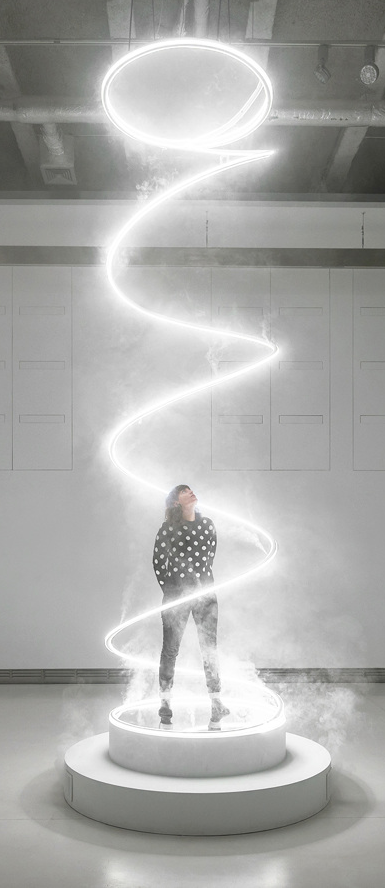
Ascent is a large-scale site-specific light installation that embodies a variety of archetypical and physical associations – from microscopic observations, electromagnetic wave dynamics, and atmospheric phenomena of a whirlwind to a spiritual epiphany. Most importantly, Ascent offers a unique immersive experience, that invites the viewer to become its central point, and transforms the perception of the viewer on a sensual level. The light and the fog create a monumental dynamic space that is participatory, the space that opens up a new dimension and directs the attention toward the bodily sensations in the explicit environment. The viewer is free to approach the work according to its own sensual response, but direct interaction can offer the potential to evoke a new perceptual imagination.

zach blas

sanctum
Zach Blas(United States、1981)の作品は、テクノクラート社会の限界と基盤を描くことを目的として、視覚言語の慣習、価値体系、デジタル技術に内在する力のダイナミクスをさまざまな文脈で分析、調査、配置しています。 。 彼の分析とデジタル文化への反映のために、彼は映画、彫刻、執筆、パフォーマンスなど、さまざまな表現形式を使用しています。 ブラスはブラックユーモアと理論的研究に取り組んでおり、彼の最も顕著な影響の中には、神秘主義の伝統、サイエンスフィクションのジャンル、ポップカルチャー、クィアの美学があります。

.

sanctum

The work of Zach Blas (United States, 1981) analyzes and explores the dynamics of visual language practices, value systems, and the forces inherent in digital technology in a variety of contexts, with the aim of depicting the limits and foundations of technocratic societies. I have placed it. .. For his analysis and reflection in digital culture, he uses a variety of forms of expression, including film, sculpture, writing and performance. Brass works on black humor and theoretical research, and among his most prominent influences are the mystical tradition, the genre of science fiction, pop culture, and the aesthetics of queer.


Ian Cheng

“Entropy Wrangler,” Ian Cheng’s 2013 exhibition at Off Vendome in Dusseldorf, was an excellent introduction to the logic behind this artist’s practice. The centerpiece was a large projection in the gallery’s basement described as “a live computer simulation that changes and evolves, forever.” Like all of Cheng’s simulations, it was programmed with motion capture techniques that register the physical movements of performers that are then translated onto digital bodies. These bodies coexist as individual entities subject to the laws and dynamics of a causal, virtual world: avatars of people and common objects, like hammers and basketball players, rendered in basic three-dimensional form and caught in the zero gravity of the digital screen

Maki Namekawa

Pianographique
Pianographique is a series of collaborations of real time visual artist Cori O’Lan and Maki Namekawa. The visualisations are not videos that are more or less synchronous to the music and it is also not the musician’s playing to prefabricated material, they are jointly created together in the moment of the performance. As with most of Cori O’Lan’s visualizations, all graphic elements are derived directly from the acoustic material, i.e. the sound of the music. For this purpose, the piano is picked up with microphones and these signals are then transformed by the computer into a multitude of information about frequency, pitch, volume, dynamics, etc… This information, in turn, is used to control the graphics computer, create graphical elements or modify them in many ways. Since these processes take place in real time, there is a direct and expressive connection between the music and visual interpretation. The visualization is actually not “created” by the computer but much more by the music itself – the computer is rather the instrument, the brush operated, played by the music.

alexander lehmann

Hybris – Garbage Truck
Inspired by chaos theory and non-linear dynamics, Hybris invested a few years sitting in the studio to create his debut, and the results of such an amount of time invested in it stand out at first glance because not only has his head blown of how much ordinary human being crosses his music in addition to blowing the minds of Noisia themselves (who surely do not have to be very easy people to surprise), it has also made UKF (the largest d & b / idm community the world) highlight his first single as a piece worthy of freezing in time and that somehow revitalizes and reinvents the d & b that in Hybris Garbage Truck has not only found a new form of expression with what you hear but also with what you see with his precise and perfectly timed video made by Alexander Lehmann.

Christoph De Boeck

Staalhemel

The intimate topography of the brain is laid out across a grid of 80 steel ceiling tiles as a spatialized form of tapping. The visitor can experience the dynamics of his cognitive self by fitting a wireless EEG interface on his head, that allows him to walk under the acoustic representation of his own brain waves.The accumulating resonances of impacted steel sheets generates penetrating overtones. The spatial distribution of impact and the overlapping of reverberations create a very physical soundspace to house an intangible stream of consciousness.‘Staalhemel’ (‘steel sky’, 2009) articulates the contradictory relationship we entertain with our own nervous system. Neurological feedback makes that the cognitive focus is repeatedly interrupted by the representation of this focus. Concentrated thinking attempts to portray itself in a space that is reshaped by thinking itself nearly every split second.

Chris Salter

n-Polytope: Behaviors in Light and Sound after Iannis Xenakis
N_Polytope: Behaviors in Light and Sound After Iannis Xenakis is a spectacular light and sound performance-installation combining cutting edge lighting, lasers, sound, sensing and machine learning software inspired by composer Iannis Xenakis’s radical 1960s- 1970s works named Polytopes (from the Greek ‘poly’, many and ‘topos’, space). As large scale, immersive architectural environments that made the indeterminate and chaotic patterns and behaviour of natural phenomena experiential through the temporal dynamics of light and the spatial dynamics of sound, the Polytopes still to this day are relatively unknown but were far ahead of their time. N_Polytope is based on the attempt to both re-imagine Xenakis’ work with probabilistic/stochastic systems with new techniques as well as to explore how these techniques can exemplify our own historical moment of extreme instability.

vadim zakharov

Захаров, Вадим Арисович
danaë installation

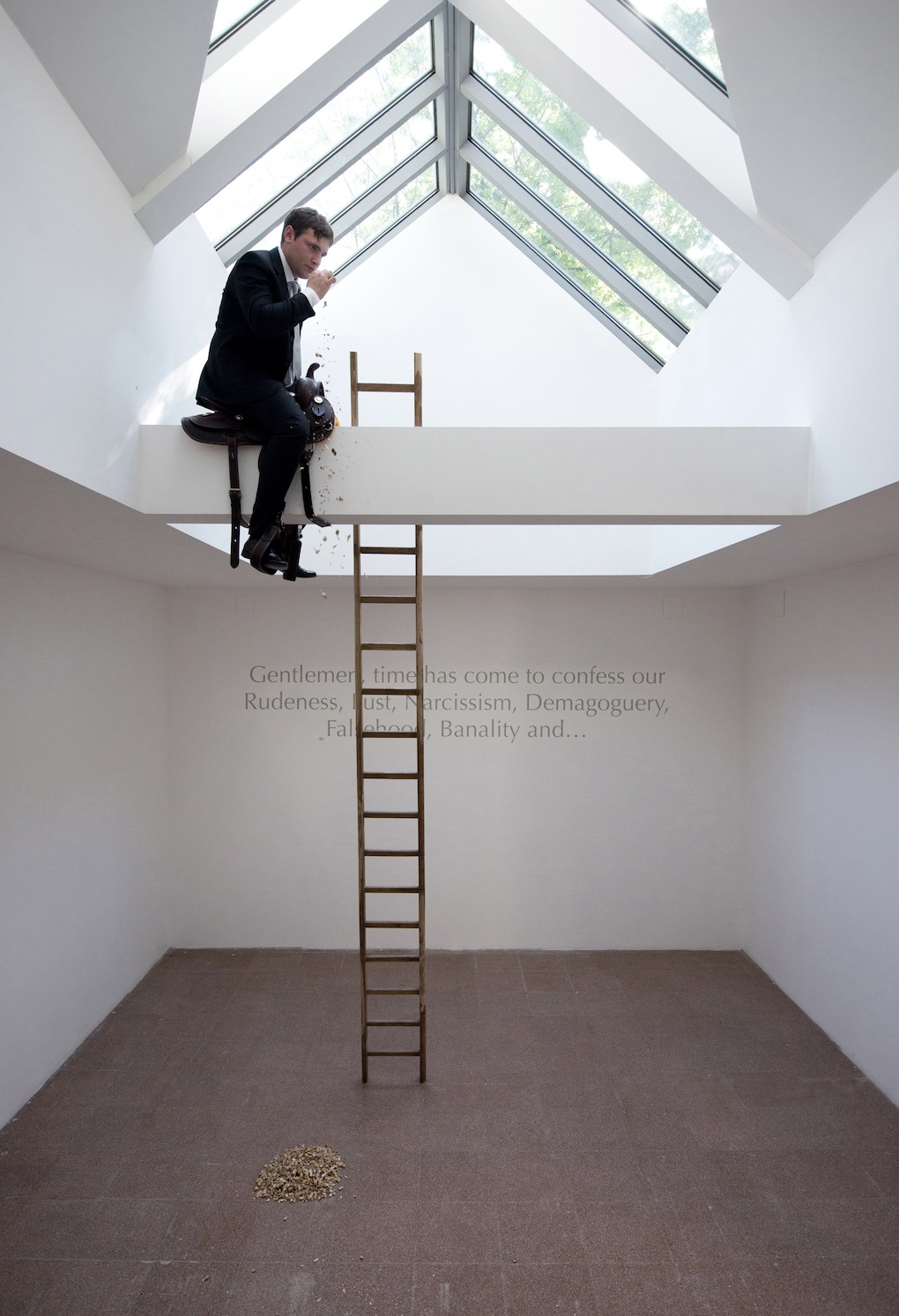
Drawing from the perpetually revisited myth of Zeus and Danae, an installation by Vadim Zakharov in the Russian pavilion at the Venice Biennale 2013 used consumable objects and the sequence of architectural spaces to make manifest underlying ideas about ‘rudeness, lust, narcissism, demagoguery, falsehood, banality, and greed, cynicism, robbery, speculation, wastefulness, gluttony, seduction, envy, and stupidity.’ the impregation of danae occurs when zeus appears to her as a golden shower after she is locked in a tower to prevent the professed death of her father. gender dynamics and the poetic cycle of gestation are reconstructed spatially with a total use of the pavilion– a first in the history of the building.

vtol

last breath
I understand passive instruments to be different multimedia objects that do not require management so much as co-existence with them based on relations born of a mutual “hybrid” symbiosis. The operating principle of the object is fairly simple – the exhaled air (its pressure and flow rate) activates the generative process, which depends on the exhalation parameters and is managed by the air movement in the organ. The object does not require any special game technique, although any change in the breathing (either premeditated or caused by physiological factors) is directly dependent on game dynamics and also on all the other parameters used to generate the sonic flow.

Kapwani Kiwanga

Flowers for Africa
Flowers For Africa the artist mined archives related to African de-colonization to compile a list of flowers associated with individuals, nations and/or resistance movements; an image library that became the basis for meticulous sculptural recreations of individual flowers, or entire bouquets. As Kapwani described of the series, in a statement that reads as apt in relation to her overall approach: “What I’m trying to do is to acquaint myself with these various historic times, and questions, and more generally an interest I have in power dynamics. With this project I have chosen to look from the African continent at these global questions of power dynamics. This project is a way for me to acquaint myself with different archives, consulting documents and simply pondering on those moments. In this process, this was the most natural gesture which emerged”

Quintessenz

Lingering Summer
“Lingering Summer” is a site-specific installation created for the 2019 West Bund Art Fair. The gradation of colors from yellow to lime green, and indigo to cerulean blue, is reminiscent of the dynamics of changing colors from early to mid-summer. The ascending and descending of layers create a natural and comforting rhythm, as if forming a virtual space to preserve the summer scene inside the steel and concrete architecture, mesmerizing the audience by breaking them away from reality.

Jan van der Ploeg

W
His paintings expand the best of contemporary non-objective work in their shear boldness and fearless scope, the entirety of the painting’s dynamics are always greater than the architecture that supports them…

matthias koenig

The Sun never sets
His work is defined in sculptures, installations, drawings and music, but most of the time it‘s a symbiosis of these elements. His artistic practice is based on the creation of compositions with a specific acoustic and physical interaction, where form and sound coexist. The playful, unpredictable aspects of this interaction has his main interest. The specific qualities of music like tone, dynamics, rhythm, timbre and its swiftly immateriality create the poetic counterpart of the physical and visual.

alexandra zierle and paul carter

Absent Engagement
Alexandra Zierle (DE) and Paul Carter’s (UK) collaborative work is interdisciplinary, multi-sensory and often site/context responsive, spanning performance, happenings and interventions, sound, video and installation. Through their collaborative practice, Zierle & Carter critically examine different modes of communication and what it means to be human, addressing notions of belonging, dynamics within relationships, and the transformation of limitations. Their work sites an embodied investigation into human interactions and encounters, acting as an invitation to venture into the spaces in-between the external and internal, permanent and transient, spoken and unheard. The work fundamentally explores society’s conventions, traditions, and rituals, often flipping them on their head, reversing orders, and disrupting the norm.

ALEXANDRA ZIERLE AND PAUL CARTER

Ways of Water – A Love Potion for Nature
Alexandra Zierle and Paul Carter’s collaborative work is interdisciplinary, multi-sensory and site and context responsive spanning performance, happenings, interventions, sound, video and installation. Through their practice, Zierle & Carter critically examine different modes of communication and what it means to be human both as individuals and as a ‘collective entity’. Their work addresses notions of belonging, cultural identity, the dynamics within relationships, harmony through conflict and the transformation of limitations.

Dominique Rey

“Working in a number of media, the subject matters I explore focus on individuals and groups of people on the periphery of dominant culture and I enter their contexts to work from a position of inclusion that approaches, as closely as possible, the residing dynamics of social and psychological forces.”

Nick Paparone

Idol
Nick Paparone functions within the systems of mass culture and the marketplace in order to satirize and expose their inner-workings. Employing a variety of media from video, installation, and performance, the artist states that his work “is slathered with evolving iterations that anatomize branding idioms and client dynamics.more…

ART+COM

Mobility
The installation spans a corridor of 7-metres width. On the left wall one hundred prosthetic hands arranged in a matrix revolve around their own vertical axis, the movements being controlled by motors. The mirrors they hold reflect the beam of a strong light across the space and onto the opposite wall. What initially seems like an asynchronous, chaotic pattern of movement soon reveals itself as a complex, computational choreography: at first the hundred light spots move around a central point, akin to the celestial dynamics of the planets or the flight pattern of a swarm of insects and creating the impression of a three-dimensional space. Then suddenly this organic oscillation converges to form a Chinese character denoting movement and action.

Leo Selvaggio

URME

My work, www.youareme.net , explores what happens when the methodology of open sourcing is applied to identity. In effect, I have relinquished control over the creation of my persona online, and have provided to the public my identity and image as material to be manipulated, created, and even destroyed. In our highly surveiled and sensitive society, I am interested in what a public might do with open access to my information. I am not only concerned with the dynamics of supposed public and private information, but also with the carefully curated creation of an online identity. How do social technologies like Facebook shape the way we present ourselves, and how do we go about editing the realities of our lives for online consumption? And if we create or recreate ourselves through our technologies, who exactly could I be, if that process is one open to public discourse. Could this expand the possibilities of who I am, or ruin my cyber-social relations and credibility?

TERRY RILEY

keyboard study

The score to “Keyboard Study 1” is spare: two pages of musical cells and two pages of written instructions for how to navigate and manipulate those cells provide the pitch material, but choices about duration, dynamics, and shape are left up to the performer. There are three ostinati that form the skeleton of the piece between which are related sets of variations that will be mixed, matched, and sometimes played on top of the primary pattern. Riley offers the recipe for how to mix the ostinati and variation sets then its up to the performer(s) to choose which variation to use out of a particular set and how to shape the transitions from one ostinato to the next. Riley’s music empowers performers to create and react while also bonding their expression to the act of composition.