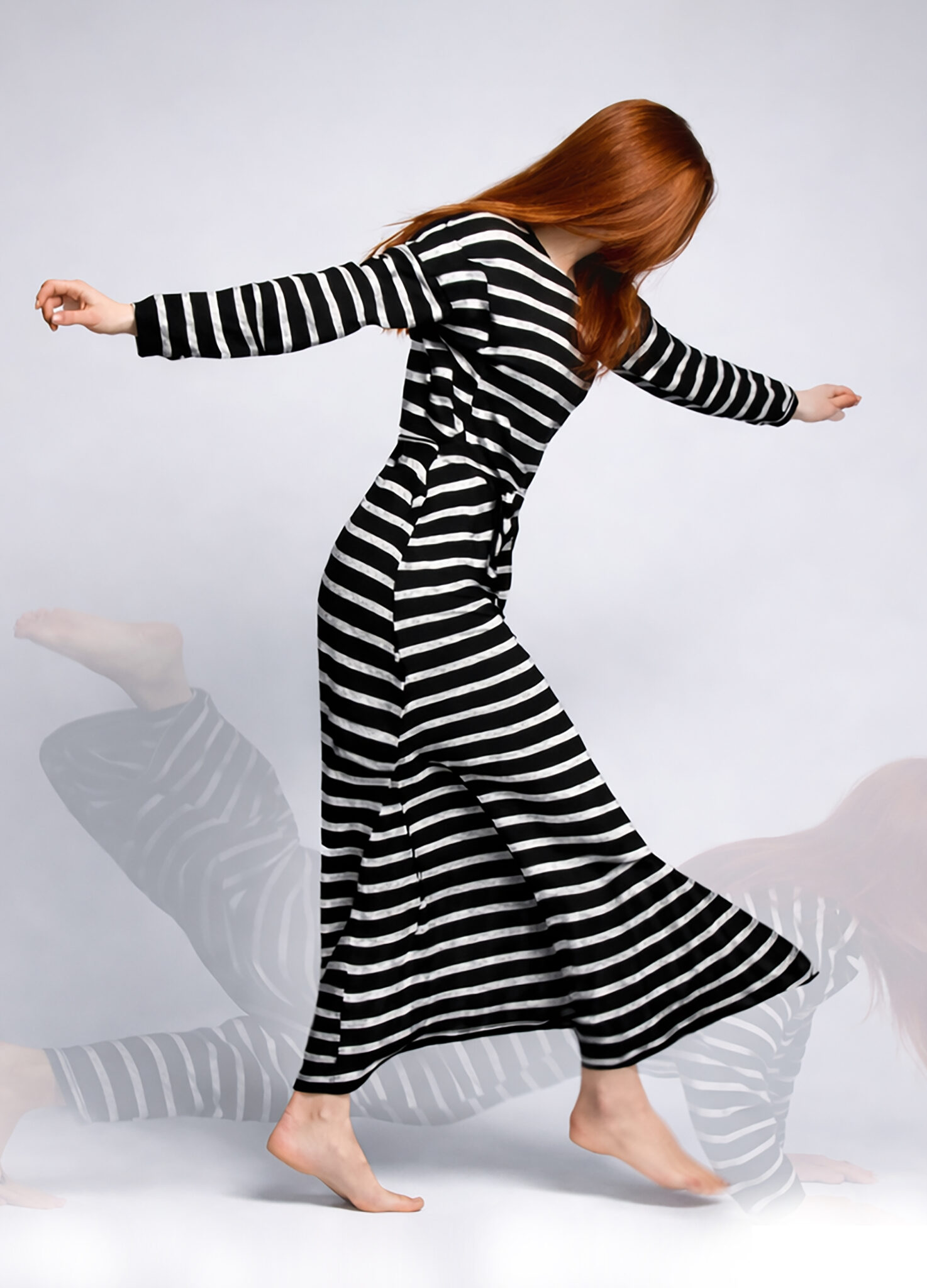
Mirtha Bermegui – Coreografía – Argentina
COREOGRAFÍA
Mirtha Bermegui
FILE SÃO PAULO 2026: Inter-creativity – Art and Technology – VIDEO ART SHORT
Electronic Language International Festival
Coreografía – Argentina
A moving body becomes a visual score. Choreography unfolds a dance suspended between gravity and illusion, where repetition and chance trace gestures that oscillate between the human and the artificial. Artificial intelligence intervenes as malleable matter, recomposing patterns in an unfinished flow. The work is configured as a visual laboratory where time, error, and reiteration are poetic strategies for exploring body, technology, and becoming.
BIO
Argentine multidisciplinary artist, lives in Buenos Aires. Her practice encompasses installations, video art, and transdisciplinary projects, with a presence in national and international exhibitions. She participates in competitions and biennials, and investigates the relationship between art and artificial intelligence in her contemporary production.
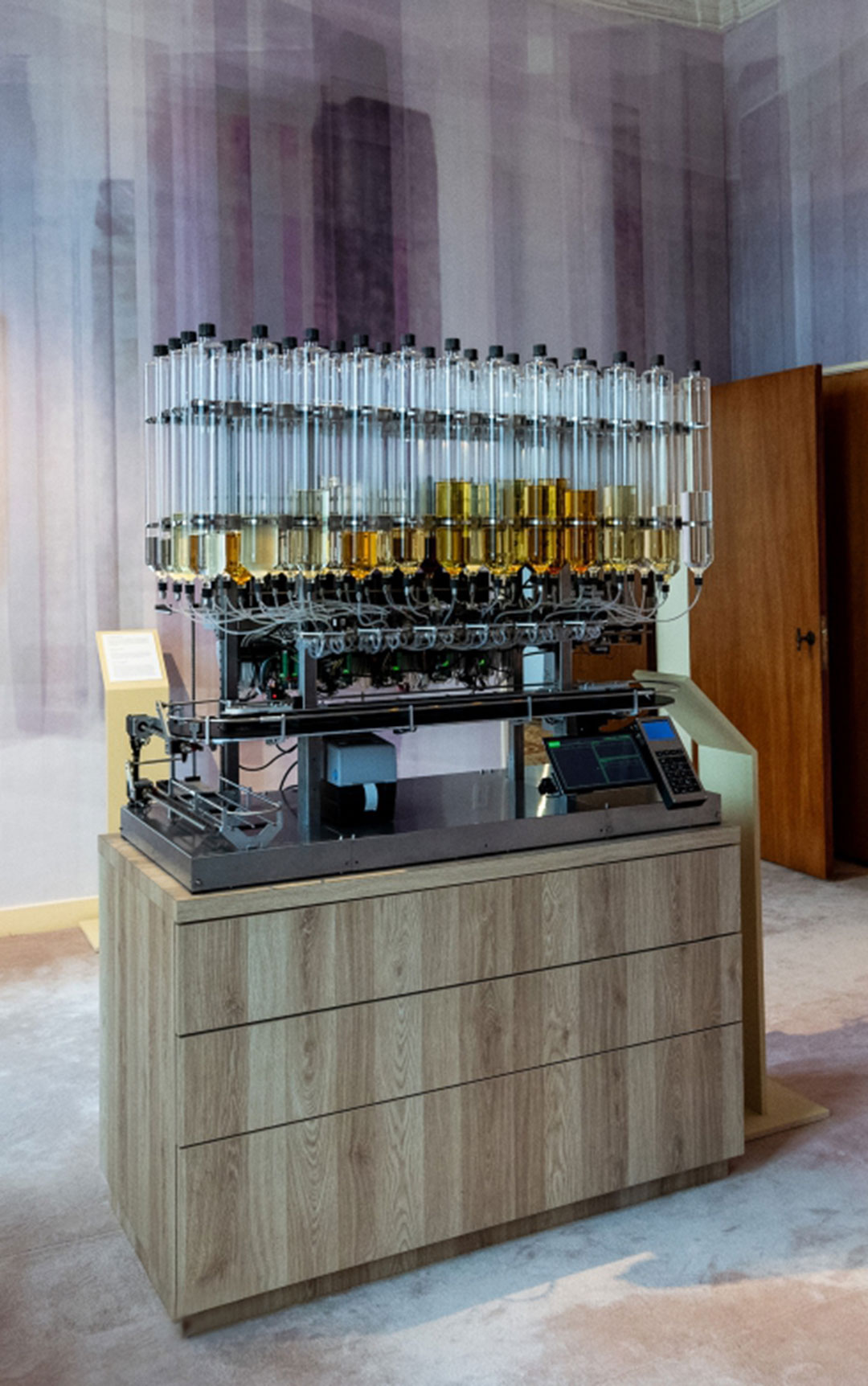
Frederik Duerinck – Algorithmic Perfumery by EveryHuman – Netherlands
ALGORITHMIC PERFUMERY BY EVERYHUMAN
Frederik Duerinck
FILE SÃO PAULO 2026: Inter-creativity – Art and Technology – Installations
Electronic Language International Festival
Algorithmic Perfumery by EveryHuman – Netherlands
Algorithmic Perfumery began with a simple question: what if every human could create their own scent? Designed as an object of curiosity, the installation invites people into a dialogue with themselves. Through interaction with an AI, visitors explore memory, imagination, preference and identity, creating a unique fragrance along the way. Scent is one of our most profound senses. It shapes emotion, evokes memory, and influences us long before we become conscious of it. By combining technology and perfumery, Algorithmic Perfumery creates a space for curiosity, reflection, and self-discovery.
BIO
Amir Admoni and Fabito Rychter have collaborated for over 10 years, creating films, TV shows, and theatrical works marked by a distinctive visual style and singular storytelling. The duo has gained international recognition, earning 71 awards and presenting their work at more than 120 festivals. Gravity VR is their first joint venture into virtual reality, followed in 2021 by Lavrynthos, their second VR project.
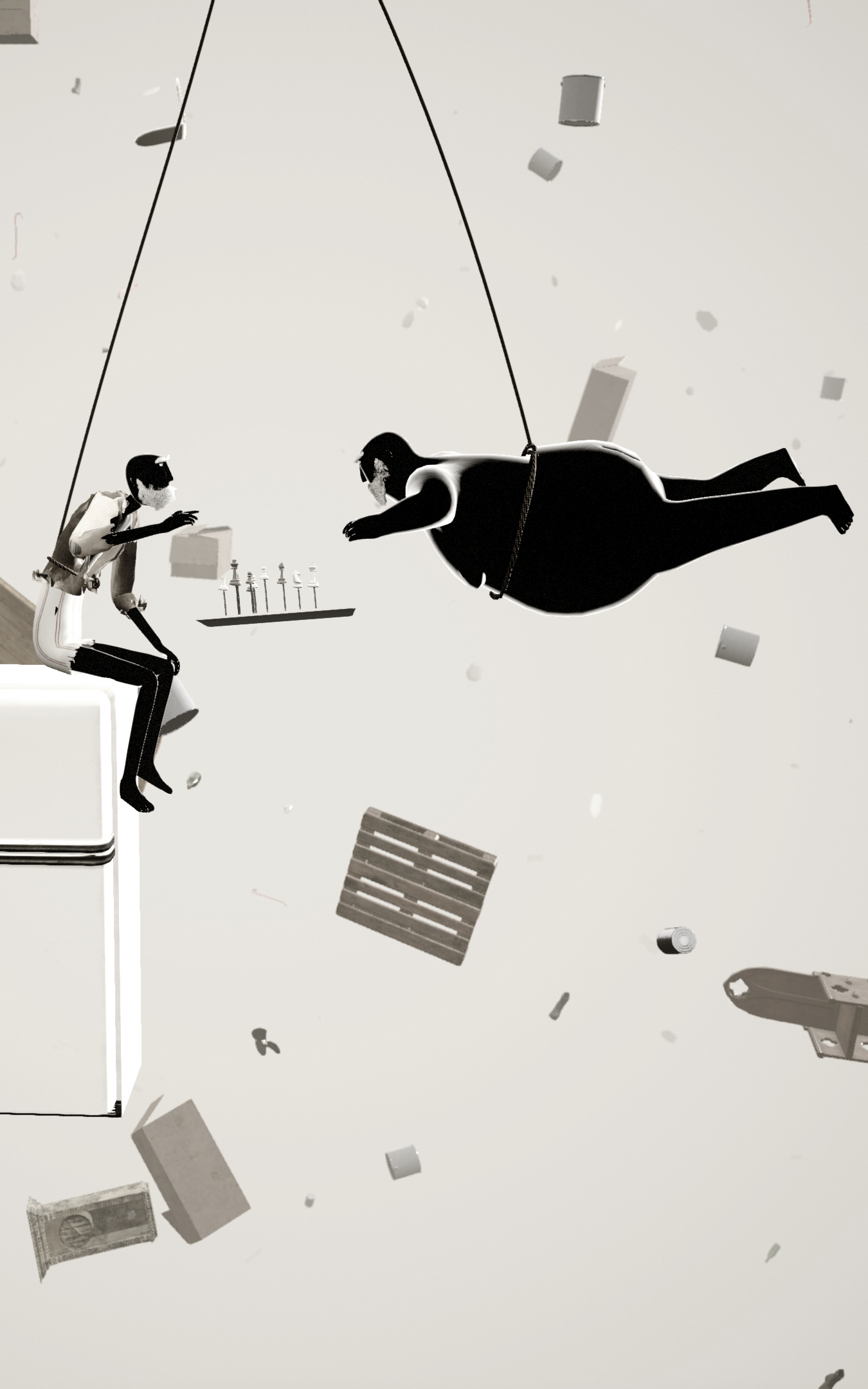
Amir Admoni & Fabito Rychter – Gravidade VR – Brazil
GRAVIDADE VR
Amir Admoni & Fabito Rychter
FILE SÃO PAULO 2026: Inter-creativity – Art and Technology – Installations
Electronic Language International Festival
Gravidade VR – Brazil
Gravidade VR takes place in a surreal world where everything, including the public, is constantly falling. In this universe, with no walls, horizon, or sense of up and down, there is no room for vertigo or fear. Within this setting, we meet Osório and Benedito, two brothers who have spent their entire lives in this endless fall. But, as with all things in life, this journey is about to come to an end.
BIO
Amir Admoni and Fabito Rychter have collaborated for over 10 years, creating films, TV shows, and theatrical works marked by a distinctive visual style and singular storytelling. The duo has gained international recognition, earning 71 awards and presenting their work at more than 120 festivals. Gravity VR is their first joint venture into virtual reality, followed in 2021 by Lavrynthos, their second VR project.

COD.ACT
Coro pêndulo
Pendulum Choir é uma peça coral original para 9 vozes A Cappella e 18 macacos hidráulicos. O coro é constituindo por um corpo vivo e sonoro. Esse corpo se expressa por meio de vários estados físicos. Sua plasticidade varia de acordo com sua sonoridade. Varia entre sons abstratos, sons repetitivos e sons líricos ou narrativos. Os corpos dos cantores e suas vozes brincam com e contra a gravidade. Eles se tocam e se evitam, criando polifonias vocais sutis. Ou, apoiados por sons eletrônicos, rompem sua coesão e explodem em um voo lírico ou se dobram em um ritual obsessivo e sombrio. O órgão viaja da vida à morte em uma alegoria robótica onde a complexidade tecnológica e o lirismo dos corpos em movimento se combinam em uma obra com acentos prometéicos.
.
Pendulum Choir is an original choral piece for 9 A Cappella voices and 18 hydraulic jacks. The choir is constituted by a living and sonorous body. This body expresses itself through various physical states. Its plasticity varies according to its sound. It varies between abstract sounds, repetitive sounds and lyrical or narrative sounds. The singers’ bodies and their voices play with and against gravity. They touch and avoid each other, creating subtle vocal polyphonies. Or, supported by electronic sounds, they break their cohesion and explode in a lyrical flight or bend in an obsessive and dark ritual. The organ travels from life to death in a robotic allegory where technological complexity and the lyricism of moving bodies combine in a work with Promethean accents.

Jennifer Townley
Inverta
A circular axle is able to rotate by the use of 36 universal joints hanging from perspex rods and transmitting their rotary motion onto the next. In between the joints, 36 stainless steel objects are attached that rotate at the same speed as the axle. One of the objects has a slightly thinner body, making room for two integrated timing pulleys and thin cogged belts that connect it with the drive mechanism situated on the upper circular frame. The objects are made from thin sheet material and are carefully balanced by placing several counterweights inside their hollow bodies and by perforating their tails, reducing the amount of material furthest away from the axle. During the entire revolution their centre of gravity perfectly aligns with the position of the axle so that a stable rotation is ensured.
Gerard O’Neill
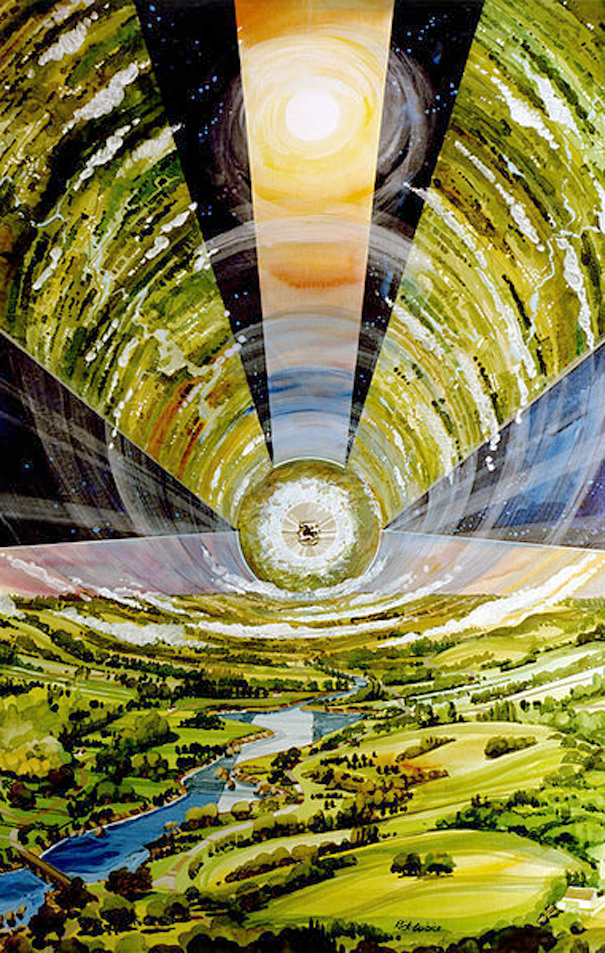
O’Neill cylinder
O’Neill was inspired by the papers written by his students. He began to work out the details of a program to build self-supporting space habitats in free space.Among the details was how to provide the inhabitants of a space colony with an Earth-like environment. His students had designed giant pressurized structures, spun up to approximate Earth gravity by centrifugal force . With the population of the colony living on the inner surface of a sphere or cylinder, these structures resembled “inside-out planets”. He found that pairing counter-rotating cylinders would eliminate the need to spin them using rockets.This configuration has since been known as the O’Neill cylinder.

danny karas
sofi
in analysis of the modern skyscraper there is traditionally an aesthetic agenda that localizes itself in a “shoes” or “hat” location. The tower typology has ignored the possibility of a center distortion. This distortion acts as an aesthetic element as well as an organizational(programmatic) locator. By designing from the middle out there is a chance for the building to better blend with its context by keeping the processional elements in the center. Entrance and roof conditions mimic their tower brothers and give a moments rest in the exuberance of design. This proposal creates a center distortion and layers form through a simulation of gravity and the“claspyness” of the outer skin. The inner void acts as a way of creating a Secretary oriented office program rather than a traditional first floor security, freeing up the center of the building to the public. The project looks to rationalize itself through components rather than a monolithic form.

INFINITE
Hibanana Studio
Liu Chang & Miao Jing
FILE SAO PAULO 2017
FILE LED SHOW
“INFINITE” is an audiovisual installation created by New York-based visual artist duo Liu Chang and Miao Jing, in collaboration with sound artist Gan Jian. “INFINITE” explores the connection between time and space, discusses about spatial gravity and its influence to human’s perception. Sound and visual elements are in completely in sync in order to contribute the immersive experience.

Ian Cheng
“Entropy Wrangler,” Ian Cheng’s 2013 exhibition at Off Vendome in Dusseldorf, was an excellent introduction to the logic behind this artist’s practice. The centerpiece was a large projection in the gallery’s basement described as “a live computer simulation that changes and evolves, forever.” Like all of Cheng’s simulations, it was programmed with motion capture techniques that register the physical movements of performers that are then translated onto digital bodies. These bodies coexist as individual entities subject to the laws and dynamics of a causal, virtual world: avatars of people and common objects, like hammers and basketball players, rendered in basic three-dimensional form and caught in the zero gravity of the digital screen

Arcangelo Sassolino
The way we were
Not only does Arcangelo Sassolino transform failure into art, but he manages to make the art of failing a profound part of the art of living. He goes even further in the awareness of risk. He is aware that his experiments may not hold up to the forces that he himself puts in place but this possible collateral damage wants to represent an additional value, becoming precisely the existential metaphor of the concepts of risk and failure. His installations explore the behavior and mechanical limits of matter, he forces their characteristics to distort their shape, gravity, pressure, friction, statics, and of each possibility Sassolino contemplates the risks of collapse with its precise timing and programming.

Zoro Feigl
POPPY
FILE FESTIVAL SÃO PAULO
As a giant poppy flower, this piece of tarpaulin unfolds itself above the viewer to show an elegant dance of waves and curls while within this dance a violent battle emerges between gravity, friction and centrifugal forces.

UJOO LIMHEEYOUNG
Machine Tree
Machine with Tree is a kinetic sculpture combining dead trees with metal machinery. It is designed to use the object’s center of gravity to achieve a movement where the tree appears to float in midair. In Machine with Tree, a dead tree is placed at the end of a long, sharp rod on the machine. The tree slowly moves back and forth with the machine’s movements, as though floating in midair. Through its creation of artificial, bizarre movements controlled by machinery, it illustrates a melancholy contemplation of the strange and contradictory things woven together by our reality.

Hussein Chalayan
フセイン·チャラヤン
ЧАЛАЯН
후세인 샬 라얀
Gravity Fatigue
Fashion designer Hussein Chalayan has created elasticated costumes and sequinned garments for performers in his first self-directed dance production (+ slideshow).The production is split into 18 chapters that each explore themes of identity, displacement and invisibility.

marnix de nijs
PIVOT POINT – ICHIHARA
‘Pivot Point – Ichihara’ is an interactive site-specific installation. Standing on a controller pod you navigate over and through a 3D terrain where gravity seems to have disappeared, you gradually become tele-present in a parallel projected space by exploring a mediated version of the venue, it’s direct surroundings and the Ichihara region. A cinematic journey to a fascinating point cloud realm, precise in details but simultaneously abstract and dreamlike.The kidney shaped interface is covered with capacitive sensors and mounted on a pole, touching this interface right, left, up or down aims the virtual camera accordingly. When you release the navigation pole the virtual camera automatically starts spiralling back to the initial starting point your journey and temporary centre of the universe, the Asohbara Art House.

kenneth snelson
Needle Tower
“Inspired by architect Buckminster Fuller’s interest in the geometry of structure, Snelson’s experiments led to a prototype for a “floating compression structure.” Fuller subsequently credited Snelson with having invented a new structural principle which the architect named tensegrity, a contraction of the words tension and integrity.
These investigations into the physical properties of structure became more fully realized as an art form beginning in the 1950s. Snelson created sculptures consisting of tubes and cables. Cylinders of steel seemingly dance through space in defiance of gravity, yet it is the structural competition between tension and compression which underlies their construction. Snelson finds beauty in bringing these forces of nature into balance: the rigid compression tubes pushing outward, the flexible tension cables pulling inward. His sculptures would maintain their structural integrity beyond gravity, in the vacuum of outer space.” Joelle Burrows

ANDY CAVATORTA
Gravity harp
Este instrumento fue diseñado por Andy Cavatorta, encargado de hacer robots musicales en el MIT Media Lab. Se ocuparon 4 pendulos de once cuerdas cada uno para hacer esta arpa gravitacional. Hay un software que controla la rotación de cada péndulo y determina la nota que suena dependiendo de su posición dentro del balance del instrumento. El sonido de este instrumento se puede escuchar en la canción de “Solstice”.

Kengo Kuma
Botanical Pavilion
To realize the ‘Botanical Pavilion’, Kengo Kuma worked alongside Geoff Nees — a melbourne-based artist and curator who has also worked on a number of architectural pavilions. Made in the japanese tradition of wooden architecture, where pieces interlock, held by tension and gravity, the structure at the NGV triennial features a tessellated interior lined with timber collected from trees felled or removed over several years at Melbourne’s royal botanic gardens. Some of the trees used within the architecture pre-date european settlement, while others signal the development of the gardens as a site of scientific research and botanical classification. Prioritizing natural phenomena over scientific order, the botanical species used are color-coded, rather than following any taxonomic order. this approach offers a statement by the designers against the reductive nature of science during the colonial era — a mindset at odds with many indigenous cultural beliefs and knowledge systems.

Eve Bailey
Rising Awareness
Could one succeed in rising the level of awareness by sharpening one’s perception rather than repeating the vapid catchphrase, “raising awareness,” which has been coopted by an ever-growing money-raising industry that fails to improve our circumstances in a substantive way? Wearing a cocktail dress, I assembled a large kinetic structure made of wooden beams and ladders in front of the audience. I then walked and balanced on the twenty-foot wide structure at eight feet off the floor. Rising Awareness addresses my ongoing preoccupations about the physicality of experience, inhabiting the body, proprioception as the possible strongest sense of self, how spatial awareness correlates with overall awareness and self-awareness, how physicality enhances creativity, finding balance between gravity and groundlessness, a concept of happiness as the fullest expression of one’s particular cognitive potential, pushing boundaries, and the current irreverent politics of liability.

Fuse
Ljós
Ljós (Icelandic for ‘light’) has been conceived in continuity with the research carried out by fuse* in the field of digital and performative arts, which explores the deep connection between light, space, sound and movement. In Ljós, the performer is the means that allows the viewer to access a surreal and dreamlike space, a dimension with no gravity nor time, made by sounds and images reacting and interacting in real time. A shape-changing universe, which evolves from amniotic fluid in the beginning – protecting and supporting the performer – to the setting for violent explosions and transformations later – leading her to a direct contact with ground and Earth.

Nicole L’Huillier and Sands Fish
Telemetron
Nicole L’Huillier and Sands Fish decided to explore how design and creativity might evolve as we begin to do more than merely survive in space. The Telemetron is a unique musical instrument that takes advantage of the poetics of zero gravity, and opens a new field of musical creativity. The project attempts to expand expression beyond the limits of Earth-based instruments and performers. Leveraging sensors, data transmission and capture (for performance after flight), as well as their experience as composers and performers, Sands and Nicole explore a new body language for music.

Josiah McElheny
Interactions of the Abstract Body
With ‘Interactions of the Abstract Body’ McElheny pushed these ideas further, creating a large and varied body of work that looks at how fashion and modernism have intersected and influenced each other, especially through the common language of the body. Crucially, McElheny animated this dynamic with the constant presence of a performer. By combining a continuous flesh-and-blood performance with static sculpture in the same gallery space, a first for White Cube, McElheny radically fractures the distinction between performance and exhibition.

Kouichi Okamoto
Re Rain
“Re-rain” is a sound installation expressing non-visible elements such as gravity, magnetic force, and sound as physical elements. This installation is created with the sound of rain sampled in Japan early spring of 2016.The sound of raindrops hitting an umbrella are recorded, and is then played back from a speaker. The umbrella is set on top of a speaker, and the vibration of the speaker is transmitted through the umbrella to make a sound. For example, an umbrella cannot vibrate if the magnetic force of the speaker is small or if the rain hitting the umbrella is either too high or too low in pitch extent. For this reason, this is a device picking out a state in which the magnetic force of the speaker, weight of the umbrella, and pitch extent of sound are all in a balanced state. Natural phenomena such as rain travels through an object and is emitted as sound to the air..

Ouchhh
SAY SUPERSTRINGS
Ouchhh will take inspiration from the notes that exist in the universe while micro-strings vibrate (Subatomic Particles) in real time and define the melodies created by the notes as “Matter” and symphonies of these melodies as “Universe”. With dastrio, Ouchhh will take 11 dimensions in abstract directions in super grade gravity theory and move them beyond space in real time. The dimensions captured intuitively in living space will constantly change and turn into reality.
dastrio:
Bernhard Metz – Violin
Manuel Von Der Nahmer – Violoncello
Suyang Kim – Piano

Alisa Andrasek
Cloud Pergola
Inspired by the cloud formations and weather events, this mathematized cloud plays with visitor’s perception. Movement through the structure generates a series of dynamic interference views in its deep fabric, drifts and ruptures in visibility. A sea of redirecting vectors is pulling the visitor like an invisible gravity force through the fabric.

Kohei Nawa
FORCE
FORCE is an installation work that provides a visualization of the force of gravity via the interaction between gravity and a liquid with carefully computed qualities. Black silicone oil, engineered to achieve the required viscosity, streams constantly from the ceiling under the influence of gravity, forming a black pool on the floor and blurring the distinction between the characteristics of solids and liquids as if it were a sculpture transformed into a liquid. The tightly configured space places the viewpoint in the interface between time, space, and matter, giving us a direct awareness of the reality of our existence within a continuous series of actual moments.
Kimchi and Chips
Line Segments Space
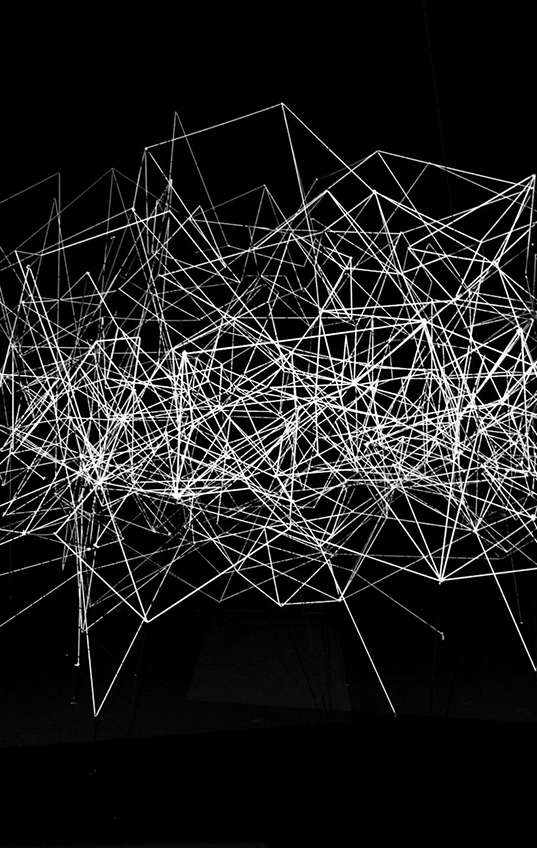
An architectural web of threads subtends a null space. It hangs abstract and undefined, a set of thin positive elements segmenting the dark negative space between. Dynamic imaginary forms are articulated into the physical volume by the material of this thread, and the semi-material of the light. The visual gravity of the filaments occupying the space between. A 2D canvas is reduced from a surface piece into a line segment, but then constructed into another dimension, a volume. Light creates contrast and order on the lines to articulate digital matter. Digital forms inhabit the interconnected boundaries of space, becoming incarnate as visual mass.

Steve Reich
スティーヴ・ライヒ
סטיב רייך
스티브 라이히
СТИВ РАЙХ
Pendulum Music
Reich came up with the concept while working at the University of Colorado. He was swinging a live microphone in the style of the cowboy’s lasso, and noting the produced feedback, he composed for an “orchestra” of microphones.Three or more microphones are suspended above the speakers by means of a cable and stand. The microphones are pulled back, switched on, and released over the speaker, and gravity causes them to swing back and forth as pendulums. As the microphone nears the speaker, a feedback tone is created. Different lengths of cable will swing at different speeds, creating an overlapping series of feedback squeals. The music created is thus the result of the process of the swinging microphones.

ONISHI YASUAKI
vertical emptiness (organic parabola)
Onishi Yasuaki uses wire, glue line and crystallized urea for this installation. The wire makes organic parabola line from the ceiling. He dripping glue through it, and vertical thin glue line is connecting our ground. Crystallized urea appears on glue line and wire. Empty space are filing some phenomena which is gravity, time, action, heat, crystallization. We can discover new landscape in it.

Martin Hesselmeier and Andreas Muxel
The weight of light
Light, as we usually interpret it, is an element without mass and gravity. For “the weight of light” a physics engine simulates the kinetic forces of a moving object. This mass is projected on a wave shaped structure in virtual space. The moving object is represented as a light particle in physical space. Gravity, mass, density and friction affect velocity and acceleration of these light particles. As the particles movement is based on a simulation, it does not have to adhere to the physical realities we know from everyday life. Therefore the installation goes beyond expected behaviour. Thus the matter of light traverses a reinterpretation of our known reality.
Cod.Act
振り子の合唱団
Pendulum Choir
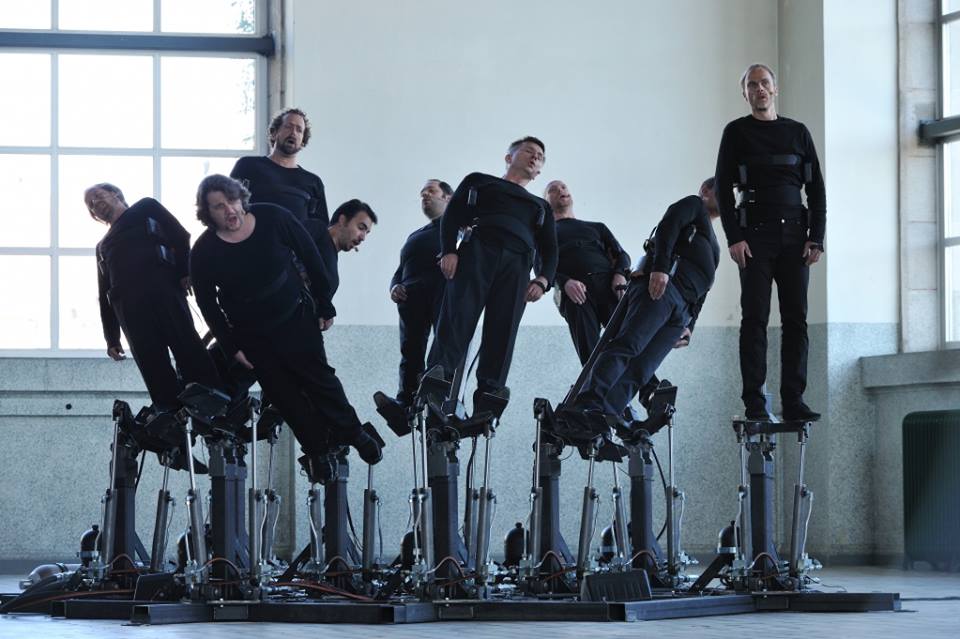
Pendulum Choir is an original choral piece for 9 A Cappella voices and 18 hydraulic jacks. The choir stands on tilting platforms, constituting a living, sonorous body. That body expresses itself through various physical states. Its plasticity varies at the mercy of its sonority. It varies between abstract sounds, repetitive sounds, and lyrical or narrative sounds. The bodies of the singers and their voices play with and against gravity. They brush and avoid each other creating subtle vocal polyphonies. Or, supported by electronic sounds, they break their cohesion and burst into lyrical flight or fold up into an obsessional and dark ritual. The organ travels from life to death in a robotic allegory where the technological complexity and the lyricism of the moving bodies combine into a work with Promethean accents.

Marnix de Nijs
Accelerator
Marnix de Nijs’ installation examines the precarious balance of machine, image and body in time and the effects that accelerated forces of gravity have on today’s urban citizenry. Participants sit in a racing car seat attached to a motorized revolving arm and focus on a video projection which is simultaneously circulating with them.

Agnes Meyer-Brandis
Cloud Core Scanner
Her current installation IN THE TROPOSPHERE LAB provides insights into the material produced under conditions distant from earth. The exhibition tells of the formation of clouds and shows conditions and combinations of art and science during zero gravity. With the exhibition by Agnes Meyer-Brandis, the project space of the Ernst Schering Foundation once again presents a contemporary art project that stimulates interdisciplinary debate and builds bridges to scientific research. The lab as a gravimetric document of the “Cloud Core Scanner” experiment shows a world alternating between controlled and bound-less states – artistic research in search of the reality level of constructions of the matter that surrounds us.

Matt Kenyon
Мэтт Кеньон
مات كينيون
매트 케년
マット・ケニヨン
Supermajor
In Supermajor, a rack of vintage oil cans sits innocuously on the gallery floor. A punctured can, located somewhere mid-stack, has sprung a leak. The oil flows out in a steady trickle, cascading onto the pedestal below; a golden-brown pool forms at its base. Upon closer inspection, however, the oil is not originating from the can. Instead, its stream is reversed. Drop-by-drop the oil flows upwards, defying gravity. At times, droplets even appear to hover in mid-air. Returning to its source, the upward ascent of oil continues uninterrupted as if neither the can’s reserves of the nor the puddle’s can ever be depleted.
FILE FESTIVAL

Damien Jalet
Skid
Pushing further his exploration of a more intense and intimate relationship of the body to the force of gravity, Damien Jalet created “Skid” (2017) for the Gothenburg Dance Company. The dancers performed for 40 minutes on a 34 degree inclined platform of 40 square meters. Together with dancer Aimilios Arapoglou and other members of the company, they developed an alphabet of new physical possibilities, alternating control and surrendering, of accelerations and slow motions, to be performed alone or with partners.

JACOB TONSKI
Balance From Within
File Festival
Jacob Tonski is a pragmatic optimist whose work explores dynamic balance through kinetic metaphors.
A self-adjusting platform makes everyone the same height, probing ideas of equality and the origins of power. A larger-than-life top spins about the room, wobbling through themes of pleasure, danger, youth and decay. A sofa teeters, standing on one leg, musing on the stability of the social structures we build.
These and other human-scale objects, both amusing and threatening, find an uncanny identity between toys and tools. The forces of time and gravity serve in these works as foils for those things we are powerless to direct in our lives, and with which we must instead dance and negotiate.


DAMIEN JALET
OMPHALOS
In ancient Greek Omphalos means navel as in navel or center of the world. Jalet’s creation examines the question of origins. The choreographer reflects on the human predicament and life in the cosmos, a recurrent theme in his work. For his first Latin American creation, Jalets brings together an ensemble of 20 dancers who perform to the music of Marihiko Hara et Ryūichi Sakamoto. This stunning performance makes light of gravity and instability, unfolding at the very edge of empty space. Exceptional event: the only performances in France as part of a world tour.


Christine Kim and Marcin Kedzior
Paper Orbs
Paper Orbs begins the night as a massive origami sculpture which dissolves into thousands of paper helmets worn by visitors as they parade down University Avenue. As both a lantern and a center of gravity, the paper float pulls visitors in and encourages them to return throughout the night to experience the dissolution of the paper sculpture. The accumulated paper helmets disperse into scattered constellations that float along the street. The helmets also resonate with notions of patterned order and militaristic armour.

Mihai Grecu
coagulate
Mihai Grecu’s video work Coagulate is a visually immersive journey into a world of water which behaves against the laws of nature. This choreography of fluids explores absence, presence and aquatic distortions. In this world, man breathes water and fish breath air. Water seems impervious to gravity. Rather than narrative, Coagulate is based on sensation and atmosphere.


DAVID LETELLIER
Caten
Created for the Saint Sauveur chapel in Caen, Caten is a levitating sculpture, determined by gravity and guiding the evolution of a sound composition.
300 fine wires suspended from two ropes, connected themselves at each end to a slowly rotating arm, form an evanescent surface which interacts with the architecture. By a symbolic mirror effect, the curves of the wires, created by the gravitational force, reflect the shapes of the church arches. Caten opposes the ephemeral to the eternal, the movement to the static, and produce a tension between the lightness and the millenary stability of the space.


Tavares Strachan
塔瓦雷斯斯特拉坎
ТАВАРЕС СТРАЧАН
Invisible Astronaut
“This neon and glass sculpture represents the cardiovascular system of astronaut Sally Ride shortly after her return to earth. The human body adapts to periods of prolonged weightlessness. When gravity suddenly returns, the blood pools in the lower extremities, and blood pressure drops. This condition is known as orthostatic intolerance. Hanging upside down can cause blood to pool around the heart, a potentially lethal condition. The awkward position shown above helps blood reach the brain without causing pooling around the heart.”

PHILIPPE RAMETTE
フィリップ·ラメット
Филиппа Рамета
Born in 1961, Philippe Ramette is a French conceptual artist who plays with the viewer’s mind. Ramette creates gravity-defying photographs that appear to be digitally manipulated, using cleverly designed weight-bearing structures (or lead weights for the underwater shots), but in fact they are real world settings that were carefully arrangement, in order to achieve these impressive scenes. In Ramette’s surreal photography, surrealism literally invades reality.

Jeff Colson
Draped Column
Standing ten feet tall and suggesting an elegant obelisk as much as a shower curtain, this curious sculpture raises questions: Is this a functional object? What function is implied? The title refers to an architectural element or a memorial, but this totem defies gravity and it unclear what could be memorialized. Instead, it exists as a conundrum, a surreal manifestation of an object of the imagination that shouldn’t be able to exist, but does so with its imposing, tangible presence. Draped Column holds our attention and our curiosity as a fully realized poetic statement.

Zilvinas Kempinas
The works of the Lithuanian artist Zilvinas Kempinas are not only kinetic but also minimalistic. Now a resident of New York, Kempinas uses the simplest of means to create complex and atmospheric room situations of great beauty. His installations play with air and lightness – the reliefs are based on time and chance[…] Gravity seems abolished, light’s palette penetrates and activates the materials in his installations.

DAVE HARDY
That a Dead Man Sings
Creating sculptures out of materials such as sheets of glass, foam, metal, cement, and various found objects, Dave Hardy composes his sculptures’ seemingly precarious poise as an intentionally engineered defiance of gravity. Distinguished by a constant shuttle between literal and allegorical readings, Hardy’s artworks are both resolutely materialist and infused with a human scale and, more precisely, a human fragility that forces the viewer to confront them as bodies in space.