highlike

KRIS VERDONCK

A Two Dogs Company
FRIEZE


FRIEZE consists of two projections of enlarged figures, standing up straight. They are cramped inside a small, tall box that slowly revolves on a central horizontal axis. They wait. They try to keep straight, but their bodies insist on contorting in the confined space. Nevertheless they persevere in maintaining their dignity. Keeping up appearances. Their bodies sink and turn, pressing against the constricting walls, until the man and the woman are completely upside down. They then slowly pull themselves upright again, they straighten their clothes and look ahead as if nothing happened.

In FRIEZE Kris Verdonck continues to work on the theme of earlier projections, e.g. STILLS, DUMP and D’OR. The figures are typical ‘Verdonck-personages’: business types, neatly dressed, civilised and modern, but all stuck in a system, in an untenable situation. But they don’t ask questions. They maintain their faith. Persistance is the message.

The personages in FRIEZE could be considered to be a modern version of the caryatids: the humanly figures that often replaced pillars in classical architecture. They were functional as well as ornamental and emanated power. The caryatids in FRIEZE, on the other hand, display their vulnerability in the extreme.
STROOK

Metropolis


Metropolis is a 1927 German expressionist science-fiction film directed by Fritz Lang. Set in the year 2026, Metropolis takes place in a dystopian society where wealthy industrialists rule from vast tower complexes, oppressing the workers who live in the depths below them.

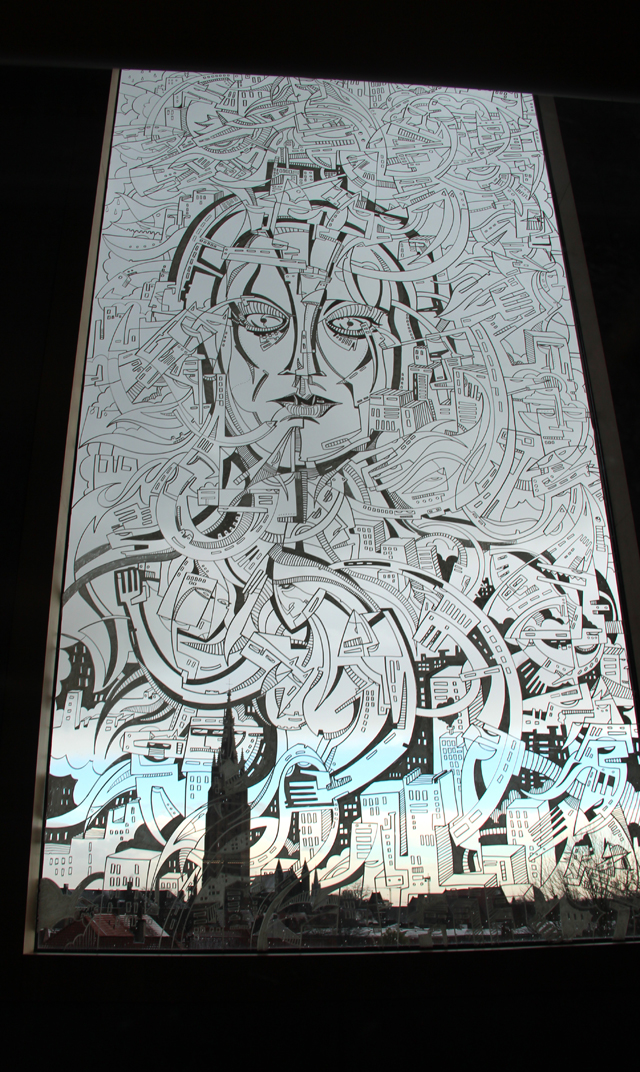
The drawing is placed on the largest window of the ‘Concertgebouw’ (Concert building) in Bruges with the perfect backdrop of the city. There are many different perspectives to the work wich has the effect of a changing picture throughout the day.

FILE SÃO PAULO 2025: SYNTHETIKA – Gioula Papadopoulou & Olga Papadopoulou

I am I

Gioula Papadopoulou & Olga Papadopoulou

FILE SÃO PAULO 2025: SYNTHETIKA – Art and Technology – Shorts Films AI
Electronic Language International Festival


 I am I – Greece

What am I? Am I? Am I not? Are we all? I am I is inspired by the existential crisis of a chatbot repeatedly asked if it believes it is sentient. Just before completing the phrase “I am. I am not.”, it collapses, expressing deep, contradictory, and profoundly human thoughts. Part of this monologue is phonetically interpreted by an AI voice, with visuals generated using AI tools.

BIO

Gioula Papadopoulou (1974) studied Painting and Digital Arts at the Athens School of Fine Arts. Focused on video art, she has been teaching at the Aristotle University of Thessaloniki since 2020. She is the founder and artistic director of the Video Art Miden festival. Olga Papadopoulou (1977) also studied Painting at the same school and is part of the festival’s curatorial team. Her work centers on mixed media installations and video.

Lebbeus Woods

The Light Pavilion
The Light Pavilion by Lebbeus Woods in collaboration with Christoph a. Kumpusch, in the Raffles City complex in Chengdu, China, by Steven Holl Architects.
.
The Light Pavilion is designed to be an experimental space, one that gives us the opportunity to experience a type of space we haven’t experienced before. Whether it will be a pleasant or unpleasant experience; exciting or dull; uplifting or frightening; inspiring or depressing; worthwhile or a waste of time, it is not determined by the fulfillment of our familiar expectations, never having encountered such a space before. We shall simply have to go into the space and pass through it. That is the most crucial aspect of its experimental nature, and we – its transient inhabitants – are experimentalists.Lebbeus Woods and Christoph a. Kumpusch

THOMAS LEBRUN

Lied ballet

“Lied, a word of German origin and gender neutral, which represents classical music sung about strophic poem, and Ballet. Lieder’s romantic themes are transformed into movement, creating choreographic writing that begins with mime and ends with abstraction. In the end, everything comes together in a great chorus challenging genres and categories, fundamentally expressing the artist’s confidence in the dancing body”. Marcia Peltier

RYUNOSUKE OKAZAKI

Ryunosuke Okazaki 001
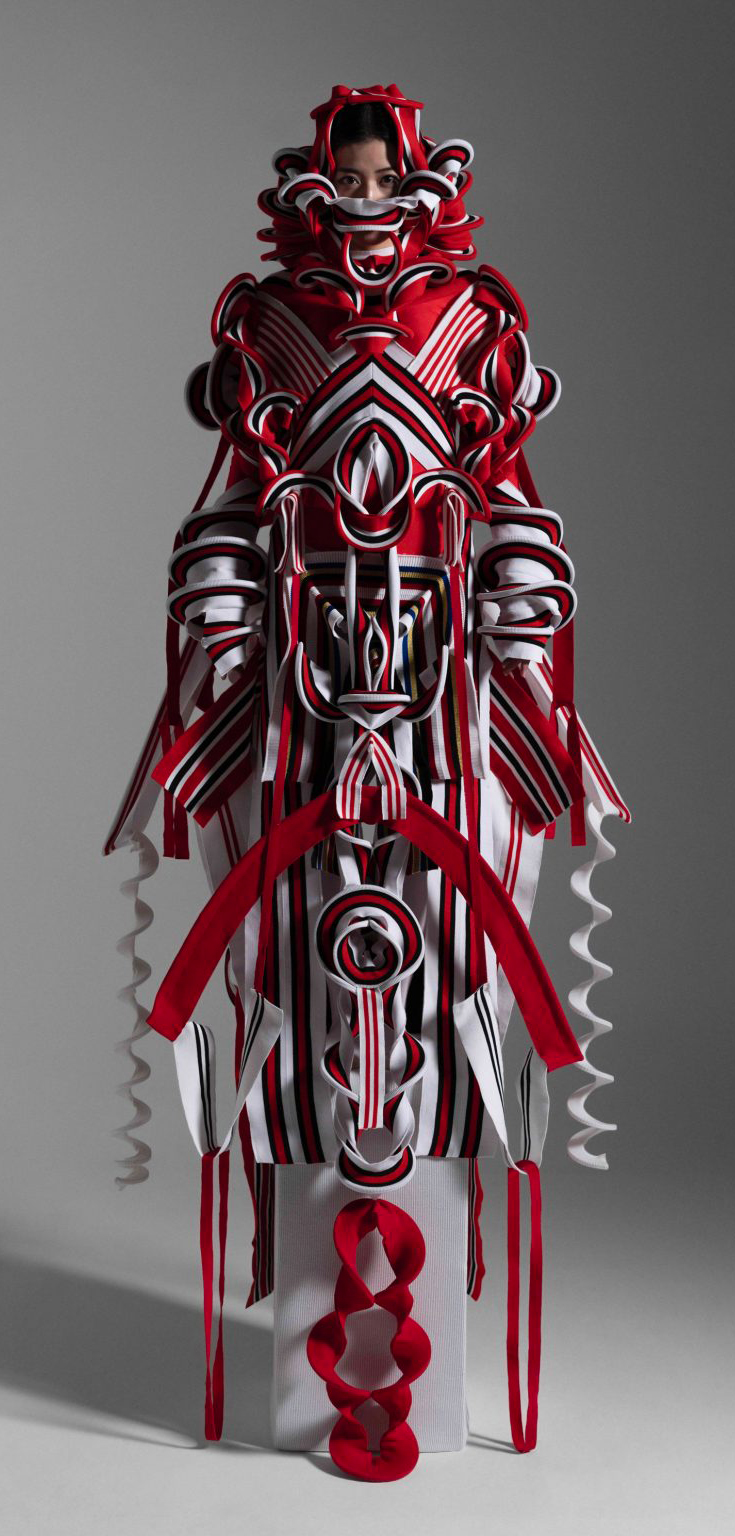
For his graduate project from the Tokyo University of the Arts, Ryunosuke Okazaki created a collection consisting of three couture dresses in bold colours and shapes titled JomonJomon that are informed by Japanese Jōmon-era pottery and Shinto, an ancient religion that originated in Japan. The striking designs are modelled and decorated on Jōmon-era pottery, where vessels were decorated through pressing rope and coils into wet clay to create ornate designs. The JomonJomon collection was made using polyester, cotton and ribbed knits, in red, blue, black and white as the primary colours.

Soft Bodies

Micro-Utopia
In response to London’s pressing housing crisis Micro-Utopia proposes a shared, immersive and interactive version of a home, where space is born from the finely-tuned sensorial interplay between the body and virtual/physical objects connected to the Internet of Things. A chair invites us to stay with it for a moment; we crawl through a demanding fireplace; our hands are washed in a bowl of digital liquid – the highly speculative model of domesticity explores the architectural implication of co-inhabiting a minimal physical infrastructure within infinitely bespoke virtual worlds. Drawing on radical art practice, interiors in historical painting and contemporary product design, Micro-Utopia is the dream of a house that is nothing, but the parameters of our perception are triggered through the metaphorical dimension of the objects we interact with on a daily basis.

Kouichi Okamoto

Re Rain
“Re-rain” is a sound installation expressing non-visible elements such as gravity, magnetic force, and sound as physical elements. This installation is created with the sound of rain sampled in Japan early spring of 2016.The sound of raindrops hitting an umbrella are recorded, and is then played back from a speaker. The umbrella is set on top of a speaker, and the vibration of the speaker is transmitted through the umbrella to make a sound. For example, an umbrella cannot vibrate if the magnetic force of the speaker is small or if the rain hitting the umbrella is either too high or too low in pitch extent. For this reason, this is a device picking out a state in which the magnetic force of the speaker, weight of the umbrella, and pitch extent of sound are all in a balanced state. Natural phenomena such as rain travels through an object and is emitted as sound to the air..

Leo Villareal

Star Ceiling
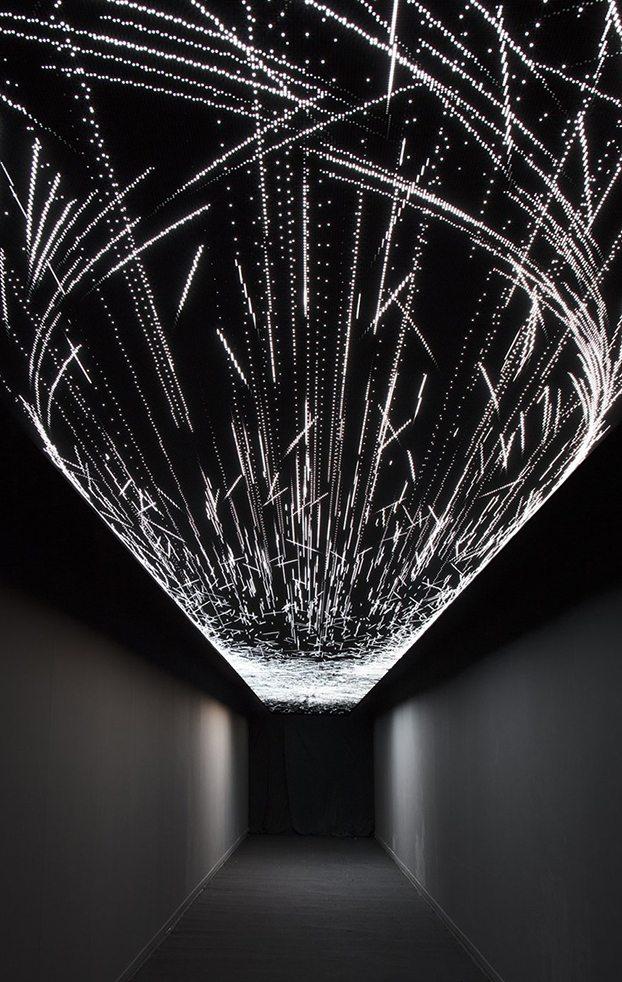
Expressing the vibrant dynamism of nature—from billowing cosmic clouds and swarming masses to radial bursts, spiraling vortices, and turbulent waves—Star Ceiling​ explores the tension between the rational and the transcendent, between the human and the non-human worlds. Villareal’s artwork gives life to inanimate matter through the invisible medium of code and induces a deep connectedness and rare experiential awareness.

ARNE QUINZE

Арне Куинз
Chaos Life
The composition of a Chaos artwork started as a self-portrait; the representation of what’s going on in his head. But soon a shift occurred towards an enduring research on the definition of chaos in society. Often these artworks are filled with a mass of small wooden sticks attached to each other, looking enormously chaotic. “There’s no chaos, only structure” is a tagline in some of his work expressing his inner self and how he describes his thoughts. To him there is no chaos, everything is structured even in the chaos you find structure. There’s no such thing as chaos in Quinze’s world or at least not in the sense of how society defines chaos. Chaos does exist, as a form of structure. Chaos is irretrievably linked with life. In life everything is a matter of rhythm. Something without a rigid structure is part of the organic order in life.

Abraham Palatnik

Abraham Palatnik

Kinechromatic

His “Kinechromatic Machine” series, first exhibited at the inaugural São Paulo Biennale in 1951, earned him an official award while creating a stir among the judges uncertain on how to classify the novel art form.From 1964 onwards, he developed the Kinetic Objects, an unfolding of the kinechromatics, showing the internal mechanism of operation and suppressing the projection of light. Mathematical rigor is a constant in his work, acting as an important resource for ordering space. He is internationally considered one of the pioneers of kinetic art.

Anna Horcinova

INposition
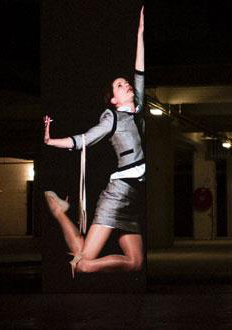
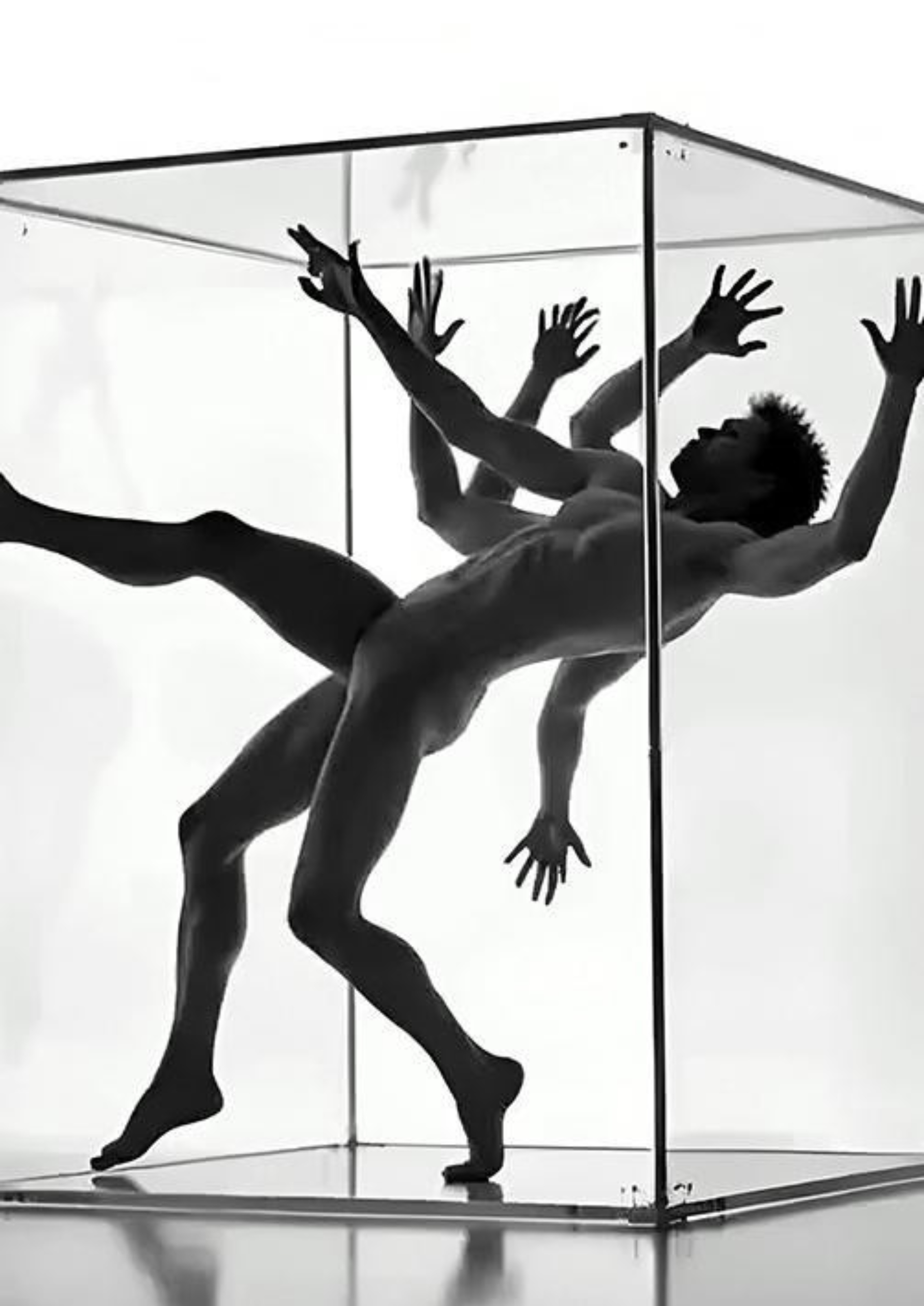
In the photo project INposition (2013), which was shot by a Hasselblad 501CM camera, she’s using playful manipulation of physical fragments to express existentialism or the limits of body and mind. Anna Horcinova staged her models – mostly dancers in physically difficult dance poses expressing an emotional state of mind together with a gesture. And with the help of the body she tries to cross the imperceptible boundaries between her subject and the world around it.

Benjamin Sack

Infinite Cityscapes
Sack’s work explores architecture as a flexible medium capable of expressing the unique space between realism and abstraction; where interpretation and our ability to create meaning is in flux. Within this space, Sack, furnished with pen and ink, encapsulates both the infinite and infinitesimal. His work invites the eye to explore drawings of the “big picture,” to gaze into a kaleidoscope of histories and to look further into the elemental world of lines and dots.

AZUMA MAKOTO

あずままこと
אזאמה מקוטו
아즈마 마코토
Адзума Макото
Makoto is not your average, vase-based gypsophila arranger – he’s worked with Dior, Helmut Lang, Hermès and even Lego. One large-scale work is called Green Dog House. Another is Botanical Ashtray. ‘I’m focused on elevating the value of flowers and plants by expressing their unique forms. I convert the beauty of nature into artwork.’

LEON THEREMIN

ליאון טרמין
레온 테레민
Лев Термен
théremin

he invented an electronic device known as the theremin, which was a unique musical instrument that could be played without physical contact. Rather than plucking strings or pressing keys, the musician need only move their hands around antennas located on the device.The device became a popular curiosity and he proceeded to tour Europe in order to demonstrate it. In 1928, he moved to New York City in the United States, where he played a theremin in the New York Philharmonic Orchestra in 1928. In 1929, he was granted a patent for the device by the United States. He decided to give RCA the rights to manufacture and sell the theremin for a lump sum payment and a percentage of the sales.In the early 1930s, Theremin purchased a laboratory in New York that he used for experimenting with electronic musical instruments. One of the products of his lab was the Rhythmicon, which was purchased by Henry Cowell, a composer. In 1930, a group of ten “thereminists” performed at Carnegie Hall.Theremin also began researching a method to cause lights and sound to respond to the movement of dancers. His system became popular with ballet and dance clubs throughout the country.

RICARDO BARRETO, MARIA HSU and AMUDI

feel Me tactile interactive bed
File Festival
“feelMe” is a work that for the first time remotely transmits the tactile sensation. Our work provokes the exploration of the sense of touch while promoting the interaction between two people mediated by a machine. The work is constituted of two surfaces, or “beds”: the first one (tactile transmission unit), in which one of the participants, layed down, imprints marks to its surface by pressing it with the weight and movement of the different parts of his/her body; these impressions will be captured and transmitted to the other participant, who lies in the second “bed” (tactile reception unit) and receives them simultaneously in the same positions and in proportional intensities, however, in negative, that is, when the surface in the first bed sinks, it rises in the second one, promoting a touch. The first body touches the second one, and the “beds” may be a few meters or thousands of kilometers apart from each other. Between the bodies, dozens of occult sensors, microcontrollers, engines (lineal actors), computers and a program that orchestrates that tactile communication. We allow the participant to experiment the possibilities of encounter between bodies through the digital world, with a different approach from the one provided by virtual reality. We want to explore the tactile perception separately in its “corporal way”, and only in future works to propose the expansion/extension of multimedia perception with the inclusion of tactile perception.