highlike

David Dória, Keshav Ramaswami & Kiko Zhang – Public Parts – Brazil / United Kingdom

PUBLIC PARTS

David Dória, Keshav Ramaswami & Kiko Zhang


FILE SÃO PAULO 2026: Inter-creativity – Art and Technology – Discrete Architecture
Electronic Language International Festival


Public Parts – Brazil / United Kingdom

Public Parts is a platform for communal living. Seeking to challenge the neoliberal model that currently dominates the gig economy through an approach to the re-socialization of housing, the platform employs automation and machine intelligence to produce reconfigurable buildings.

Co-authors: Keshav Ramaswami and Xuan “Kiko” Zhang

Tutors: Mollie Claypool, Gilles Retsin, Manuel Jimenez Garcia, Kevin Saey, Sonia Magdziarz, Alessandro Bava

BIO

David Dória is an architect and urban designer whose work explores the convergence of digital technologies and architecture, with a particular focus on their theoretical and political implications for the discipline. His research spans automation, artificial intelligence applications in architecture, computational design, and digital fabrication. He holds a Bachelor’s degree in Architecture and Urbanism from the Federal University of Sergipe and an MArch in Architectural Design from the Bartlett School of Architecture, UCL.

Wyss Institute, SEAS & Boston University

Microfluidic Origami for Reconfigurable Pneumatic/Hydraulic (MORPH)
Looking to create a robot smaller than a centimeter that might someday perform precision surgery or help destroy tumors, researchers from Harvard University’s Wyss Institute and School of Engineering and Applied Sciences (SEAS), and Boston University looked to nature for inspiration, and developed a novel microfabrication technique to construct it. Their tiny robot looks like a rubbery, transparent spider — and in fact, the team modeled the form after Australia’s famously colorful and captivating peacock spider.

xenobots

Xenobots – the First “Living Robots”
Researchers used the Deep Green supercomputer cluster and an evolutionary algorithm to design new life-forms that could achieve an assigned task. Then they built them by combining together different biological tissues from Xenopus laevis embryos, hence the name Xenobots.
Credit:A scalable pipeline for designing reconfigurable organisms
Sam Kriegman, Douglas Blackiston, Michael Levin, and Josh Bongard
PNAS, DOI: 10.1073/pnas.1910837117

William Bondin

Morphs
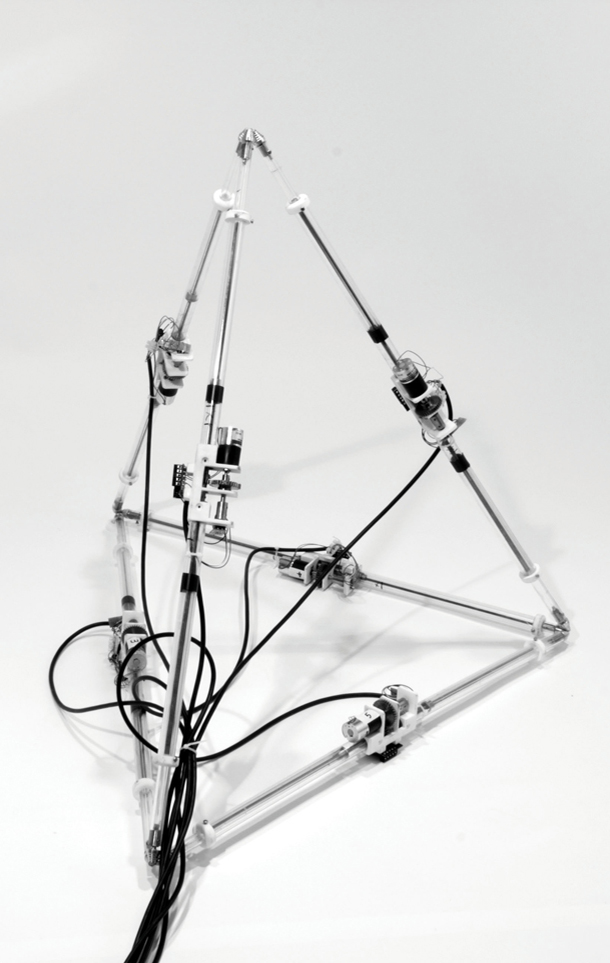
MORPHs, short for Mobile Reconfigurable Polyhedra, are motive architectural structures which can crawl and self-assemble in order to encourage social interaction through play. These playful robotic creatures encourage the public to choreograph them into dance routines, assemble them into complex sculptural geometries or else play music at them, which they will play back over time. Groups of people can interact at any one time and eventually develop a dialogue amongst participants, through the use of contemporary digital technology.