highlike

Gerald Trimmel – WAYWARD APPROXIMATIONS (20250518) – Austria

WAYWARD APPROXIMATIONS (20250518)

Gerald Trimmel


FILE SÃO PAULO 2026: Inter-creativity – Art and Technology – VIDEO ART SHORT
Electronic Language International Festival


WAYWARD APPROXIMATIONS (20250518) – Austria

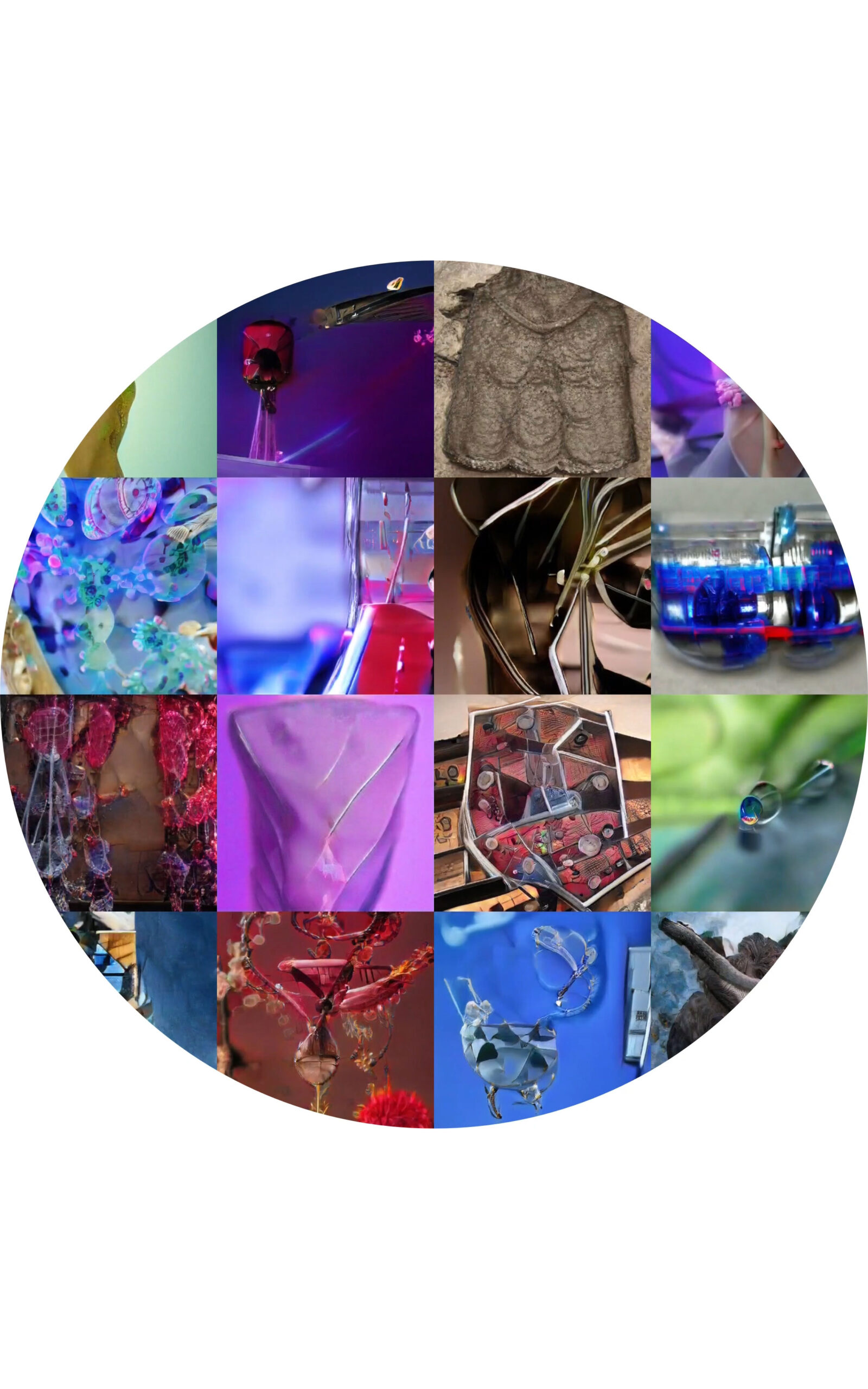
WAYWARD APPROXIMATIONS (20250518) is a dynamic Cybernetic Canvas in the form of an audiovisual tondo. A 4×4 matrix of parallel morphing image streams generates hybrid worlds between biology, technology, and textile structures. Recurring synchronization moments create unexpected homogenization as an anomaly within proliferation. Image and sound form autonomous poles connected through structural resonance.

BIO

Gerald Trimmel is a Vienna-based media artist, composer, and art therapist. His work explores transformation processes between analog material, digital systems, and AI-based image generation, often in circular audiovisual formats (Cybernetic Canvas). Recent presentations include Chongqing (China), ArteScienza Festival (Rome), and The Wrong Biennale (São Paulo | online).

JOY DIVISION

חטיבת שמחה
ジョイ·ディヴィジョン
Closer
Joy Division, released in 1980, was considered one of the most important albums of the post-punk movement. As the songs were recorded under a specially constructed stucco vault, an end to capture and resonance from a chapel. There is no indication of the sides, either on the seal or in the insert. Thus, with the previous album, Unknown Pleasures, the relationship of the songs is found only without insert. In the CD edition, consider side A that starts with the Atrocity Exhibition, and side B starts with Heart And Soul.

Martin Messier

ECHO CHAMBER
Performance audiovisuelle en plusieurs tableaux, Echo Chamber s’inspire des technologies qui permettent de sonder l’intérieur du corps, telles que les ultrasons et l’acupuncture, générant une composition sonore dans laquelle l’idée de résonance prédomine. En créant une interface modulaire à trois panneaux permettant de multiples manipulations, Messier a défini les limites des possibilités d’exécution d’une chorégraphie son et lumière. Saisissez de longues aiguilles comme s’il s’agissait de notes d’un instrument, perçant une plaque sensible à l’audio qui déclenche des séquences sonores.

Yeh Ting Hao

Imagery Resonance
“This work-in-progress piece is about reverse oscilloscope synthesizer. When I used the ilda laser protocol to manipulate the laser graphic, I found it turned the vector graphic to stereo audio first , then the laser point started drawing by X and Y axis coordinates. So I reverse the system and made a live-control set to make 3d model data into sound.” Yeh Ting Hao

A.I.L.O it pronounces Hello

Art and Light
Exploration sensorielle. Tout part de la ligne, comme une envie d’infini. Composition géométrique de lignes lumineuses projetées sur les miroirs et le mur. En partant de la ligne la plus épurée jusqu’à une recherche d’accumulation en travaillant la profondeur et la perte de repère. Le travail sonore créé à partir des vibrations lumineuses nous enveloppe et joue sur nos propres resonances. Interaction avec les surfaces réfléchissantes qui transcendent

Studio A N F

Computervisionen 2
Nach mehr Jahrzehnten des Versuchs, einen Apparat zu konstruieren, der denken kann, können wir endlich die Früchte dieser Bemühungen erleben: Maschinen, die es wissen. Das heißt, nicht nur Maschinen, die Informationen messen und nachschlagen können, sondern auch solche, die ein qualitatives Verständnis der Welt zu haben scheinen. Ein auf Gesichtern trainiertes neuronales Netzwerk weiß nicht nur, wie ein menschliches Gesicht aussieht, es hat auch ein Gefühl dafür, was ein Gesicht ist. Obwohl die Algorithmen, die solche para-neuronalen Formationen erzeugen, relativ einfach sind, verstehen wir nicht vollständig, wie sie funktionieren. Eine Vielzahl von Forschungslabors hat solche Netze auch erfolgreich auf fMRT-Scans (Functional Magnetic Resonance Imaging) lebender Gehirne trainiert, um Bilder, Konzepte und Gedanken effektiv aus dem Geist einer Person zu extrahieren. Hier geschieht die Beugung wahrscheinlich als doppelte: eine Technologie, deren Funktionsweise nicht gut verstanden wird und die eine ebenso unklare natürliche Formation mit einem gewissen Erfolg qualitativ analysiert. Andreas N. Fischers Arbeit Computer Visions II scheint kurz hinter dieser Schwelle zu warten, wo sich zwei Arten von wissenden Wesen in einer Art psychotherapeutischer Sitzung treffen […]

Studio TISH

Resonance
Resonance is an interactive audio-visual experience that encourages people to engage in a dialogue with water, whilst creating an intimate atmosphere of contemplation. The installation comes fully to life when people interact with it. We used sound and color to immerse the museum visitors and invite them to explore the role that technology and human intervention might play in harmonizing our environment.

Studio A N F

Computer Visions 2
After more decades of trying to construct an apparatus that can think, we may be finally witnessing the fruits of those efforts: machines that know. That is to say, not only machines that can measure and look up information, but ones that seem to have a qualitative understanding of the world. A neural network trained on faces does not only know what a human face looks like, it has a sense of what a face is. Although the algorithms that produce such para-neuronal formations are relatively simple, we do not fully understand how they work. A variety of research labs have also been successfully training such nets on functional magnetic resonance imaging (fMRI) scans of living brains, enabling them to effectively extract images, concepts, thoughts from a person’s mind. This is where the inflection likely happens, as a double one: a technology whose workings are not well understood, qualitatively analyzing an equally unclear natural formation with a degree of success. Andreas N. Fischer’s work Computer Visions II seems to be waiting just beyond this cusp, where two kinds of knowing beings meet in a psychotherapeutic session of sorts[…]

Projet EVA

The Object of the Internet
L’Objet de l’Internet est une installation jouant le rôle d’un mausolée destiné à la Fin du web, Grâce à des procédés optiques et cinétiques placés dans une boîte fermée où le visiteur insère sa tête, le visage humain est décomposé en une multitudes de fragments. Les visiteurs deviennent les sujets d’une fiction dystopique post-humaine où, sur les réseaux sociaux, ne demeureraient sous la forme d’une résonance que les traces de quelques égo-portraits encore artificiellement animés. Ces derniers, condamnés au statut de solipsismes stériles, s’agiteraient dans le vide sidéral de la fin d’Internet.

Christoph De Boeck

Staalhemel

The intimate topography of the brain is laid out across a grid of 80 steel ceiling tiles as a spatialized form of tapping. The visitor can experience the dynamics of his cognitive self by fitting a wireless EEG interface on his head, that allows him to walk under the acoustic representation of his own brain waves.The accumulating resonances of impacted steel sheets generates penetrating overtones. The spatial distribution of impact and the overlapping of reverberations create a very physical soundspace to house an intangible stream of consciousness.‘Staalhemel’ (‘steel sky’, 2009) articulates the contradictory relationship we entertain with our own nervous system. Neurological feedback makes that the cognitive focus is repeatedly interrupted by the representation of this focus. Concentrated thinking attempts to portray itself in a space that is reshaped by thinking itself nearly every split second.

MARIKO MORI

ماریکو موری
森万里子
Мори, Марико
Tom Na H-Iu

Tom Na H-iu is a three-dimensional glass work almost 3 meters in height. It is networked to the Super Kamiokande neutrino observatory operated by the Institute for Cosmic Ray Research, University of Tokyo, enabling it to interact and respond when the observatory captures a neutrino. On detecting a neutrino, such as those emitted by stars in our galaxy as they die in supernova explosions[…] Tom Na H-iu represents a modern standing stone that conveys the death of a star, meanwhile hinting at the birth that follows – as if to suggest to the viewer that our existence is in resonance with the universe. When we view this work that emits peaceful light amidst darkness, we can project ourselves into the darkness and gain a sense that we are standing quietly in the flow of eternal time.

Marianthi Papalexandri-Alexandri

Untitled VI
für drei Männerstimmen und Klangobjekte
In Untitled VI the vocalists are singing with modified resonant tubes and motors the Greek word “akousate” that means to listen attentively. What happens when voice and singing are mediated and controlled with motor driven resonant bodies? How does this act of singing change the physical and imagined presence of the voice? How does it affect the process of intensive listening to one’s own voice, to one another, and to external sounds? Exploring these questions, Papalexandri encourages hearing the resonances between different voices and bodies.
text: Dr. Zeynep Bulut

MICHEL FRANÇOIS

米歇尔·弗朗索瓦
walk through a line of neon lights

Les sculptures de Michel François tentent de donner à la matière la fulgurance du dessin. Une fois construites, le processus créatif perdure au moyen de l’installation, laquelle cherche à faire cohabiter l’ensemble autour d’un sens commun. Connexions, tensions et résonances ouvrent ainsi un dialogue inédit entre les pièces, où noirceur et liberté prédominent.

VINCENT MAUGER

Super Asymmetry
Vincent Mauger’s sculptures do not just stand on a site, they bring pressure into it. The relationship to the site is an intrinsic part of the artist’s work, he questions the space in order to reveal its breaking and equilibrium points. From the adequacy between the occupied space and the shown volume, resonances rise towards the spectators’ sensitivity. The spectator is caught by the play of the surfaces, the hollow and the solid, he experiences a stimulated landscape which scale oscillates between the infinitesimal and the colossal.

Camille Henrot

Endangered Species
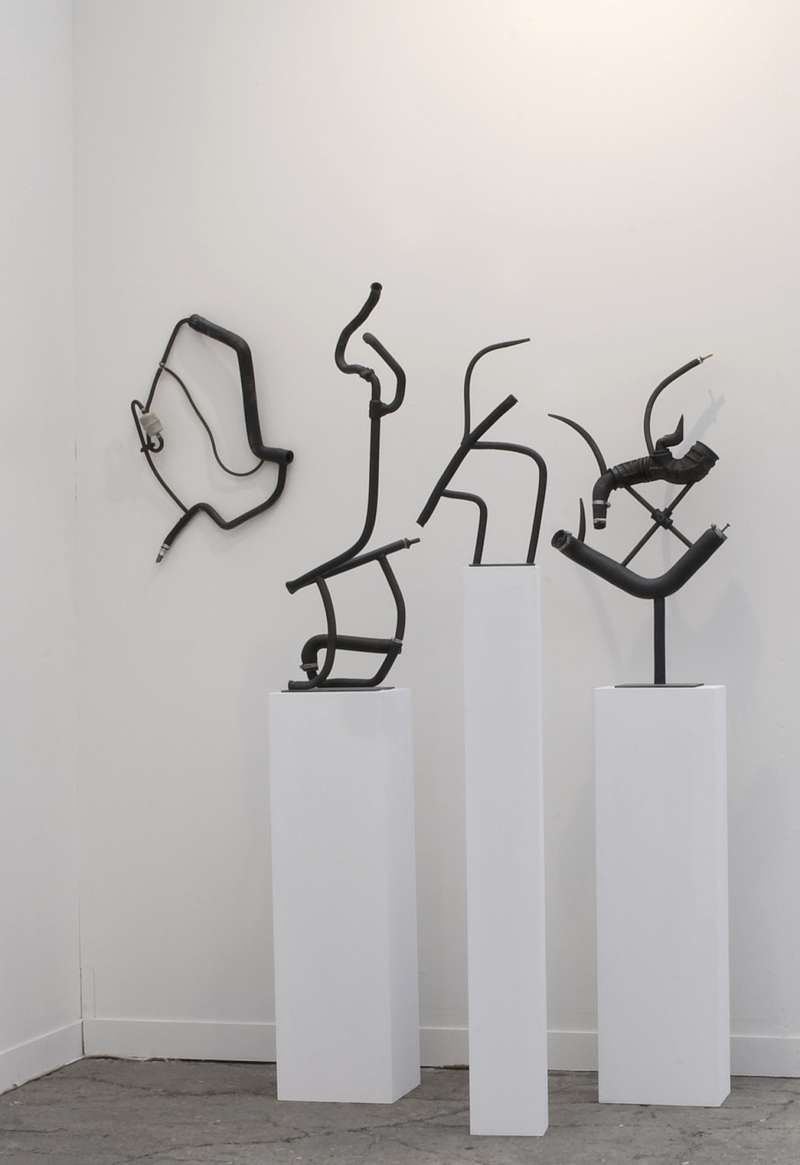
Best-known for her videos and animated films combining drawn art, music and occasionally scratched or reworked cinematic images, Camille Henrot’s work blurs the traditionally hierarchical categories of art history. Her recent work, adapted into the diverse media of sculpture, drawing, photography and, as always, film, considers the fascination with the “other” and “elsewhere” in terms of both geography and sexuality. This fascination is reflected in popular modern myths that have inspired her, such as King Kong and Frankenstein. The artist’s impure, hybrid objects cast doubt upon the linear and partitioned transcription of Western history and highlight its borrowings and grey areas. In the series of sculptures Endangered Species, for example, the artist has created objects inspired by African art by using pieces from car engines; placed on tall pedestals, these slender silhouettes with zoomorphic allure make reference to the migration of symbols and forms as well as to the economic circulation of objects. This survival of the past, full of misunderstandings, shifts and projections (as shown in the slideshow Egyptomania, the film Cynopolis, drawings of the Sphinx, and even in the photographs of prehistoric flints) troubles cultural codes and conventions. In this way, Camille Henrot’s work questions mental resistances and the past’s resonance, whether it be drawn from myth or from reality.