highlike

Grupo Labirintus – Micélio – Brazil

MICÉLIO

Grupo Labirintus


FILE SÃO PAULO 2026: Inter-creativity – Art and Technology – LED SHOW
Electronic Language International Festival


Micélio – Brazil

Inspired by the fungal networks described by Merlin Sheldrake, Micélio is an audiovisual investigation that reinterprets the city. The work converts urban photography into a “mycelial database” through computational processes, decomposing architectural rigidity. This system metabolizes raw information, culminating in a video art installation where the city transcends static concrete, revealing itself as a continuous flow of energy and regeneration.

BIO

Being the artistic arm of InterLab21_CCM (PUC-SP/CNPq), Labirintus Group articulates theoretical research and aesthetic experimentation under the coordination of Lucia Leão. Aligned with the UN SDGs, the collective creates affective cartographies, installations, and digital platforms that address the climate emergency and social inequalities. 

Glenn Branca

Lesson Nº 1 + The Ascension
Glenn Branca has always been a musician positioned halfway between the role of avant-garde composer and that of a rock musician. A pupil and disciple of the masters of American minimalism such as La Monte Young, Terry Riley, Philip Glass and Steve Reich, he has always had to fight against prejudice and fierce criticism. His position was certainly uncomfortable, too academic for rock fans and too “politically incorrect” for academics. In fact, Branca was trying to unhinge all the limits imposed by the rigid schemes of the avant-garde, aware of the fact that those who want to be truly avant-garde should have no limits. John Cage was also able to criticize him, even calling him a fascist ( Luciano Berio also did so for all minimalists) for the excessive rigidity of his compositions, even though he recognized his innovative power. After having created his best known album, The Ascension (1981), a true monument of maximalism played with a classical rock formation (guitars, bass and drums), he tries to approach a different format, the Symphony, as always halfway between rock and academia. Branca will like the experiment and will re-propose it several times in the following decades, to date there are sixteen symphonies (not all recordings are available). Here is how young Branca’s ensemble appeared to the American composer John Adams in one of his first live performances of the First Symphony: “Branca’s event that I listened to at the Japan Center Theater in San Francisco in 1981 was one of his symphonies for guitar . The group didn’t look very different from thousands of other independent or alternative rock bands of the time: guys in jeans and worn t-shirts busy with cables while maintaining that typical distracted expression of rock musicians.


Roman Vlasov

concept 47
Vlasov’s striking conceptual architecture hits upon contemporary’s most important design features: sharpness, elegance, simplicity, and sleekness. The juxtaposition between nature and the rigidity of a man-made structure accentuate the beauty of the construction. Aesthetically beautiful, Vlasov’s work is efficiently displayed from every angle.

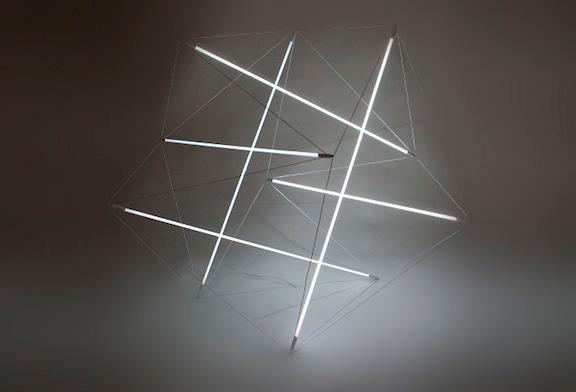
MICHAL MACIEJ BARTOSIK TENSEGRITY

lights

The tensegrity space frame light is comprised of a four strut lamp module whose geometry is the derivative of a cube. It affords a stable platonic structure with the ability to orthogonally tessellate in the x,y.z axes without change to its orientation to produce generic architectural elements such as: columns, roofs, walls and beams. Because tensegrity yields a system of structural correlation, moment force is eliminated and makes way for a high strength to weight ratio; as the system’s surface area increases, to a greater extent so too does its rigidity, allowing for generous spans and cantilevers. When arrayed, each consecutive module is pinned to the latter using its lamp connector to fasten to the mid point of an adjacent electrical tendon. The uniform array produces two distinct patterns of lamp and lattice. Where the lamps produce a luminous weave that at times resembles an orthogonal grid of offset lines, the lattice generates a sequential pattern of two distinct squares rotated at 45 degrees, one four times the size of the other.