highlike

Alex Pachón – Corpo Expandido – Spain

CORPO EXPANDIDO

Alex Pachón


FILE SÃO PAULO 2026: Inter-creativity – Art and Technology – LED SHOW
Electronic Language International Festival


Corpo Expandido – Spain

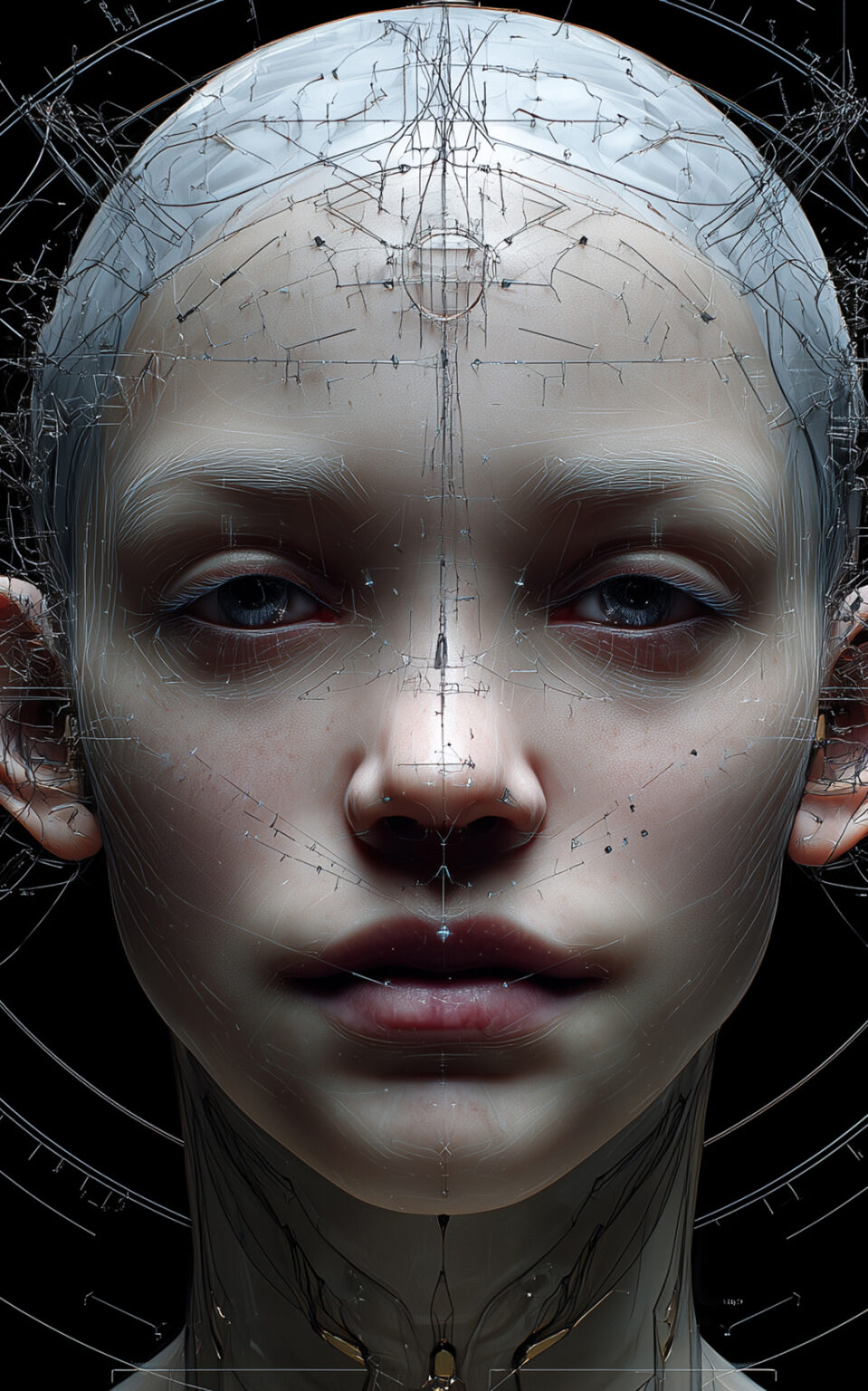
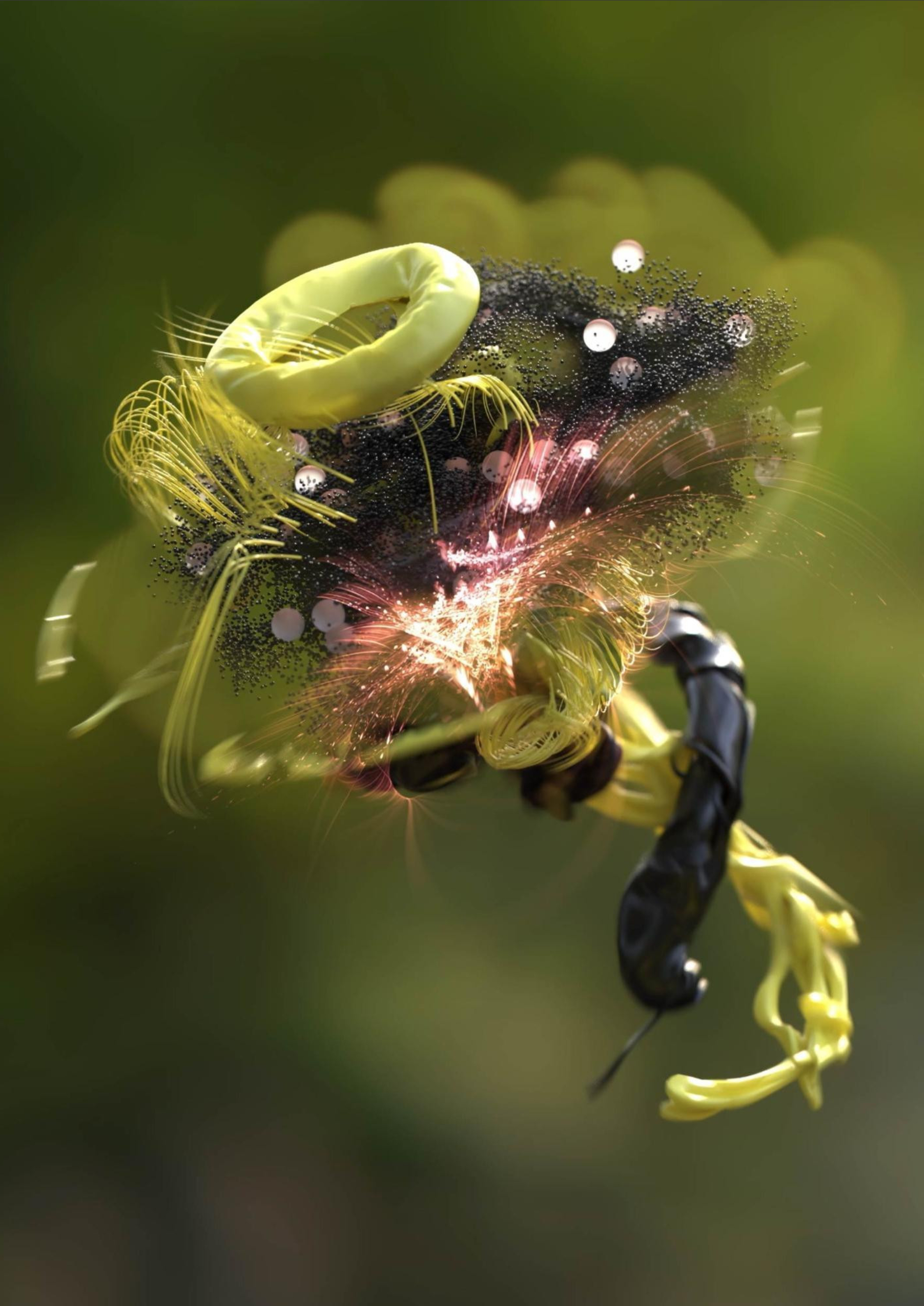
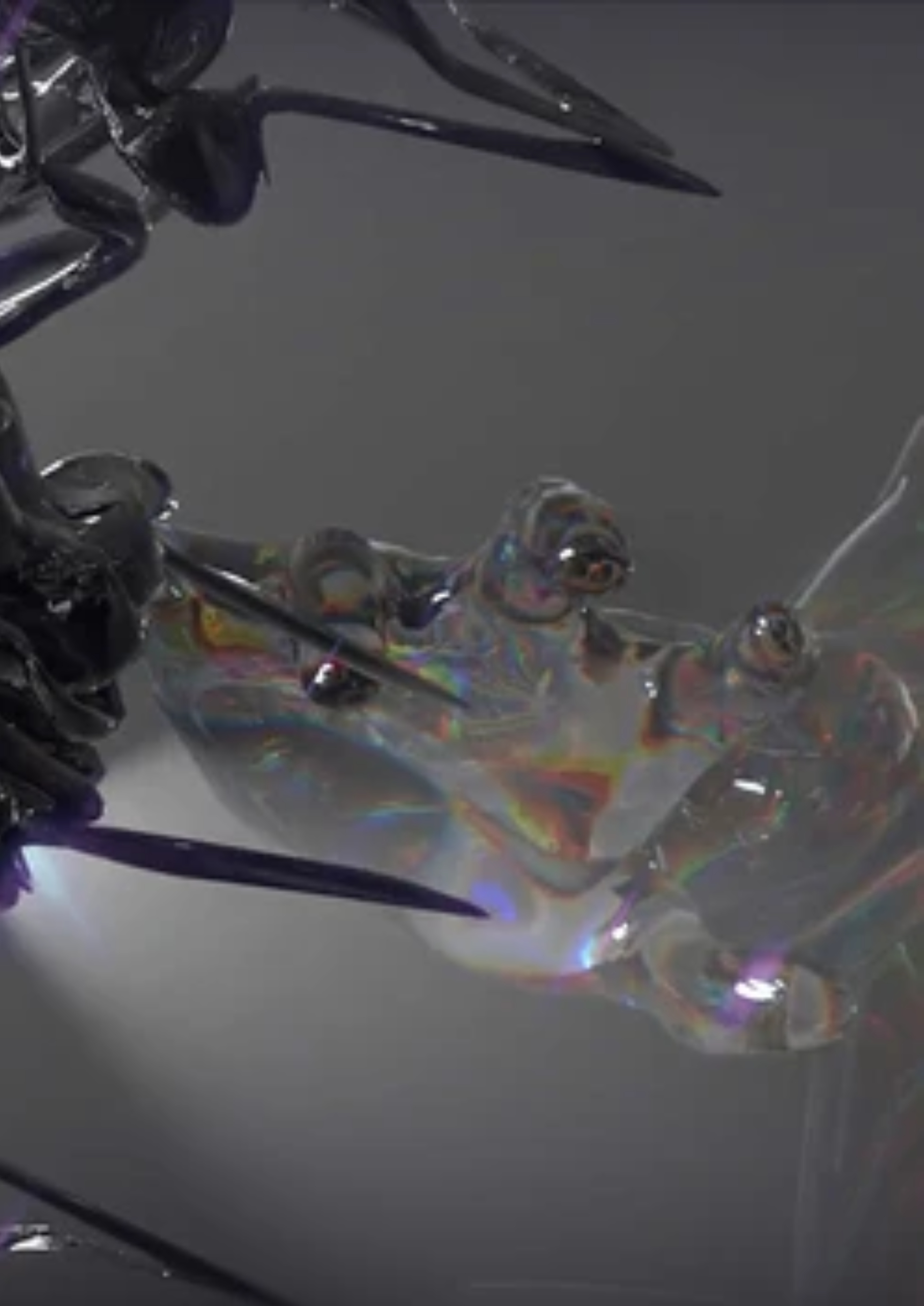
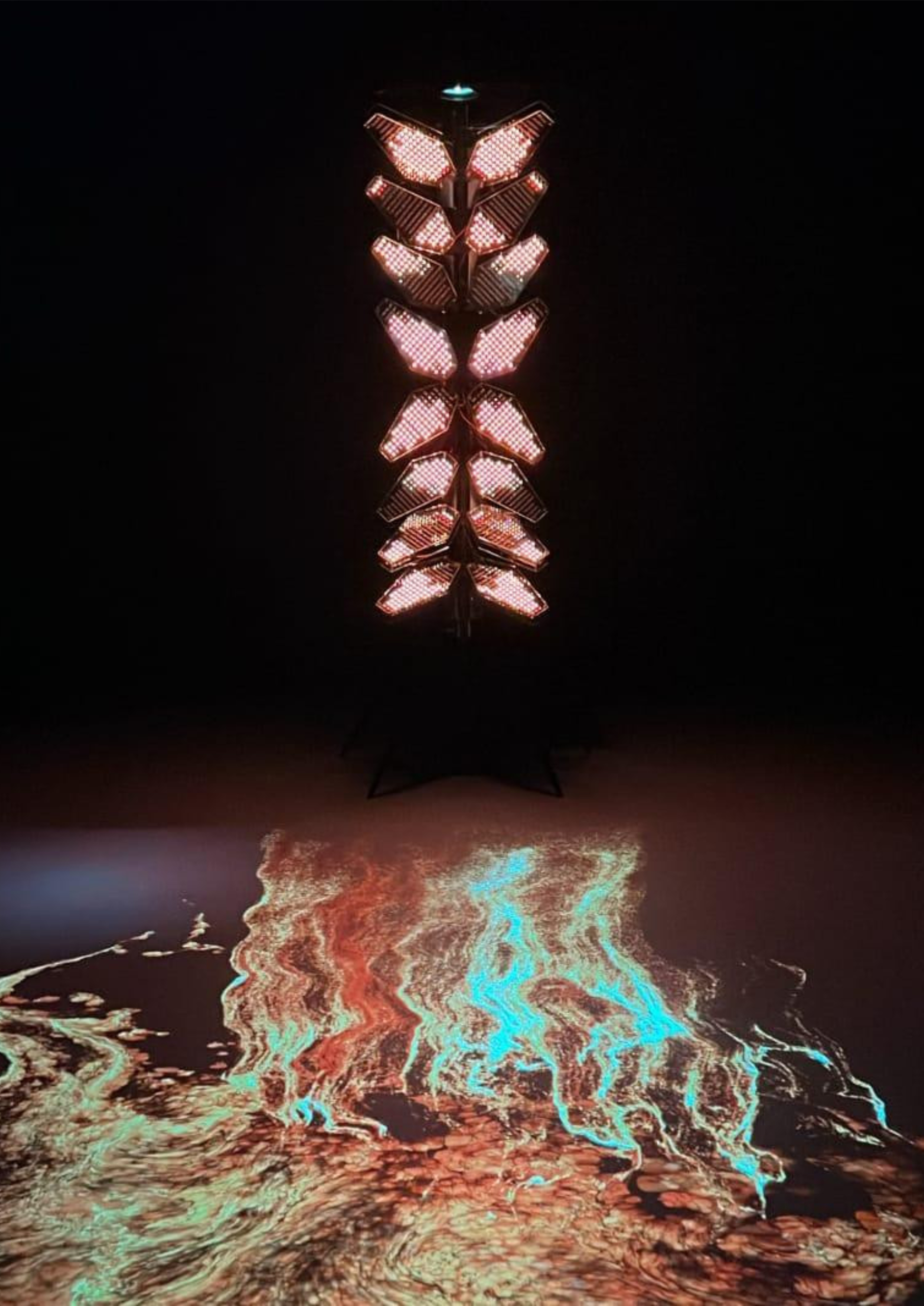
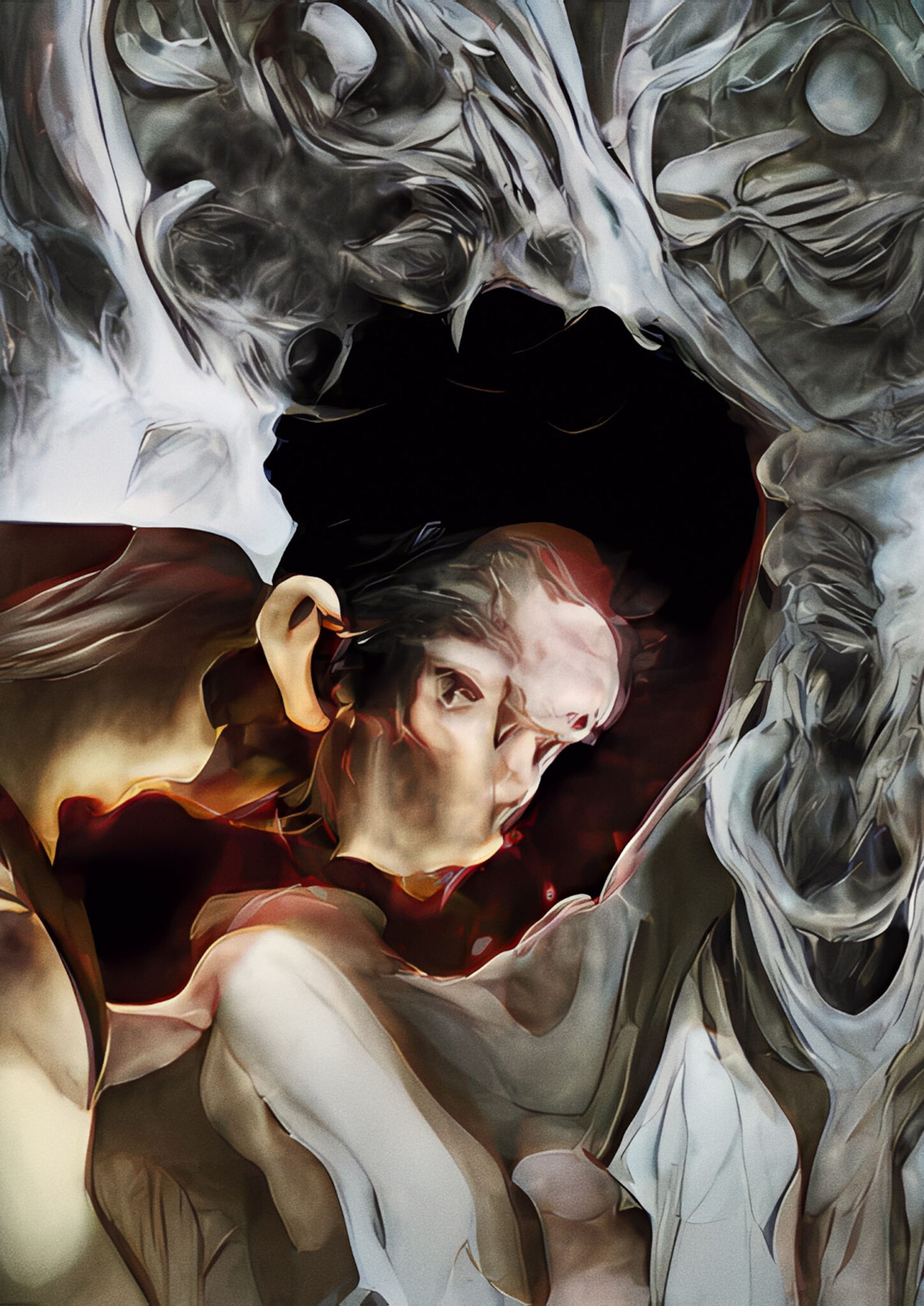
Corpo Expandido is the result of research on body and movement in public spaces and unconventional territories, on a large scale. The work questions whether what is seen is a human body or a creature linked to the subconscious and science fiction. After filming, glitch and datamosh techniques were explored. The theory of expanded bodies addresses projected virtual bodies, free in the time and space of technology, expanding choreographic possibilities and collective memory.

BIO

Alex Pachón works in creation, research and teaching, with work in visual effects and animation as a digital artist and art director at the on.graphics studio. He has presented works in 45 countries and more than 200 festivals. His research focuses on expanded cinema, the body-camera-territory relationship and the intersection between narrative, new media, technology and live arts.

Eylul Alıcı – The Black Hole – Turkey

THE BLACK HOLE

Eylul Alıcı


FILE SÃO PAULO 2026: Inter-creativity – Art and Technology – LED SHOW
Electronic Language International Festival


The Black Hole – Turkey

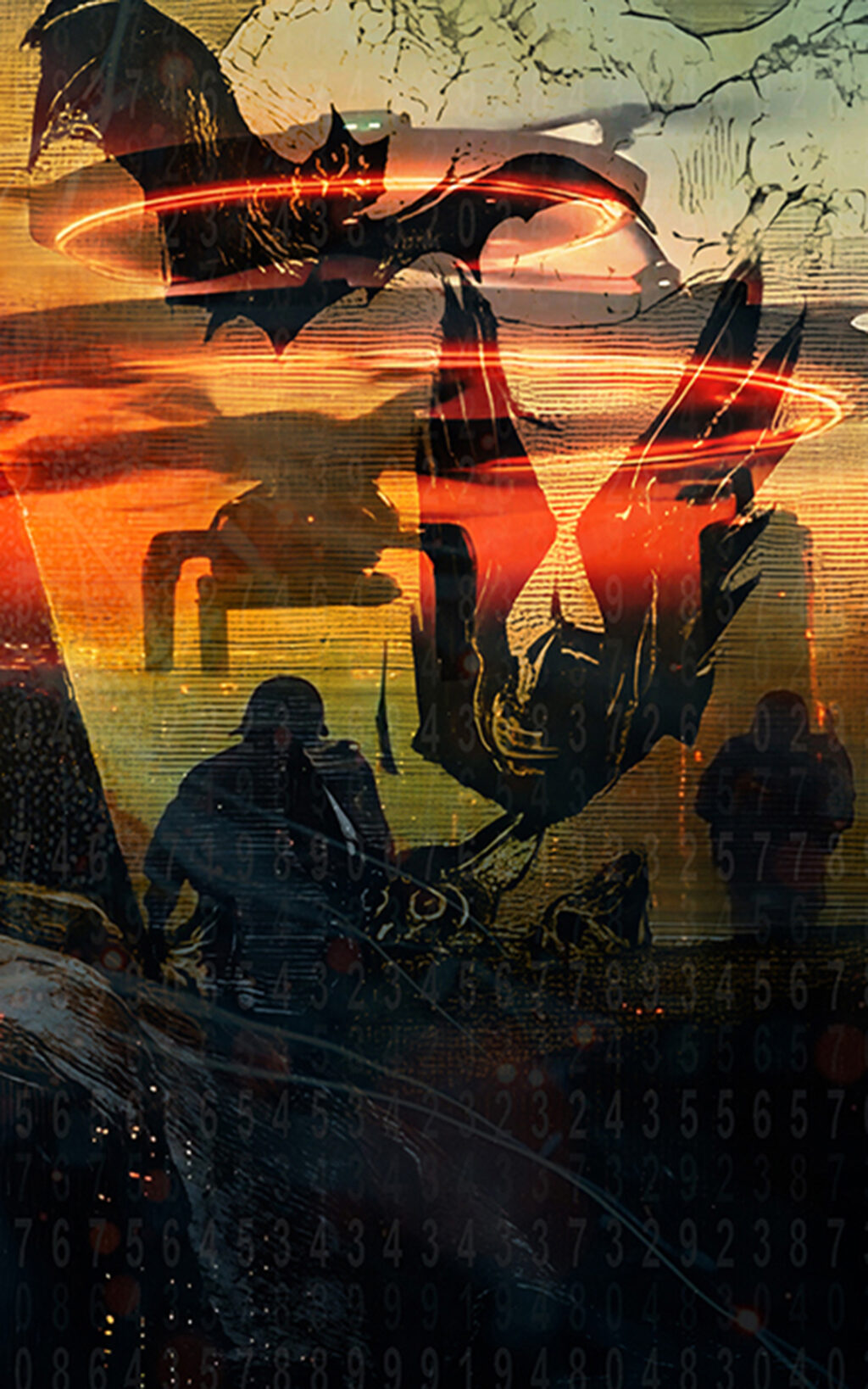
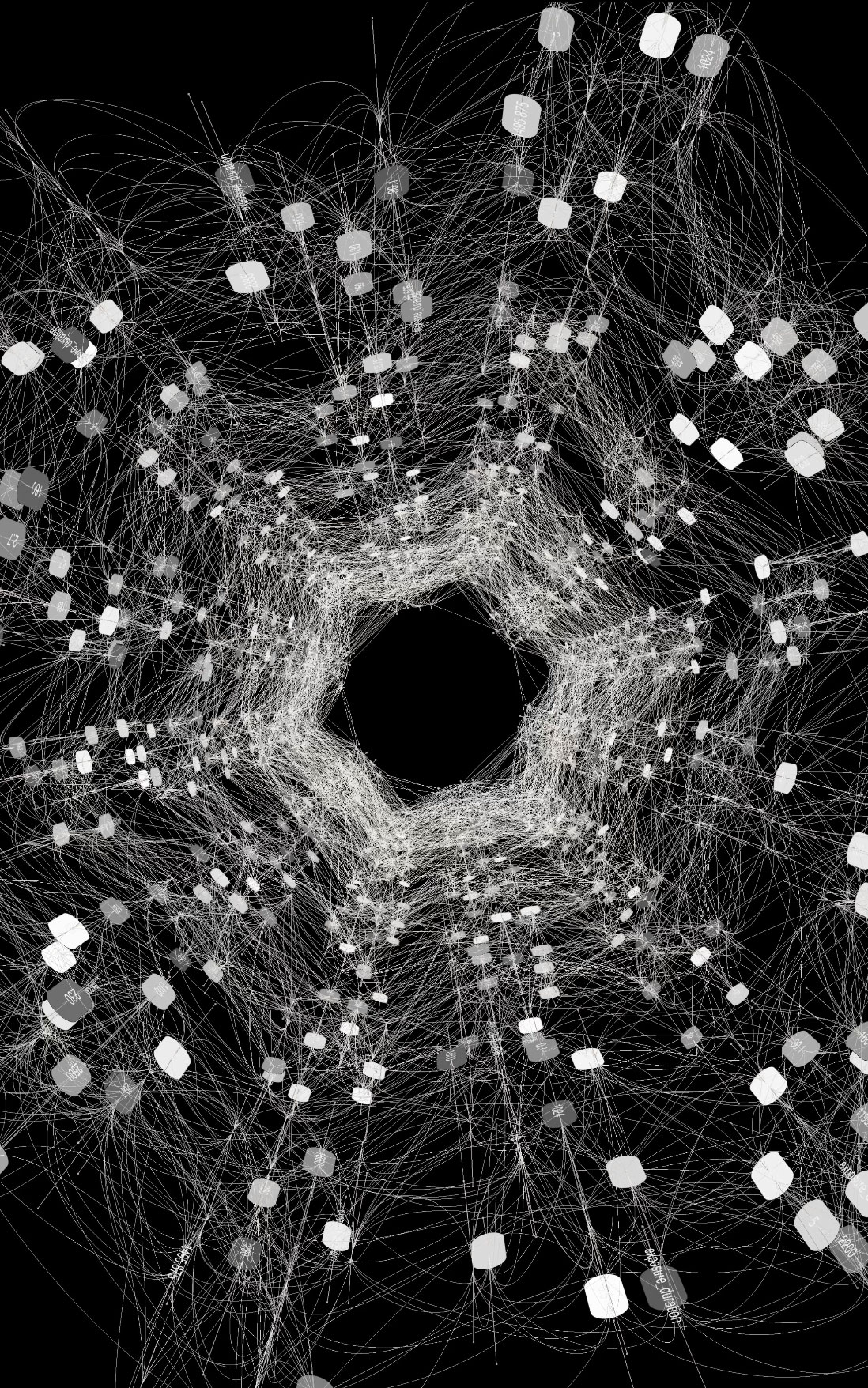
Black Hole is a data-driven artwork created using over 73,000 data points that represent the dynamics of black holes. These data include parameters such as black hole masses, locations, distances, spin rates, merger angles, and gravitational wave signals. 

The project’s data were sourced from institutions such as the NASA Hubble Legacy Archive, the European Gravitational Observatory, LIGO Hanford, LIGO Livingston, and Virgo, which are ground-based gravitational wave detectors.

BIO

With over fifteen years at the intersection of art and science, Eylul Duranagac Alıcı is an award-winning new media artist and creative director exploring AI, machine learning, and data-driven systems as creative agents. A faculty member at Yıldız Technical University, her internationally exhibited work spans institutions such as NASA, CERN, MoMA, and Ars Electronica.

Nueve Voltios – Farol Infinito – Colombia

FAROL INFINITO

Nueve Voltios


FILE SÃO PAULO 2026: Inter-creativity – Art and Technology – LED SHOW
Electronic Language International Festival


Farol Infinito – Colombia

FAROL INFINITO presents an immersive journey in which sound and visual art intertwine to bring to life a poetic and sensory work. Carefully crafted in every detail, its narrative takes the lighthouse as a device for communication and navigation and, from a mythological perspective, explores the infinite fire it contains, a symbol of science and technology, understood as humanity’s ability to harness the forces of nature for the development of civilizations.

BIO

Leonardo González Quevedo, born in 1977, is an architect with 18 years of experience as a video artist and VJ. His audiovisual practice has focused primarily on the creation, development, and design of visual, trans architectural, transmedia, and stage-based languages, implemented in large-scale events, art exhibitions, and television. | Maria José Marulanda, born in 1987, is a singer, industrial designer, and composer with 15 years of experience as a sound artist and producer. Her sonic practice focuses primarily on the creation, development, and design of electronic, transmedia, and stage-based sound languages, presented in large-scale events, concerts, and television broadcasts.

Timothy Weaver & Xavier Barriga-Abril – contrapuntoEnteógeno – Ecuador / United States

CONTRAPUNTOENTEÓGENO

Timothy Weaver & Xavier Barriga-Abril


FILE SÃO PAULO 2026: Inter-creativity – Art and Technology – MUSIC
Electronic Language International Festival


contrapuntoEnteógeno – Ecuador / United States

contrapuntoEnteógeno is an entheogenic plant biosonification composed in counterpoint from North & South American ecosystems. Brugmansia arborea (Andean cloud forest) and Datura innoxia (New Mexican desert) generate bioimpedances and scopolamine entheogens under celestial influences. In situ, Eurorack analog synthesis transmediates bioelectrical plant signals into ecogenerated electroacoustic sound, negotiating agencies between human and beyond-human/plant expression.

BIO

Timothy Weaver is a biomedia artist, microbiologist and bioenvironmental engineer focused on restoring ecological memory through speculative inquiry at the art-science interface. He is Professor Emeritus of Emergent Digital Practices at the University of Denver.
Xavier Barriga Abril is an Equatorian designer/artist/researcher exploring posthuman interactive systems through creative coding and electronic fabrication.


IN MEMORIAM

Tribute to Timothy Wayne Weaver: A Life Dedicated to Art, Science, and Knowledge

FILE—Electronic Language International Festival—honors the legacy of Timothy Wayne Weaver, artist, researcher, and professor whose career fostered a meaningful dialogue between art, science, and technology, inspiring artists, researchers, and audiences alike. 

Throughout his career, Timothy developed an interdisciplinary practice that brought together art, science, and environmental responsibility. His work explored the complex relationships between human beings, nature, and technology, guided by experimentation, rigorous research, and a deep commitment to the creation and dissemination of knowledge.

FILE is grateful for Timothy’s intellectual generosity, enduring curiosity, and dedication to building new dialogues across disciplines, contributions he also shared with our audiences and our community. His work and legacy will continue to resonate in the memory of the festival and in the lives of all those touched by his practice.

Ryan S. Jeffery – An Engineer / Not a Camera – United States

AN ENGINEER / NOT A CAMERA

Ryan S. Jeffery


FILE SÃO PAULO 2026: Inter-creativity – Art and Technology – VIDEO ART SHORT
Electronic Language International Festival


An Engineer / Not a Camera – United States

The production of a computer chip is the most complex technical human achievement to date. Photolithography, a critical step in this process, relies directly on the older science of optics and photography, which are centuries old. Today, generative AI and computer-generated imagery are nearly indistinguishable from those made with a camera. Once a method for capturing an image of the world, the science of optics is now used to build machines that can make images of the world without seeing it.

BIO

Ryan S. Jeffery’s work with the moving image sits at the intersection between documentary, art, and media studies. Grounded in an analysis of aesthetics and politics, his work considers how technology, ideology, and political economy shape one another. His work has appeared in FIDMarseille, Transmediale, EMAF, and UNCCC, as well as The New York Times, e-flux, and Filmmaker Magazine.

Michael Lyons – Circles and Squares – United Kingdom/Japan

CIRCLES AND SQUARES

Michael Lyons


FILE SÃO PAULO 2026: Inter-creativity – Art and Technology – VIDEO ART SHORT
Electronic Language International Festival


Circles and Squares – United Kingdom/Japan

Circles & Squares is an audiovisual work structured around the interaction of geometric motion and sound. Circular forms intersect and recede in continuously shifting configurations, generating patterns of (a)symmetry, interference, and temporal tension. The animation operates as a visual score, organizing the square-wave tones of the soundtrack through evolving spatial relations. Free of narrative or representation, the work foregrounds rhythm, recurrence, and perceptual transformation.

BIO

Michael Lyons (UK, Canada) is an artist and researcher based in Kyoto, Japan. He is currently Professor of Image Arts and Sciences at Ritsumeikan University.

Lilia Chak – Copy. Repeat. Disappear. – Israel

COPY. REPEAT. DISAPPEAR.

Lilia Chak


FILE SÃO PAULO 2026: Inter-creativity – Art and Technology – VIDEO ART SHORT
Electronic Language International Festival


Copy. Repeat. Disappear. – Israel

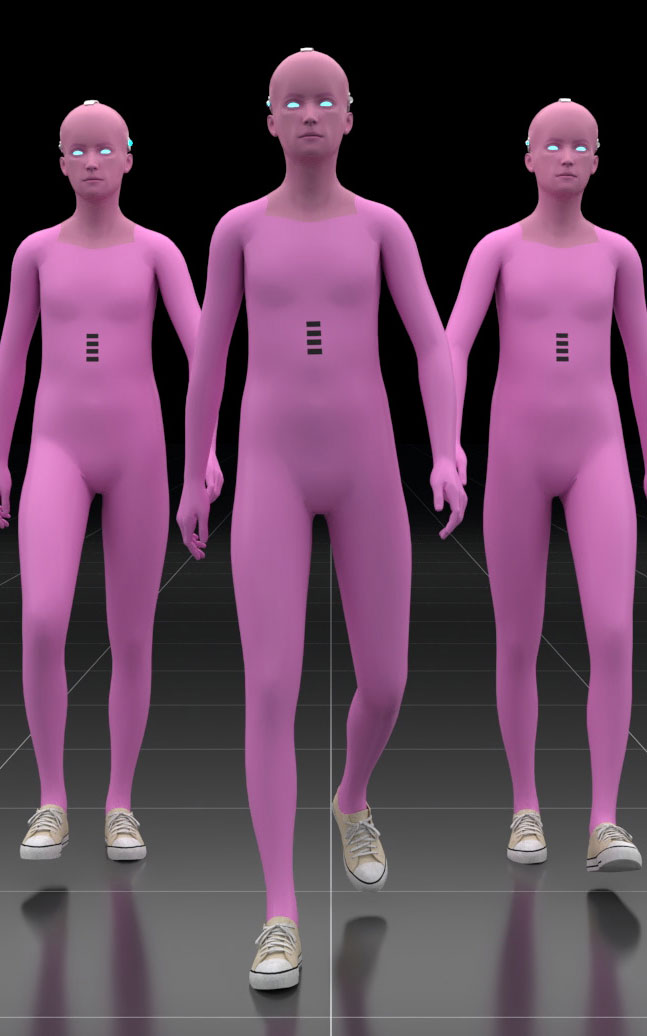
Copy. Repeat. Disappear. explores the dissolution of identity in the age of AI. Seven digital avatars recite an AI-generated poem; voices are intentionally aligned and misaligned to expose the tension between human embodiment and machine indifference. Through repetition and transformation, presence dissolves into data, questioning authenticity, intimacy, and memory within algorithmic systems.

BIO

Lilia Chak is an Israeli artist, designer, and art-science researcher based in Jerusalem. Her practice spans AI art, Bio-art, video, photography, and installation. She holds a PhD from Sorbonne University and is a postdoctoral fellow at Bar-Ilan University. Her work has been shown internationally, including at Ars Electronica and BOZAR.

Galina Bleikh – The Sleep of Reason Produces Monsters – Israel

THE SLEEP OF REASON PRODUCES MONSTERS

Galina Bleikh


FILE SÃO PAULO 2026: Inter-creativity – Art and Technology – VIDEO ART SHORT
Electronic Language International Festival


The Sleep of Reason Produces Monsters – Israel

Inverting Goya’s warning, AI Ballet asks: if reason’s sleep produces monsters, what emerges from AI’s eternal wakefulness? The installation explores algorithmic mind control through surveillance and behavioral prediction. Empty halls with silent pianos symbolize obsolete human creativity, while text evolving from “AI” to “GOD” reveals algorithms’ quasi-religious authority. Using AI-generated choreography, the work questions who controls our consciousness and whether autonomy survives.

BIO

Galina Bleikh is a multidisciplinary artist at the intersection of art, technology, and science. She holds an MA from Stieglitz Academy, St. Petersburg, and has been based in Jerusalem since 1993. Her practice spans AI, generative, bio, and digital art. Bleikh exhibits internationally at venues including CICA Museum (South Korea), NordArt (Germany), Haifa Museum of Art, Art Asia Miami, etc.

Jaspreet Singh – Aethrimus – India

AETHRIMUS

Jaspreet Singh


FILE SÃO PAULO 2026: Inter-creativity – Art and Technology – CINEFILE | Short
Electronic Language International Festival


Aethrimus – India

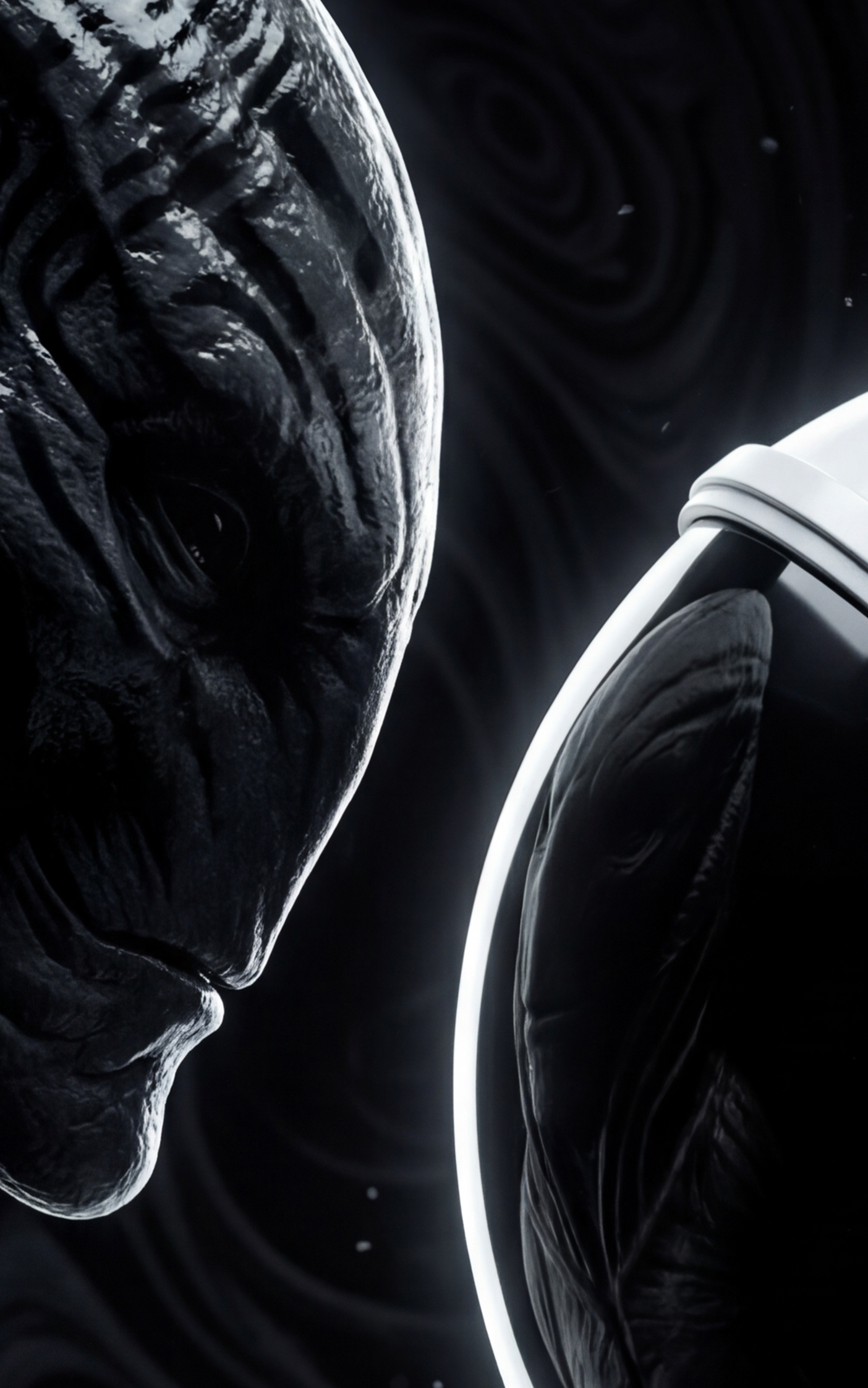
A mysterious object known as 3I Atlas, expected to pass harmlessly through space, suddenly changes course and impacts the Moon, destroying a U.S. satellite in the process. The unexplained event triggers global alarm. A rapid-response mission is launched to investigate the anomaly before it threatens Earth. When the team reaches the Moon, they uncover a shocking truth: the object is not a comet, but an alien spacecraft hidden beneath the lunar surface.

BIO

Jaspreet Singh is an independent filmmaker from India with a strong passion for science fiction, mystery, and experimental storytelling. His work explores themes of the unknown, technology, and human perception, blending cinematic visuals with emerging digital and AI-assisted filmmaking tools. Jaspreet creates atmosphere-driven narratives that challenge traditional storytelling and invite audiences to question reality, intelligence, and existence.

John Butler – The Magic Robot – England

THE MAGIC ROBOT

John Butler


FILE SÃO PAULO 2026: Inter-creativity – Art and Technology – Full-length
Electronic Language International Festival


The Magic Robot – England

A tale of technological unemployment, only this time it’s the robots who are losing their jobs.

Loosely based on Upton Sinclair’s ‘The Jungle’, the Magic Robot traverses the worlds of bonded labour, industrial espionage, fine art and spirituality in his search for ‘Self‘. The Magic Robot is a work of Bureaucratic Science Fiction, confirming that we are living in a spreadsheet, not a simulation.

BIO

Studied Drawing & Painting and Electronic Imaging at Duncan of Jordanstone College of art, Dundee.

Lives and works in Glasgow as 3D animator. His personal work makes extensive use of CGI, motion capture, and, lately, ‘Interrogative Fashion’.

Has exhibited and screened media art work extensively in the UK and abroad, and has produced work for broadcast in UK for BBC2 and Channel 4.

Karl Sims – Seven Experiments in Procedural Animation – United States

SEVEN EXPERIMENTS IN PROCEDURAL ANIMATION

Karl Sims


FILE SÃO PAULO 2026: Inter-creativity – Art and Technology – Randomic Dimension
Electronic Language International Festival


Seven Experiments in Procedural Animation – United States

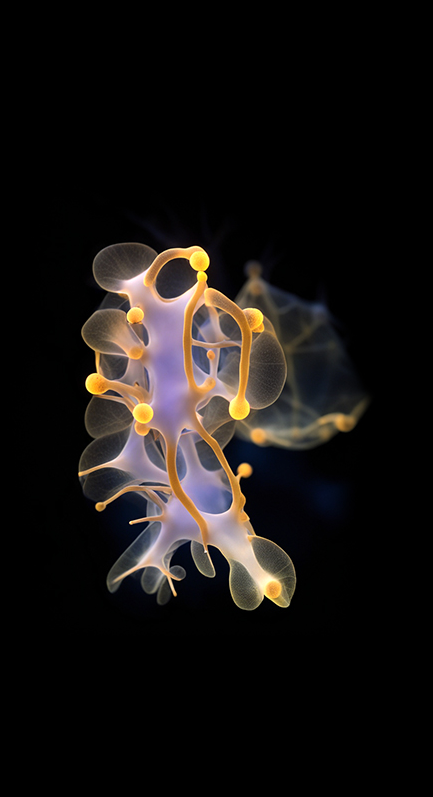
Animated textures and patterns created from custom computer code employing various fractal algorithms, procedural noise, and reaction-diffusion techniques. The moving images are purely defined by mathematics, but are meant to evoke a biological aesthetic by resembling sea creatures, neurons, or other microscopic structures that transform from one emergent pattern to another.

BIO

Digital media artist and visual effects software developer. He founded GenArts Inc., which created special effects software tools for the motion picture industry. Karl studied computer graphics at the MIT Media Lab, and Life Sciences as an undergraduate at MIT. He is the recipient of various awards including two Ars Electronica Golden Nicas, a MacArthur Genius Grant, and an Emmy Award.

Non-Linear – Transmissions into the Void – India

TRANSMISSIONS INTO THE VOID

Non-Linear


FILE SÃO PAULO 2026: Inter-creativity – Art and Technology – Installations
Electronic Language International Festival


Transmissions into the Void – India

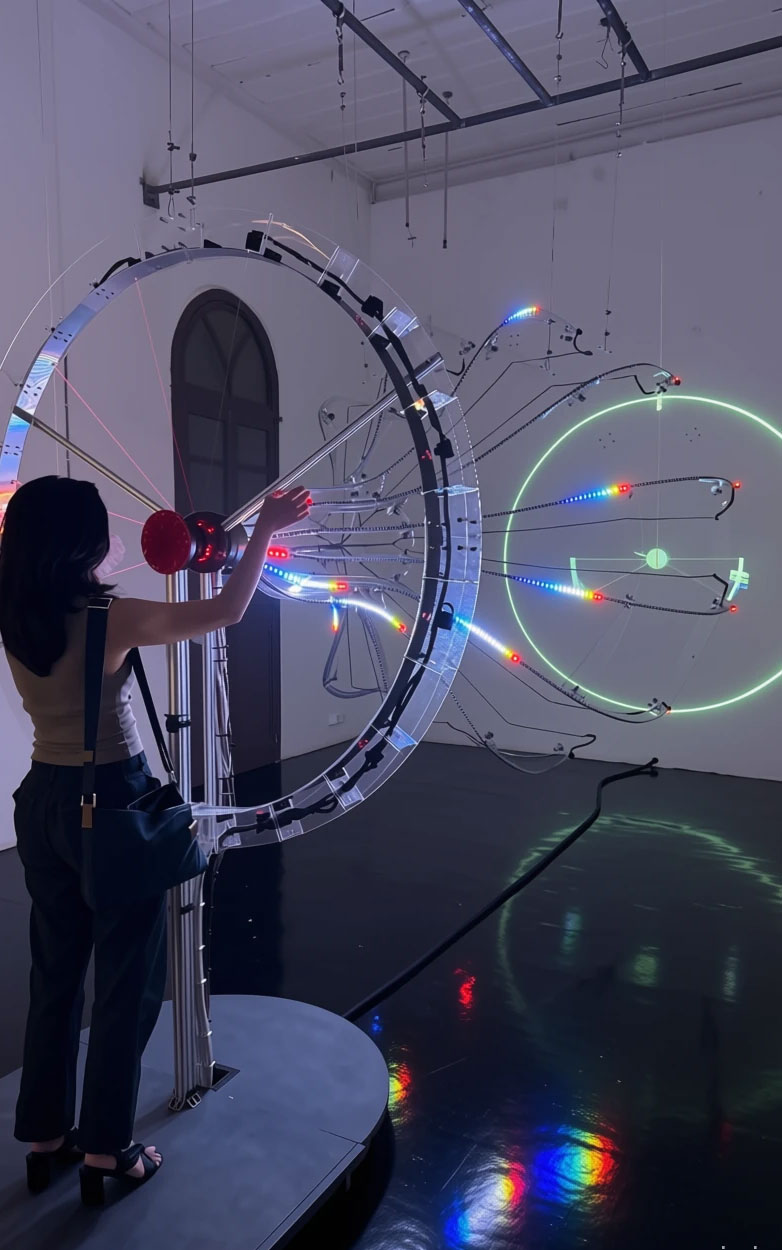
Transmissions into the Void explores the temporal nature of improvisation and the inevitable decay of information, transforming the space into an immersive sound and light machine. Influenced by science fiction and the modular design principles of modern engineering, the room becomes a dynamic interface between viewer and technology. Ultimately, the piece serves as a meditation on the temporal fragility of all information and data—whether biological, digital, or analog—and how time irreversibly erodes it.

BIO
Non-Linear is the creative project of Dennis Peter, an interaction designer and artist redefining the intersection of technology, nature, and creative expression. With a background in architecture and an ever-evolving curiosity, his work spans kinetic installations, generative art, and algorithmic music. From hacking old calculators as a child to crafting immersive, interactive experiences, Dennis continuously expands the boundaries of digital creativity.

LENOX-LENOX

impossible objects

TMRRW


TMRRW(dot)net combines predictable and unpredictable change in order to form a cubic time capsule of tomorrow’s relics. Predictions arise by mapping the course of natural disasters and desiccated resources, and non-predictions are postulated from science fiction and myth. The resulting guided tour of The Last Gallery presents attributes of artifactual design and nostalgia: we will remember impact events and Y2K12 hysteria; thirst, wetness, and all things glossy; sitting, leisurely commodities, and decoration. This piece intends to simulate future documentation of the past, while simultaneously proposing precursory relics.

INGRESS (GLOBAL AUGMENTED REALITY GAME)

Ingress uses the mobile device GPS to locate and interact with “portals” that are in proximity to the player’s real-world location. The portals are physical points of interest where “human creativity and ingenuity is expressed,” often manifesting as public art such as statues and monuments, unique architecture, outdoor murals, historic buildings, local community hubs and other displays of human achievement. The game uses the portals as elements of a science fiction backstory along with a continuous open narrative provided through various forms of media.

STROOK

Metropolis


Metropolis is a 1927 German expressionist science-fiction film directed by Fritz Lang. Set in the year 2026, Metropolis takes place in a dystopian society where wealthy industrialists rule from vast tower complexes, oppressing the workers who live in the depths below them.

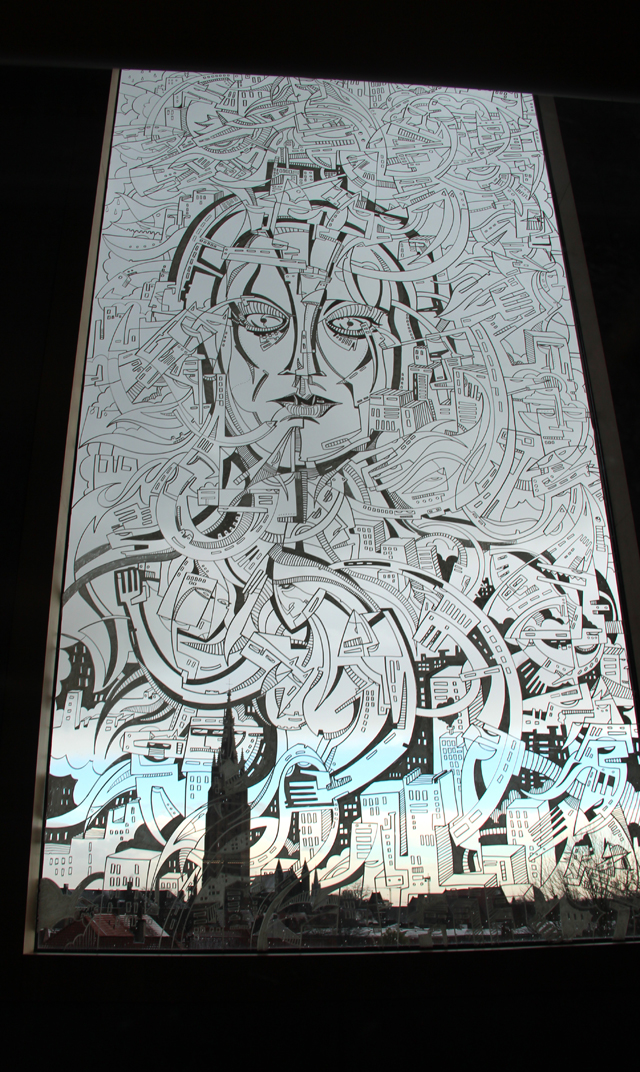
The drawing is placed on the largest window of the ‘Concertgebouw’ (Concert building) in Bruges with the perfect backdrop of the city. There are many different perspectives to the work wich has the effect of a changing picture throughout the day.

ADAM W. BROWN

Great Work of the Metal Lover

Magnum Opus, or The Great Work, is an Alchemical process that describes a personal, spiritual and chemical method for creating the Philosopher’s Stone, a mysterious red colored substance that was capable of transmuting base matter into the noble metal of gold. Discovering the principals of the Philosopher’s Stone was one of the defining and at the same time seemingly unobtainable objectives of Western Alchemy. The Great Work of the Metal Lover is an artwork that sits at the intersection of art, science and alchemy, re-examining the problem of transmutation through the use of modern microbiological practice and thus solving the ancient riddle.

SIDI LARBI CHERKAOUI

سيدي العربي الشرقاوي
西迪·拉比·切考维
Сиди Ларби Шеркауи
TeZukA


Het is een eer, een genoegen en een zegen om zijn wereld met die van mij te laten samenvloeien.” Dat zegt choreograaf Sidi Larbi Cherkaoui over Osamu Tezuka. Het universum van deze visionaire Japanse striptekenaar – een fascinerende mix van traditie, sciencefiction en hedendaagse werkelijkheid – vormt het materiaal voor Cherkaoui’s nieuwe dansvoorstelling. Met ‘TeZukA’ keert de choreograaf terug naar zijn eerste liefde, de tekenkunst. Maar de meester van de manga (Japanse striptekening) beïnvloedde de choreograaf op meer dan louter vormelijk vlak. Opgegroeid in het naoorlogse Japan behandelde Osamu Tezuka universele thema’s zonder enig taboe. Hij droeg mensenrechten, ethiek en tolerantie hoog in het vaandel. In ‘TeZukA’ maakt Sidi Larbi Cherkaoui het artistieke proces fysiek zichtbaar: hij zet zowel zijn dansers als kalligrafen in om het tekenproces op de scène te beschrijven. Van een leeg blad over één enkele Japanse kanji (letter) tot een volledig uitgewerkt mangapersonage. ‘TeZukA’ brengt hulde aan de tekeningen en de humaniteit in het werk van de ‘god van de manga’.

CHRISTOPHE LUXEREAU

Ombre


Après des études d’art classique en peinture (école des Beaux-Arts) et en architecture (génie civil), Christophe Luxereau se consacre à la photographie à partir de 1986. Il travaille l’image numérique dès 1995 pour développer le thème de la relation à la machine électronique.

Cette relation établit de nouveaux codes, d’autres comportements et de nouvelles icônes. Le photographe est un cinéphile, famillier de la cyberculture et des maîtres de science-fiction, base de son univers visuel. Le monde, la mode, qu’il côtoie de façon professionnelle lui inspire des hybridations entre design et haute-couture.

Son travail porte ainsi une réflexion sur l’idée de la beauté artificielle véhiculée par la publicité cosmétique et de luxe. La pratique du graphisme 2D et 3D accentue la réalité virtuelle de ses créations. Toujours en prospection, chaque série est une étape, une expérience technique et esthétique.

Chacune de ses expositions donne lieu à une mise en espace des oeuvres pour immerger le spectateur au coeur de ses visions. Ainsi il créé mobilier, ambiances sonores et lumineuses sous forme de sho-room pour société robotique ou chapelle dédiée au culte de ses madones.

FILE SÃO PAULO 2025: SYNTHETIKA – Andy Thomas

Visual Bird Sounds

Andy Thomas

FILE SÃO PAULO 2025: SYNTHETIKA – Art and Technology – INTERATOR

Electronic Language International Festival

Visual Bird Sounds – Australia

Visual Bird Sounds transforms bird songs and sounds into computer-generated 3D visualizations. The recordings are converted into animated figures that resemble living digital organisms—like virtual representations of the birds themselves. The work invites the audience to reflect on the beauty of nature and the urgency of preserving its habitats.


BIO

Thomas is an artist specializing in the creation of “sonic lifeforms” and creative sound visualization. He collects recordings and images of birds and other animals on expeditions to remote regions, transforming these data into videos and digital works. His work unites science and art by fusing elements of flora and fauna into abstract visual compositions.

FILE SÃO PAULO 2025: SYNTHETIKA – Clarissa Ribeiro

Afterlives-Chimeras: Wetland Carbonized Memories

Clarissa Ribeiro

FILE SÃO PAULO 2025: SYNTHETIKA – Art and Technology – WORKSHOP
Electronic Language International Festival


Afterlives-Chimeras: Wetland Carbonized Memories – Brazil

Afterlives-Chimeras: Wetland Carbonized Memories reimagines ancient Egyptian animal mummification through the lens of ecological tragedy. Inspired by Brazilian swamps and the destruction of wildlife caused by agribusiness, mining, and the steel industry, the project uses AI (Krea.AI and Meshy.AI) to create hybrid creatures from images of charred animals. The chimeras, 3D printed with PLA, reminiscent of mummified linen, symbolize loss, transformation, and the urgency of ecological balance.

BIO

Clarissa Ribeiro is an Assistant Professor of Visual Arts at USP and former Director of Roy Ascott’s Technoetic Arts Studio in Shanghai. A PhD holder with a Fulbright postdoctoral degree, she intersects art, science, and technology in morphogenetic practices, adopting animism as a way to navigate ecologies as cosmologies.

FILE SÃO PAULO 2025: SYNTHETIKA – CNDSD & Iván Abreu

AUTOCONSTRUCCION

CNDSD & Iván Abreu

FILE SÃO PAULO 2025: SYNTHETIKA – Art and Technology – CGI VIDEOS
Electronic Language International Festival


AUTOCONSTRUCCION – Mexico

AUTOCONSTRUCCIÓN is a live-coded audiovisual concert and a video game animation performed by real-time algorithms. Through speculative architectural fictions, it narrates the phenomenon of informal housing in places like Mexico, Latin America, Asia, India, and the outskirts of Europe and the U.S. The artists are interested in live coding as a fluid, granular way to craft audiovisual storytelling.

BIO

Iván Abreu is a Mexican-Cuban interdisciplinary artist who blends science, design, and technology to question human interaction and social systems. A Lumen Prize winner, his work has been shown at ZKM, Ars Electronica, and MAB. Malitzin Cortés (CNDSD) is a Mexican artist exploring sound, technology, and speculative architecture through live coding, audiovisuals, and critical narrative.

FILE SÃO PAULO 2025: SYNTHETIKA – Jiatong Yao

ChromaPause

Jiatong Yao

FILE SÃO PAULO 2025: SYNTHETIKA – Art and Technology – CGI VIDEOS
Electronic Language International Festival


ChromaPause – China

ChromaPause is an experimental film that explores the relationship between urban life, posthuman identity, and the yearning for nature in a digitalized world. Futuristic flowers bloom in a surreal mesh, symbolizing the balance between the organic and the synthetic. Posthuman figures merge with the technological landscape, embodying the convergence of humanity and technology. The work invites pause and reflection in this pulsating universe.

BIO

Jiatong Yao connects art, technology, and culture, exploring XR, 3D, AI, and interactive computing. He reflects on the transformation of the modern self through technology, creating immersive experiences that intertwine humanity and the digital age. With a background in computer science and technical art, he develops innovative projects on the impacts of information on society. 

FILE SÃO PAULO 2025: SYNTHETIKA – Hsujing

XENO: UNDERTOW

Hsujing

FILE SÃO PAULO 2025: SYNTHETIKA – Arte e Tecnologia – Videoart
Festival Internacional de Linguagem Eletrônica


XENO: UNDERTOW – China / England

XENO: UNDERTOW is an experimental short film that employs stream-of-consciousness narration and AI-generated surreal visual art to explore the identity struggles and inner turmoil of cross-cultural migrants in mainstream society. Through metaphor, the film depicts a whale forcibly displaced from the boundless azure sea, cast into a desert of shifting sands. This imagery symbolizes the challenges cultural migrants face in adapting to dominant cultures and the profound sense of identity loss.

BIO

Hsujing is a contemporary artist and digital artist & director. His primary research focuses on the integration of technology and art, as well as speculative creative outputs. He is skilled in combining diverse techniques for artistic creation. His works blend elements of classicism with science fiction, not only envisioning future landscapes but also revealing persistent realities.

FILE SÃO PAULO 2025: SYNTHETIKA – Cornelis Clement

AI Created a Sci-Fi World You Won’t Believe!

Cornelis Clement

FILE SÃO PAULO 2025: SYNTHETIKA – Art and Technology – Shorts Films AI
Electronic Language International Festival

AI Created a Sci-Fi World You Won’t Believe! – Germany

AI Created a Sci-Fi World You Won’t Believe! is a science fiction universe generated by artificial intelligence. Custom-created images for this world were brought to life with motion and an original soundtrack, resulting in an immersive experience. The work invites the audi ence to explore breathtaking alien landscapes, futuristic cities, and cosmic phenomena reminiscent of Dune and No Man’s Sky. This AI-generated video transports viewers into a realm of visual marvels and hypnotic atmospheres.

BIO

Cornelis is a Berlin-based artist specializing in AI-generated art. He views technology as the dawn of a new era in artistic creation and seeks to be an active part of this movement. His work aims to push creative boundaries, offering audiences new ways to experience imagined worlds.

FILE SÃO PAULO 2025: SYNTHETIKA – PintoCreation

Epic Alien Landscapes

PintoCreation

FILE SÃO PAULO 2025: SYNTHETIKA – Arte e Tecnologia
Festival Internacional de Linguagem Eletrônica


Epic Alien Landscapes – Italy

Embark on a cinematic voyage across otherworldly landscapes. Created with Mi djourney V6.1, animated through Hailuo AI, and set to an original Suno AI v4 soundtrack, this video brings to life vast alien worlds, futuristic civi lizations, and breathtaking digital vistas.

BIO

Since childhood, Luigi Novellino (aka PintoCreation) dreamed of distant galaxies and cities floating in the sky. Now, thanks to artificial intelligence, these dreams come to life. PintoCreation creates images that tell stories of hidden worlds, born from his passion for science fiction and his desire to share them with everyone.

FILE SÃO PAULO 2025: SYNTHETIKA – CNDSD & Iván Abreu

Pre(N)atura | Fonocene

CNDSD & Iván Abreu

FILE SÃO PAULO 2025: SYNTHETIKA – Art and Technology – Shorts Films AI
Electronic Language International Festival


Pre(N)atura | Fonocene – Mexico

Speculative audiovisual project inspired by postnatural studies, designed to explore the era of the Fonocene—a period where both human and non-human sounds define sensory experiences and interspecies interactions. In this narrative, Chthulucene beings, hybrid creatures, emerge to challenge traditional forms of communication, using listening as a tool to activate our awareness of interdependence. 

BIO

Iván Abreu is a Mexican-Cuban interdisciplinary artist who uses science, design and technology to create works that question human interaction and social systems. Malitzin Cortés, (CNDSD), is a Mexican artist who explores the intersection of sound, technology and speculative architecture. Her work combines live coding, audiovisuals and critical narratives. 

FILE SÃO PAULO 2025: SYNTHETIKA – Arthur Boeira e Gustavo Milward

Aquarela de Íons

Arthur Boeira e Gustavo Milward

FILE SÃO PAULO 2025: SYNTHETIKA – Arte e Tecnologia
Festival Internacional de Linguagem Eletrônica


Aquarela de Íons – Brazil

Aquarela de Íons is an artwork-device that translates solar flares and magnetic activity cycles into forces within the exhibition space. Inspired by satellites, the sculpture captures real-time data of solar activity, creating a data-driven artwork that reacts to the presence of viewers in an immersive and generative environment. The system translates spatial information into sound, light, and image, establishing an interface between the cosmos and human territory. The piece invites reflection on the impact of space weather—an aurora borealis brought to life, transforming astronomical data into an aesthetic experience.

BIO

Arthur Boeira has been conducting transdisciplinary research since 2015, exploring the philosophy of science and technology as applied to artistic practices. Gustavo Milward (Drawlim) specializes in interactive art and algorithmic narratives, investigating the relationship between body, space, and code.

FILE SÃO PAULO 2025: SYNTHETIKA – Thomas Marcusson

The MicroCinescope

Thomas Marcusson

FILE SÃO PAULO 2025: SYNTHETIKA – Art and Technology – Installations
Electronic Language International Festival


The MicroCinescope – Australia

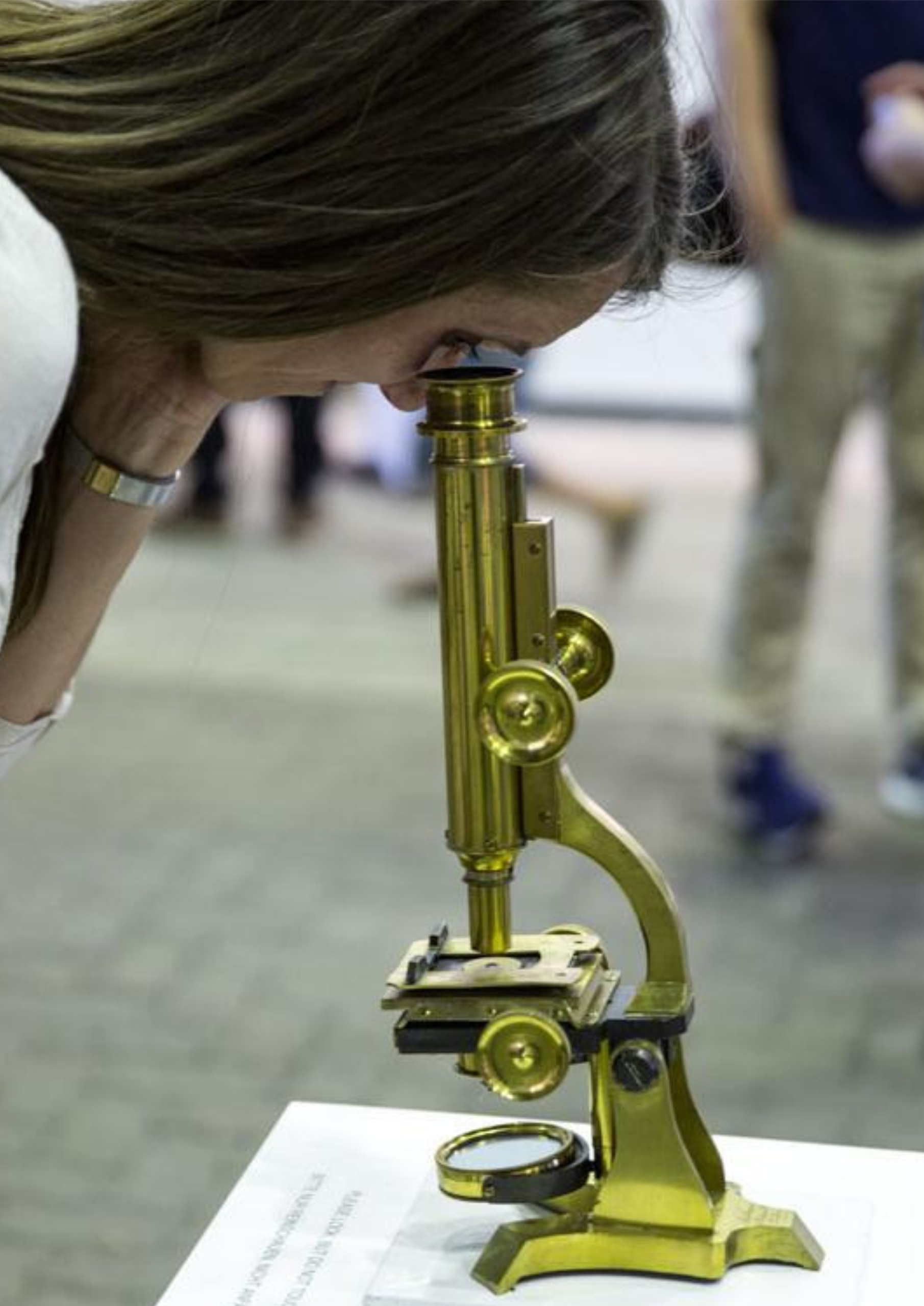
The MicroCinescope is an interactive artwork merging art and science. A high-resolution screen, magnified by an antique brass microscope, shows a live feed from above the device and the surrounding visitors. Placing the audience literally under the lens, the piece invites reflection on ourselves and our cultural habits—such as visiting art exhibitions.

BIO

Thomas is an artist exploring the intersection of science and contemporary culture, blending technology with traditional media like sculpture, video, and installation. Studied mathematics in Gothenburg and earned a Bachelor of Arts from the University of Technology Sydney, working across Australia and Europe.

FILE SÃO PAULO 2025: SYNTHETIKA – Frederik De Wilde

Hunter and Dog

Frederik De Wilde

FILE SÃO PAULO 2025: SYNTHETIKA – Art and Technology – Installations
Electronic Language International Festival

Hunter and Dog – Belgium

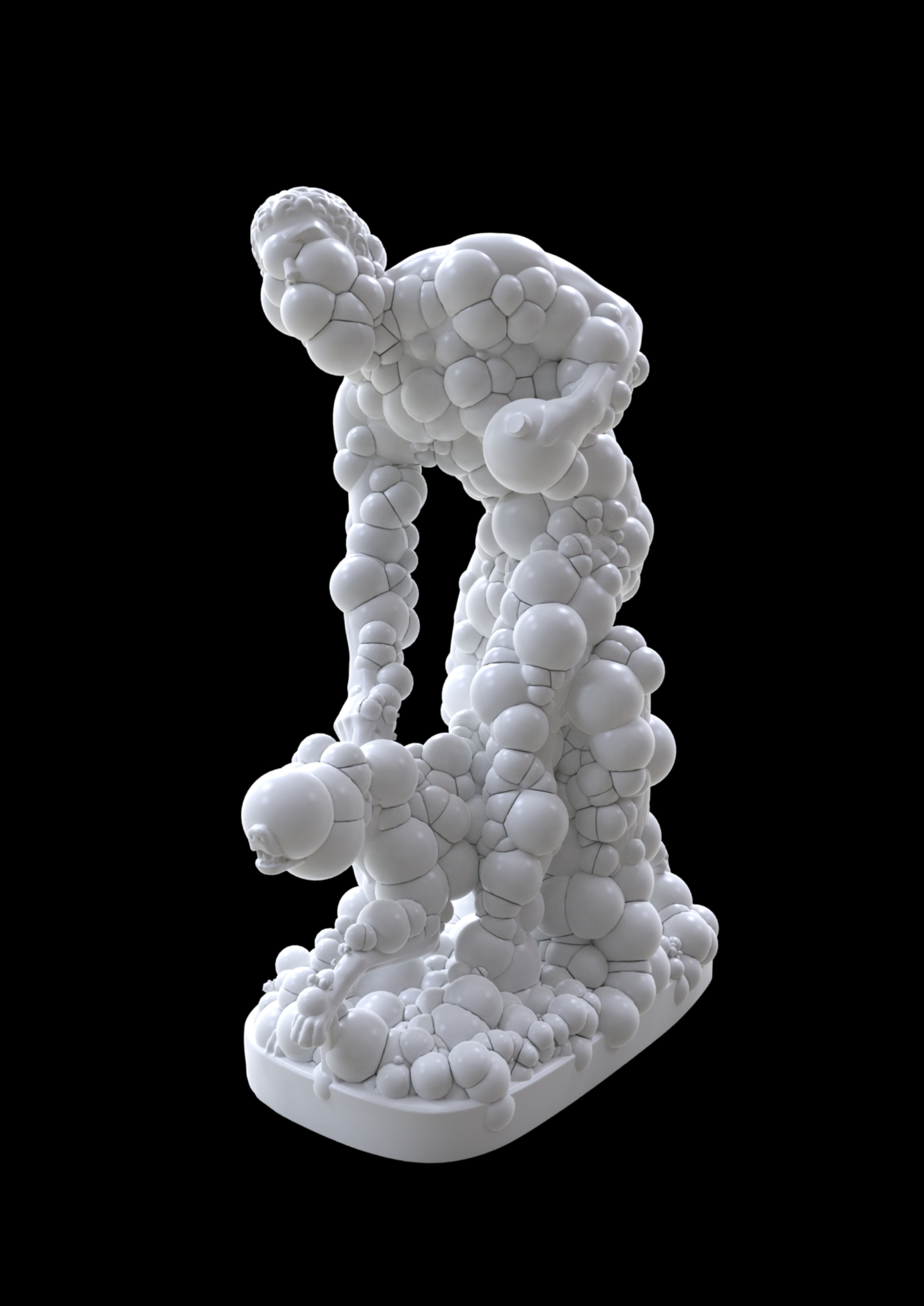
Genetic and evolutionary algorithms reinterpret an existing artwork. De Wilde uses digital scans and custom genetic and evolutionary algorithms as a deconstruction technique to reinterpret and update the nineteenth-century work Hunter and Dog from sculptor John Gibson R. A. (1790–1866).

Frederik De Wilde’s Hunter and Dog interrogates the intersections of human evolution, genetic engineering, and the hybridization of technology and biology. De Wilde reinterprets the historical sculpture through the lens of post-evolutionary theory, engaging with contemporary debates on CRISPR, synthetic biology, and the implications of human-directed genetic modification. CRISPR, the revolutionary gene-editing technology, has introduced an unprecedented rupture in the trajectory of evolution. No longer constrained by the slow mechanisms of natural selection, humans now possess the ability to intervene directly in their own genetic blueprint, marking a shift toward a post-Darwinian paradigm. This technological power, however, is not neutral; it emerges from a historical lineage of scientific inquiry deeply entangled with colonialism. The history of genetic manipulation is inseparable from colonial bioprospecting, eugenics, and exploitative medical experimentation on marginalized populations. Colonial regimes treated bodies—both human and non-human—as sites of intervention, control, and optimization, a logic that persists in contemporary biotechnological frameworks. Post-colonial discourse reveals how genetic engineering risks perpetuating these legacies, reinforcing power asymmetries between those who wield biotechnological control and those subjected to its consequences. CRISPR, while offering the promise of eradicating disease and expanding human potential, also raises ethical concerns about genetic stratification, bio-capitalism, and the commodification of life itself. De Wilde’s work visualizes these tensions, making visible the processes of cell division and morphogenesis—the very biological mechanisms now subject to human intervention. Hunter and Dog does not merely depict the transformation of a neoclassical form but speculates on the future of the human body as a site of engineered evolution. From a decolonial perspective, the artwork questions who has the authority to edit life and to what ends. It challenges the techno-utopian narratives that frame genetic modification as an inevitable progress while obscuring its social, ethical, and ecological implications. By hybridizing art, science, and technology, Hunter and Dog compels us to confront the uncertainties of a CRISPR-driven future: Will genetic editing reinforce existing inequalities, or can it be decolonized and democratized? How do we navigate this post-natural frontier without losing the human—and more-than-human—dimensions of our existence? De Wilde’s work invites us into this speculative space, where the hunter, the dog, and the algorithm coalesce into a vision of a world where biology is no longer destiny, but a site of contested agency.

Where are we going from here? 

BIO

Frederik De Wilde fuses art, science, and tech. Known for his Blackest-Black works that inspired Kapoor’s Vantablack, he has shown at Venice Biennale, BOZAR, MAAT, Pompidou, and ZKM, winning awards like Ars Electronica.
Memo Akten and Katie Peyton Hofstadter

Embodied Simulation

‘Embodied Simulation’ is a multiscreen video and sound installation that aims to provoke and nurture strong connections to the global ecosystems of which we are a part. The work combines artificial intelligence with dance and research from neuroscience to create an immersive, embodied experience, extending the viewer’s bodily perception beyond the skin, and into the environment.
The cognitive phenomenon of embodied simulation (an evolved and refined version of ‘mirror neurons’ theory) refers to the way we feel and embody the movement of others, as if they are happening in our own bodies. The brain of an observer unconsciously mirrors the movements of others, all the way through to the planning and simulating execution of the movements in their own body. This can even be seen in situations such as embodying and ‘feeling’ the movement of fabric blowing in the wind. As Vittorio Gallese writes, “By means of a shared neural state realized in two different bodies that nevertheless obey to the same functional rules, the ‘objectual other’ becomes ‘another self’.”

QUBIT AI – International Electronic Language Festival – Art and Technology

QUBIT AI | quantum & synthetic ai
Electronic Language International Festival

July 3rd to August 25th
Tuesday to Sunday, 10am – 8pm
FIESP Cultural Center

Design: André Lenz
Image: Iskarioto Dystopian AI Films – Athena

QUBIT AI

In its 25 years of existence, the International Electronic Language Festival (FILE) is an internationally renowned Brazilian project that since 2000 has explored the intersection between art and technology. With more than two decades of history, the festival stands out for fostering exhibition spaces and debate about artistic innovations driven by disruptive and innovative technologies, inviting the public to get involved with experimental forms of art that challenge the boundaries of conventionality. Currently, two of these technologies stand out in the contemporary scenario: the accelerated development of quantum computing and artificial intelligence corroborated by synthetic data.

Quantum computing, an emerging revolution in the technological field, offers a new range of creative possibilities for contemporary artists. This new era allows the exploration of unprecedented frontiers through a new computational format that consists mainly of quantum superposition and entanglement, a new field of exploration for synthetic computer science, as well as for the arts in general; on the other hand, artificial intelligence, fueled by synthetic data, offers artists a new way of making and understanding art, opening up space for new forms, concepts and artistic expressions.
Entitled QUBIT AI, the exhibition delves into this unexplored territory presenting a selection of works of art resulting from the connection between artistic creation and technology, proposing a theoretical reflection on what the interrelationship between quantum computers and synthetic artificial intelligence will be.

Visitors will be invited to experience immersive installations, experimental videos, digital sculptures and other forms of interactive art, which intertwine reality and imagination. The exhibition encourages reflections on the influence of technology on art and contemporary society, while at the same time providing an environment to compare already established technological arts (analog and digital) with the possible futures of art in the synthetic era, enhanced by quantum computing. The QUBIT AI exhibition at FILE SP 2024 transcends the mere presentation of works of art; it is a journey to the limits of human creativity, driven by the convergence of art, science and technology.

Ricardo Barreto and Paula Perissinotto
co-organizers and curators of FILE
International Electronic Language Festival


QUBIT AI: Marc Vilanova

Shell of

FILE 2024 | Installations
International Electronic Language Festival
Marc Vilanova – Cascade – Spain

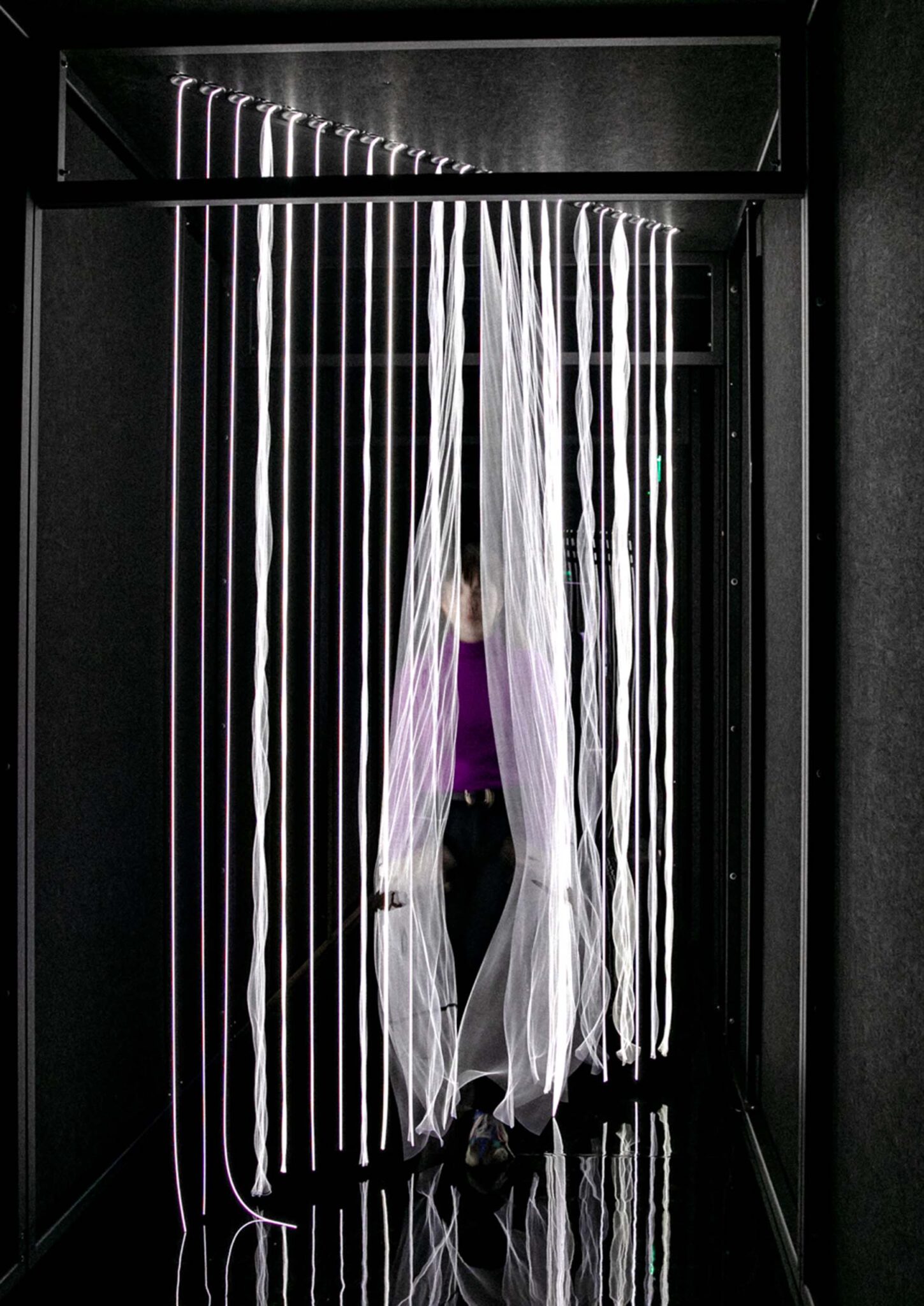
Waterfalls are a continuous source of infrasonic frequency found in nature. Although inaudible to humans, they play a crucial role in ecosystems, especially for migratory birds who use them as a compass. However, many waterfalls have lost their frequencies due to climate change. The work creates an immersive experience in which the audience interacts with the visualization of sound waves, experiencing the vibration of sound through illuminated strings.

Bio

Marc Vilanova is a sound and visual artist who works at the intersection of art, science and nature. Vilanova’s artistic production has always been led by a spirit of innovation fueled by an interest in new media. His practice combines sound/light installations, performance, and sculpture.

Credits

This work was partially carried out within the scope of the EMAP program at gnration, with the support of the Creative Europe Culture Programme, the Avatar Center in Quebec City and the Ramon Llull Institute.

Photo:
Eloise Coomber

QUBIT AI: Max Haarich (Project Smart Hans)

Smart Hans

FILE 2024 | Installations
International Electronic Language Festival
Max Haarich (Project Smart Hans) – Smart Hans – Germany

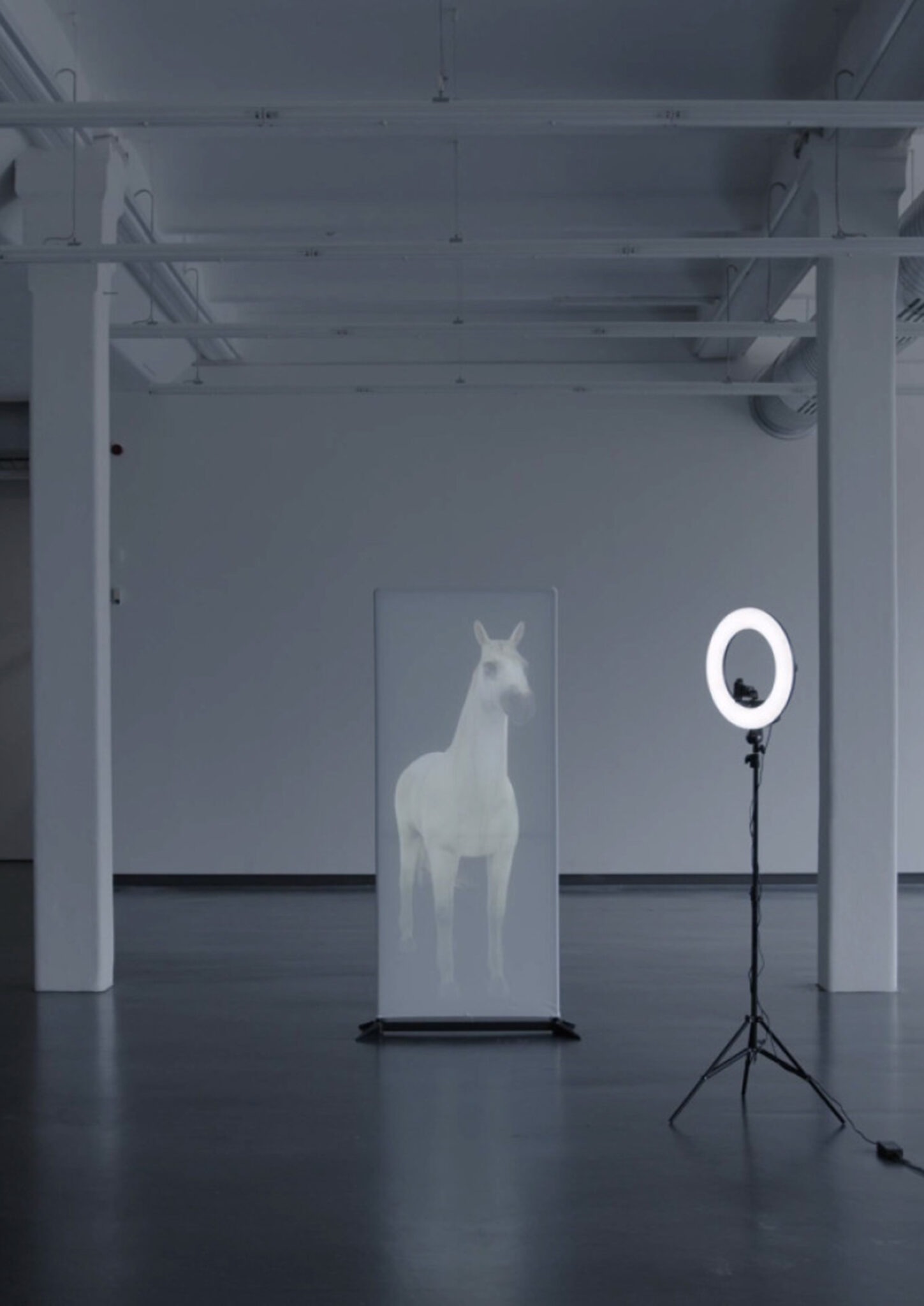
The Smart Hans project is a synthetic reincarnation of Clever Hans, a horse that became famous in the early 20th century for apparently answering mathematical questions by tapping its hoof. The interactive installation features an animated horse that can guess any number in its mind through posture recognition. At the same time a fun joke and an illustration of why we worry about artificial intelligence.

Bio

Max Haarich is an artistic researcher, ethicist and consultant focusing on artificial intelligence and web3. He studied communication science at RWTH Aachen and critical thinking at the University of the Underground. After his studies, he researched artificial superintelligence at RWTH Aachen and later worked as a communications manager at Europe’s leading startup hub.

Credits

Team: Anja Borowicz Richardson (UK), Bruce Gilchrist (UK), Akshita Gupta (IND), Max Haarich (Artistic Lead/DE), Martina Huynh (NL), Asad Imtiaz (PAK), Muhammad Qasim Khan (PAK), Adrian Ludwig (DE), Pekka Ollikainen (FI), Raphael Pickl (DE).

QUBIT AI: Paul Gründorfer & Leonhard Peschta

The Sea

FILE 2024 | Installations
International Electronic Language Festival

The Sea is an extraction of a complex natural phenomenon, resulting in an artificial emulation that develops a life form of its own. Just like the sea with its endless waves, this artificial system follows the impact of an immersive state, leading to a unique vision of an artificial generator. Despite appearing chaotic, it is capable of generating associations ranging from the movement of waves to science fiction scenarios.

Bio

Paul Gründorfer develops process-related systems and explores variable or unstable conditions in the occurrence of sound when exposed to amplification, feedback, and multiple signal streams. His works focus on processes that evolve in a social space. Leo Peschta is an artist and researcher. During his studies, he worked in various fields of media arts, including sound, installations and software, developing over the years a special interest in robotics and machinery.

Credits

Austrian Embassy

QUBIT AI: Anna Vasof & VRinMotion Team

The Cage of Time

FILE 2024 | Installations
International Electronic Language Festival
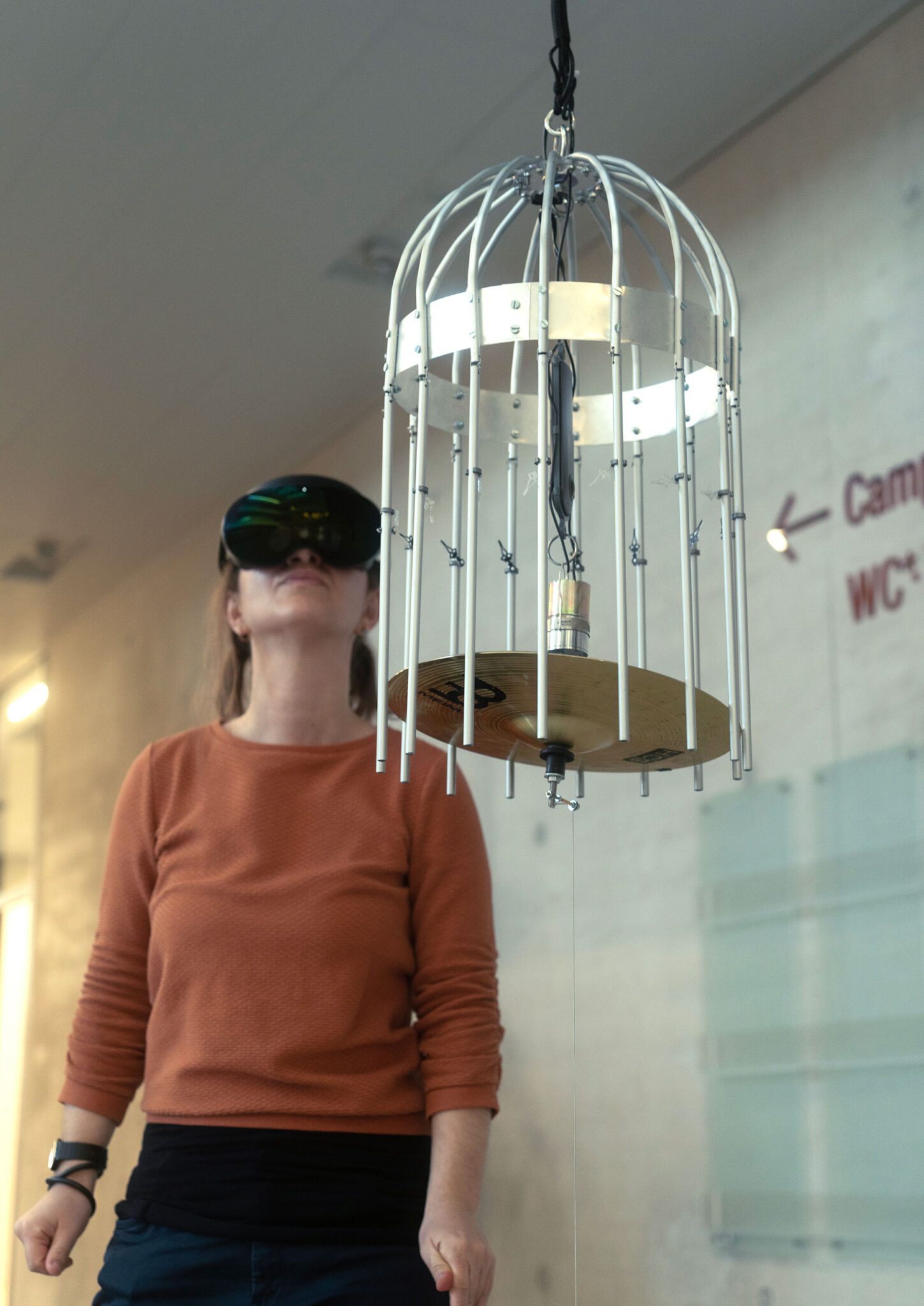
Interactive installation that presents a kinetic instrument object and virtual reality glasses, functioning as a device that animates the illusion of the passage of time in virtual space. In the fabric of existence, time weaves a cage around our ephemeral moments, limiting our perceptions of the past, present and future. By embracing this paradox, we may discover that the cage of time becomes the crucible where the alchemy of experience transforms our understanding of existence.

Bio

Anna Vasof is a multi-award-winning artist who focuses on filmmaking, short videos, and time-based sculptures. VRinMotion is an artistic research project based at St. Pölten University of Applied Sciences in Austria that investigates how features of stop-motion animation and motion capture can be combined with virtual reality to enrich current artistic discourse.

Credits

VRinMotion Team: Franziska Bruckner, Christoph Schmid, Clemens Gürtler, Matthias Husinsky, Christian Munk, Julian Salhofer, Stefan Nebel, Vrääth Öhner.
Concept by: Anna Vasof.

QUBIT AI: Seph Li

Everything Before, Everything After

FILE 2024 | Installations
International Electronic Language Festival
Seph Li – Everything Before, Everything After – China and UK

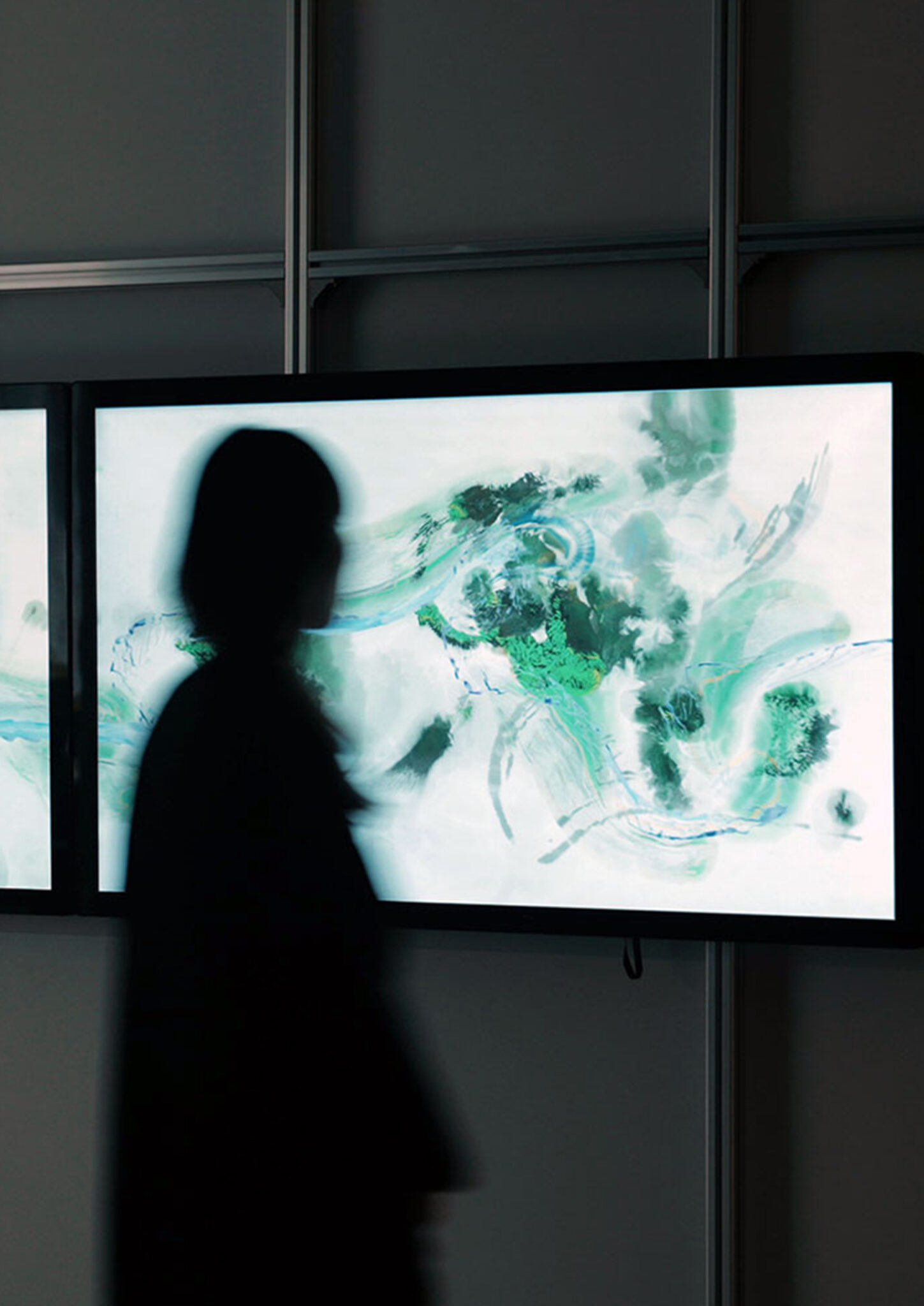
A digital installation features a winding river in the style of Chinese painting, symbolizing time and transition. Touch screens allow visitors to paint over it, altering its course unpredictably. The river embodies history and the future, with each trace contributing to its eternal flow through space and time. Recorded interactions ensure its perpetual existence.

Bio

Born in Beijing in 1988, Seph Li has a mixed background in technology and design, and his keen interest in interactive artworks led him to the field of media arts. Seph studied computer science and entertainment design at Tsinghua University and continued his master’s study in design/media arts at UCLA. Seph currently resides in London, United Kingdom; he creates interactive artworks as well as technical experiments with other production studios.

QUBIT AI: Robert Seidel

HYSTERESIS

FILE 2024 | Aesthetic Synthetics
International Electronic Language Festival
Robert Seidel – HYSTERESIS – Germany

HYSTERESIS intimately weaves a transformative fabric between Robert Seidel’s projections of abstract drawings and queer performer Tsuki’s vigorous choreography. Using machine learning to mediate these delayed re-presentations, the film intentionally corrupts AI strategies to reveal a frenetic, delicate and extravagant visual language that portrays hysteria and hysteresis in this historical moment.

Bio

Robert Seidel is interested in exploring abstract beauty through cinematic techniques and insights from science and technology. His projections, installations and award-winning experimental films have been presented at numerous international festivals, art venues and museums, highlighting his innovative approach to visual art.

Credits

Film: Robert Seidel
Music: Oval
Performer: Tsuki
Graphics: Bureau Now
5.1 Mixing: David Kamp
Support: Miriam Eichner, Carolin Israel, Falk Müller, Paul Seidel
Financing: German Federal Film Board

QUBIT AI: AESTHETIC SYNTHETIC FILE – São Paulo 2024 – Art and Technology

FILE 2024

QUBIT AI | quantum & synthetic ai
Electronic Language International Festival
July 3rd to August 25th
Tuesday to Sunday, 10am – 8pm
FIESP Cultural Center

Design: André Lenz
Image: Iskarioto Dystopian AI Films – Athena

QUBIT AI

In its 25 years of existence, the International Electronic Language Festival (FILE) is an internationally renowned Brazilian project that since 2000 has explored the intersection between art and technology. With more than two decades of history, the festival stands out for fostering exhibition spaces and debate about artistic innovations driven by disruptive and innovative technologies, inviting the public to get involved with experimental forms of art that challenge the boundaries of conventionality. Currently, two of these technologies stand out in the contemporary scenario: the accelerated development of quantum computing and artificial intelligence corroborated by synthetic data.

Quantum computing, an emerging revolution in the technological field, offers a new range of creative possibilities for contemporary artists. This new era allows the exploration of unprecedented frontiers through a new computational format that consists mainly of quantum superposition and entanglement, a new field of exploration for synthetic computer science, as well as for the arts in general; on the other hand, artificial intelligence, fueled by synthetic data, offers artists a new way of making and understanding art, opening up space for new forms, concepts and artistic expressions.

Entitled QUBIT AI, the exhibition delves into this unexplored territory presenting a selection of works of art resulting from the connection between artistic creation and technology, proposing a theoretical reflection on what the interrelationship between quantum computers and synthetic artificial intelligence will be.

Visitors will be invited to experience immersive installations, experimental videos, digital sculptures and other forms of interactive art, which intertwine reality and imagination. The exhibition encourages reflections on the influence of technology on art and contemporary society, while at the same time providing an environment to compare already established technological arts (analog and digital) with the possible futures of art in the synthetic era, enhanced by quantum computing. The QUBIT AI exhibition at FILE SP 2024 transcends the mere presentation of works of art; it is a journey to the limits of human creativity, driven by the convergence of art, science and technology.

Ricardo Barreto and Paula Perissinotto
co-organizers and curators of FILE
International Electronic Language Festival

QUBIT AI: Dennis Schöneberg

Transparency

FILE 2024 | Interator – Sound Synthetics
International Electronic Language Festival
Dennis Schöneberg – Transparenza – Germany

Music controls camera settings, the weight of prompts, and the creativity of the AI. The objective of the project is to create a symbiosis between music and images, in which both elements complement and enhance each other. By directly linking musical parameters to AI creative processes, a unique audiovisual experience is created.

Bio

Dennis Schöneberg, German AI artist, data science student and developer of open source AI models, integrates his passion for electronic music into his creative endeavors. Merging art with technology, he explores the synergy between creativity and artificial intelligence.

Credits

Music: Transparenza by Michael Mayer & Reinhard Voigt

QUBIT AI: Dennis Schöneberg

Russian Roulette

FILE 2024 | Interator – Sound Synthetics
International Electronic Language Festival
Dennis Schöneberg – Russian Roulette – Germany

An incessant bass drum drives the journey through an eccentric world populated by fruity alien creatures in a cheerful and colorful environment.

Bio

Dennis Schöneberg, German AI artist, data science student and developer of open source AI models, integrates his passion for electronic music into his creative endeavors. Merging art with technology, he explores the synergy between creativity and artificial intelligence.

Credits

Music: Believe by Russian Roulette

QUBIT AI: Dennis Schöneberg

N-DRA

FILE 2024 | Interator – Sound Synthetics
International Electronic Language Festival

Dennis Schöneberg – N-DRA – Germany

Created during the pandemic, N-DRA is a video that explores the nostalgia of pre-pandemic times. Through a dreamlike and psychedelic journey through the artist’s memories, it reflects feelings of loneliness, isolation and the desire for connection.

Bio

Dennis Schöneberg, German AI artist, data science student and developer of open source AI models, integrates his passion for electronic music into his creative endeavors. Merging art with technology, he explores the synergy between creativity and artificial intelligence.

Credits

Music: N-DRA by Ricardo Villalobos

QUBIT AI: Dennis Schöneberg

Bodydub

FILE 2024 | Interator – Sound Synthetics
International Electronic Language Festival
Dennis Schöneberg – Bodydub – Germany

This video experiment combines music properties with AI generation settings to create a unique audiovisual experience. The synthesizer works as a control instrument for movement in the 3D space of the video.

Bio

Dennis Schöneberg, German AI artist, data science student and developer of open source AI models, integrates his passion for electronic music into his creative endeavors. Merging art with technology, he explores the synergy between creativity and artificial intelligence.

Credits

Music: Bodydub (Bangkok Impact Remix) by Unit4

QUBIT AI: Gabriela Barreto Lemos

Quantum Photography

FILE 2024 | Quantico
International Electronic Language Festival
Gabriela Barreto Lemos – Quantum Photography – Brazil

Quantum photography technique that allows you to record images without light passing through the object.

Typically, a beam of light interacts with an object; In this same beam, the image of that object is formed, which is recorded on a camera, on paper or directly into the eye. This research used two quantumly entangled photon beams. An infrared photon was directed at a silicon wafer engraved with the image of a cat. The other photon, red, was sent on a different trajectory, did not pass through the silicon plate and was detected by an EMCCD (electron-multiplying charge-coupled device – a photographic camera with sensitivity to very low intensity light). The image of the cat engraving was recorded by the camera, which only detected the red light, which did not touch the engraving. It is the first time that an image has been captured in a beam of light that has not interacted with the object that produced the image.

The experiment, led by researcher Gabriela Barreto Lemos, was carried out at the Institut für Quantenoptik und Quanteninformation in Vienna, 2014.

The technique has potential for applications in indirect image capture, from medicine to quantum computing.

Bio

Professor at the Federal University of Rio de Janeiro, in Brazil, whose research focus is on quantum optics, with an emphasis on quantum foundations, quantum images and quantum information. Additionally, she is involved in interdisciplinary creative projects and promoting inclusion and diversity in science.

Credits

Gabriela Barreto Lemos
Vienna Center for Quantum Science and Technology
Institut für Quantenoptik und Quanteninformation
Group of Anton Zeilinger

QUBIT AI: Eduardo Reck Miranda

Sounding Qubits

FILE 2024 | Quantico
International Electronic Language Festival
Eduardo Reck Miranda – Sounding Qubits – Brazil

Although he has learned classical musical instruments since childhood, Eduardo Miranda’s favorite tool for composing is the computer. The researcher has been delving into artificial intelligence and innovative computing methods for compositing for some time, as they offer fresh insights and ideas beyond his own.

A quantum computer deals with information encoded as qubits. A qubit is to a quantum computer what a bit is to a digital one: a basic unit of information. In hardware, qubits exist in the subatomic world. They are subject to the laws of quantum mechanics.

Quantum computers are like super-powered versions of classical digital computers. While a digital computer processes data in a linear, step-by-step fashion, a quantum computer can explore many possibilities at once.

Operating a quantum computer requires different ways of thinking about encoding and processing information. This is where composers can benefit greatly. This technology is destined to facilitate the development of unprecedented ways of creating music.

Bio

Composer who works at the intersection of music, science and new technologies. His background as an artificial intelligence scientist and classical composer with early involvement in avant-garde pop music informs his distinctive music. He has composed for BBC Radio 3, BBC Concert Orchestra, BBC Singers and Scottish Chamber Orchestra. He is a professor at the University of Plymouth and a research associate at Quantinuum, where he explores music composition with quantum computers.

QUBIT AI: FILE QUANTUM WORKSHOP 2024 – São Paulo – Art and Technology

FILE 2024

QUBIT AI | quantum & synthetic ai
Electronic Language International Festival
July 3rd to August 25th
Tuesday to Sunday, 10am – 8pm
FIESP Cultural Center

Design: André Lenz
Image: Iskarioto Dystopian AI Films – Athena

QUBIT AI

In its 25 years of existence, the International Electronic Language Festival (FILE) is an internationally renowned Brazilian project that since 2000 has explored the intersection between art and technology. With more than two decades of history, the festival stands out for fostering exhibition spaces and debate about artistic innovations driven by disruptive and innovative technologies, inviting the public to get involved with experimental forms of art that challenge the boundaries of conventionality. Currently, two of these technologies stand out in the contemporary scenario: the accelerated development of quantum computing and artificial intelligence corroborated by synthetic data.

Quantum computing, an emerging revolution in the technological field, offers a new range of creative possibilities for contemporary artists. This new era allows the exploration of unprecedented frontiers through a new computational format that consists mainly of quantum superposition and entanglement, a new field of exploration for synthetic computer science, as well as for the arts in general; on the other hand, artificial intelligence, fueled by synthetic data, offers artists a new way of making and understanding art, opening up space for new forms, concepts and artistic expressions.

Entitled QUBIT AI, the exhibition delves into this unexplored territory presenting a selection of works of art resulting from the connection between artistic creation and technology, proposing a theoretical reflection on what the interrelationship between quantum computers and synthetic artificial intelligence will be.

Visitors will be invited to experience immersive installations, experimental videos, digital sculptures and other forms of interactive art, which intertwine reality and imagination. The exhibition encourages reflections on the influence of technology on art and contemporary society, while at the same time providing an environment to compare already established technological arts (analog and digital) with the possible futures of art in the synthetic era, enhanced by quantum computing. The QUBIT AI exhibition at FILE SP 2024 transcends the mere presentation of works of art; it is a journey to the limits of human creativity, driven by the convergence of art, science and technology.

Ricardo Barreto and Paula Perissinotto
co-organizers and curators of FILE
International Electronic Language Festival

QUBIT AI: FILE OPENING LECTURE 2024 – São Paulo – Art and Technology

FILE 2024

QUBIT AI | quantum & synthetic ai
Electronic Language International Festival
July 3rd to August 25th
Tuesday to Sunday, 10am – 8pm
FIESP Cultural Center

Design: André Lenz
Image: Iskarioto Dystopian AI Films – Athena

QUBIT AI

In its 25 years of existence, the International Electronic Language Festival (FILE) is an internationally renowned Brazilian project that since 2000 has explored the intersection between art and technology. With more than two decades of history, the festival stands out for fostering exhibition spaces and debate about artistic innovations driven by disruptive and innovative technologies, inviting the public to get involved with experimental forms of art that challenge the boundaries of conventionality. Currently, two of these technologies stand out in the contemporary scenario: the accelerated development of quantum computing and artificial intelligence corroborated by synthetic data.

Quantum computing, an emerging revolution in the technological field, offers a new range of creative possibilities for contemporary artists. This new era allows the exploration of unprecedented frontiers through a new computational format that consists mainly of quantum superposition and entanglement, a new field of exploration for synthetic computer science, as well as for the arts in general; on the other hand, artificial intelligence, fueled by synthetic data, offers artists a new way of making and understanding art, opening up space for new forms, concepts and artistic expressions.

Entitled QUBIT AI, the exhibition delves into this unexplored territory presenting a selection of works of art resulting from the connection between artistic creation and technology, proposing a theoretical reflection on what the interrelationship between quantum computers and synthetic artificial intelligence will be.

Visitors will be invited to experience immersive installations, experimental videos, digital sculptures and other forms of interactive art, which intertwine reality and imagination. The exhibition encourages reflections on the influence of technology on art and contemporary society, while at the same time providing an environment to compare already established technological arts (analog and digital) with the possible futures of art in the synthetic era, enhanced by quantum computing. The QUBIT AI exhibition at FILE SP 2024 transcends the mere presentation of works of art; it is a journey to the limits of human creativity, driven by the convergence of art, science and technology.

Ricardo Barreto and Paula Perissinotto
co-organizers and curators of FILE
International Electronic Language Festival


FILE LED SHOW Neuroscientific-Installation


FILE FESTIVAL

FILE LED SHOW

saccade
OUCHHH STUDIO
Neuroscientific-Installation
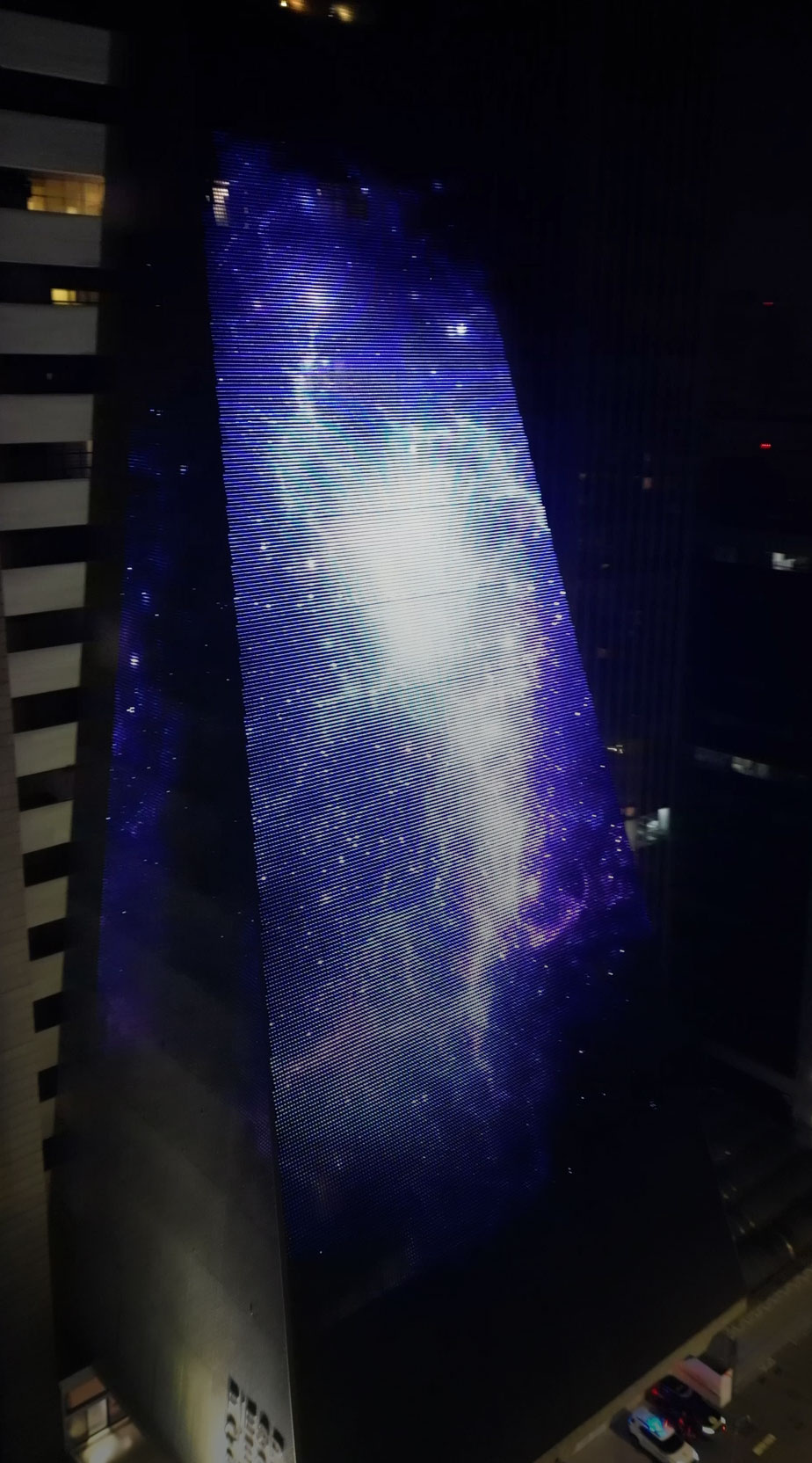
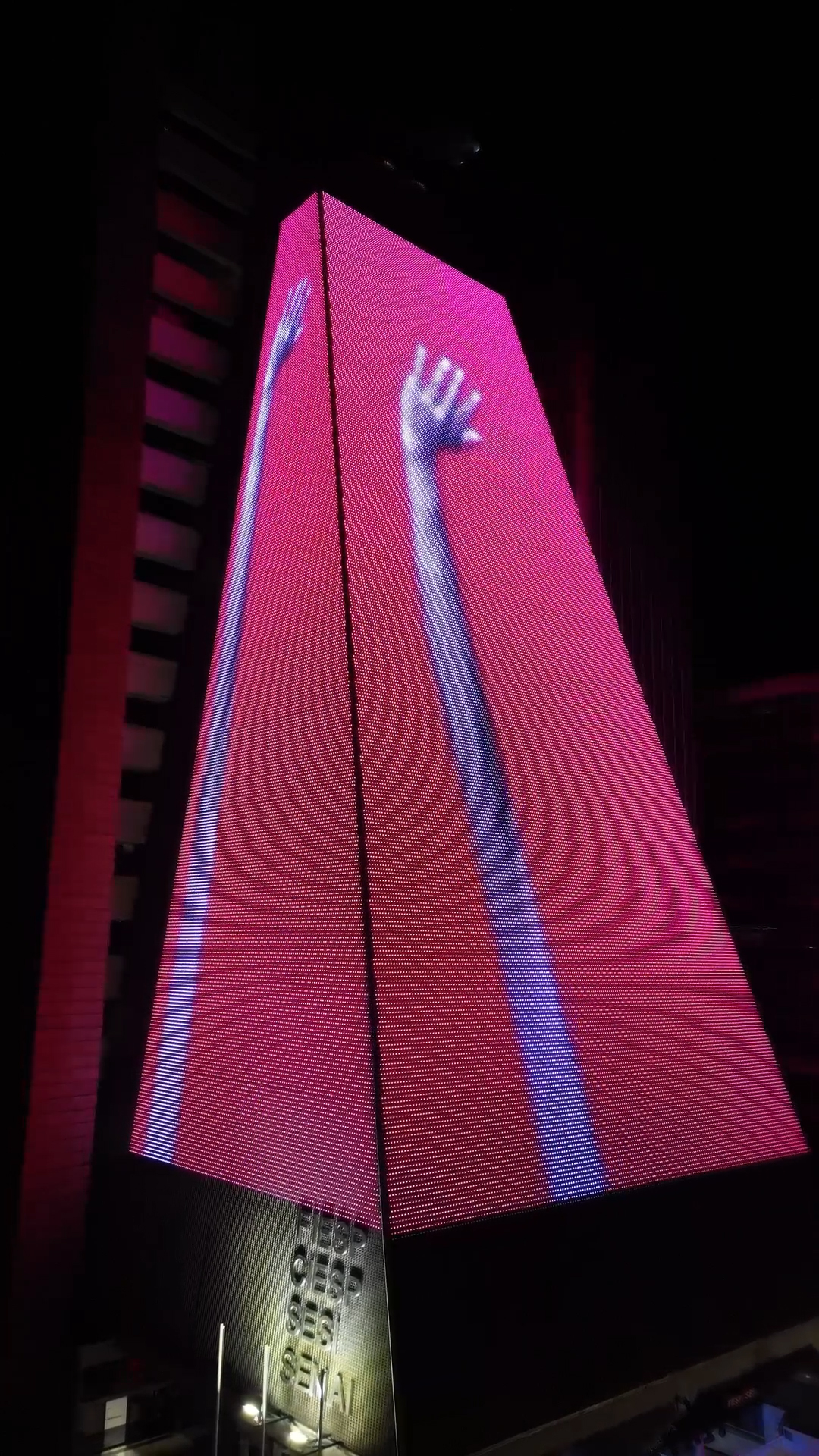
We are invited to São Paulo for our vertical light and sound installation which will transform the facade of São Paulo’s one of the most important architecture which is Fiesp Led Building.
We started this project with the idea that Neuroscience and simultaneous movement of both eyes between two or more phases of fixation in the same direction algorithms, and we transform the high-resolution led screen into a media canvas which transformed into living architecture.

KAZUSHI MUKAIYAMA

IJIROS
file festival
Ijiro is a robot which expresses emotions reacting to a user’s actions. Boldly, it consists of an OLED display, a speaker and an accelerometer in a cylinder shell. Ijiro isn’t able to move itself because it doesn’t have any actuators. However, it expresses emotions with faces in the display and voice from the speaker when a user touches it, lying, standing, swinging, hanging and so on. For example, if a user swings it softly, it reacts smiling. But if a user swings it roughly, it reacts angrily. So those reactions let users feel it like a baby. It is actually baby’s emotions characterized by cognitive science. Also, Ijiro’s shape is designed as a cylinder. It is considered to get various user’s actions because only a cylinder can be stood, lied down, rolled and so on in primitive shapes. Recently it has been easier to use electronic parts for arts. One advantage of making art pieces with compact electronics like a cell phone. So the art style is able to change from being viewed in a large room to being anywhere. Ijiro was developed to entertain people to keep it like a physical pet. We hope you all enjoy touching it.

Isaac Arthur

The Megastructure Compendium
Science & Futurism
In the future humanity may build enormous structures, feats of mega-engineering that may rival planets or even be of greater scope. This episode catalogs roughly 100 major types of Megastructure, from those that are cities in space to those that rival galaxies.

bohyun yoon

БОХЬЮН ЮН
윤보현
To Reverse Yourself

FILE FESTIVAL

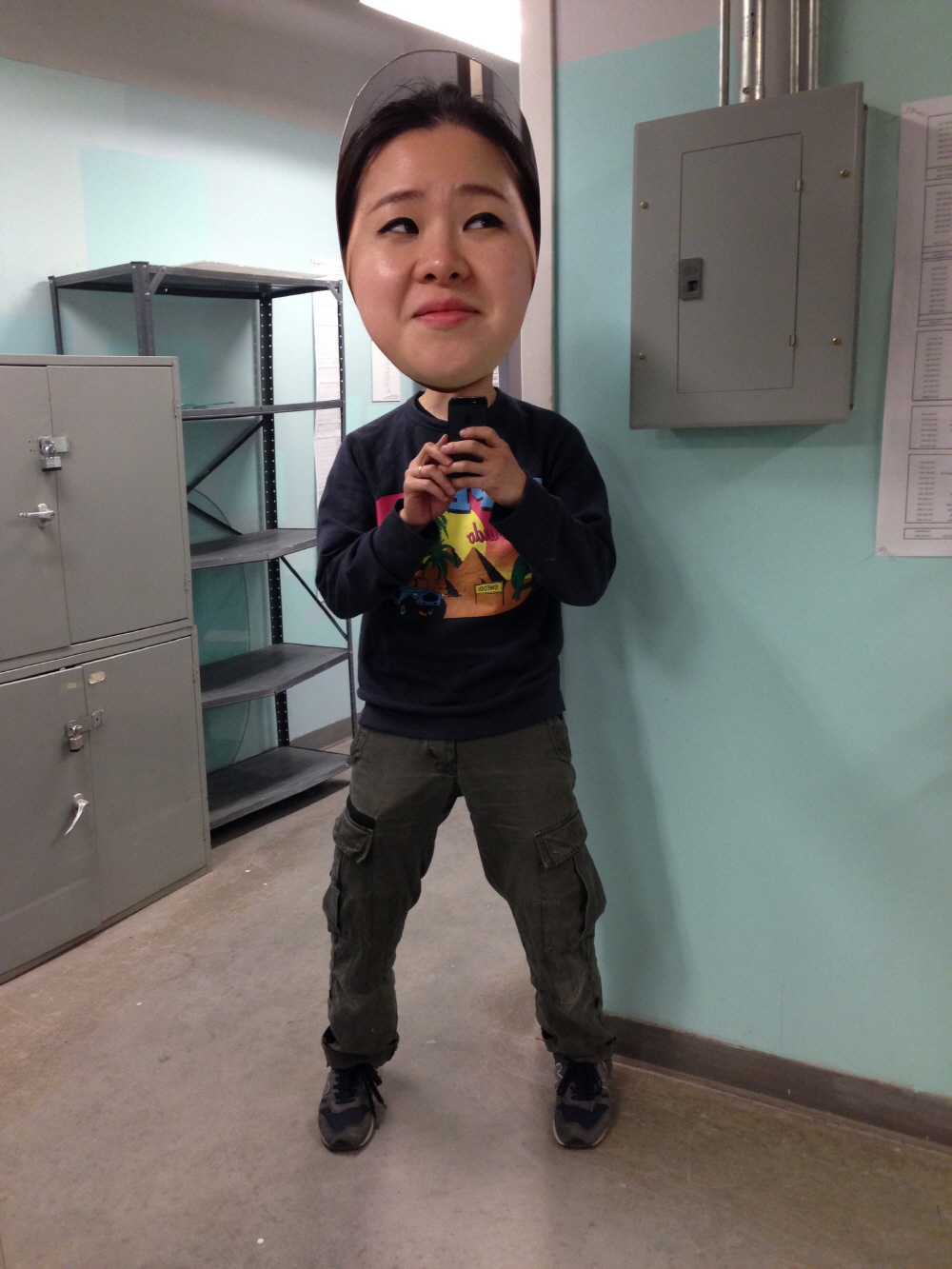
My work poses the question: how does reality becomes exquisitely animated by certain social control systems such as politics, mass media, technology, science, and etc. It is my artistic goal to reveal how human beings are fragile and delicate in these social environments. By living in Korea, Japan and the U.S, I have first-hand experience in diverse social systems and have come to view my life experiences as raw material for my research. With my research in mind, my art utilizes the body as the tool for an intensive investigation of the public and private; examining the relationship between how people understand their body and how this understanding represents themselves in the greater context.
Currently, I am curious about human perception developing parallel with the ever-evolving progression of technological world. Thus, I question technology’s relationship to reality and illusion; asking what is reality? My work takes advantage of illusion to explore and answer this question, and often my artistic materials consist of the body and mirrors. I use mirrors for integrating reality and illusion.