highlike

FILE SÃO PAULO 2025: SYNTHETIKA – ChrisLee

Robot Journey: Part 1, 2 & 3

ChrisLee

FILE SÃO PAULO 2025: SYNTHETIKA – Art and Technology – Cine SYN
Electronic Language International Festival


Robot Journey: Part 1, 2 & 3 – China

In a future where Earth’s environment has become uninhabitable, a lone robot sets out in search of a new home for humanity. After decades of travel, it discovers a planet strikingly similar to Earth — but it’s not alone. In The Last Explorer, the robot encounters mysterious presences and begins to develop emotions while exploring the unfamiliar world. Confronted with challenges, it must make choices that reflect its growing sense of awareness.

BIO

Chris Lee is a visual artist and independent creator from China. Trained in industrial design, he worked as a visual designer before turning to independent filmmaking. A lifelong passion for drawing now drives his ambition to develop an original series that blends animation with live action, showing that small teams and independent creators can produce powerful, high-quality stories.

Música: Karol Skowronek

FILE SÃO PAULO 2025: SYNTHETIKA – Frederik De Wilde

Hunter and Dog

Frederik De Wilde

FILE SÃO PAULO 2025: SYNTHETIKA – Art and Technology – Installations
Electronic Language International Festival

Hunter and Dog – Belgium

Genetic and evolutionary algorithms reinterpret an existing artwork. De Wilde uses digital scans and custom genetic and evolutionary algorithms as a deconstruction technique to reinterpret and update the nineteenth-century work Hunter and Dog from sculptor John Gibson R. A. (1790–1866).

Frederik De Wilde’s Hunter and Dog interrogates the intersections of human evolution, genetic engineering, and the hybridization of technology and biology. De Wilde reinterprets the historical sculpture through the lens of post-evolutionary theory, engaging with contemporary debates on CRISPR, synthetic biology, and the implications of human-directed genetic modification. CRISPR, the revolutionary gene-editing technology, has introduced an unprecedented rupture in the trajectory of evolution. No longer constrained by the slow mechanisms of natural selection, humans now possess the ability to intervene directly in their own genetic blueprint, marking a shift toward a post-Darwinian paradigm. This technological power, however, is not neutral; it emerges from a historical lineage of scientific inquiry deeply entangled with colonialism. The history of genetic manipulation is inseparable from colonial bioprospecting, eugenics, and exploitative medical experimentation on marginalized populations. Colonial regimes treated bodies—both human and non-human—as sites of intervention, control, and optimization, a logic that persists in contemporary biotechnological frameworks. Post-colonial discourse reveals how genetic engineering risks perpetuating these legacies, reinforcing power asymmetries between those who wield biotechnological control and those subjected to its consequences. CRISPR, while offering the promise of eradicating disease and expanding human potential, also raises ethical concerns about genetic stratification, bio-capitalism, and the commodification of life itself. De Wilde’s work visualizes these tensions, making visible the processes of cell division and morphogenesis—the very biological mechanisms now subject to human intervention. Hunter and Dog does not merely depict the transformation of a neoclassical form but speculates on the future of the human body as a site of engineered evolution. From a decolonial perspective, the artwork questions who has the authority to edit life and to what ends. It challenges the techno-utopian narratives that frame genetic modification as an inevitable progress while obscuring its social, ethical, and ecological implications. By hybridizing art, science, and technology, Hunter and Dog compels us to confront the uncertainties of a CRISPR-driven future: Will genetic editing reinforce existing inequalities, or can it be decolonized and democratized? How do we navigate this post-natural frontier without losing the human—and more-than-human—dimensions of our existence? De Wilde’s work invites us into this speculative space, where the hunter, the dog, and the algorithm coalesce into a vision of a world where biology is no longer destiny, but a site of contested agency.

Where are we going from here? 

BIO

Frederik De Wilde fuses art, science, and tech. Known for his Blackest-Black works that inspired Kapoor’s Vantablack, he has shown at Venice Biennale, BOZAR, MAAT, Pompidou, and ZKM, winning awards like Ars Electronica.

Cao Yuxi

Shenzhen Citizen Square
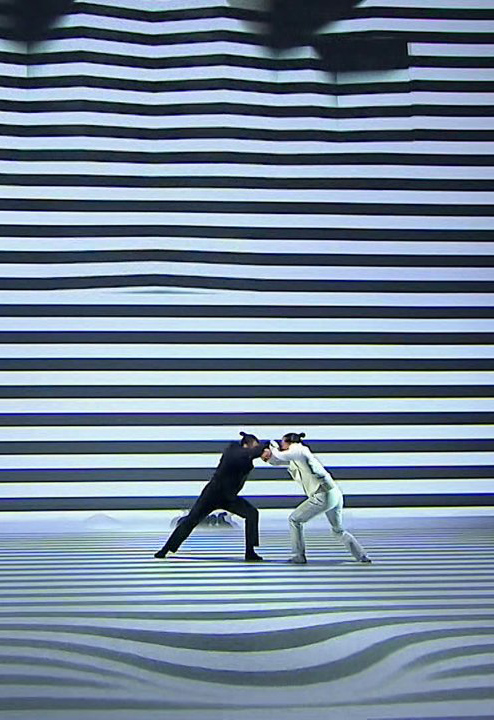
Cao Yuxi is een nieuwe mediakunstenaar wiens oeuvre zich uitstrekt over audiovisuele installaties, interactieve kunst, meeslepend ruimtelijk ontwerp en codering. Van zijn monumentale show in Shenzhen, waar 41 gebouwen van de skyline van de stad als canvas werden gebruikt, tot de hypnotiserende audiovisuele serie Dimensional Sampling en de op QR-codes geïnspireerde beelden, Cao’s werk confronteert de menselijke waarneming en daagt de kijker uit om na te denken over de veelzijdige aspecten van het moderne leven en het digitale tijdperk.
Kanlun Cen

岑侃倫
The Undercurrent
file festival
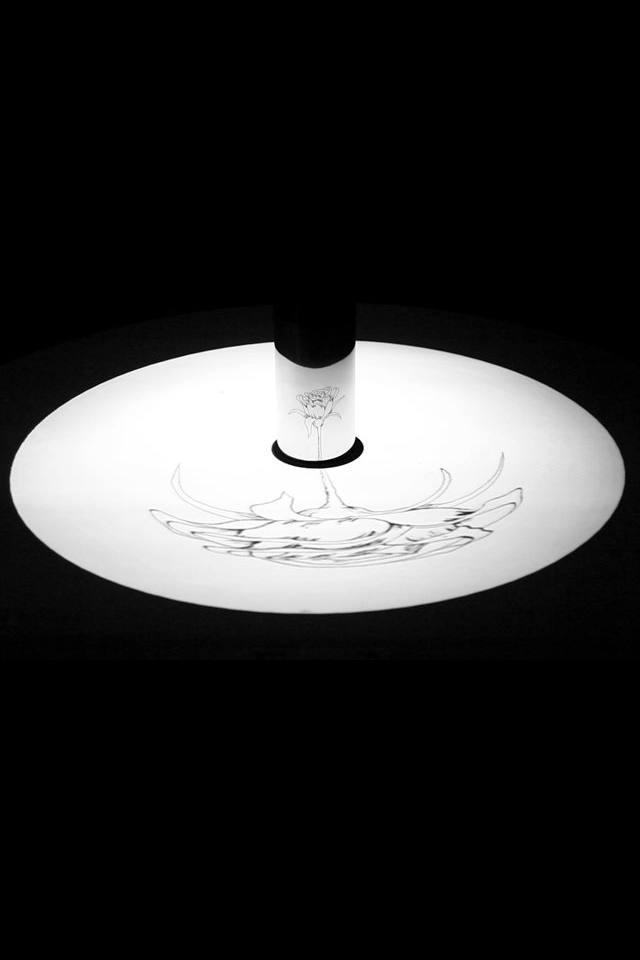
In the installation, the distorted image projected on the tabletop is reflected in the cylindrical mirror. While one sequence is distorted and reminiscent of a dreamlike state or the hazy inner workings of the mind, the other is clear and in proportion, which enables us to decipher the anamorphic image, thus to confront the “undercurrent” in our mind.

SUNYUAN & PENGYU

孙原和彭禹
ВС ЮАНЬ И ПЭН ЮЙ
Teenager Teenager
“Teenager Teenager est une installation unique et hyper-réaliste réalisée par les artistes chinois collaboratifs Sun Yuan et Peng Yu. L’installation présente des corps humains vêtus de costumes fantaisie et de robes du soir tout en se prélassant sur des canapés et des chaises en cuir, mais avec des rochers géants pour les têtes. L’étrange La situation évoque un sentiment de perplexité chez les téléspectateurs, qui sont confrontés à déchiffrer un message dissimulé dans l’arrangement inhabituel. ” Katie Hosmer

Lionel Hun and Pixel n’Pepper

Black and White
Dedicated to the design and distribution of live shows combining the arts in all its forms, Compagnie Hybride offers a fusion of aesthetics. It is positioned at the crossroads of creativity where the bodies and new technology meet. Land on which confronts, body language and visual arts, in order to promote a work interdisciplinary research, choreography and artistic innovation. Through its creations, productions, performances, films, exhibitions, installations, educational workshops and event services, Compagnie Hybride, carried primarily by a desire to exchange, sharing, research and development, has a mandate to create and disseminate its designs in the artistic and cultural networks nationally and internationally.

mourad merzouki

Vertikal
“Pour cette nouvelle création, je désire aborder un nouvel espace, celui de la verticalité. À travers un dispositif proposé par la compagnie Retouramont et Benjamin Lebreton, et accompagné d’une dizaine de danseurs au plateau je me confronterai à un environnement où le mouvement se joue de la gravité.”more

BILL VORN

DSM-VI
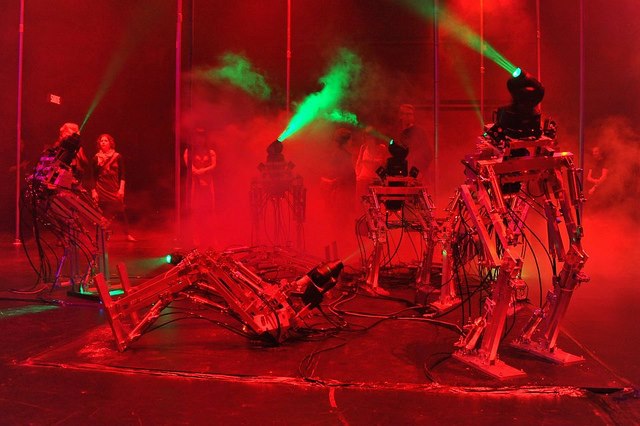
DSM-VI est une suite logique à notre approche artistique de création de mondes artificiels et de systèmes entièrement robotiques. Cette fois, nous voulons créer un univers qui met en scène des créatures exprimant des symptômes de comportements psychologiques «anormaux» et confrontés à de graves problèmes de «santé mentale», tels que névrose, psychose, troubles de la personnalité, paranoïa, schizophrénie, dépression, délire, etc. formes de comportement et troubles mentaux. Le titre du projet est inspiré du célèbre manuel de référence publié par l’American Psychiatric Association, le DSM-IV. Le DSM-IV (Manuel diagnostique et statistique des troubles mentaux) est considéré comme la bible de la psychiatrie moderne. Tantôt glorifié tantôt fortement critiqué, il s’agit d’un ouvrage de représentation qui décrit et classe les troubles du comportement humain et les maladies mentales. La version IV du DSM a été publiée en 1994 puis révisée en 2000. La version V est actuellement en préparation et devrait à terme être publiée en 2012. Avec ce projet, nous proposons la version VI. A l’instar de certains de nos précédents travaux conçus autour de l’idée de «la misère des machines» (voir La cour des miracles), le projet DSM-VI veut poursuivre notre travail de création sur la métaphore du vivant en interrogeant désormais la notion d’une «psychose des machines».

ANITA MOLINERO

Sans titre

Anita Molinero, tuttavia, impiega spazzatura non mascherata come materia primaria delle sue sculture esponendole pericolosamente al rischio che non vengano riconosciute come opere d’arte perché il loro status di spazzatura rifiutata è difficile da scrollarsi di dosso. La natura ripugnante della spazzatura avrebbe potuto essere così facilmente sfruttata per attingere ad aspetti simbolici ed emotivi; trasformare il normale grasso e la sporcizia ripugnanti in grasso e sporcizia grondante di significato e metafora. Invece no, Anita Molinero ci confronta senza compromessi con oggetti di plastica e polistirolo espanso, contenitori di scarto e sacchi della spazzatura. Sono sculture letteralmente abbandonate, colte in uno stato di debolezza come i personaggi di un’opera teatrale di Beckett, che divorano costantemente la loro desolazione e solitudine, ma profondamente umane nella loro esitazione, espressione inadeguata e consapevolezza del loro abbandono.