highlike

FILE SÃO PAULO 2025: SYNTHETIKA – Frederik De Wilde

Hunter and Dog

Frederik De Wilde

FILE SÃO PAULO 2025: SYNTHETIKA – Art and Technology – Installations
Electronic Language International Festival

Hunter and Dog – Belgium

Genetic and evolutionary algorithms reinterpret an existing artwork. De Wilde uses digital scans and custom genetic and evolutionary algorithms as a deconstruction technique to reinterpret and update the nineteenth-century work Hunter and Dog from sculptor John Gibson R. A. (1790–1866).

Frederik De Wilde’s Hunter and Dog interrogates the intersections of human evolution, genetic engineering, and the hybridization of technology and biology. De Wilde reinterprets the historical sculpture through the lens of post-evolutionary theory, engaging with contemporary debates on CRISPR, synthetic biology, and the implications of human-directed genetic modification. CRISPR, the revolutionary gene-editing technology, has introduced an unprecedented rupture in the trajectory of evolution. No longer constrained by the slow mechanisms of natural selection, humans now possess the ability to intervene directly in their own genetic blueprint, marking a shift toward a post-Darwinian paradigm. This technological power, however, is not neutral; it emerges from a historical lineage of scientific inquiry deeply entangled with colonialism. The history of genetic manipulation is inseparable from colonial bioprospecting, eugenics, and exploitative medical experimentation on marginalized populations. Colonial regimes treated bodies—both human and non-human—as sites of intervention, control, and optimization, a logic that persists in contemporary biotechnological frameworks. Post-colonial discourse reveals how genetic engineering risks perpetuating these legacies, reinforcing power asymmetries between those who wield biotechnological control and those subjected to its consequences. CRISPR, while offering the promise of eradicating disease and expanding human potential, also raises ethical concerns about genetic stratification, bio-capitalism, and the commodification of life itself. De Wilde’s work visualizes these tensions, making visible the processes of cell division and morphogenesis—the very biological mechanisms now subject to human intervention. Hunter and Dog does not merely depict the transformation of a neoclassical form but speculates on the future of the human body as a site of engineered evolution. From a decolonial perspective, the artwork questions who has the authority to edit life and to what ends. It challenges the techno-utopian narratives that frame genetic modification as an inevitable progress while obscuring its social, ethical, and ecological implications. By hybridizing art, science, and technology, Hunter and Dog compels us to confront the uncertainties of a CRISPR-driven future: Will genetic editing reinforce existing inequalities, or can it be decolonized and democratized? How do we navigate this post-natural frontier without losing the human—and more-than-human—dimensions of our existence? De Wilde’s work invites us into this speculative space, where the hunter, the dog, and the algorithm coalesce into a vision of a world where biology is no longer destiny, but a site of contested agency.

Where are we going from here? 

BIO

Frederik De Wilde fuses art, science, and tech. Known for his Blackest-Black works that inspired Kapoor’s Vantablack, he has shown at Venice Biennale, BOZAR, MAAT, Pompidou, and ZKM, winning awards like Ars Electronica.

QUBIT AI: Klaus Obermaier, Stefano D’Alessio & Martina Menegon

EGO

FILE 2024 | Installations
International Electronic Language Festival

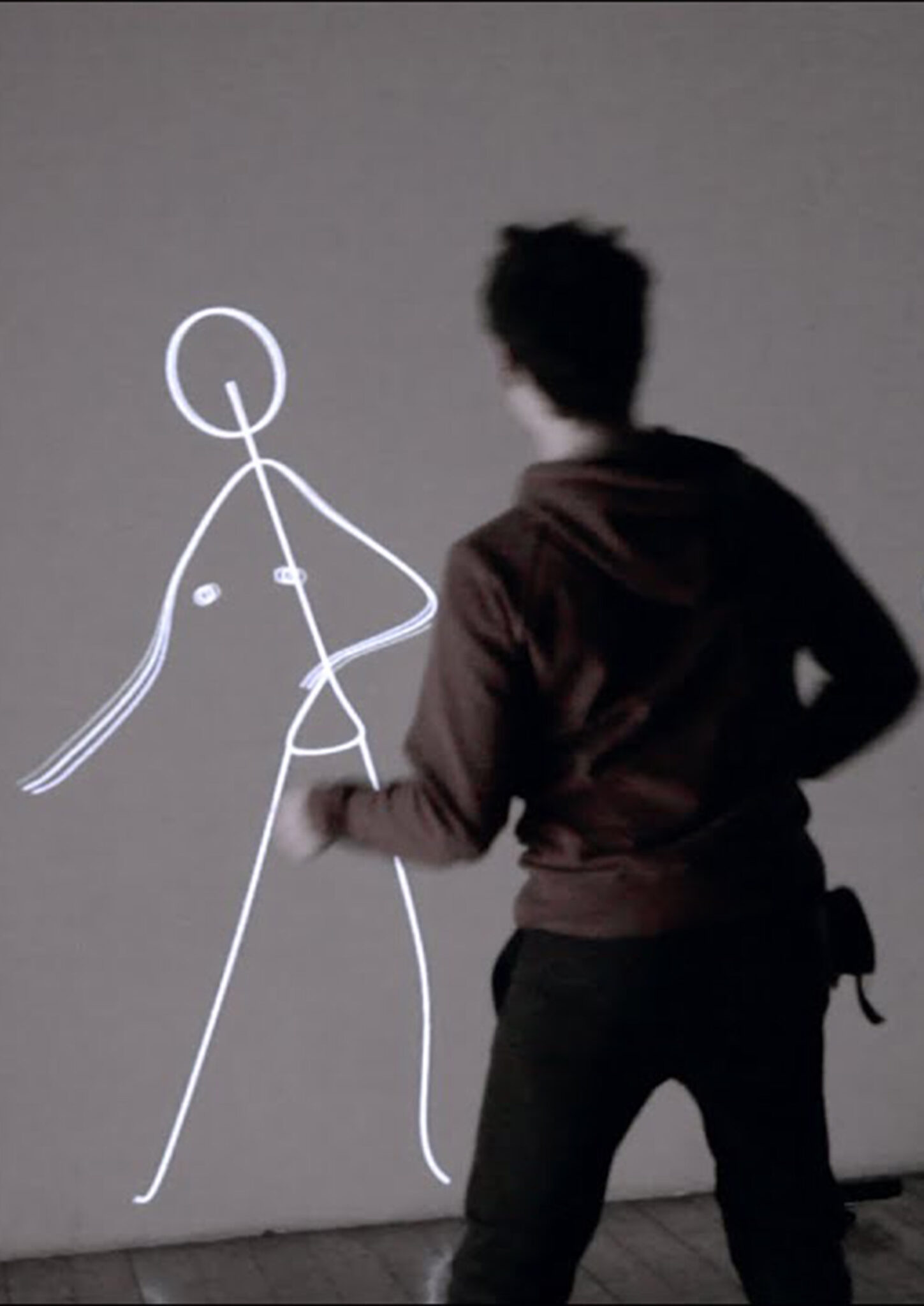
The mirror stage in psychology explains how the Ego forms through objectification, where one’s visual appearance comes into conflict with emotional experience, a concept called ‘alienation‘ by psychoanalyst Jacques Lacan. The interactive installation EGO reenacts and reverses this process by distorting the mirror image based on the user’s movements, highlighting the tension between the real and the symbolic, the Ego and the It, subject and object.

Bio

Klaus Obermaier is an interdisciplinary artist, director and composer who creates innovative works in the performing arts, music and installations using new media. Stefano D’Alessio researches social issues induced by the internet and explores how the web and its derivatives influence human behavior and the body. Martina Menegon creates intricate assemblages of physical and virtual elements, exploring the contemporary self and its hybrid corporeality.

Van Grimde Corps Secrets

Eve 2050
Nous sommes en 2050, dans un monde ou être humain ne signifie plus la même chose. Les avancées technologiques et biomédicales des 30 dernières années ont bouleversé le statut du corps et redéfini les identités. Certains humains ont embrassé les progrès technologiques, jusqu’à augmenter leurs corps avec des dispositifs artificiels. D’autres ont préféré s’hybrider avec d’autres espèces, faisant du biologique et du vivant leur technologie à eux. D’autres encore chérissent et honorent le corps originel, refusant toute modification corporelle ou n’ayant pas les moyens de s’augmenter. La web série Eve 2050 nous emmène au cœur de ce monde étonnant à travers 5 épisodes qui suivent le parcours d’Eve. Personnage symbolique, de toutes origines culturelles, à la fois enfant et adulte, homme, femme, transgenre, être de chair, virtuel ou artificiel. Eve 2050 propose un voyage inédit vers les corps et les êtres de demain.

Dragan Ilic

Re)Evolution

With the machine programed to draw, the robot becomes a medium for interaction and for “symbiosis” with the artist, creating a kind of “hybrid body” of man and machine, whose nervous system and brain waves administer “software commands” to the robot during the drawing performance. A key actor in the exhibition will be the new model of the KUKA KR 210 robot, that has a multi-functioning performative role: from drawing, experimental dance, music – through the production of industrial sound, and a six channel video projection that documents Ilić’s projects.

Lionel Hun and Pixel n’Pepper

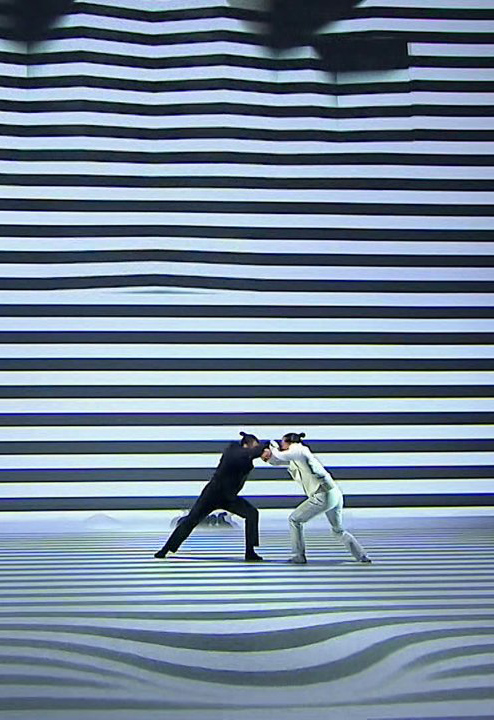
Black and White
Dedicated to the design and distribution of live shows combining the arts in all its forms, Compagnie Hybride offers a fusion of aesthetics. It is positioned at the crossroads of creativity where the bodies and new technology meet. Land on which confronts, body language and visual arts, in order to promote a work interdisciplinary research, choreography and artistic innovation. Through its creations, productions, performances, films, exhibitions, installations, educational workshops and event services, Compagnie Hybride, carried primarily by a desire to exchange, sharing, research and development, has a mandate to create and disseminate its designs in the artistic and cultural networks nationally and internationally.

GILBERTO ESPARZA

Nomadic Plants
Vegetation and microorganisms live in symbiosis inside the body of the Nomadic Plants robot. Whenever its bacteria require nourishment, the self-sufficient robot will move towards a contaminated river and ‘drink’ water from it. Through a process of microbial fuel cell, the elements contained in the water are decomposed and turned into energy that can feed the brain circuits of the robot. The surplus is then used to create life, enabling plants to complete their own life cycle. As Gilberto wrote in our email conversation, “The nomadic plant is a portray of our own species. It also deals with the alienated transformation of this new hybrid species that fights for its survival in a deteriorated environment.”