highlike

Stefan Tiefengraber

TH-42PH10EK x 5
Five screens were installed by the artist as pendulums that swing continuously. As soon as all five have come to a standstill, they are pulled back into their original positions with the help of cable winches and are made to swing again – triggered by pulling a rip cord, a performative act that cannot take place without human intervention and which involves the exhibition supervisor in the installation. Each cycle, which lasts approximately 45 minutes, ends as soon as all five screens have come to a standstill and no more sound is produced by their movement. The sound is produced by the amplification of the friction to which the joints of the moving pendulum are subjected. Multiplication thus creates five oscillating loops that merge into one another with a time offset.
Roman Ermakov

Роман Ермаков
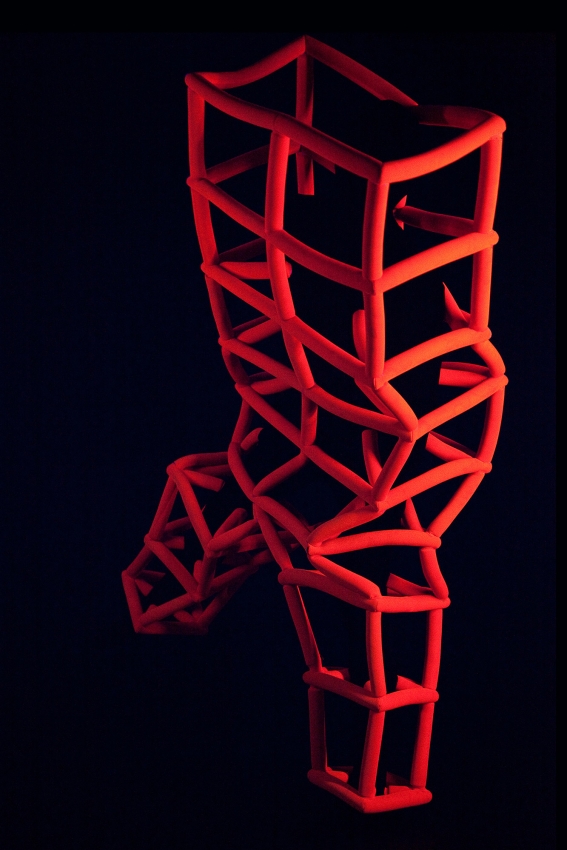
live sculpture

Our perception — the only true reality. Creation as a feeling that generates the image, expressed in the form. Beauty manifesto calling to go beyond that limit imagination. The aesthetics of art can not be reduced to a clear set of building blocks with which you can strengthen or weaken the perception of contrast. Beauty should not be subjected to analysis, that is communication and the call to participate in the transformation of the emotional to the visible.The process of creating — is the alignment of the mosaic, many repetitions of simple and pure elements, which form a collection, harmonious in its incompleteness.

Roman Ermakov

Alchemy 3

Our perception — the only true reality. Creation as a feeling that generates the image, expressed in the form. Beauty manifesto calling to go beyond that limit imagination. The aesthetics of art can not be reduced to a clear set of building blocks with which you can strengthen or weaken the perception of contrast. Beauty should not be subjected to analysis, that is communication and the call to participate in the transformation of the emotional to the visible.

FILE SÃO PAULO 2025: SYNTHETIKA – Frederik De Wilde

Hunter and Dog

Frederik De Wilde

FILE SÃO PAULO 2025: SYNTHETIKA – Art and Technology – Installations
Electronic Language International Festival

Hunter and Dog – Belgium

Genetic and evolutionary algorithms reinterpret an existing artwork. De Wilde uses digital scans and custom genetic and evolutionary algorithms as a deconstruction technique to reinterpret and update the nineteenth-century work Hunter and Dog from sculptor John Gibson R. A. (1790–1866).

Frederik De Wilde’s Hunter and Dog interrogates the intersections of human evolution, genetic engineering, and the hybridization of technology and biology. De Wilde reinterprets the historical sculpture through the lens of post-evolutionary theory, engaging with contemporary debates on CRISPR, synthetic biology, and the implications of human-directed genetic modification. CRISPR, the revolutionary gene-editing technology, has introduced an unprecedented rupture in the trajectory of evolution. No longer constrained by the slow mechanisms of natural selection, humans now possess the ability to intervene directly in their own genetic blueprint, marking a shift toward a post-Darwinian paradigm. This technological power, however, is not neutral; it emerges from a historical lineage of scientific inquiry deeply entangled with colonialism. The history of genetic manipulation is inseparable from colonial bioprospecting, eugenics, and exploitative medical experimentation on marginalized populations. Colonial regimes treated bodies—both human and non-human—as sites of intervention, control, and optimization, a logic that persists in contemporary biotechnological frameworks. Post-colonial discourse reveals how genetic engineering risks perpetuating these legacies, reinforcing power asymmetries between those who wield biotechnological control and those subjected to its consequences. CRISPR, while offering the promise of eradicating disease and expanding human potential, also raises ethical concerns about genetic stratification, bio-capitalism, and the commodification of life itself. De Wilde’s work visualizes these tensions, making visible the processes of cell division and morphogenesis—the very biological mechanisms now subject to human intervention. Hunter and Dog does not merely depict the transformation of a neoclassical form but speculates on the future of the human body as a site of engineered evolution. From a decolonial perspective, the artwork questions who has the authority to edit life and to what ends. It challenges the techno-utopian narratives that frame genetic modification as an inevitable progress while obscuring its social, ethical, and ecological implications. By hybridizing art, science, and technology, Hunter and Dog compels us to confront the uncertainties of a CRISPR-driven future: Will genetic editing reinforce existing inequalities, or can it be decolonized and democratized? How do we navigate this post-natural frontier without losing the human—and more-than-human—dimensions of our existence? De Wilde’s work invites us into this speculative space, where the hunter, the dog, and the algorithm coalesce into a vision of a world where biology is no longer destiny, but a site of contested agency.

Where are we going from here? 

BIO

Frederik De Wilde fuses art, science, and tech. Known for his Blackest-Black works that inspired Kapoor’s Vantablack, he has shown at Venice Biennale, BOZAR, MAAT, Pompidou, and ZKM, winning awards like Ars Electronica.

RACHEL ALTABAS

“I move, reverse, manipulate the rules so that they cannot integrate in any frame. My measure is dynamic, it always ties and unties, endlessly exceeding itself. I overflow, going past the initial measure. The resulting drift becomes my new measure and imposes on me another frame, a palette with rigid outlines. I am confronted to strict and solid delimitations. One more time bored of being subjected to the measure.”

REYNOLD REYNOLDS

레이 놀드 레이놀즈
РЕЙНОЛЬД РЕЙНОЛЬДС
Secrets Trilogy
Secret Machine

Secret Machine is the second of the Secrets Trilogy; a cycle exploring the imperceptible conditions that frame life and is preceded by Secret Life (2008) and followed by Six Easy Pieces (2010)
In Secret Machine a woman is subjected to Muybridge’s motion studies. She is treated in the same fashion as in the original Muybridge photography: with Greek aesthetic in a Cartesian grid. A short time after Mybridge’s studies, Duchamp painted Nude Descending a Staircase, No. 2 (1912) attempting to show time on a flat surface. He is expanding cubism and painting into another dimension: time. Time is about movement and change, like our experience of reality. Without change life does not exist. Photography does not capture this experience. In Secret Machine different filming techniques are compared to the motion of the body. The film camera becomes another measurement tool in a way a video camera cannot. The intention was to make an art piece from the point of view of a machine, specifically a camera.
.
.