highlike

FILE SÃO PAULO 2025: SYNTHETIKA – Frederik De Wilde

Hunter and Dog

Frederik De Wilde

FILE SÃO PAULO 2025: SYNTHETIKA – Art and Technology – Installations
Electronic Language International Festival

Hunter and Dog – Belgium

Genetic and evolutionary algorithms reinterpret an existing artwork. De Wilde uses digital scans and custom genetic and evolutionary algorithms as a deconstruction technique to reinterpret and update the nineteenth-century work Hunter and Dog from sculptor John Gibson R. A. (1790–1866).

Frederik De Wilde’s Hunter and Dog interrogates the intersections of human evolution, genetic engineering, and the hybridization of technology and biology. De Wilde reinterprets the historical sculpture through the lens of post-evolutionary theory, engaging with contemporary debates on CRISPR, synthetic biology, and the implications of human-directed genetic modification. CRISPR, the revolutionary gene-editing technology, has introduced an unprecedented rupture in the trajectory of evolution. No longer constrained by the slow mechanisms of natural selection, humans now possess the ability to intervene directly in their own genetic blueprint, marking a shift toward a post-Darwinian paradigm. This technological power, however, is not neutral; it emerges from a historical lineage of scientific inquiry deeply entangled with colonialism. The history of genetic manipulation is inseparable from colonial bioprospecting, eugenics, and exploitative medical experimentation on marginalized populations. Colonial regimes treated bodies—both human and non-human—as sites of intervention, control, and optimization, a logic that persists in contemporary biotechnological frameworks. Post-colonial discourse reveals how genetic engineering risks perpetuating these legacies, reinforcing power asymmetries between those who wield biotechnological control and those subjected to its consequences. CRISPR, while offering the promise of eradicating disease and expanding human potential, also raises ethical concerns about genetic stratification, bio-capitalism, and the commodification of life itself. De Wilde’s work visualizes these tensions, making visible the processes of cell division and morphogenesis—the very biological mechanisms now subject to human intervention. Hunter and Dog does not merely depict the transformation of a neoclassical form but speculates on the future of the human body as a site of engineered evolution. From a decolonial perspective, the artwork questions who has the authority to edit life and to what ends. It challenges the techno-utopian narratives that frame genetic modification as an inevitable progress while obscuring its social, ethical, and ecological implications. By hybridizing art, science, and technology, Hunter and Dog compels us to confront the uncertainties of a CRISPR-driven future: Will genetic editing reinforce existing inequalities, or can it be decolonized and democratized? How do we navigate this post-natural frontier without losing the human—and more-than-human—dimensions of our existence? De Wilde’s work invites us into this speculative space, where the hunter, the dog, and the algorithm coalesce into a vision of a world where biology is no longer destiny, but a site of contested agency.

Where are we going from here? 

BIO

Frederik De Wilde fuses art, science, and tech. Known for his Blackest-Black works that inspired Kapoor’s Vantablack, he has shown at Venice Biennale, BOZAR, MAAT, Pompidou, and ZKM, winning awards like Ars Electronica.

David Spriggs

Vision II
David Spriggs’ Vision artwork series have a distinct focus on the senses. Accentuated by an affinity between its subject matter and the fragmentary nature of the medium, there is a tension created between form and emptiness. Appearing both as an implosion and as an explosion depending on the one’s perception, the viewer has the sense that he/she is observing a form in becoming, yet at the same time breaking down. The immersive experience created by Vision provides the audience with the impression that they are in the midst of witnessing an event, something of monumental proportions akin to the Big Bang. In changing viewpoints by navigating around the work, Vision is continually altered, breaking down at the sides so that the viewer can only see the edge planes of multiple sheets, begging the question: Is there in fact a form, or just individual images?
Samuel Fasse & Morgan Belenguer

The look elsewhere
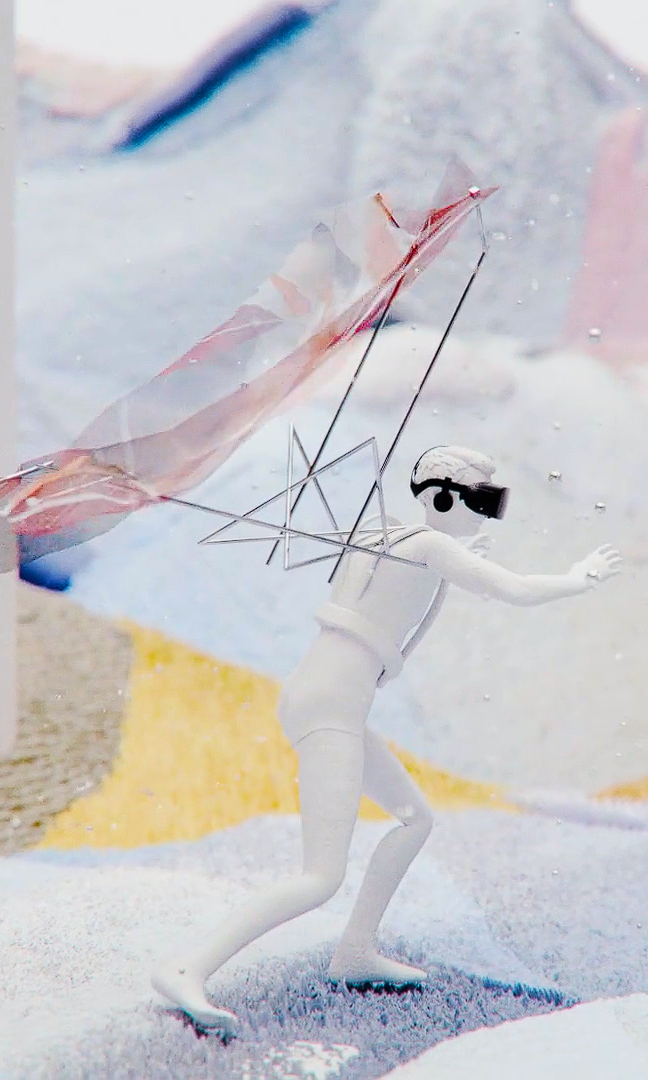
The work, which in this video version is coupled with uncanny virtual landscapes, blurs the boundaries between the real and the simulated, while expanding the artwork into the virtual via the VR-headset wearing dancers. The artwork captures the entangled play between the participants, but also provides the viewer with a new perspective—opening a window onto the virtual dimension of the performance. The borders keep on fading, from the point where technology begins and physicality ends.

Objective Realities

automato.farm
FILE FESTIVAL 2018
As things become smarter and connected, their roles in people’s lives are challenged. Things become closer and closer to us, eventually becoming “users” themselves. How will we understand objects’ needs and perspectives and potentially design for them?