highlike

Jacek Doroszenko – Landscape Video Score. Fjord – Poland

LANDSCAPE VIDEO SCORE. FJORD

Jacek Doroszenko


FILE SÃO PAULO 2026: Inter-creativity – Art and Technology – CINEFILE | Short
Electronic Language International Festival


Landscape Video Score. Fjord – Poland

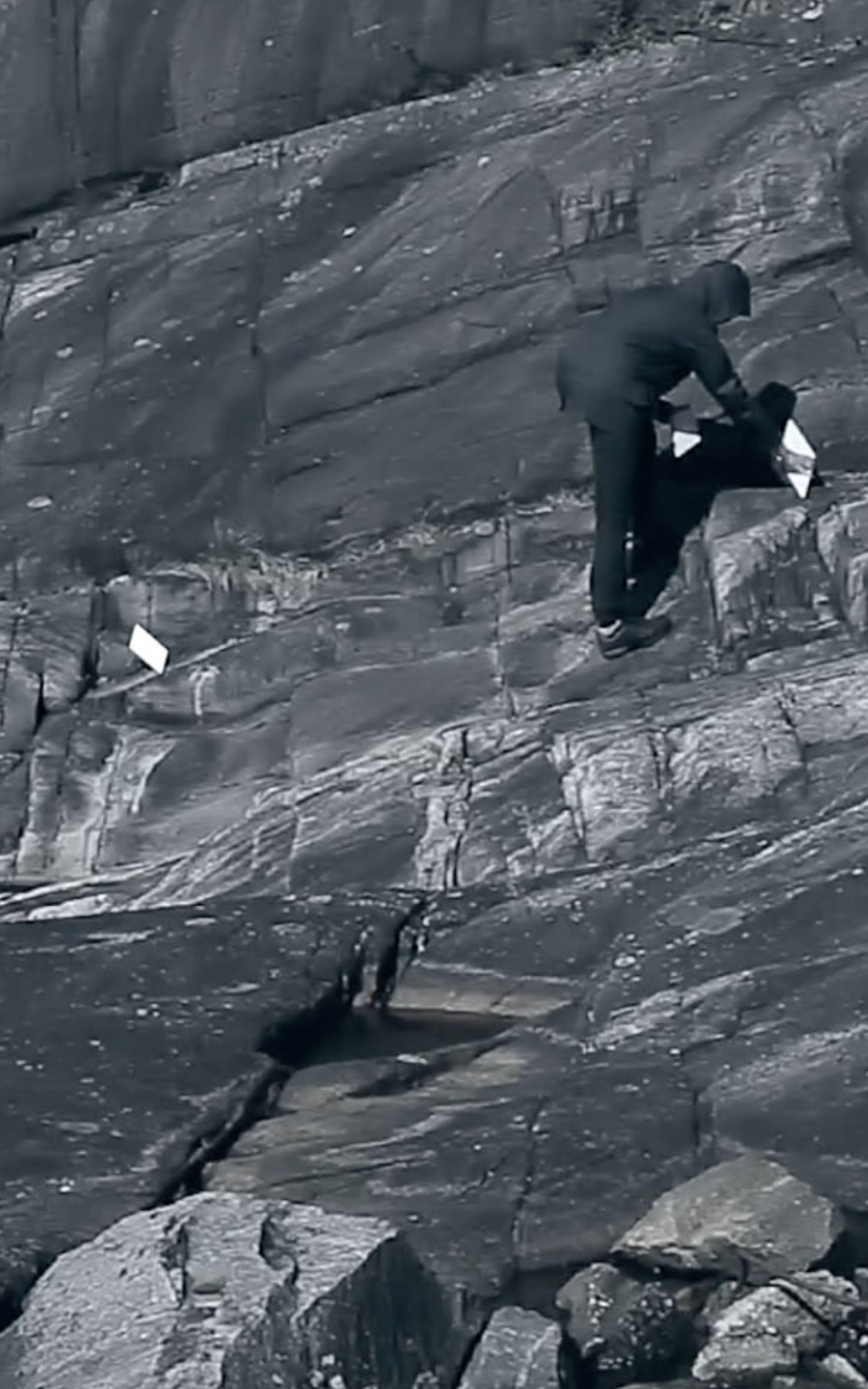
Landscape Video Score. Fjord by Jack Doroszenko is a video art recorded in the landscape of the Hardangerfjord, Norway. Based on the artist’s original concept of a video score, the film combines image and sound: topography and character movement shape the sound composition. The landscape becomes both a visual frame and a sound structure, exploring the performative dialogue between the body, nature and technology.

BIO

Jacek Doroszenko is a Polish intermedia artist. His work deals with topics related to sound phenomena in the context of space. He is a graduate of the Academy of Fine Arts in Krakow, a cultural scholarship holder, a participant in numerous international residencies and exhibitions around the world, and the author of solo music albums released in France, the United Kingdom and the USA.

Joris Strijbos

DARK ECOLOGY

IsoScope

IsoScope is a kinetic audiovisual outdoor installation, a sensorial experience in which the audience wanders through rotating lights and an ever-changing sonic cloud. This new work by Dutch artist Joris Strijbos consists of multiple robotic wind objects interacting with each other and with their surroundings. Strijbos aimed at creating a human-constructed phenomenon, an abstract entity which, like most natural phenomena, can only be experienced in certain weather conditions. IsoScope can be seen as a proposition for a new kind of machinic and artificial lifeform. IsoScope was commissioned by Sonic Acts for the second Dark Ecology Journey (2015) and realised in collaboration with Jeroen Molenaar, Daan Johan and Erfan Abdi.

Hicham Berrada

Présage
Nurtured by a dual artistic and scientific background, Hicham Berrada’s work combines intuition and knowledge, science and poetry. In his works, he explores scientific protocols that mimic different natural processes and/or climatic conditions as closely as possible. “I try to control the phenomena I mobilize as a painter controls his pigments and brushes. My brushes and pigments would be temperature, magnetism, light.”

Jessica Eaton

ジェシカ·イートン
杰西卡·伊顿
polytopes

Jessica Eaton’s photographs dissect chemical and optical phenomena, the materiality of film, and the language of light itself. Eaton came to international acclaim through her Cubes for Albers and LeWitt (commonly referred to by the acronym cfaal)—a series of vibrant photographs that deconstruct her studio practice. Like the majority of Eaton’s works, these optically charged images are made by taking multiple in-camera exposures of common studio supplies. Through her abundant use of traditional analog photography practices—such as colour-separation filtering and in-camera masking—Eaton imbues her large-format images with an aesthetic more reminiscent of the paintings and drawings of hard-edge geometric abstraction than the photographs of traditional studio work.