highlike

WILLIAM FORSYTHE

ויליאם פורסיית
ウィリアム·フォーサイス
威廉‧科西
윌리엄 포사이드
Уильям Форсайт
scattered crowd

Thousand of white balloons, suspended in a billowing wash of sound; an air-borne landscape of relationship, of distance, of humans and emptiness, of coalescence and decision. In the gorgeous, breathless space that is choreographer William Forsythes «Scattered Crowd», the viewer inhabits and alters, through their stillness or speed, their sense of proportion and time, the configurations that make up this constantly shifting, ecstatic world.

FILE SÃO PAULO 2025: SYNTHETIKA – Edwin van der Heide

Spiral of Time — Amazonas Brazil — UFAM

Edwin van der Heide

Interact with Spiral of Time — Amazonas Brazil — UFAM via FILE ARCHIVE


FILE SÃO PAULO 2025: SYNTHETIKA – Art and Technology – Installations
Electronic Language International Festival


Spiral of Time — Amazonas Brazil — UFAM – Netherlands

Spiral of Time captures and stages the diverse soundscape of a specific location over the course of several years. By documenting the unique natural, cultural, spatial, and temporal dynamics of a place, the work honors the contributions of all its actors. Every hour, a one-minute recording is made, resulting in a vast sonic archive over time. It is accessible online through a spiral-shaped interface, allowing listeners to explore the cyclical patterns revealed by navigating the material across different time intervals. 


Since July 17th, 2024, the artist has been recording the sounds of the square in front of MACBA (Museum of Contemporary Art of Barcelona). It is a very interesting, diverse, and vibrant urban space. The work is accessible online via https://www.macba.cat/en/spiral-of-time-placa-dels-angels/ and will also be presented physically in the museum starting July 10th, 2025.


Edwin is expanding the project to include other recording locations around the world—not only in urban contexts (dominated by humans) but also in areas governed by nature. The artist dedicated himself to a recording site in the Amazon region. Since February 11th, 2025 Spiral of Time has been installed at the Amazon Rainforest surrounding The UFAM (Federal University of Amazonas) in Manaus. It is home to one of the world’s largest urban forest fragments. Completely surrounded by the dense urban matrix of Manaus, this forest has been isolated since the late 1980s. The forest retains rich ecological features, including areas of mature terra-firme forest, late-stage secondary vegetation, and small patches of white-sand forests. This unique setting offers a rare opportunity to study tropical forest dynamics within a metropolitan environment. 

Spiral of Time-UFAM immerses the listeners in the acoustic life of one of the most biodiverse ecosystems on the planet. This contrast between the natural rhythms of the forest and the human-made patterns of the city enriches the broader narrative of the Spiral of Time, offering a deeper reflection on coexistence, change, and continuity across different environments.

BIO

Edwin van der Heide is an artist, composer, and researcher focused on sound, space, and interaction. His work pushes the boundaries of musical composition toward spatial, interactive, and interdisciplinary directions. He creates installations, performances, and immersive environments where the audience is placed at the center, encouraged to engage sensorially and investigatively.


Studio TheGreenEyl

Appeel
»Appeel« is a game without rules. It starts with a wall that is covered all over with a signal red adhesive foil. The foil consists of thousands of circular stickers pre-cut in a narrow grid that wait to be pulled off and put in a new order by the visitors. The stickers, and its white negative on the wall, form, similarly to binary coded pixels, ornaments, news and pictures – on the original wall and far beyond: they move to adjoining rooms, onto faces and even leave the city.

KEITH ARMSTRONG

Shifting Intimacies
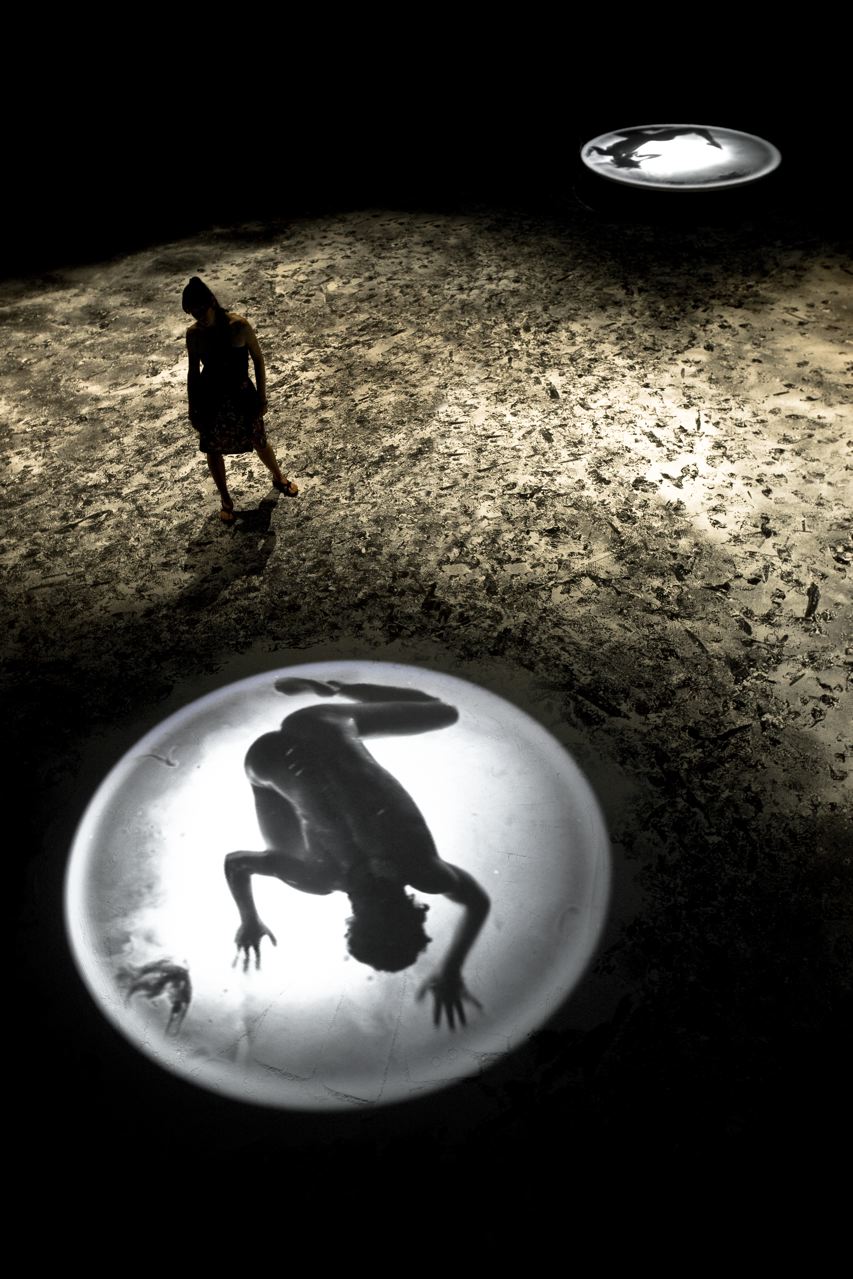
An interactive/media artwork for one person at a time. Each participant enters a large, dark space containing two circles of projected film imagery presented within an immersive sound environment. One image floats upon a disc of white sand and the other on a circle of white dust. Participants’ movements direct and affect the filmic image and spatialised audio experience. Throughout the work a layer of dust (an artificial life form) slowly eats away and infuses itself deep into the imagery and sound. Each person has 10 minutes alone with the work. Their movement through the space continually affects speed, quality, balance and flow within the work. At the end of the experience they are invited to climb a lit platform and cast dust back onto the images below.

GARY CARD

Plasticine Cave
Gary Card is a young and amazing English designer, a graduate of Central Saint Martins, who made the “Plasticine Cave” installation for Spring Studios Gallerya few years ago. He is redefining boundaries by using plasticine in huge quantities and making us feel disturbed by all those skulls. The installation consists of 2 thousands gawking faces sculpted out of almost 3 tonnes of white plasticine, giving a huge and dramatic cave where the combination of materials and light give an outstanding interior space.

YE Cheng

野城
Kong Shanshui – 空山水

The base of the installation consists of layers of white stones which fill the ancient palace’s courtyard, echoing peaceful, meditative gardens. On top of the stones are piles or gatherings of petri dishes, some ten thousand in total, stacked in various forms, resembling miniature hills, mountains and rock formations.

KENICHI KANAZAWA

Kaleidoscope of Sounds issue

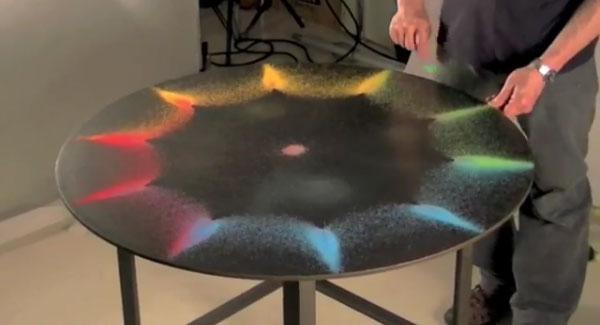
This movie was taken during the photo shooting for “Otona no Kagaku Magazine with Kids / Kaleidoscope of Sounds issue”, a magazines with giveaways. This shows the art performance by Mr. Kenichi Kanazawa who sublimated the method of making sounds visible, invented by Ernst Chladni — a physicist of 18-19 century, to a work of art in his unique style. After placing white-colored sand on a steel pan, he rubs the surface of a pan with a rubber ball attached to the tip of metal stick to generate the vibration.

Ballet Preljocaj

AND THEN, ONE THOUSAND YEARS OF PEACE
And Then, One Thousand Years of Peace is a huge, ambitious monolith of a work. First created by Angelin Preljocaj for the Bolshoi Ballet in 2010, it takes inspiration from the vision of apocalypse conjured by St John in the biblical Book of Revelation.There are no horses galloping across the stage or horned beasts. But Preljocaj sets himself a barely less daunting task: choreographing the essential meaning of apocalypse, as a cataclysm so profound it lays bare the very essence and history of human nature.Preljocaj launches his work with a shattering opening sequence. Ten women drive through hard, slicing, geometric formations; lights flash, electro-percussive music reverberates; and the air becomes as thick and swarming as a tropical thunderstorm as the movement accelerates towards its convulsive climax.Out of this intensity emerges a Garden of Eden tranquillity, where men lope and flutter in delicately animalistic moves, and two women in white tunics play like lazy cherubs.