highlike

FILE SÃO PAULO 2025: SYNTHETIKA – Frederik De Wilde

Hunter and Dog

Frederik De Wilde

FILE SÃO PAULO 2025: SYNTHETIKA – Art and Technology – Installations
Electronic Language International Festival

Hunter and Dog – Belgium

Genetic and evolutionary algorithms reinterpret an existing artwork. De Wilde uses digital scans and custom genetic and evolutionary algorithms as a deconstruction technique to reinterpret and update the nineteenth-century work Hunter and Dog from sculptor John Gibson R. A. (1790–1866).

Frederik De Wilde’s Hunter and Dog interrogates the intersections of human evolution, genetic engineering, and the hybridization of technology and biology. De Wilde reinterprets the historical sculpture through the lens of post-evolutionary theory, engaging with contemporary debates on CRISPR, synthetic biology, and the implications of human-directed genetic modification. CRISPR, the revolutionary gene-editing technology, has introduced an unprecedented rupture in the trajectory of evolution. No longer constrained by the slow mechanisms of natural selection, humans now possess the ability to intervene directly in their own genetic blueprint, marking a shift toward a post-Darwinian paradigm. This technological power, however, is not neutral; it emerges from a historical lineage of scientific inquiry deeply entangled with colonialism. The history of genetic manipulation is inseparable from colonial bioprospecting, eugenics, and exploitative medical experimentation on marginalized populations. Colonial regimes treated bodies—both human and non-human—as sites of intervention, control, and optimization, a logic that persists in contemporary biotechnological frameworks. Post-colonial discourse reveals how genetic engineering risks perpetuating these legacies, reinforcing power asymmetries between those who wield biotechnological control and those subjected to its consequences. CRISPR, while offering the promise of eradicating disease and expanding human potential, also raises ethical concerns about genetic stratification, bio-capitalism, and the commodification of life itself. De Wilde’s work visualizes these tensions, making visible the processes of cell division and morphogenesis—the very biological mechanisms now subject to human intervention. Hunter and Dog does not merely depict the transformation of a neoclassical form but speculates on the future of the human body as a site of engineered evolution. From a decolonial perspective, the artwork questions who has the authority to edit life and to what ends. It challenges the techno-utopian narratives that frame genetic modification as an inevitable progress while obscuring its social, ethical, and ecological implications. By hybridizing art, science, and technology, Hunter and Dog compels us to confront the uncertainties of a CRISPR-driven future: Will genetic editing reinforce existing inequalities, or can it be decolonized and democratized? How do we navigate this post-natural frontier without losing the human—and more-than-human—dimensions of our existence? De Wilde’s work invites us into this speculative space, where the hunter, the dog, and the algorithm coalesce into a vision of a world where biology is no longer destiny, but a site of contested agency.

Where are we going from here? 

BIO

Frederik De Wilde fuses art, science, and tech. Known for his Blackest-Black works that inspired Kapoor’s Vantablack, he has shown at Venice Biennale, BOZAR, MAAT, Pompidou, and ZKM, winning awards like Ars Electronica.

Aqua Creations

Manta Ray Light
Aqua Creations creates hand crafted lighting design. Each piece is designed in their studio, on a made to order basis by their team of artisans who have been working for 30 years. Through spellbinding designs combined with master craftsmanship and innovative technology, light fuses with function and becomes art.

Jacky Tsai

Golden Years
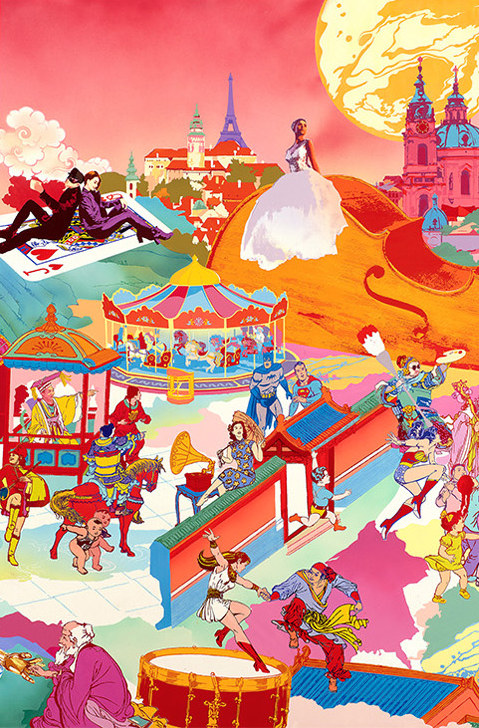
Jacky Tsai is a Chinese artist based in London. His inventive approach fuses traditional eastern artistic techniques and imagery with western Pop Art references to create an original style that seeks to establish balance and harmony between cultural extremes.

NARINDA REEDERS

the shy picture
Narinda Reeders and David MacLeod
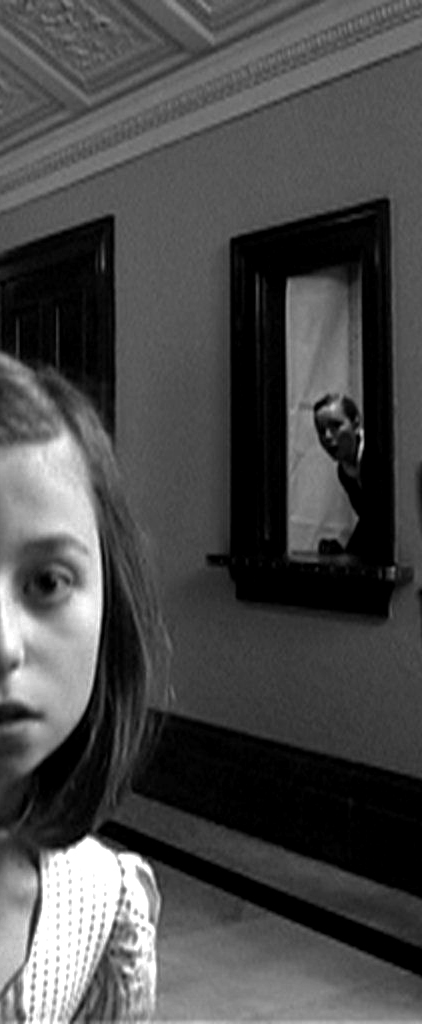
Here is a calm and intimate film in black and white, but which refuses to divulge the plot. The characters in the story are revealed to be in a painting. Although the subject is very classic since the portrayal of Dorian Gray by Oscar Wilde. Everything happens this time as if the problematic of creation ultimately had its own existence. This is often the case for the artist when faced with his production. Where in front of the finished work. Narinda Reeders and David MacLeod’s bring this little photo hanging on the gallery wall to life. It’s calm, discreet and mysterious. It is a duality that nevertheless works in both directions, that of the work vis-à-vis the artist, that of the art lover in front of a work. In both cases there is a personal touch that brings you to life. But the real does not come out unscathed.

MOMU3 X BULO

Frederik Heyman and Wout Bosschaert

For MOMU3, Frederik Heyman creates, in collaboration with graphic artist Wout Bosschaert, 3 fashion films in which he infuses the rich collection of the ModeMuseum with digital life by using 3D scans and manipulations.

.

MOMU3 では、フレデリック ヘイマンがグラフィック アーティストの Wout Bosschaert と協力して、3D デジタル化と操作を使用して ModeMuseum の膨大なコレクションにデジタル ライフをもたらす 3 つのファッション映画を制作しました。


Kohei Nawa

Throne
This work attempts to express that premonition as an immense “floating vacant throne”. If instances of power and authority have ruled since ancient times, and the pyramids provide one example—we must ask what the future will hold. Created with reference to the forms of festival floats and portable shrines that appear in the rituals and festivities of the East, the sculpture fuses today’s 3D modeling techniques with gold leaf applications that date back to ancient Egypt. In the frontal center is an empty room, space enough for a 2 to 3-year-old child to sit, suggesting that the new intelligence is still in a young state. Shining, spherical mirrors placed at the center in front and back. Made of platinum foil, they represent “the eyes overlooking the world”, where the frontal one faces the future and the back reflects into the past.

Tobias Gremmler

Virtual Actors in Chinese Opera
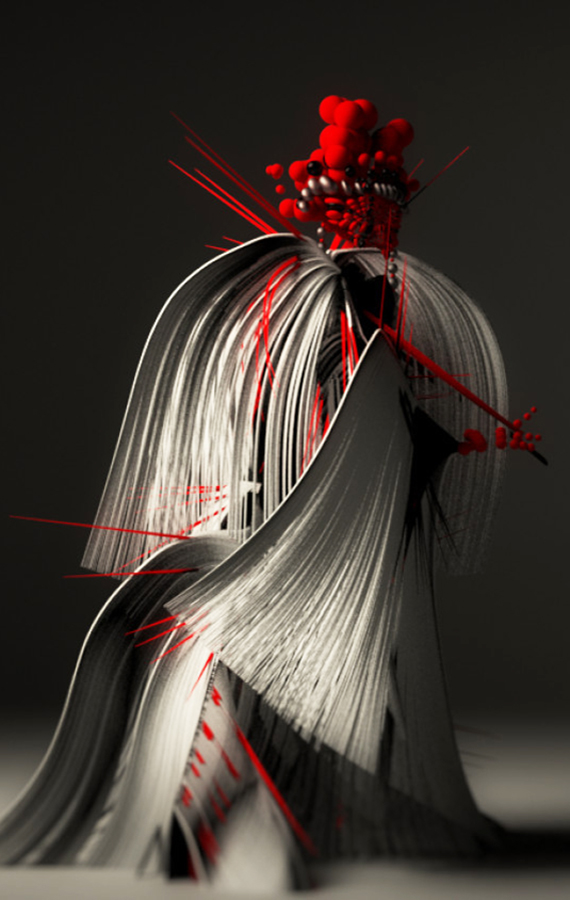
Created for a theater piece that fuses Chinese Opera  with New Media, the virtual actors are inspired by shapes, colors and motions of traditional Chinese costumes and dance. The project explores how costumes and motions can virtually reshape a human body.

KEITH ARMSTRONG

Shifting Intimacies
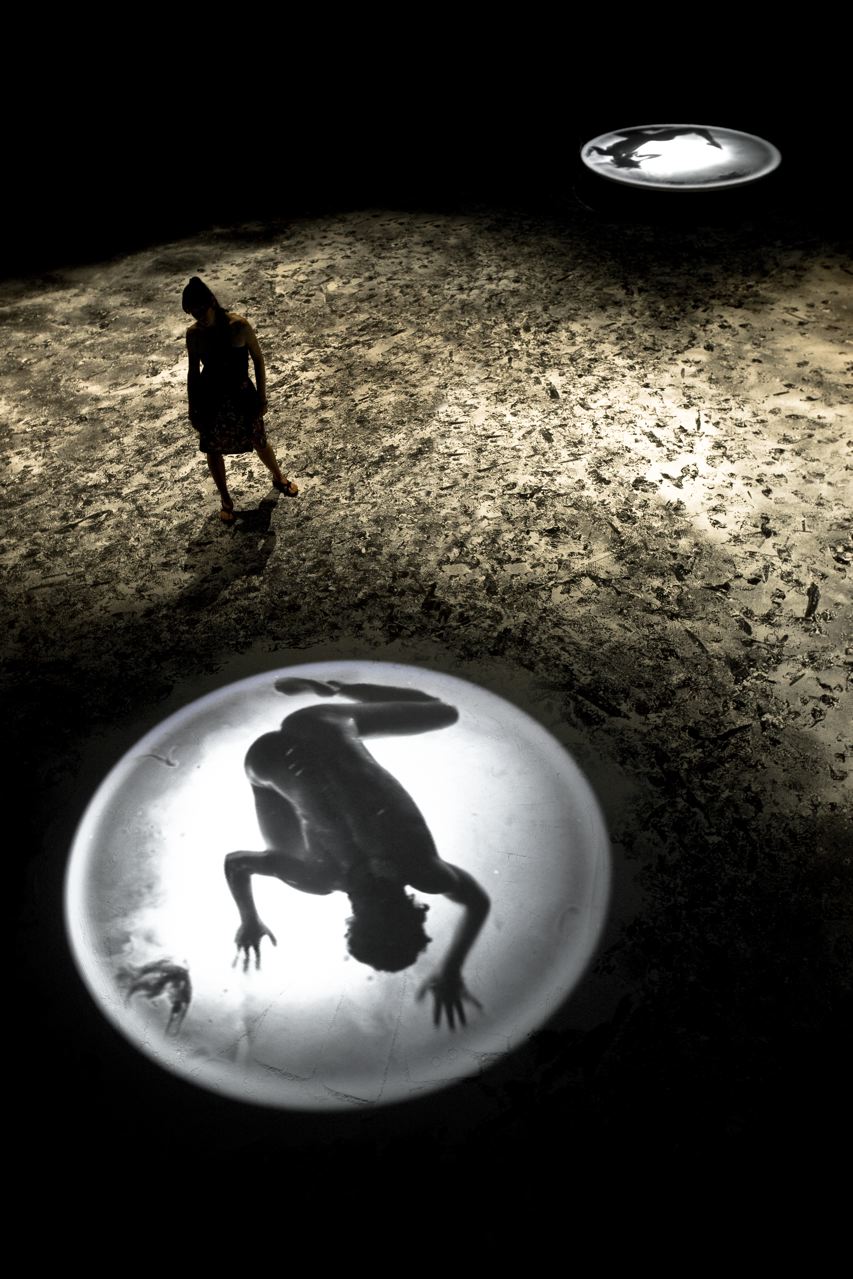
An interactive/media artwork for one person at a time. Each participant enters a large, dark space containing two circles of projected film imagery presented within an immersive sound environment. One image floats upon a disc of white sand and the other on a circle of white dust. Participants’ movements direct and affect the filmic image and spatialised audio experience. Throughout the work a layer of dust (an artificial life form) slowly eats away and infuses itself deep into the imagery and sound. Each person has 10 minutes alone with the work. Their movement through the space continually affects speed, quality, balance and flow within the work. At the end of the experience they are invited to climb a lit platform and cast dust back onto the images below.

Katja Heitmann

Eggs Are Good For Your Hair
Katja is inspired by the influence of everydays’ digital technologies on society and with that the arising questions about the identity of our human body. She fuses everydays’ technology, the dancers’ body and the presence of the audience into unconventional performances. Who moves who?

lauren dimaya krystal li heidy cordero arias

every time the stars align
FILE LED SAO PAULO 2018
“Every Time the Stars Align” fuses different natural elements of crystals, plasma and flowers in a lava lamp environment. Red crystals freeze with rigid edges and thaws into a relaxing mood. Plasma liquid rises and falls reflecting a lava-like quality. Flowers fluctuate between a spectrum of color symbolizing intense human affections. Contradicting and uniting flat and deep spaces, the three elements compose and decompose.

Katja Heitmann

Me, My Selfie and I
Katja is inspired by the influence of everydays’ digital technologies on society and with that the arising questions about the identity of our human body. She fuses everydays’ technology, the dancers’ body and the presence of the audience into unconventional performances. Who moves who?

Aranda\Lasch

阿兰达\拉希
アランダ\ラッシュ
Railing Lounge Chair

Railing is an exploration of structural modular loops that are upholstered like handle-grips to become furniture. Each piece of furniture is a single loop made up of many circles. Here, the circle does not display the qualities it is most known for, but it is what a circle can be. It is not whole or complete but is instead growing into itself. It is a circle that refuses its own dimension and finitude, that struggles to be endless.

Ieva Misevičiūtė

Performing Tongue PhD
Tongue PhD is a new eclectic solo performance by artist Ieva Misevičiūtė. This ambitious piece consists of ten chapters each investigating a different metaphoric lens of the tongue. Tongue PhD fuses elements of physical theater, academic reverie, dance and Butoh, structured in the format of a PhD dissertation. CREDITS concept, text, choreography and scenography Ieva Miseviciutè

Jonathan Monk

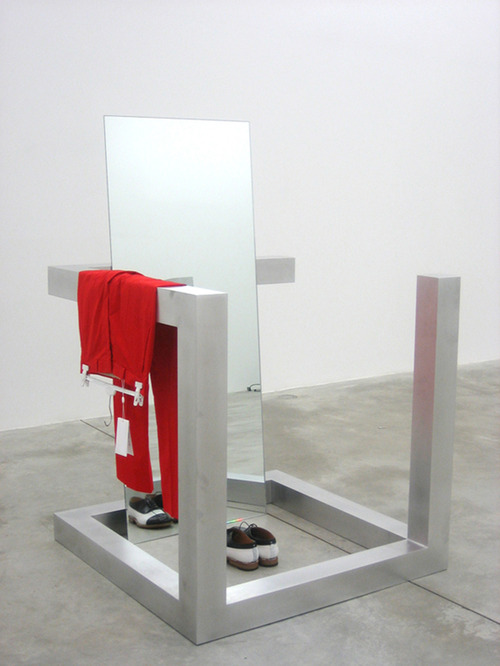
The New Sculpture
Jonathan Monk was born in Leicester in 1969. Monk received a BFA from Leicester Polytechnic in 1988 and an MFA from Glasgow School of Art in 1991. In his work, Monk adopts the esthetics and practices of 1960s Conceptualism, but infuses the tradition with humor, levity, and autobiographical elements.

Strijbos & Van Rijswijk

rocking chairs
Strijbos & Van Rijswijk invite you to sit back, relax and enjoy making music in a one-of-a-kind sonic rocking chair, where physical movement diffuses and modifies sound emanating from specially developed sensorpack and loudspeaker technology. Swaying back and forth produces an interactive, personalized performance where the compositions you hear are directly shaped by your individual movements and ability to coordinate and work in unison with your fellow rockers.

guillaume mazars

ambient light
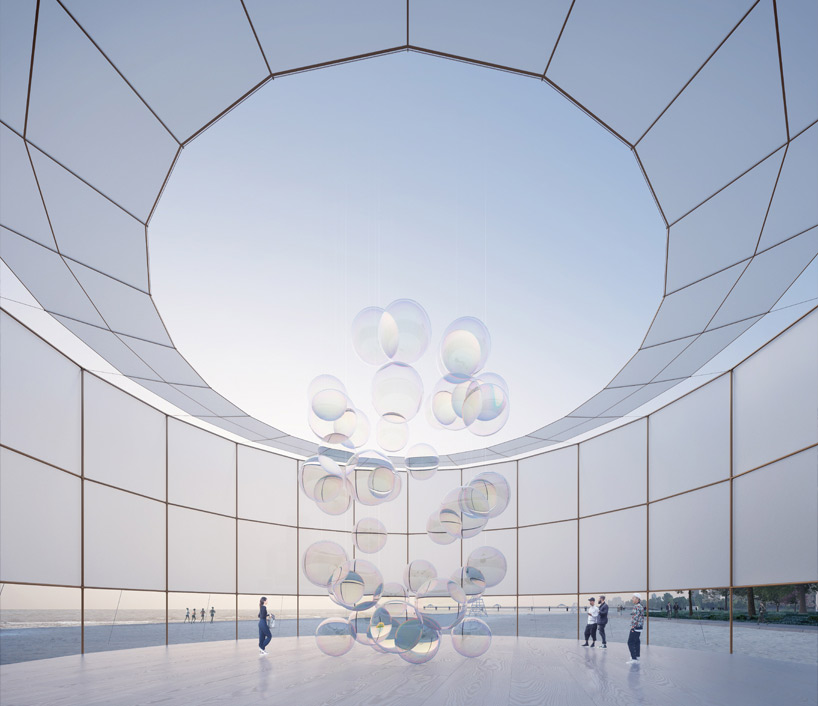
Project for a kiosk on the lakefront of Chicago. Waterfronts are special places. A meeting point between earth and sea, the horizon is exposed. More than elsewhere the sky is present, it illuminates and color permeates the place. The project aims to exacerbate this feeling by framing the views and accentuating the light of the moment.A translucent fabric filter diffuses the light, revealing the average color of the sky. This veil delimits the space and generates privacy. The fabric masks some of the context to better reveal its brightness. Inside a suspended fabric ring provides shade. The center of the roof is open to expose the sky. All you can see and connect with is the horizon and the sky.