highlike

FILE 2026 – Registration Open for the Digital Architecture and AI Festival – Art and Technology

FILE 2026

Digital Architecture and AI Festival :  investigates the use of computational technologies in the conception, visualization, and experience of space.  Works may involve virtual environments, simulations, digital facades, interactive architectural installations, and discrete systems. Algorithms and data become design tools. It is a practice that articulates art, architecture, and technology.

Applications were open until February 19, 2026. Access  the application form.

FILE 2026 | GENERAL REGULATIONS

FILE 2026 – Registration Open for Digital Animation and AI Festival – Art and Technology

FILE 2026

Animation Festival | Digital Animations and AI Animations: investigate movement as an expressive language, using computational tools and experimental aesthetics.  The works can explore abstract or figurative narratives, often hybridized with data, algorithms, and simulations. Technology expands the formal and temporal possibilities of animation. It is a field that articulates art, cinema, and computer graphics. Movement becomes a means of visual thought.

Applications were open until February 19, 2026. Access  the application form.

FILE 2026 | GENERAL REGULATIONS

FILE SÃO PAULO 2025: SYNTHETIKA – Memo Akten & Katie Peyton Hofstadter

Boundaries

Memo Akten & Katie Peyton Hofstadter

FILE SÃO PAULO 2025: SYNTHETIKA – Art and Technology – Installations
Electronic Language International Festival


Boundaries – United States

Boundaries is a monumental work that explores the illusion of separation—between self and other, body and environment, matter and mind—and reflects on the interconnectedness of all things, from microorganisms to atoms forged in extinct stars. Created with custom code, AI, computer vision, digital painting, and dance, the work unites technology and bodily expression in an intimate and contemplative experience.

BIO

Memo Akten, a Turkish artist, musician, and researcher based in Los Angeles, creates speculative simulations about the relationship between humans and machines. With a PhD from Goldsmiths, he is a pioneer in the creative use of neural networks under human control. Katie Peyton Hofstadter is an artist, writer, and curator. Her work investigates the intersections between embodiment, technology, and consciousness, exploring how technologies shape cultural narratives and sensory experience.

FILE SÃO PAULO 2025: SYNTHETIKA – Jon Chambers

Approximations of a Body Part

Jon Chambers

FILE SÃO PAULO 2025: SYNTHETIKA – Art and Technology – Video Art
Electronic Language International Festival


Approximations of a Body Part – United States

A machine learning experiment that takes custom model outputs trained on 3D body scans and uses them in other model inputs. After a few cycles, the resulting videos depict terrifying, seductive and uncanny distant echoes of the original body.

BIO

Jon Chambers is an artist and educator based in New Orleans. His work explores how we negotiate our physical and virtual lives to highlight a fractured sense of self as we attempt to coalesce disparate echoes of reference into something coherent amidst the difficulty of manifesting or orienting oneself within approximation and simulation overload.

Studio Lifeforms – Planet Garden – United States

PLANET GARDEN

Studio Lifeforms


FILE SÃO PAULO 2026: Inter-creativity – Art and Technology – Games
Electronic Language International Festival


Planet Garden – United States

Planet Garden is a real-time interactive world exploring the convergence of artificial intelligence, ecology, and planetary imagination. The project invites visitors into a speculative environment where technology becomes a medium for sensing, caring for, and rethinking the Earth as a living system.

BIO

Studio Lifeforms is a Los Angeles-based studio founded by Damjan Jovanovic and Lidija Kljakovic. Working across games, simulation, architecture, and moving image, the studio creates speculative worlds that explore the relationship between technology, ecology, artificial intelligence, and new forms of spatial imagination.

Project Aurora – El Macroscopio – Colombia

EL MACROSCOPIO

Project Aurora


FILE SÃO PAULO 2026: Inter-creativity – Art and Technology – Installations
Electronic Language International Festival


El Macroscopio – Colombia

Using the movement of your hands, manipulate a real-time universe simulation and blur the boundaries between scales, from the astronomically large galaxies to the tiniest particles of life. Become the composer of your own visual and auditory experience, as you create a unique and unforgettable journey for yourself and those around you under the dome.

BIO
Daniel Shambo is an award-winning art director and immersive media artist blending animation, creative coding, and new media design to craft visually poetic, sensorial experiences.

QUBIT AI: Marc Lee & Shervin Saremi

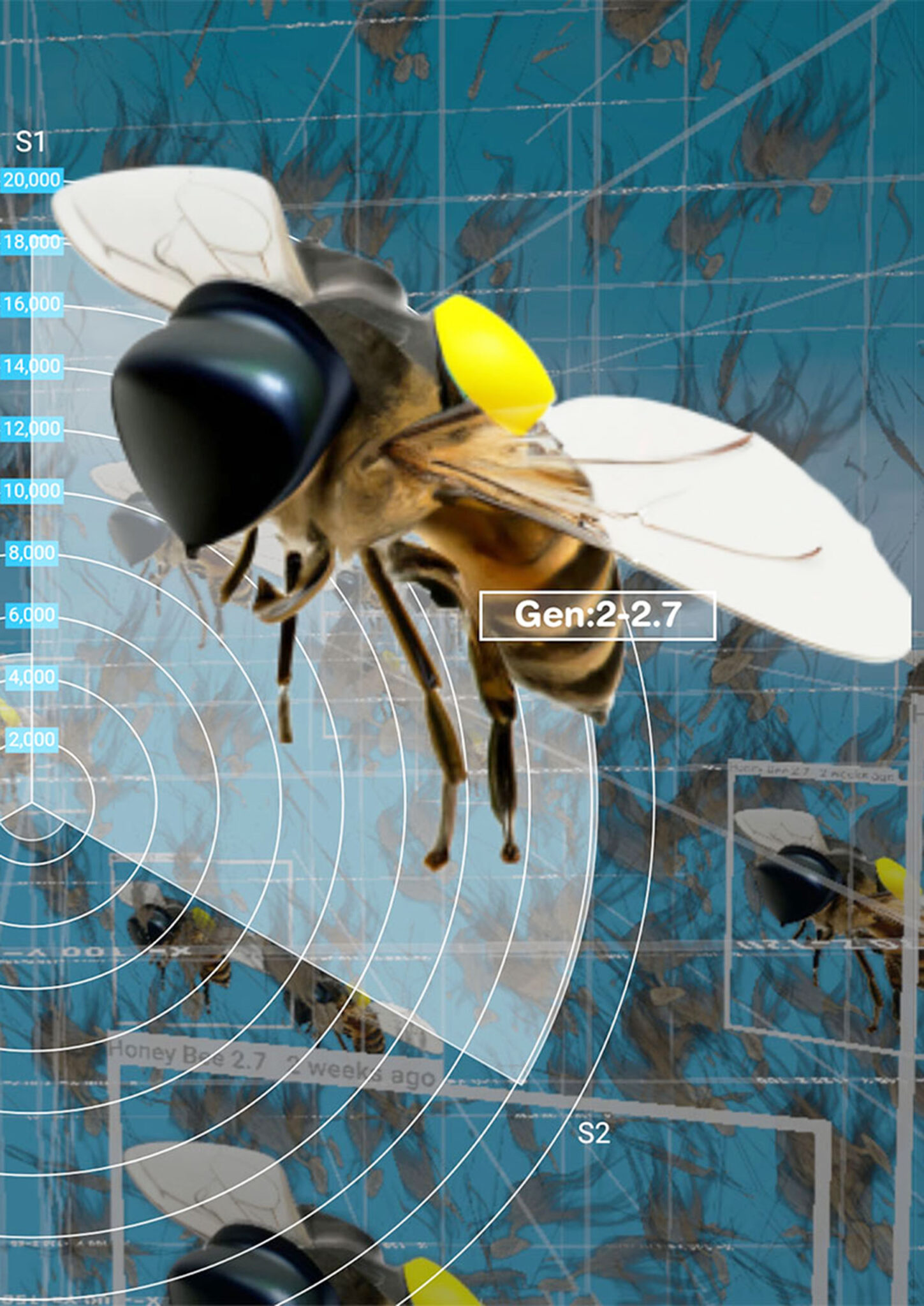
Speculative Evolution, Prototype 1

FILE 2024 | Installations
International Electronic Language Festival
Speculative experiment on a future ecosystem under strict control. The narrative takes place in a simulation, 30 years in the future, where artificial intelligence and synthetic biology collaborate to optimize an environment for cultivated species. An AI-powered simulator helps visitors generate new species to balance the ecosystem. Inspiration comes from the book Under the White Sky by Elizabeth Kolbert and artists’ stories about life on a damaged planet.

Bio

Marc Lee is a Swiss artist focused on real-time rendered audiovisual installations, AR, VR and mobile applications, critically exploring creative, cultural, social, ecological, political and speculative themes. His work has been exhibited in important museums and new media art spaces. Shervin Saremi is an Iranian musician and audio engineer specializing in sonic computing, procedural sound design and production. Currently researching immersive audio at UdK Berlin.
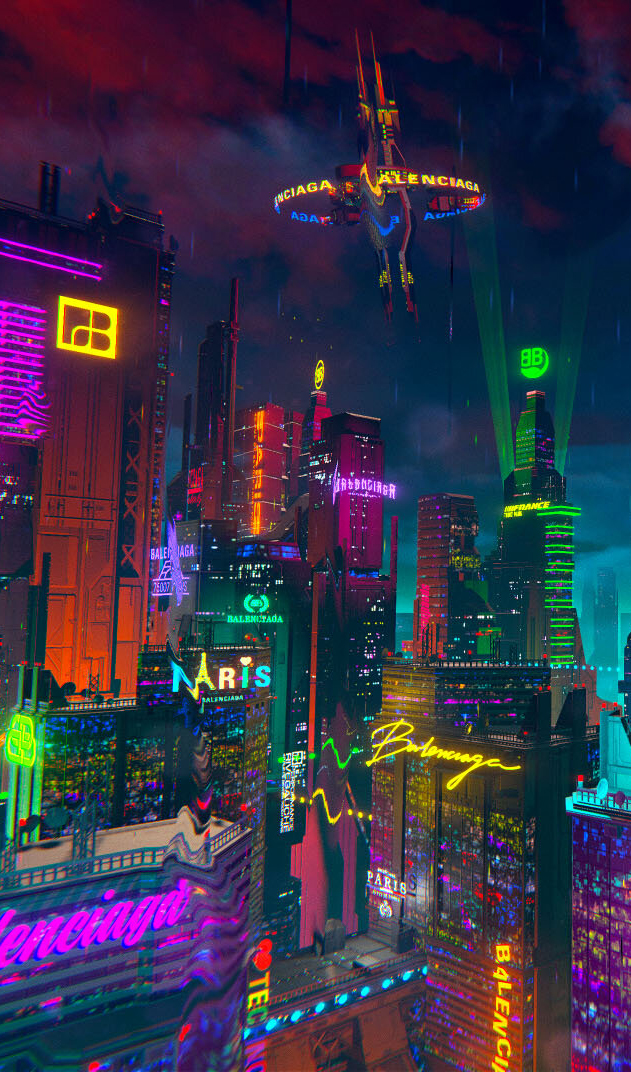
tabor robak

balenciaga collaboration
A 25 minute video loop with previously unreleased tracks by DJ Hell, made in collaboration with Balenciaga.

Here is a dramatic tension in his work between the real and the imagined in his use of often-appropriated digital objects to create virtual landscapes, which frequently contain elements – animals, machines, fragments of videogames – that are recognisable from our day to day life. This creates a symbiotic relationship between the digital and the real. In a very real way digital space has now become an intangible reality. The worlds built by Robak have a distinctly cinematic sensibility that hyperbolises the shine and dramatic effects of 3D rendered animation. The aesthetic of his work is supremely important, drawing the viewer into a truly alluring, indulgent and strangely gratifying environment. There is a further challenge to the void between high-art and the worlds of 3D animation and gaming, in the intersection between depiction and simulation. This can be partially attributed to the vernacular of advertising Robak is so proficient at utilising.

Sam Twidale & Marija Avramovic

Sunshowers
(AI) infinite simulations
FILE FESTIVAL SP 2019
.
‘Sunshowers’ is the third in our series of real-time animation artworks. It is inspired by the opening chapter of Akira Kurosawa’s film Dreams which follows a young boy as he explores a forest and stumbles across a fox wedding (Kitsune no Yomeiri). Our piece explores ideas of animism and techno-animism by assigning life in the form of artificial intelligence to all of the objects, both natural and man-made, within the virtual world. The piece unfolds in real time with the characters themselves deciding which paths they will follow.

JF Malouin

Les trois Grâces

file festival
“Les Trois Grâces” is a presence and corporeality simulation in virtual reality. Exposing the underlying power struggle implied within touch, this piece explores the trespassing  of bodily frontiers and territoriality. As a sculpture, its object is not matter, but our relationship to the other.
It offers a troubling experience of intimate proportions.

Daniel Widrig

‘SnP’, 2018, recycled plastic, injection moulded

“Widrig’s art breaks down the boundaries between disciplines; borrowing tools traditionally associated with one industry and using them in other fields, in often unanticipated and exciting ways. Widrig uses computer simulation processes and advanced technologies adopted from the special effects business to create sculptural 3D-printed craftwork—digital designs materialize into intricate sculptures in glass or recycled plastic and furniture pieces with impeccable undulated thin surfaces,” Devid Gualandris

Ian Cheng

“Entropy Wrangler,” Ian Cheng’s 2013 exhibition at Off Vendome in Dusseldorf, was an excellent introduction to the logic behind this artist’s practice. The centerpiece was a large projection in the gallery’s basement described as “a live computer simulation that changes and evolves, forever.” Like all of Cheng’s simulations, it was programmed with motion capture techniques that register the physical movements of performers that are then translated onto digital bodies. These bodies coexist as individual entities subject to the laws and dynamics of a causal, virtual world: avatars of people and common objects, like hammers and basketball players, rendered in basic three-dimensional form and caught in the zero gravity of the digital screen

Ed Fornieles

Test Studies
In the 20th century, the film industry largely monopolized the representation of human feelings, whereas in the 21st century, the video game industry engages our emotions through participation. At least that is what Ed Fornieles is trying to demonstrate with his video installation Test Studies in which three-dimensional simulations of a role-playing game are juxtaposed with the emotional comments of those who experience it.
video

Ian Cheng

BOB

Cheng’s work explores mutation, the history of human consciousness and our capacity as a species to relate to change. Drawing on principles of video game design, improvisation and cognitive science, Cheng develops live simulations – virtual ecosystems of infinite duration, populated with agents who are programmed with behavioural drives but left to self-evolve without authorial intent, following the unforgiving causality found in nature.

Photo: Andrea Rossetti

Maria Guta and Adrian Ganea

Cyberia

Performance & live computer generated simulation

A postmodern fairytale, Cyberia takes place somewhere in a cold distant East, stretching between and endless imaginary realm and a vast physical space. It is a westwards journey towards a promised future with no arrival and no return. There is no here or there, only a twilight zone between a departure point and a simulated destination. Between digital video projections and a physical setting, using the mechanics of a video-game engine with a motion capture suit, Cyberia is the simulation of an endless pre-climax state where a performer and a CG avatar dance as one to the rhythms of an imaginary West. In a world oversaturated by digital data –mysticism and paranormal are as popular as ever. Emerging technologies are increasingly incorporated in a form of postmodern spiritualism, as Arthur C. Clarke points out: “Any sufficiently advanced technology is indistinguishable from magic.

Sam Twidale & Marija Avramovic

After Party

(AI) infinite simulations

‘After Party’ is an animation about two young girls, Ada and Milica. They find themselves in a strange space where an adult party is happening. With every new simulation their personalities evolve in unpredictable ways: between Childhood and Adolescence, Refined and Savage. Our digital work consists of creating artificial environments in the form of real-time animation using our own custom software, where artificial intelligence characters interact with each other as well as with the virtual world that surrounds them. These pieces are usually inspired by stories or myths found in different cultures.

FILE SAO PAULO 2019

David O’Reilly

Everything
FILE GAMES 2017
Everything is an interactive experience where everything you see is a thing you can be, from animals to planets to galaxies and beyond. Travel between outer and inner space, and explore a vast, interconnected universe of things without enforced goals, scores, or tasks to complete. Everything is a procedural, AI-driven simulation of the systems of nature, seen from the points of view of everything in the Universe.

JUSTINE KHAMARA

Жюстин Khamara

„Bis vor kurzem habe ich meine Fotocollagen erstellt, indem ich Hunderte von Bildern auf Film aufgenommen, fotografische Elemente von Hand aus ihrem ursprünglichen Kontext herausgeschnitten und mit Klebstoff zusammengeklebt habe. Ich war interessiert an der Beziehung des Fotos zu seinem Thema und daran, wie digitale Technologien das Verständnis des fotografischen Bildes verändern können. In der Installation Thud (2003) haben veraltete Produktionsmethoden eine Umgebung geschaffen, die die digitale High-Tech-Simulation „nachahmt“. Meine Illusion war buchstäblich hauchdünn – alle Oberfläche keine Tiefe – und erinnerte an Erinnerung, Verlust und ein nervenaufreibendes Gefühl der Sterblichkeit.