highlike

FILE SÃO PAULO 2025: SYNTHETIKA – Frederik De Wilde

Hunter and Dog

Frederik De Wilde

FILE SÃO PAULO 2025: SYNTHETIKA – Art and Technology – Installations
Electronic Language International Festival

Hunter and Dog – Belgium

Genetic and evolutionary algorithms reinterpret an existing artwork. De Wilde uses digital scans and custom genetic and evolutionary algorithms as a deconstruction technique to reinterpret and update the nineteenth-century work Hunter and Dog from sculptor John Gibson R. A. (1790–1866).

Frederik De Wilde’s Hunter and Dog interrogates the intersections of human evolution, genetic engineering, and the hybridization of technology and biology. De Wilde reinterprets the historical sculpture through the lens of post-evolutionary theory, engaging with contemporary debates on CRISPR, synthetic biology, and the implications of human-directed genetic modification. CRISPR, the revolutionary gene-editing technology, has introduced an unprecedented rupture in the trajectory of evolution. No longer constrained by the slow mechanisms of natural selection, humans now possess the ability to intervene directly in their own genetic blueprint, marking a shift toward a post-Darwinian paradigm. This technological power, however, is not neutral; it emerges from a historical lineage of scientific inquiry deeply entangled with colonialism. The history of genetic manipulation is inseparable from colonial bioprospecting, eugenics, and exploitative medical experimentation on marginalized populations. Colonial regimes treated bodies—both human and non-human—as sites of intervention, control, and optimization, a logic that persists in contemporary biotechnological frameworks. Post-colonial discourse reveals how genetic engineering risks perpetuating these legacies, reinforcing power asymmetries between those who wield biotechnological control and those subjected to its consequences. CRISPR, while offering the promise of eradicating disease and expanding human potential, also raises ethical concerns about genetic stratification, bio-capitalism, and the commodification of life itself. De Wilde’s work visualizes these tensions, making visible the processes of cell division and morphogenesis—the very biological mechanisms now subject to human intervention. Hunter and Dog does not merely depict the transformation of a neoclassical form but speculates on the future of the human body as a site of engineered evolution. From a decolonial perspective, the artwork questions who has the authority to edit life and to what ends. It challenges the techno-utopian narratives that frame genetic modification as an inevitable progress while obscuring its social, ethical, and ecological implications. By hybridizing art, science, and technology, Hunter and Dog compels us to confront the uncertainties of a CRISPR-driven future: Will genetic editing reinforce existing inequalities, or can it be decolonized and democratized? How do we navigate this post-natural frontier without losing the human—and more-than-human—dimensions of our existence? De Wilde’s work invites us into this speculative space, where the hunter, the dog, and the algorithm coalesce into a vision of a world where biology is no longer destiny, but a site of contested agency.

Where are we going from here? 

BIO

Frederik De Wilde fuses art, science, and tech. Known for his Blackest-Black works that inspired Kapoor’s Vantablack, he has shown at Venice Biennale, BOZAR, MAAT, Pompidou, and ZKM, winning awards like Ars Electronica.

MARK JEFFERY AND JUDD MORRISSEY

The Precession 2011
via highlike submit

Judd Morrissey and Mark Jeffery are a collaboration merging live art and digital literary practices. The work, which is visual, textual and choreographic, evolves through context-specific research and practice and always considers the constraints of a given venue or occasion. Site responsive considerations include the performance/exhibition space as well as the local community and online textual activity happening within the locale. A given piece is a body of material that may have no singular fixed form but is alternately presented as internet art, durational live installation, an ongoing activity, or a performance of fixed length.

ecoLogicStudio

BioBombola
The Coral
Home Algae Garden
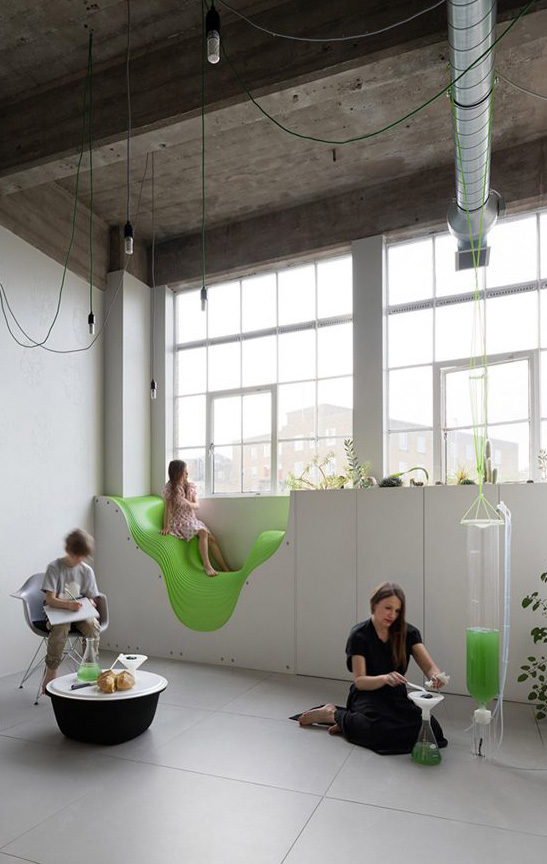
In June 2020 ecoLogicStudio has devised BioBombola, a pioneering project that invites individuals, families and communities to cultivate a domestic algae garden – a sustainable source of vegetable proteins. BioBombola absorbs carbon dioxide and oxygenates homes more effectively than common domestic plants while fostering a fulfilling daily interaction with nature. Each BioBombola is composed of a single customized photobioreactor, a one metre tall lab grade glass container, filled with 15 litres of living photosynthetic Spirulina strain and culture medium with nutrients.

Kate Cooper

Infection Drivers
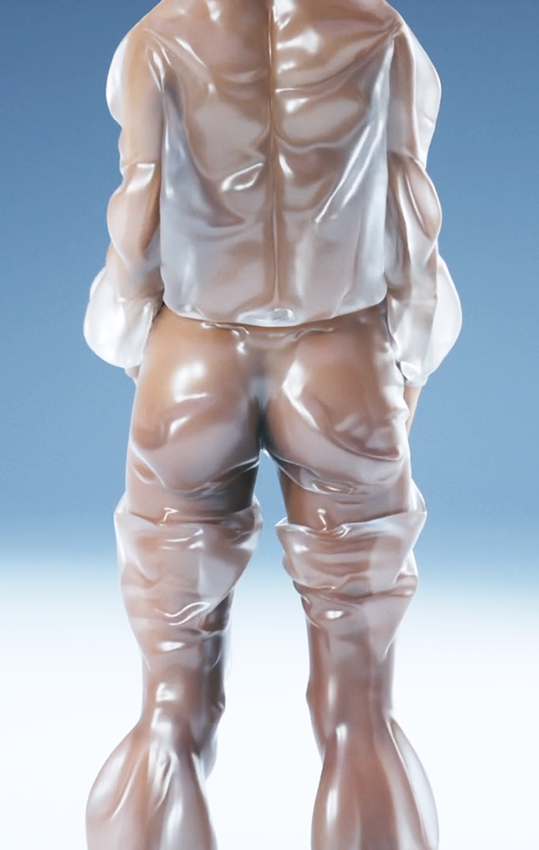
Infection Drivers (2019) explores the body under attack. In this work, a CGI figure struggles to move and breathe in a translucent suit, which takes her body through transmutations of stereotypically masculine and feminine physiques as it inflates and deflates. In a time of increased public surveillance through facial-recognition software and biometric data  mining, Cooper’s high-definition world invites us to investigate and perhaps find freedom in the technologies often used to constrain us.

Doug Aitken

Sonic Mountain
As a unique site-specific commission for the Donum Estate, Los Angeles-based artist Doug Aitken has created the ethereal work Sonic Mountain (Sonoma), three concentric circles of suspended stainless-steel pipes whose differing lengths form a wave at their base, mirroring the free Euler-Bernoulli shape that describes the chime’s frequency. Installed in the eucalyptus grove, measuring forty-five feet in diameter and twice human height, and comprising 365 chimes — one for each day of the year — Sonic Mountain (Sonoma) works with one of Donum’s most persistent elements, the Carneros breeze that cools the grapes and creates a temperate zone for growing Pinot Noir. Each day, the warm wind begins its soft whisper, rustling through the vines and trees, building in strength through the day until mid-afternoon, and then gradually diminishing in force. Known to have been used since at least the ancient Roman period in Europe and the second century in India and China, wind chimes create chance, inharmonic music. At Donum, Aitken has teamed up with his friend the composer Terry Riley to compose chords in the chimes to be played by the wind , depending on how it blows, so the lyrical work sounds throughout the estate, demonstrating the artist’s practice of making installations that synthesize many media and are never constrained by tradition.
video
AURÉLIEN BORY

PLEXUS
Aurélien Bory is a Toulouse-based choreographer working at the intersection of dance, circus and visual art. In Plexus, he encloses the Japanese dancer Kaori Ito in a forest of tensioned vertical cables. It’s as if she’s in a transparent cuboid cage. We can see her, but her image is blurred by the shimmer of Arno Veyrat’s lighting as it moves across the cables. Ito strains against these confines, writhing, flailing and hurling herself against the cables. Every sound is hugely amplified, so with her every movement we are assailed by a high-tensile jangling and groaning. At intervals she subjects her environment to furious challenge, racing backwards and forwards within the limited inner space so that the cage rocks on its axis. At other times she positions herself between the cables so that they bear her weight, and hangs there like an exhausted insect, faintly articulating her limbs.

David Spriggs

Vision II
David Spriggs’ Vision artwork series have a distinct focus on the senses. Accentuated by an affinity between its subject matter and the fragmentary nature of the medium, there is a tension created between form and emptiness. Appearing both as an implosion and as an explosion depending on the one’s perception, the viewer has the sense that he/she is observing a form in becoming, yet at the same time breaking down. The immersive experience created by Vision provides the audience with the impression that they are in the midst of witnessing an event, something of monumental proportions akin to the Big Bang. In changing viewpoints by navigating around the work, Vision is continually altered, breaking down at the sides so that the viewer can only see the edge planes of multiple sheets, begging the question: Is there in fact a form, or just individual images?

Doug Rosman

Self-contained II
A neural network, trained to see the world as variations of the artist’s body, enacts a process of algorithmic interpretation that contends with a body as a subject of multiplicity. After training on over 30,000 images of the artist, this neural network synthesizes surreal humanoid figures unconstrained by physics, biology and time; figures that are simultaneously one and many. The choice of costumes and the movements performed by the artist to generate the training images were specifically formulated to optimize the legibility of the artist within this computational system. self-contained explores the algorithmic shaping of our bodies, attempting to answer the question: how does one represent themselves in a data set? Building on the first iteration of the series, the synthetic figures in self-contained II proliferate to the point of literally exploding. Through the arc of self-contained II, this body that grows, multiples, and dissolves never ceases to be more than a single body.