highlike

Ben Cullen Williams

Remnants

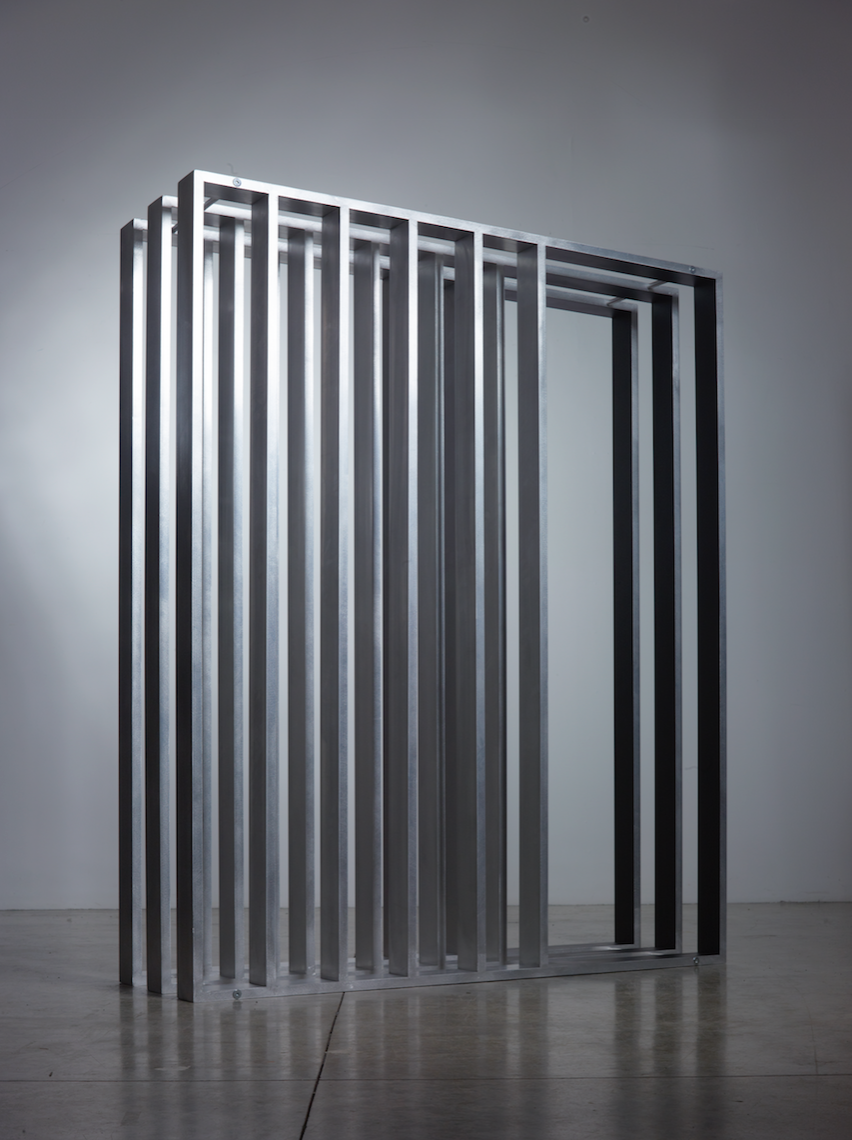
Remnants is an installation, comprised of two individual sculptures, Anatomy and Lacuna, which explores this evolving symbiosis between the mechanical and the biological become. Anatomy and Lacuna are constructed of aluminium, both containing areas of uncertain space. Anatomy contains a plane of black viscous matter and Lacuna, a black void, creating a tension between the two sculptures. The work draws on diagrammatic anatomical and architectural models, distorting scale and hijacking visual languages, creating an undetermined terrain where the purpose of our made objects is undefined.

FILE SÃO PAULO 2025: SYNTHETIKA – Frederik De Wilde

Hunter and Dog

Frederik De Wilde

FILE SÃO PAULO 2025: SYNTHETIKA – Art and Technology – Installations
Electronic Language International Festival

Hunter and Dog – Belgium

Genetic and evolutionary algorithms reinterpret an existing artwork. De Wilde uses digital scans and custom genetic and evolutionary algorithms as a deconstruction technique to reinterpret and update the nineteenth-century work Hunter and Dog from sculptor John Gibson R. A. (1790–1866).

Frederik De Wilde’s Hunter and Dog interrogates the intersections of human evolution, genetic engineering, and the hybridization of technology and biology. De Wilde reinterprets the historical sculpture through the lens of post-evolutionary theory, engaging with contemporary debates on CRISPR, synthetic biology, and the implications of human-directed genetic modification. CRISPR, the revolutionary gene-editing technology, has introduced an unprecedented rupture in the trajectory of evolution. No longer constrained by the slow mechanisms of natural selection, humans now possess the ability to intervene directly in their own genetic blueprint, marking a shift toward a post-Darwinian paradigm. This technological power, however, is not neutral; it emerges from a historical lineage of scientific inquiry deeply entangled with colonialism. The history of genetic manipulation is inseparable from colonial bioprospecting, eugenics, and exploitative medical experimentation on marginalized populations. Colonial regimes treated bodies—both human and non-human—as sites of intervention, control, and optimization, a logic that persists in contemporary biotechnological frameworks. Post-colonial discourse reveals how genetic engineering risks perpetuating these legacies, reinforcing power asymmetries between those who wield biotechnological control and those subjected to its consequences. CRISPR, while offering the promise of eradicating disease and expanding human potential, also raises ethical concerns about genetic stratification, bio-capitalism, and the commodification of life itself. De Wilde’s work visualizes these tensions, making visible the processes of cell division and morphogenesis—the very biological mechanisms now subject to human intervention. Hunter and Dog does not merely depict the transformation of a neoclassical form but speculates on the future of the human body as a site of engineered evolution. From a decolonial perspective, the artwork questions who has the authority to edit life and to what ends. It challenges the techno-utopian narratives that frame genetic modification as an inevitable progress while obscuring its social, ethical, and ecological implications. By hybridizing art, science, and technology, Hunter and Dog compels us to confront the uncertainties of a CRISPR-driven future: Will genetic editing reinforce existing inequalities, or can it be decolonized and democratized? How do we navigate this post-natural frontier without losing the human—and more-than-human—dimensions of our existence? De Wilde’s work invites us into this speculative space, where the hunter, the dog, and the algorithm coalesce into a vision of a world where biology is no longer destiny, but a site of contested agency.

Where are we going from here? 

BIO

Frederik De Wilde fuses art, science, and tech. Known for his Blackest-Black works that inspired Kapoor’s Vantablack, he has shown at Venice Biennale, BOZAR, MAAT, Pompidou, and ZKM, winning awards like Ars Electronica.

Unlimited Corridor

Keigo Matsumoto, Yohei Yanase, Takuji Narumi & Yuki Ban
FILE FESTIVAL 2018
“Unlimited Corridor ” é um sistema de VR que permite a experiência de percorrer um vasto mundo virtual num espaço físico estreito, manipulando a percepção espacial. Esta obra utiliza uma técnica chamada andar visual-háptico redirecionado que utiliza a incerteza da percepção espacial humana e a interação entre visão e senso háptico.

.

“Unlimited Corridor” is a VR system that allows the experience of traversing the space of a vast narrow physical virtual world, manipulating spatial perception. This work uses a technique called redirected visual-haptic spatial walking that utilizes the uncertainty of human perception and the interaction between vision and haptic sense.

Olafur Eliasson

Your uncertain shadow
Five coloured spotlights, directed at a white wall, are arranged in a line on the floor: a green light positioned next to another green light, followed by a magenta light, an orange light, and, finally, a blue light. These colours combine to illuminate the wall with a bright white light. When the visitor enters the space, her projected shadow, by blocking each coloured light from a slightly different angle, appears on the wall as an array of five differently coloured silhouettes.

Madi Boyd

the Point of Perception
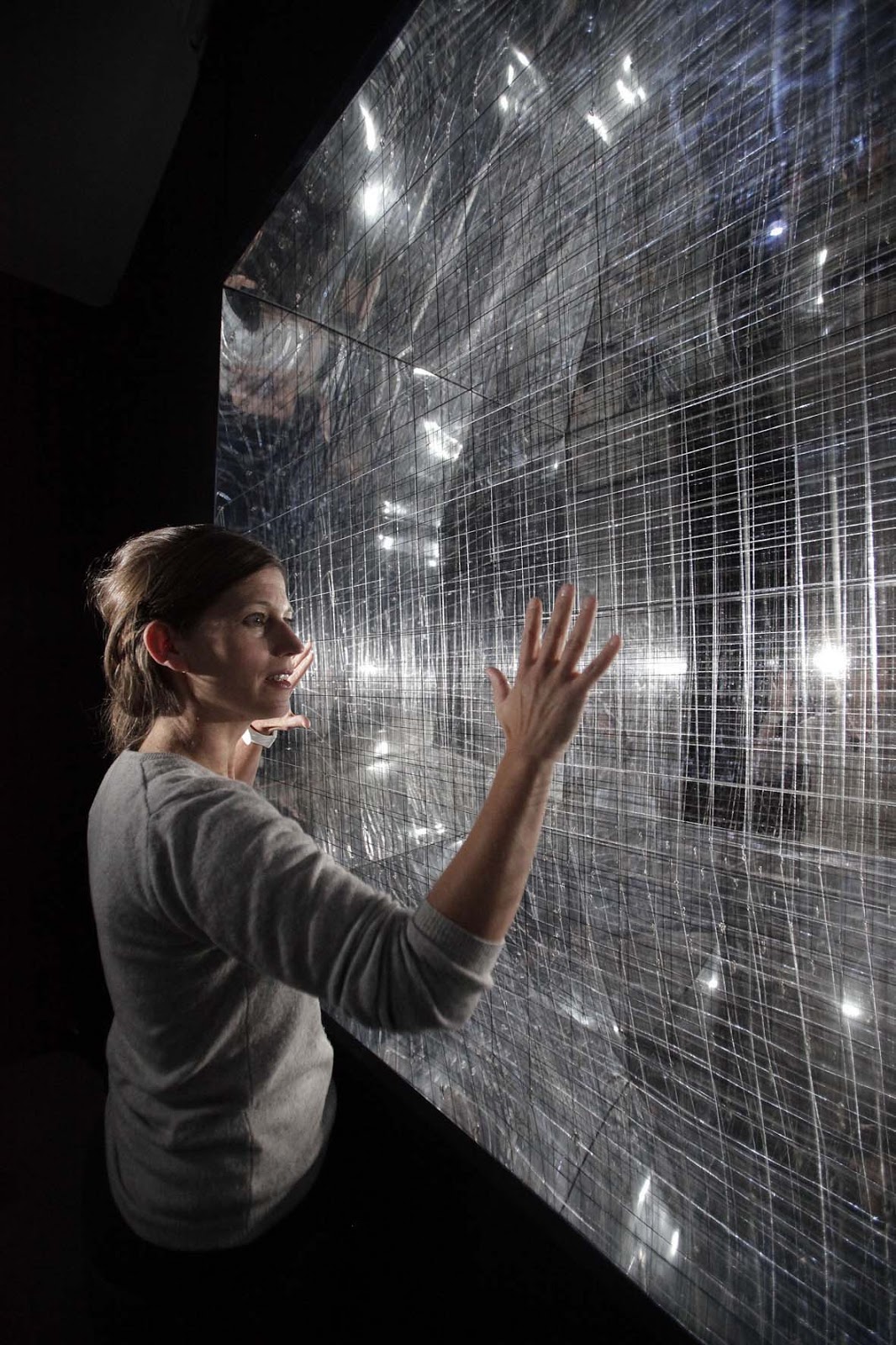
Produced in collaboration with neuroscientists at UCL, Beau Lotto and Mark Lythgoe, this work is art and science; we intend it as an experiment in the gallery. It manifests as an immersive environment consisting of a ‘screen’ which is a large gridded space of uncertainty and projected film.The project came about after I undertook a period of research of the human visual system and neuroesthetics and set up a collaboration with Professor Mark Lythgoe and Dr Beau Lotto at UCL.

Abraham Palatnik

Abraham Palatnik

Kinechromatic

His “Kinechromatic Machine” series, first exhibited at the inaugural São Paulo Biennale in 1951, earned him an official award while creating a stir among the judges uncertain on how to classify the novel art form.From 1964 onwards, he developed the Kinetic Objects, an unfolding of the kinechromatics, showing the internal mechanism of operation and suppressing the projection of light. Mathematical rigor is a constant in his work, acting as an important resource for ordering space. He is internationally considered one of the pioneers of kinetic art.

OLAFUR ELIASSON

オラファー·エリアソン
اولافور الياسون
奥拉维尔·埃利亚松
אולאפור אליאסון
Олафур Элиассон
Your Rainbow Panorama

Olafur Eliasson’s dazzling “Your Rainbow Panorama” is a permanent installation on the rooftop of the ARoS Museum in Aarhus, Denmark. The spectacular work of art has a diameter of 52 metres and is mounted on slender columns 3.5 metres above the roof of the museum. Visitors can literally walk through the entire color spectrum viewing the world for the first time in all pink, green, blue and yellow tones.
“Your rainbow panorama enters into a dialogue with the existing architecture and reinforces what is assured beforehand, that is to say the view of the city. I have created a space which virtually erases the boundaries between inside and outside – where people become a little uncertain as to whether they have stepped into a work or into part of the museum. This uncertainty is important to me, as it encourages people to think and sense beyond the limits within which they are accustomed to moving”. -Olafur Eliasson