highlike

FILE SÃO PAULO 2025: SYNTHETIKA – Jorge Bandera

Disconnection

Jorge Bandera

FILE SÃO PAULO 2025: SYNTHETIKA – Art and Technology – LED SHOW
Electronic Language International Festival


Disconnection – Colombia

Desconexion explores the transformation of energy. The piece intertwines spiritual and scientific perspectives—grounded in the Law of Conservation of Energy and Einstein’s Theory of Relativity. Symbolizing the continuous metamorphosis of life, the work reveals the eternity of energy, where the end of each cycle marks a new beginning.

BIO

Jorge Bandera is a multimedia designer and assistant professor at the Universidad de los Andes in Bogotá, Colombia. A specialist in design, interactivity, animation, and immersive experiences, he has collaborated with institutions such as Google, Teatro Mayor, and the Ministry of Culture. He is also an advocate of interdisciplinary co-creation in education.

FILE SÃO PAULO 2025: SYNTHETIKA – DMTPortal

Recursive Empyrean

DMTPortal

FILE SÃO PAULO 2025: SYNTHETIKA – Art and Technology – Shorts Films AI
Electronic Language International Festival


Recursive Empyrean – Canada

Recursive Empyrean merges fractal-based visuals with an original ambient soundtrack, guiding viewers through infinite loops of creation and collapse. Each cos mic structure reflects itself into eternity, unveiling deeper mysteries with every shift in perspective. Radiant geometry and ambient pulses draw awareness beyond time and space, where subtle patterns reveal gentle truths, echoing the hum of cosmic purpose.

BIO

John Dobbie, a Classical Animation graduate from Sheridan College in Canada, has spent over 20 years shaping digital worlds for franchises like Call of Duty and God of War. Now based in New York’s Capital Region with his family, he crafts immersive cosmic-themed works as DMTPORTAL, merging technology, mysticism, and decades of experience to expand perception beyond the ordinary.

FILE SÃO PAULO 2025: SYNTHETIKA – Tin&Ed

Deep Field

Tin&Ed

FILE SÃO PAULO 2025: SYNTHETIKA – Art and Technology – Installations
Electronic Language International Festival


Deep Field – United States

An augmented reality experience where visitors draw fantastical plants that instantly bloom into immersive 3D structures within the space. As people contribute their creations, a collective digital landscape begins to take shape. Layers of recordings of endangered, extinct, and elusive species compose a responsive and evolving soundscape, developed by The Listening Planet.

BIO

Tin & Ed are New York-based artists whose work explores the interconnection of life across biological, geological, and cosmic systems. Through speculative world-building, they reveal connections that transcend human time, spatial boundaries, and sensory thresholds. Their practice spans sculpture, immersive and interactive installations, creating environments that invite audiences to shift perspective and inhabit the world beyond the limits of human perception. Technology is not used as spectacle, but as a perceptual tool that makes the invisible felt and the distant intimately present.

FILE SÃO PAULO 2025: SYNTHETIKA – Frederik De Wilde

Hunter and Dog

Frederik De Wilde

FILE SÃO PAULO 2025: SYNTHETIKA – Art and Technology – Installations
Electronic Language International Festival

Hunter and Dog – Belgium

Genetic and evolutionary algorithms reinterpret an existing artwork. De Wilde uses digital scans and custom genetic and evolutionary algorithms as a deconstruction technique to reinterpret and update the nineteenth-century work Hunter and Dog from sculptor John Gibson R. A. (1790–1866).

Frederik De Wilde’s Hunter and Dog interrogates the intersections of human evolution, genetic engineering, and the hybridization of technology and biology. De Wilde reinterprets the historical sculpture through the lens of post-evolutionary theory, engaging with contemporary debates on CRISPR, synthetic biology, and the implications of human-directed genetic modification. CRISPR, the revolutionary gene-editing technology, has introduced an unprecedented rupture in the trajectory of evolution. No longer constrained by the slow mechanisms of natural selection, humans now possess the ability to intervene directly in their own genetic blueprint, marking a shift toward a post-Darwinian paradigm. This technological power, however, is not neutral; it emerges from a historical lineage of scientific inquiry deeply entangled with colonialism. The history of genetic manipulation is inseparable from colonial bioprospecting, eugenics, and exploitative medical experimentation on marginalized populations. Colonial regimes treated bodies—both human and non-human—as sites of intervention, control, and optimization, a logic that persists in contemporary biotechnological frameworks. Post-colonial discourse reveals how genetic engineering risks perpetuating these legacies, reinforcing power asymmetries between those who wield biotechnological control and those subjected to its consequences. CRISPR, while offering the promise of eradicating disease and expanding human potential, also raises ethical concerns about genetic stratification, bio-capitalism, and the commodification of life itself. De Wilde’s work visualizes these tensions, making visible the processes of cell division and morphogenesis—the very biological mechanisms now subject to human intervention. Hunter and Dog does not merely depict the transformation of a neoclassical form but speculates on the future of the human body as a site of engineered evolution. From a decolonial perspective, the artwork questions who has the authority to edit life and to what ends. It challenges the techno-utopian narratives that frame genetic modification as an inevitable progress while obscuring its social, ethical, and ecological implications. By hybridizing art, science, and technology, Hunter and Dog compels us to confront the uncertainties of a CRISPR-driven future: Will genetic editing reinforce existing inequalities, or can it be decolonized and democratized? How do we navigate this post-natural frontier without losing the human—and more-than-human—dimensions of our existence? De Wilde’s work invites us into this speculative space, where the hunter, the dog, and the algorithm coalesce into a vision of a world where biology is no longer destiny, but a site of contested agency.

Where are we going from here? 

BIO

Frederik De Wilde fuses art, science, and tech. Known for his Blackest-Black works that inspired Kapoor’s Vantablack, he has shown at Venice Biennale, BOZAR, MAAT, Pompidou, and ZKM, winning awards like Ars Electronica.

STROOK

Metropolis


Metropolis is a 1927 German expressionist science-fiction film directed by Fritz Lang. Set in the year 2026, Metropolis takes place in a dystopian society where wealthy industrialists rule from vast tower complexes, oppressing the workers who live in the depths below them.

The drawing is placed on the largest window of the ‘Concertgebouw’ (Concert building) in Bruges with the perfect backdrop of the city. There are many different perspectives to the work wich has the effect of a changing picture throughout the day.

Soichiro Mihara

三原 聡一郎
The Blank to Overcome
file festival
Part of the ”blank” project that the artist has been creating since 2011, “The Blank to Overcome” utilizes air pumps, power supply control circuitry, water, solution, glycerin, ethanol and electricity to produce bubbles in the air. The theme of ”blanks” denotes a space for an unsolved ”inquiry” through the perspectives for thinking about the post-3.11 present: how the bubbles are always shifting as a giant cluster, almost without mass or structure, and the facing up to this; and the framework since modernity that has prescribed society, and the ”involved” or the ”other”. From this work debate will surely emerge.

.

克服するための空白

アーティストが2011年から作成している「ブランク」プロジェクトの一部である「TheBlankto Overcome」は、エアポンプ、電源制御回路、水、溶液、グリセリン、エタノール、電気を利用して空気中に気泡を生成します。 「空白」のテーマは、3.11以降の現在について考えるための視点を通して、未解決の「問い合わせ」のためのスペースを示しています。泡は、ほとんど質量や構造がなく、巨大なクラスターとして常にシフトしており、これに直面しています。 ; そして、社会を規定してきた近代以来の枠組み、そして「関与する」または「その他」。 この仕事から議論が確実に浮かび上がるでしょう。

ポンプ

Jakob Kudsk Steensen

Liminal Lands
Liminal Lands is an environmental multiplayer experience shared by four people at the same time. Each person transforms into the basic elements controlling life across the landscape: Algae, salt, water and mud. As they embark on a communal ritual experience, people morph and change throughout their journey, exploring each new world from a changed perspective of the landscape. Visitors move across different scales and global weather conditions, shedding their human perspective as they are pulled into six different realms inspired by the macro-landscape.

YOICHI YAMAMOTO

Japanese firm yoichi yamamoto architects has completed ‘2D/3D chairs’ for tokyo fashion labels issey miyake store. featuring a series of traditional dining chairs, the installation transforms from a two dimensional graphic into a tangible piece. The perspective is manipulated creating a unique appearance from different vantage points for onlookers. graphics of legs in varying perspectives are printed onto a horizontal plane while the chair backs rest upon the surface. The seat backs maintain a seamless transition from the graphics by utilizing assorted sizes, heights and placed at diverse angles.

Vanessa Beecroft

瓦妮莎比克罗夫特
נסה יקרופט
ヴァネッサ·ビークロフト
바네사 비크로프트
ВАНЕССА БИКРОФТ
La Membre Fantôme

For the installation ‘le membre fantôme’, vanessa beecroft takes the visitor back to the classical language of sculpture through a conceptual perspective, leading us towards an intimate gallery room inhabited by timeless statuary. shown at the 2015 venice biennale, beecroft presents a scene that is visible only at a distance, where the viewer must look through a crevice carved out of two marble walls. Through the panels, we see fragments of a stone garden, rich in archaeological allures and echoes of early twentieth century avant-garde. the archive of memory is here a tribute in bronze – placed at the centre of the installation – to marcel duchamp’s ‘étant donnés’, a reference model for her research that combines personal memories, historical and artistic impressions and a conceptual tension.

Samuel Mathieu

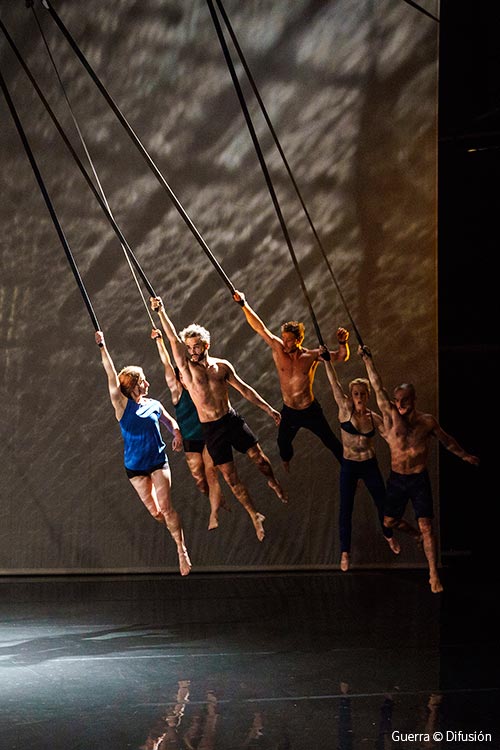
Guerre

A struggle that seems to be of particular relevance today. A metaphorical title, poetry of the line and of colour, that highlights the challenge that each of the parties represents. A kind of symbolic correspondence that flirts with our world, with our history, our human condition. War opens up perspectives of matter, a struggle both real and poetic that blends lines and directions, inscribing the trace, the hue, in the flesh of the dancing body but also in a seductive paradox between line and colour.

Objective Realities

automato.farm
FILE FESTIVAL 2018
As things become smarter and connected, their roles in people’s lives are challenged. Things become closer and closer to us, eventually becoming “users” themselves. How will we understand objects’ needs and perspectives and potentially design for them?

Daniel Widrig and Melih Altinisik

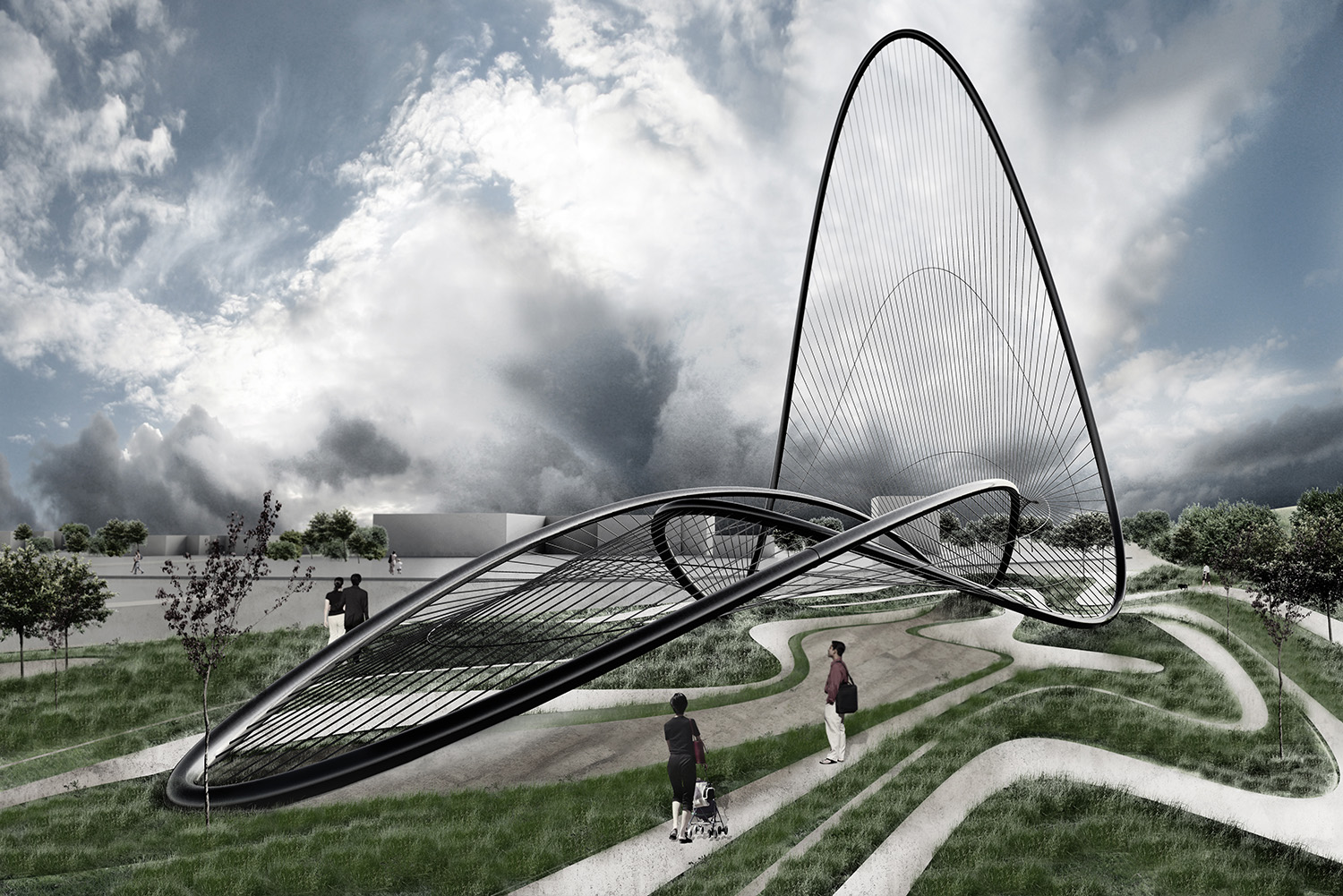
Kartepe 30.Meridien Landmark

30.Meridien is located on the North side of the Istanbul-Adapazari D-100 Road and it will become the key Landmark for the development of the Kartepe Region. All the visitors approaching the site from all other cities to the region for skiing or visiting the Sapanca Lake will experience the amazing Vista so it will turn into an attraction point for the developing prestige of the Kartepe. The design concept for Landmark is like the dance of two eliptical steel rings which are balanced with the cables located in between them. This fluid interaction gives various visual perspectives to the structural Landmark design. 30M with its fluid form and its well integrated landscape design will attract the visitors not only to the site also inside the landmark. When the visitors are standing under the center of the 20m high Meridien Structure, they will experience the elevated 30.Meridien.

YOKO ISHII AND HIROSHI HOMURA

It´s fire, you can touch it

On the other hand, an example of a work representing a difference in which the viewer is faced with participation in the event, is an installation by Yoko Ishii and Hiroshi Homura It’s fire, you can’t touch it (2007). In this work which appoints the active environment, onto the hands reached out by the participants, miniature light signs are projected—a Japanese tanka poem is running through, glyphs change form, fuse together, move. Here we deal with a poetic spectacle in which the perspective of cognitive interactivity, set off in contact with poetry, is complemented by tactile sensations and poems themselves are as if extracted from the environment by interactive gestures of receivers-readers.

AZIZ + CUCHER

Synaptic Bliss
Begun in 2003, the series of works collectively known as “SYNAPTIC BLISS” explore ideas of a digital consciousness that allows for the simultaneous perception of multiple perspectives and scales, as well as the blurring of the distinctions between the body and its environment, the exterior and the interior, and the organic and the artificial. The works in this ongoing series include a variety of media, ranging from architectural installations, to video projections and environments, as well as digital prints and hand-woven rugs.

CILDO MEIRELES

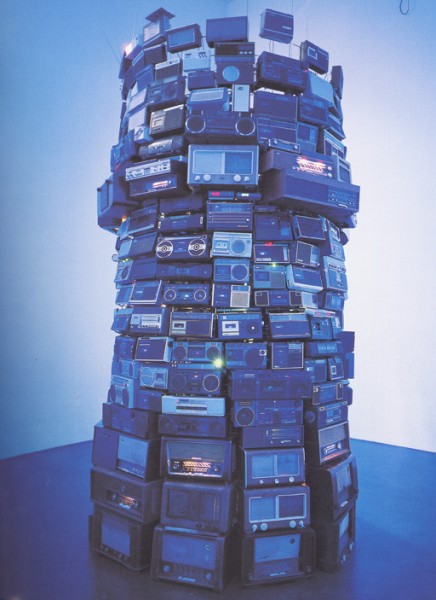
babel

Babel consists of around 800 radios of varying ages, from the beautiful, large, valve radios which make up the bottom tiers of the tower to the smaller mass-produced electronic radios of recent years which form its summit. By using radios of decreasing size from the floor to the ceiling, Meireles emphasises the perspective and the sheer height of the work.
Furthermore, Babel constitutes a survey of radios from the 1920s to the present day, which in turn presents what the artist has described as ‘an archaeological sample of events’. Due to the time-based nature of the medium of radio, no two experiences of this work are ever the same.

DAMIAN ORTEGA

داميان أورتيغا
达米安·奥尔特加
דמיאן אורטגה
ダミアン·オルテガ
데미안 오르테가
Дамиан Ортега
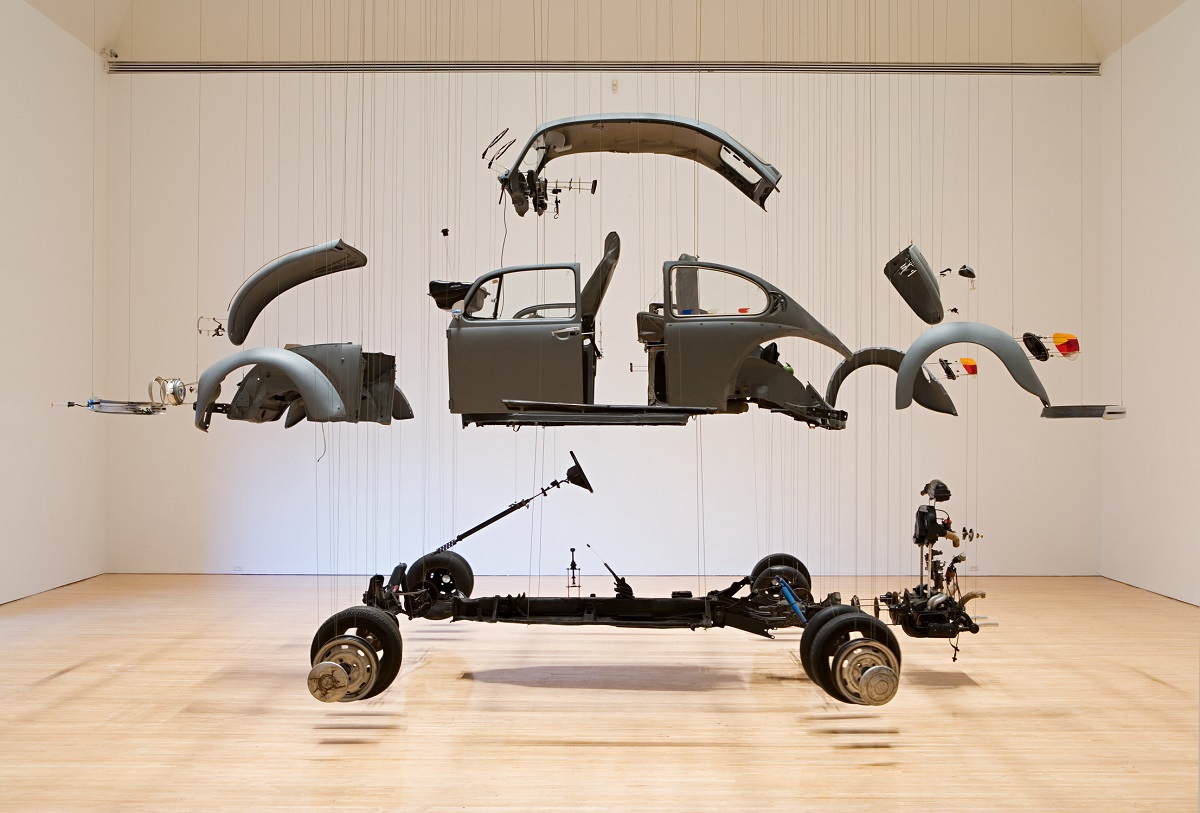
Cosmic Thing
Mexican deassemblage artist Damian Ortega creates suspended sculpture, diagrams and manuals brought to life, exposing the inner workings and mystery of products and concepts. In the 2003 Venice Biennale, Ortega acheived international acclaim with his breakout hit, “Cosmic Thing,” which reassembled a Volkswagon Bug, the populist car manufactured in his home country. With roots in cartooning and satire, Ortega’s tongue in cheek works exemplify his former craft and present new perspectives to commonplace items. Get a look at several of the artist’s most famous installations here on Hi-Fructose.