highlike

FILE SÃO PAULO 2025: SYNTHETIKA – Grupo de Pesquisa e Extensão Realidades

Animated Sprites: Frame-by-Frame Animation for Games

Realities Research and Extension Group

FILE SÃO PAULO 2025: SYNTHETIKA – Art and Technology – WORKSHOP
Electronic Language International Festival
 

Animated Sprites: Frame-by-Frame Animation for Games – Brazil

Want to learn how game animations are created? In this workshop, we’ll explore how animated sprites work, and you’ll have the opportunity to create your own! Using free and accessible tools, we’ll transform ideas into animated art and integrate them into the programming of a simple game.

BIO

The Realidades Group (https://realidades.eca.usp.br/), founded in 2010, is a research and extension group at USP that works with art, technology and the concept of reality.

FILE SÃO PAULO 2025: SYNTHETIKA – CRUDE_CASTIN

Leonardo Da Vinci Project: Neo-Renaissance

CRUDE_CASTIN

FILE SÃO PAULO 2025: SYNTHETIKA – Art and Technology – CGI VIDEOS
Electronic Language International Festival


Leonardo Da Vinci Project: Neo-Renaissance – China

Neo-Renaissance uses the protagonist and Leonardo da Vinci as clues to tell the story of people’s prosperous lives in the “cloud,” the emergence of a latent crisis, and the connection of digital subjects in the context of decentralization in the near future. The film makes extensive use of artificial intelligence-generated materials (AIGC), interweaving the Renaissance and Web 3.0 into a single narrative, aiming to reflect on the fading of popular power in the lower echelons of various social processes and on imaginations for the future.

BIO

CRUDE_CASTIN is a creative collective of young artists. Their focus is on revealing the hidden power structures behind technology and using diverse methods to explore the tension between technology and humanity. Their work combines art and technology, reflecting on the dilemmas of today’s technological society through themes such as technology and power, history, and nature.

FILE SÃO PAULO 2025: SYNTHETIKA – Frederik De Wilde

Hunter and Dog

Frederik De Wilde

FILE SÃO PAULO 2025: SYNTHETIKA – Art and Technology – Installations
Electronic Language International Festival

Hunter and Dog – Belgium

Genetic and evolutionary algorithms reinterpret an existing artwork. De Wilde uses digital scans and custom genetic and evolutionary algorithms as a deconstruction technique to reinterpret and update the nineteenth-century work Hunter and Dog from sculptor John Gibson R. A. (1790–1866).

Frederik De Wilde’s Hunter and Dog interrogates the intersections of human evolution, genetic engineering, and the hybridization of technology and biology. De Wilde reinterprets the historical sculpture through the lens of post-evolutionary theory, engaging with contemporary debates on CRISPR, synthetic biology, and the implications of human-directed genetic modification. CRISPR, the revolutionary gene-editing technology, has introduced an unprecedented rupture in the trajectory of evolution. No longer constrained by the slow mechanisms of natural selection, humans now possess the ability to intervene directly in their own genetic blueprint, marking a shift toward a post-Darwinian paradigm. This technological power, however, is not neutral; it emerges from a historical lineage of scientific inquiry deeply entangled with colonialism. The history of genetic manipulation is inseparable from colonial bioprospecting, eugenics, and exploitative medical experimentation on marginalized populations. Colonial regimes treated bodies—both human and non-human—as sites of intervention, control, and optimization, a logic that persists in contemporary biotechnological frameworks. Post-colonial discourse reveals how genetic engineering risks perpetuating these legacies, reinforcing power asymmetries between those who wield biotechnological control and those subjected to its consequences. CRISPR, while offering the promise of eradicating disease and expanding human potential, also raises ethical concerns about genetic stratification, bio-capitalism, and the commodification of life itself. De Wilde’s work visualizes these tensions, making visible the processes of cell division and morphogenesis—the very biological mechanisms now subject to human intervention. Hunter and Dog does not merely depict the transformation of a neoclassical form but speculates on the future of the human body as a site of engineered evolution. From a decolonial perspective, the artwork questions who has the authority to edit life and to what ends. It challenges the techno-utopian narratives that frame genetic modification as an inevitable progress while obscuring its social, ethical, and ecological implications. By hybridizing art, science, and technology, Hunter and Dog compels us to confront the uncertainties of a CRISPR-driven future: Will genetic editing reinforce existing inequalities, or can it be decolonized and democratized? How do we navigate this post-natural frontier without losing the human—and more-than-human—dimensions of our existence? De Wilde’s work invites us into this speculative space, where the hunter, the dog, and the algorithm coalesce into a vision of a world where biology is no longer destiny, but a site of contested agency.

Where are we going from here? 

BIO

Frederik De Wilde fuses art, science, and tech. Known for his Blackest-Black works that inspired Kapoor’s Vantablack, he has shown at Venice Biennale, BOZAR, MAAT, Pompidou, and ZKM, winning awards like Ars Electronica.

QUBIT AI: Klaus Obermaier, Stefano D’Alessio & Martina Menegon

EGO

FILE 2024 | Installations
International Electronic Language Festival

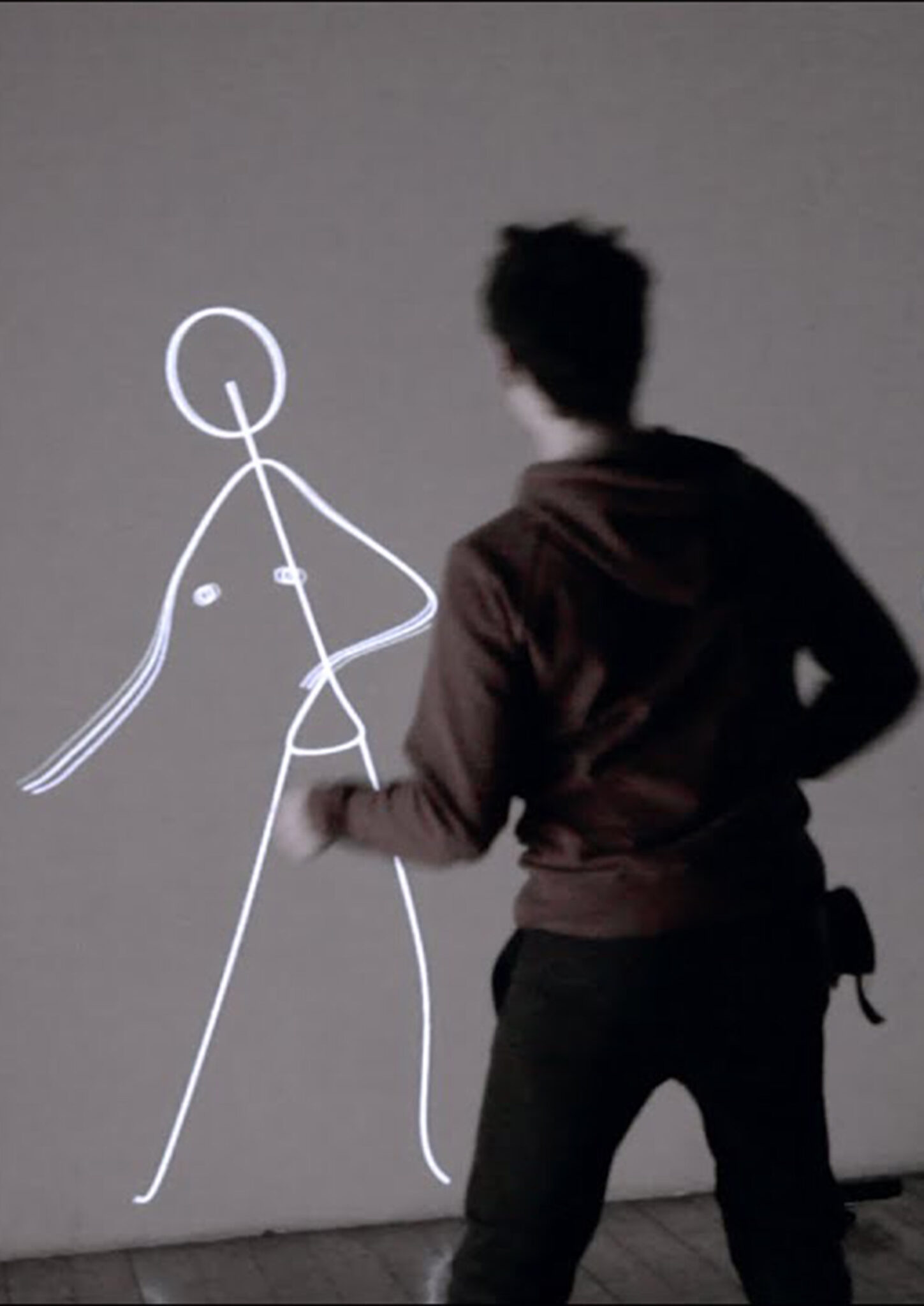
The mirror stage in psychology explains how the Ego forms through objectification, where one’s visual appearance comes into conflict with emotional experience, a concept called ‘alienation‘ by psychoanalyst Jacques Lacan. The interactive installation EGO reenacts and reverses this process by distorting the mirror image based on the user’s movements, highlighting the tension between the real and the symbolic, the Ego and the It, subject and object.

Bio

Klaus Obermaier is an interdisciplinary artist, director and composer who creates innovative works in the performing arts, music and installations using new media. Stefano D’Alessio researches social issues induced by the internet and explores how the web and its derivatives influence human behavior and the body. Martina Menegon creates intricate assemblages of physical and virtual elements, exploring the contemporary self and its hybrid corporeality.
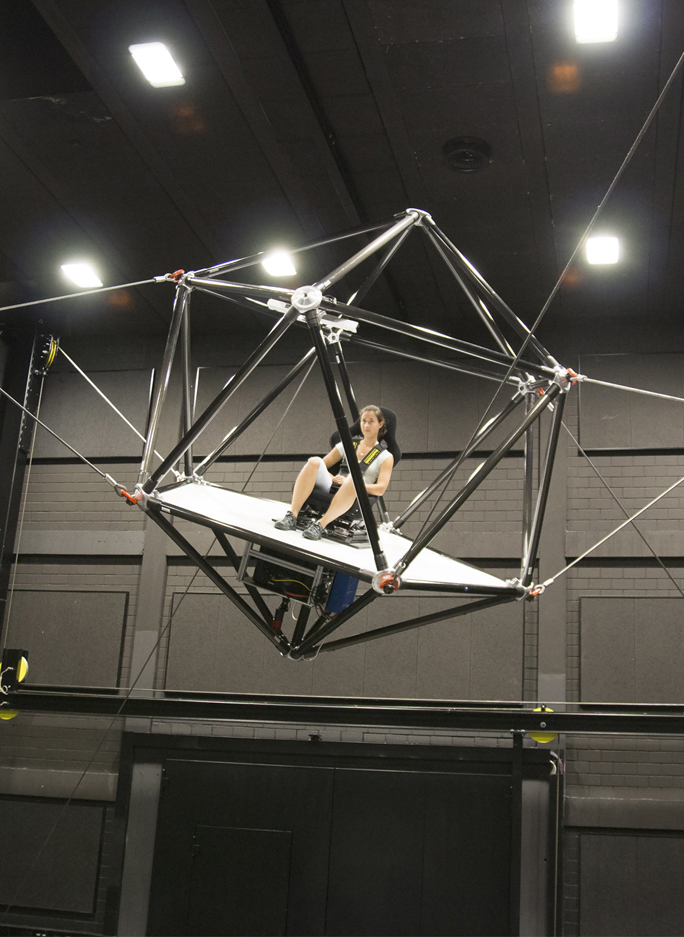
Heinrich Bulthoff

Cable Robot Simulator
Max-Planck-Institut für biologische Kybernetik

Eight steel cables, each with 1.4 tons of tensions, hold aloft a caged platform with a seat for one person. Using a wireless VR headset, that person can simulate experiences like flight while being zoomed in dozens of different ways. Eight retracting cables connected to a winch pull on the cage. It’s like a giant, flying VR jungle gym.

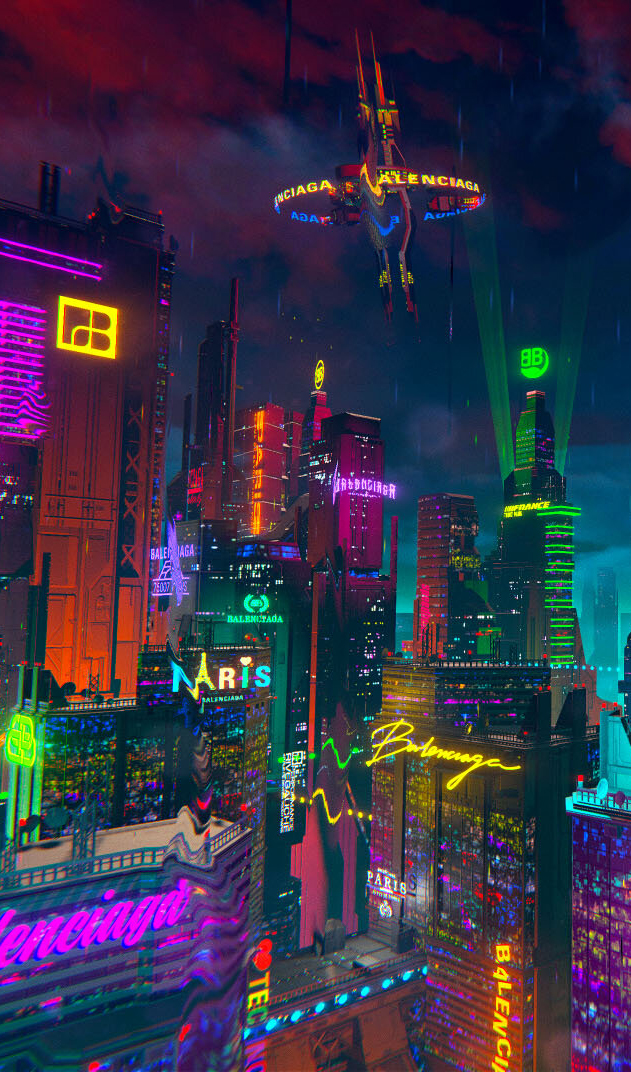
tabor robak

balenciaga collaboration
A 25 minute video loop with previously unreleased tracks by DJ Hell, made in collaboration with Balenciaga.

Here is a dramatic tension in his work between the real and the imagined in his use of often-appropriated digital objects to create virtual landscapes, which frequently contain elements – animals, machines, fragments of videogames – that are recognisable from our day to day life. This creates a symbiotic relationship between the digital and the real. In a very real way digital space has now become an intangible reality. The worlds built by Robak have a distinctly cinematic sensibility that hyperbolises the shine and dramatic effects of 3D rendered animation. The aesthetic of his work is supremely important, drawing the viewer into a truly alluring, indulgent and strangely gratifying environment. There is a further challenge to the void between high-art and the worlds of 3D animation and gaming, in the intersection between depiction and simulation. This can be partially attributed to the vernacular of advertising Robak is so proficient at utilising.

RAY KING

Solar sônico
“Solar sônico” é composto por 14 lentes que ficam suspensas na estrutura externa da cobertura de vidro do terminal. As lentes – uma estrutura de anel de puxar envolta em um lado com vidro defletor de luz holográfico – é graduada e conectada por 20 cabos horizontais tecidos em um padrão toroidal, tensionados e presos a âncoras em ambas as extremidades. Solar sônico é uma de uma série de esculturas cromáticas de King projetadas para interagir com o sol. As lentes holográficas côncavas da escultura são posicionadas de frente para o meridiano sul do sol e são iluminadas à noite. Ray King é um artista que usa os fenômenos naturais da luz e da ótica como meio de arte. Desde 1976 expõe internacionalmente o seu trabalho. Grandes instalações foram comissionadas nos EUA, Europa e Ásia – todas são específicas do local e inspiradas no espaço e na paisagem ao redor.

AURÉLIEN BORY

PLEXUS
Aurélien Bory is a Toulouse-based choreographer working at the intersection of dance, circus and visual art. In Plexus, he encloses the Japanese dancer Kaori Ito in a forest of tensioned vertical cables. It’s as if she’s in a transparent cuboid cage. We can see her, but her image is blurred by the shimmer of Arno Veyrat’s lighting as it moves across the cables. Ito strains against these confines, writhing, flailing and hurling herself against the cables. Every sound is hugely amplified, so with her every movement we are assailed by a high-tensile jangling and groaning. At intervals she subjects her environment to furious challenge, racing backwards and forwards within the limited inner space so that the cage rocks on its axis. At other times she positions herself between the cables so that they bear her weight, and hangs there like an exhausted insect, faintly articulating her limbs.

Vanessa Beecroft

瓦妮莎比克罗夫特
נסה יקרופט
ヴァネッサ·ビークロフト
바네사 비크로프트
ВАНЕССА БИКРОФТ
La Membre Fantôme

For the installation ‘le membre fantôme’, vanessa beecroft takes the visitor back to the classical language of sculpture through a conceptual perspective, leading us towards an intimate gallery room inhabited by timeless statuary. shown at the 2015 venice biennale, beecroft presents a scene that is visible only at a distance, where the viewer must look through a crevice carved out of two marble walls. Through the panels, we see fragments of a stone garden, rich in archaeological allures and echoes of early twentieth century avant-garde. the archive of memory is here a tribute in bronze – placed at the centre of the installation – to marcel duchamp’s ‘étant donnés’, a reference model for her research that combines personal memories, historical and artistic impressions and a conceptual tension.

J. MAYER H. und Partner, Architekten

于爾根·邁爾
يورغن ماير
위르겐 마이어
יורגן מאייר
ユルゲン・マイヤー
Юрген Майер
Danfoss Universe Science Park

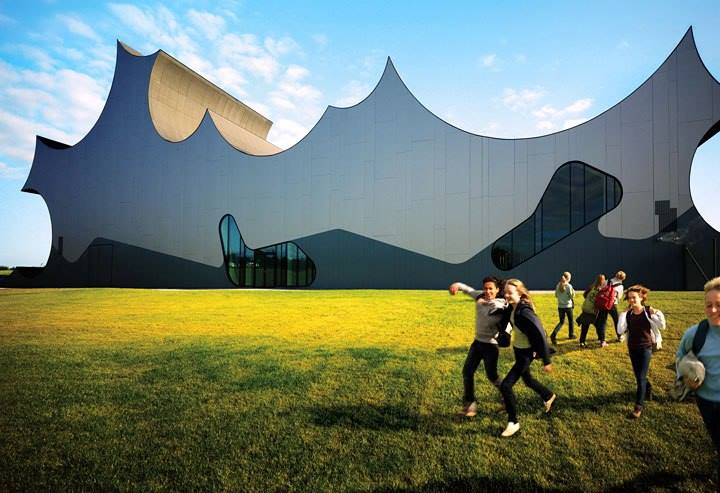
Jürgen Mayer H. prévoit d’étendre «Danfoss Universe», un parc d’aventures scientifiques et technologiques à Nordborg, au Danemark, près du siège de Danfoss au printemps 2007. Plusieurs bâtiments d’extension sont en cours de construction sur le site de 5,5 ha, dont un restaurant et un centre d’expositions et de conférences (total 1400 m2). Ces bâtiments, d’une apparence exceptionnelle, mettent en valeur l’idée de base pédagogique et innovante de Danfoss Universe et visent à susciter l’intérêt pour la nature et la science.

Martin Kersels

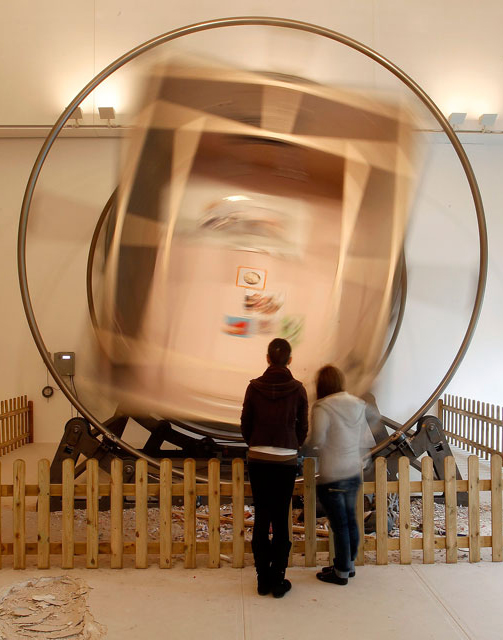
Tumble Room
Mr. Kersels was born in Los Angeles and attended UCLA for both his undergraduate and graduate educations, receiving a BA in art in 1984 and an MFA in 1995. His body of work ranges from the collaborative performances with the group SHRIMPS (1984-1993) to large-scale sculptures such as Tumble Room (2001). His interest in machines, entropy, sound, and dissolution has produced work that examines the dynamic tension between failure and success, the individual and the group, and the thin line between humor and misfortune.

Chen Qi

The Overall Effect of Flying with the Wind
Chen Qi has applied watermarked prints, woodcuts, books, installations, videos and other various media in his “Notations of Time” of 2010. In his new creations, he continues his exploration into “time”, “life”, “existence” and other basic issues with his off-screen language. Thus, his “Flying with the Wind” can be taken as an extension of his general concept of “Notation of Time”, as well as being closely related to his water-based printmaking which is a continuation of the infatuation with the traces of objects from Chinese wash paintings and the ink rubbings of ancient stele inscriptions.

LAURA LYNN JANSEN AND THOMAS VAILLY

Inner Fashion
Inner Fashion questions the codes, rules and production technic of fashion. The human body is seen as a fluid, inflatable and mobile structure in which the tension of fabric remplace muscles. Each piece of cloth are made of 2 layers: an inner layer, XXS, highly strechable and an outer layer, XL and none strechable. Both layer are dressed on a zeppelin shaped balloon representing the human body. As the balloon fills up with air, the fabric of the inner layer stretches out and both fabric are touching each other.

Buckminster Fuller

Tensegrity Sphere

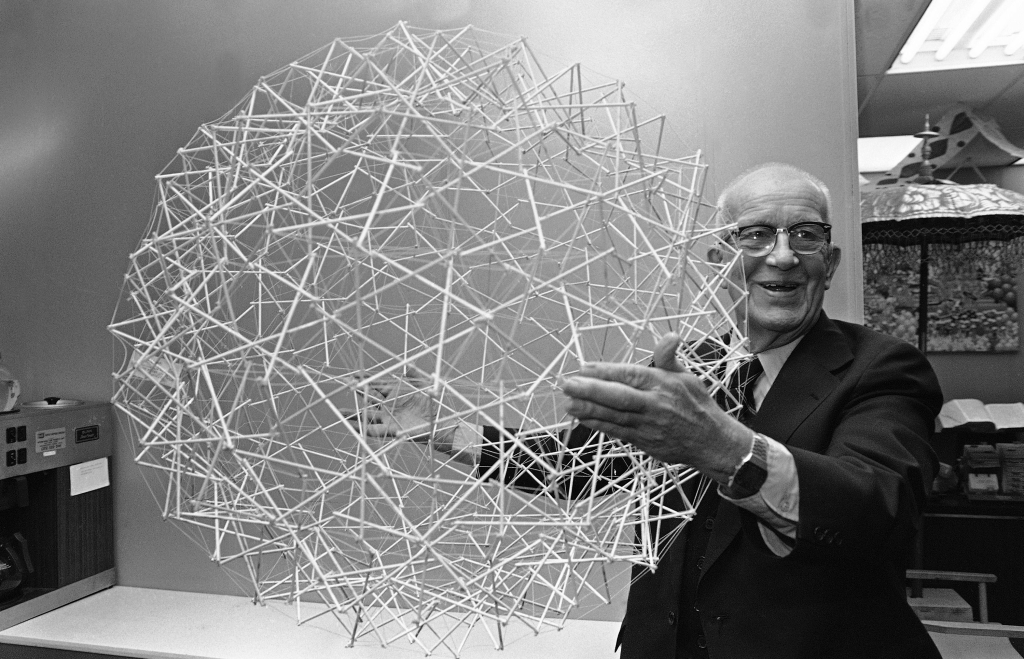
Sixty-Strut Tensegrity Sphere by Buckminster Fuller is both a feat of engineering and an object of beauty. Wire individually snakes through sixty stainless steel tubes, suspending them in a icosahedral (20 face) form. Tensional integrity, or tensegrity – a term coined by Fuller – is a structural-relationship principle.

A.LTER S.ESSIO PERFORMER ART GROUP

A.lter S.essio
“Loss”
via highlike submit
A.lter S.essio的组织Panem Et Circenses负责制作和行政管理,是Fabrice Planquette基于各种艺术合作发起的一个部分。
Fabrice Planquette偶尔邀请各个领域的人共享一个创意空间。 他给出了第一个动力和方向,每个人都有自己的语言,敏锐的感觉和前景。 2007年底,开始创作表演。 该系列已经由LOSS,LAYERS,ENDURANCE,EXTENSION(S)和ASCENSIO开始,并将继续进行SURFACE,DESERT(三重奏)和ENSEMBLE(7位舞者的作品)。 所有这些部分都是相互联系的:套件,互补,并行,对立。 他们遵循着对人类及其所处环境的探索的进步。 与环境,自己,对方面对

BART HESS

바트 헤스
巴特·赫斯
בארט הס
Барта Хесса
Heart to Mouth
Bart Hess, le dernier court métrage de l’artiste néerlandais, propose un échange passionnant de passion au ralenti pour l’amour. Selon Bart Hess, «il voulait créer une tension entre le corps et la matière – presque comme s’ils ne faisaient plus qu’un». Dans le court métrage ci-dessous, deux femmes se caressent la tête de ballon en latex pour exprimer l’amour l’une de l’autre. Les œuvres artistiques de Bart Hess ont été présentées lors de l’exposition «Dutch invertuals» lors de la semaine du design de Milan en 2009.