highlike

STROOK

Metropolis


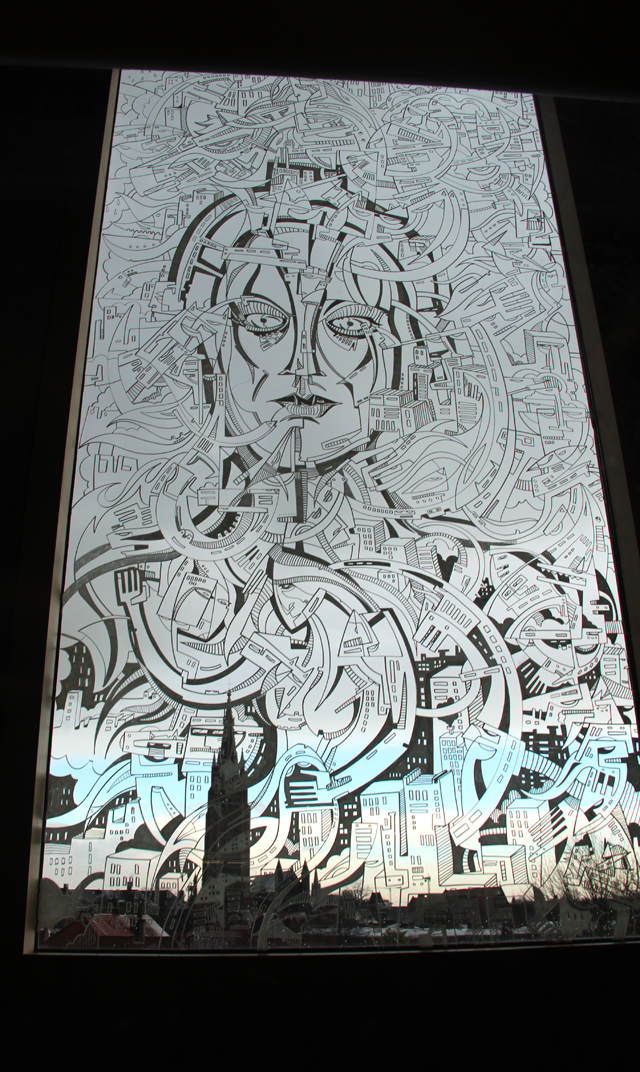
Metropolis is a 1927 German expressionist science-fiction film directed by Fritz Lang. Set in the year 2026, Metropolis takes place in a dystopian society where wealthy industrialists rule from vast tower complexes, oppressing the workers who live in the depths below them.

The drawing is placed on the largest window of the ‘Concertgebouw’ (Concert building) in Bruges with the perfect backdrop of the city. There are many different perspectives to the work wich has the effect of a changing picture throughout the day.

LIGHTING DESIGN COLLECTIVE

Silo 468 Light Art Helsinki


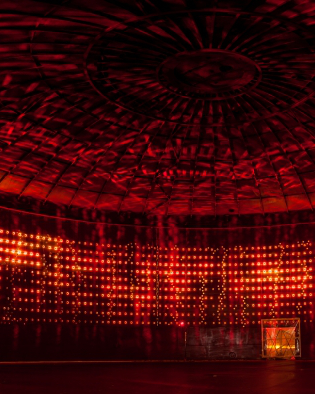
INTERACTIVE LIGHT ART FOR URBAN REDEVELOPMENT SILO 468 HELSINKI Disused oil silo has been converted into mesmerizing light art piece and a public space with the aid of swarm intelligence and interactive lighting. The project is a conversion of oil silo into light art piece and a public space designed by Madrid based Lighting Design Collective (LDC). It sits by the sea facing central Helsinki, Finland. Prevailing winds well known to residents are strongly present. The natural light, wind and the movement of light on the water formed the principles for the lighting concept. Walls are perforated with 2012 holes referring to the Helsinki World Design Capital 2012 year. The lighting signifies the start of a major urban redevelopment for the City of Helsinki. It functions to draw focus to unknown district and creates a landmark and a marketing device for the City. Maybe most importantly through the use of natural and artificial light it created a unique civic space for the citizens to use. Furthermore, it set a precedent for a new district for 11000 people to become the “district of light”. During the first years the silo is mainly viewed from distance when the area starts to get build. 1280 LED domes in 2700K white are fitted inside the silo behind the cut-outs and visible from several kilometres away. LDC developed a bespoke software using swarm intelligence and nature simulating algorithms that refresh responding to parameters such as wind speed, direction, temperature, clear night and snow. System dials out every 5 minutes for new data. The patterns are fluid, natural in feel and never repeat. They are slow but speed up in relation to the wind speeds creating constantly changing mural of light. At midnight the exterior turns deep red for 1 hour. The colour refers to the former use of the silo as a container of energy. At 02:30 when the last ferry goes past to Suomenlinna lights go off. The interior gains importance as the area gets populated. Inside is painted deep red. Daylight seeps through the pattern derived from original rust patterns on the walls. North facing wall has no perforations. 450 steel mirrors moved by winds are fitted behind the holes. With sunlight the silo appears to glimmer and sparkle like surface of water.The warm white LED grid reflects light indirectly via the red walls into the space. The moving patterns read as halos racing across the walls. The Silo is a civic space for the citizens of Helsinki. Floor was added and rigging infrastructure, power, water and emergency & cleaning lighting. Light intervention has created a new space for people.

Synarcade Audio-Visuals

The Museum of Faces

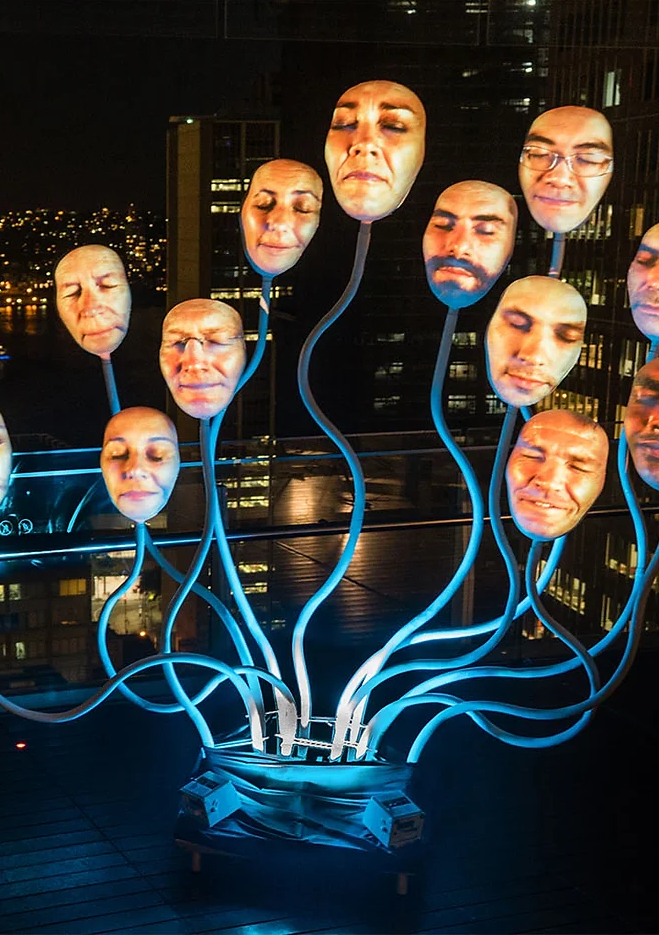
Designed to record and tell the stories of the local community and beyond, this futuristic invention by Synarcade Audio-Visuals is an astonishing communal forum of the city at a unique moment of growth and change.
Visitors are invited to approach the work and press a glowing button to make the faces come alive and speak. Then, they can step into a special Video Capture Booth and contribute their own face, voice, and story to become part of the ever-changing Museum.
The Museum of Faces is based on Synarcade Audio-Visuals’ award-winning invention, The Lumiphonic Creature Choir, an eerie mechanical choir that can sing together in unison, beatbox, or recite poetry at the touch of a button. The Lumiphonic Creature Choir has performed to sell-out audiences in Melbourne, Croatia, New York, and at TEDxSydney 2018.

QUBIT AI: Verbo Pluriel (aka volt46) & XWave

Squid

FILE 2024 | Interator – Sound Synthetics
International Electronic Language Festival
Verbo Pluriel (aka volt46) & XWave – Calamar – United States and France

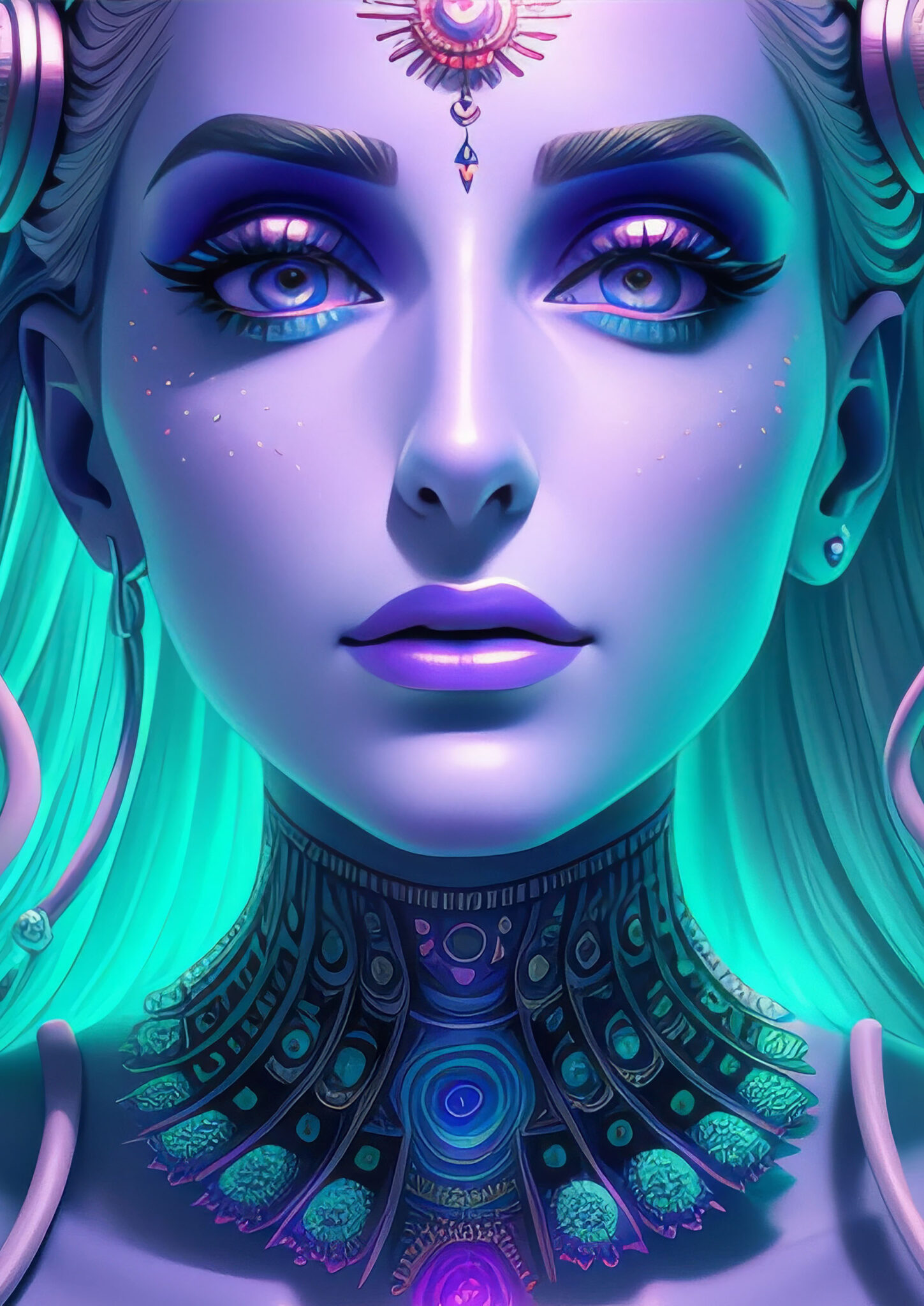
The Calamar music video is comprised of AI-generated clips that are sequenced and synchronized to create a hypnotic, ever-changing landscape.

Bio

Verbo Pluriel is an electronic music producer who has been active in the NFT scene since 2020 under the name volt46. X-Wave is also an NFT producer that trains its own AI models to generate collections. Although they never met in person, their participation in the web 3.0 art collective Based Ghouls led to their collaboration.

Credits

Music: Calamar (Kraken Mix) by Verbo Pluriel
Music Video: volt46
AI Video Generation: XWave

Wolfgang Buttress

LUMEN
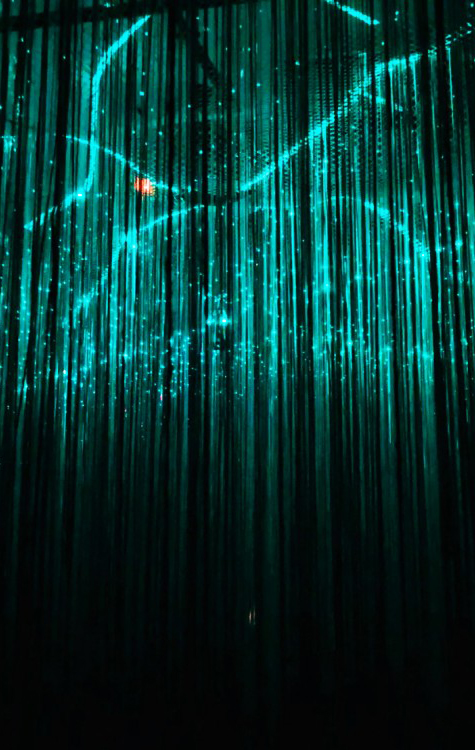
LUMEN is an artwork which expresses our ever changing relationship and perception of space and time. The sculpture will be installed in Taiwan in 2022. It expresses in form, light and sound the ever changing star-scape above Taichung. Using a live NASA feed from the sun, a bespoke light and sound system will express the live energy of the sun and the real time positions of the stars above Taichung on and in the sculpture.

Joris Strijbos

DARK ECOLOGY

IsoScope

IsoScope is a kinetic audiovisual outdoor installation, a sensorial experience in which the audience wanders through rotating lights and an ever-changing sonic cloud. This new work by Dutch artist Joris Strijbos consists of multiple robotic wind objects interacting with each other and with their surroundings. Strijbos aimed at creating a human-constructed phenomenon, an abstract entity which, like most natural phenomena, can only be experienced in certain weather conditions. IsoScope can be seen as a proposition for a new kind of machinic and artificial lifeform. IsoScope was commissioned by Sonic Acts for the second Dark Ecology Journey (2015) and realised in collaboration with Jeroen Molenaar, Daan Johan and Erfan Abdi.

Ying Yu

airmorphologies

Humans, as social beings, use language to communicate. The human voice, as a biometric authentication mechanism, is constantly used throughout daily life applications, such as speech recognition, speaker verification, and so on. Currently, language-based communications mainly fall into two categories: voice over air, and voice over internet protocol. Can we add a new dimension for voice communication such as a wearable material? If so, how could we shape matter in order to physicalize vocal information?

airMorphologiesis an interactive installation that uses soft materials, such as silicon, fabric, and air, to realize these physicalizations. The human voice controls the actuation of a soft wearable structure, changing the appearance of the human body.

CyberMotion Simulator

Max-Planck-Institut

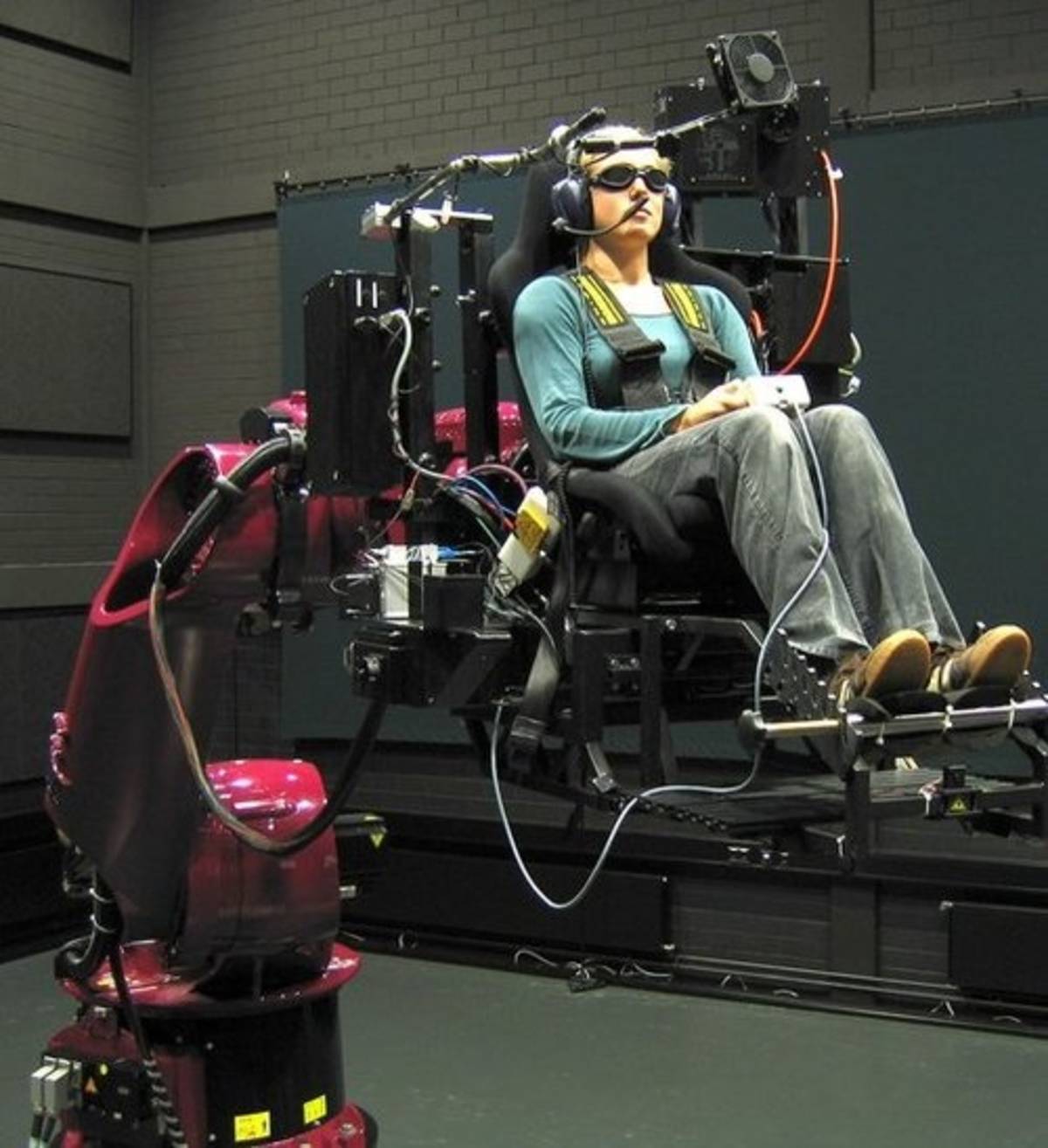
The CMS consists of an industrial robot arm with six independent axes, extended with an L-shaped cabin axis. The seventh axis allows for varying the orientation of the cabin with respect to the robot arm by changing the location of the cabin’s attachment point from behind the seat to under the seat, or any intermediate position. Recently, the CMS has been further extended with a linear axis of ten meters. The resulting eight degrees-of-freedom (DOF) provide an exceptionally large workspace. Several extreme motions and positions can be achieved, such as large lateral/longitudinal motions, sustained centrifugal motions, infinite head-centered rotation, and up-side-down motions.

Pedro Veneroso

file festival 2019
‘Tempo: cor’(Time:color) consists of an immersive installation that seeks to modify our experience of time by converting hours into color. A set of chromatic clocks, each set to a different GMT time zone, projects, in a semicircle, the current time in their mathematical and chromatic representations. The conversion between these two forms of time representation is based on an algorithm composed of sinusoidal functions that modulates the RGB colors as a function of the current time, gradually modifying the intensities of blue, green and red throughout the day: at midday yellow predominates, while at four in the afternoon the hour is red; midnight is blue, six o’clock in the morning is green. Side by side, the colors projected by the clocks merge, creating an immersive experience of a continuous and circular time, between the different time zones, that crosses the entire chromatic spectrum. This installation is part of a series of works in which I investigate the relationships between human notations and codes and our experience of space-time, seeking to change the ways we understand it; in this case, visitors immerse themselves in a spatial experience of time that provokes the questioning of notations and perceptions that we usually consider axiomatic. Changing the way we represent time will change our way of experiencing it?

tangible media group

transdock
Ken Nakagaki, Yingda (Roger) Liu, Chloe Nelson-Arzuaga, and Hiroshi Ishii
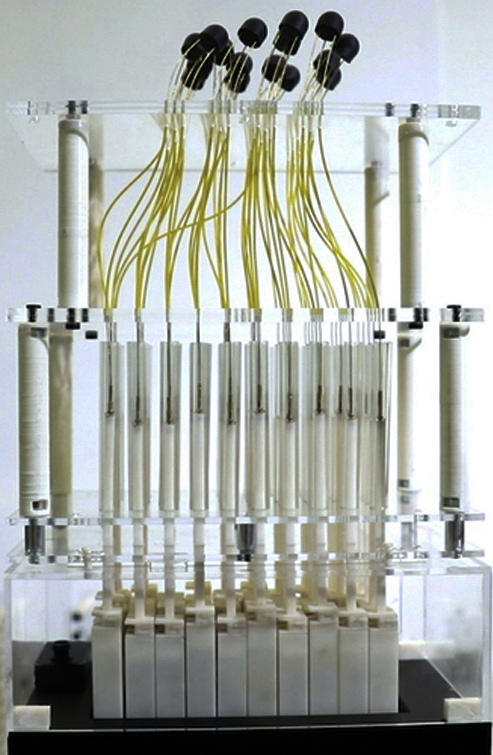
TRANS-DOCK is a docking system for pin-based shape displays that expand their interaction capabilities for both the output and input. By simply interchanging the transducer modules, composed of passive mechanical structures, to be docked on a shape display, users can selectively switch between different configurations including display sizes, resolutions, and even motion modalities such as rotation, bending, and inflation.
In our paper accepted to TEI 2020, we introduce a design space consisting of several mechanical elements and enabled interaction capabilities. Our proof-of-concept prototype explores the development of the docking system based on our previously developed 10 x 5 shape display, inFORCE. A number of transducer examples are shown to demonstrate the range of interactivity and application space achieved with the approach of TRANS-DOCK.

Quintessenz

Lingering Summer
“Lingering Summer” is a site-specific installation created for the 2019 West Bund Art Fair. The gradation of colors from yellow to lime green, and indigo to cerulean blue, is reminiscent of the dynamics of changing colors from early to mid-summer. The ascending and descending of layers create a natural and comforting rhythm, as if forming a virtual space to preserve the summer scene inside the steel and concrete architecture, mesmerizing the audience by breaking them away from reality.

Mattia Paco Rizzi + Jessica Bergstein-Collay

Taumascopio
‘Taumascopio’ is an art installation designed and realized by parisian architect-artist mattia paco rizzi for the 2014 kanal playground festival in brussels, belgium. the structure is completely covered with mirrors and as a result, offers a complete visual camouflage along the molenbeek’s canal. as its exterior panels fold, the overall massing creates a kaleidoscopic effect that reacts to heat. during the temperature’s evolution throughout the day, the surfaces present an ever-changing reflective effect. ‘the ‘taumascopio’ invites us to reflect in poetic vein on public space, like a box of delights that gives us multiple visions and allows us to see the city differently,’ says rizzi. ‘the mosaic of reflections sends our thoughts in new directions and invite us to create new ideas.’

HEATHERWICK STUDIO

Zeitz MOCCA
V&A Waterfront and Jochen Zeitz have announced a unique partnership to create a major new cultural institution that will focus on collecting, preserving, researching, and exhibiting contemporary art from Africa. An addition to Cape Town’s already prestigious V&AWaterfront, the museum is scheduled to be completed in 2016, at which point it will assume its place as the largest museum of modern art on the continent. In the meantime, the Zeitz MOCCA Pavilian presents changing exhibitions and educational programs that are available throughout the year.

Ateliers Jean Nouvel

努维尔
جان نوفيل
ז’אן נובל
ジャン·ヌーヴェル
Жан Нувель
장 누벨
Serpentine Pavilion

The design contrasted lightweight materials with dramatic metal cantilevered structures, rendered in a vivid red that, in a play of opposites, contrasts with the green of its park setting. In London, the colour reflects the iconic British images of traditional telephone boxes, postboxes and London buses. The building consists of bold geometric forms, large retractable awnings and a sloped freestanding wall that stands 12m above the lawn.
Striking glass, polycarbonate and fabric structures create a versatile system of interior and exterior spaces, while the flexible auditorium accommodates the changing summer weather and Park Nights, the Serpentine’s acclaimed programme of public talks and events, which attracts up to 250,000 visitors each summer.
Nouvel’s Serpentine Gallery Pavilion, the architect’s first completed building in the UK, operates as a publicly accessible structure within Kensington Gardens and as a café. The pavilion design highlights the idea of play with its incorporation of traditional French outdoor table-tennis tables.
This 2010 Pavilion is the tenth commission in the gallery’s annual series, the world’s first and most ambitious architectural programme of its kind, which has become an international site for architectural experimentation and follows a long tradition of pavilions by some of the world’s greatest architects. The immediacy of the commission – a maximum of six months from invitation to completion – provides a unique model worldwide.