highlike

FILE SÃO PAULO 2025: SYNTHETIKA – Ultravioletto

Mycelium — Natural Intelligence

Ultravioletto

FILE SÃO PAULO 2025: SYNTHETIKA – Arte e Tecnologia
Festival Internacional de Linguagem Eletrônica


Mycelium — Natural Intelligence – Itália

A inteligência é frequentemente vista como aquilo que distingue os seres humanos, com a tecnologia como seu produto. Essa visão antropocêntrica exclui grande parte do mundo natural da ideia de progresso. E se a inteligência for um processo distribuído, resolvendo problemas por meio de conexões? Fungos otimizam redes de alimentação e comunicação pelo micélio, oferecendo um modelo para repensarmos nossa relação com a natureza e as cidades. Ultravioletto explora esse conceito em um vídeo gerado por algoritmos.

BIO

Ultravioletto é um estúdio criativo especializado em fundir arte e design com tecnologias interativas. Com uma abordagem não convencional, o estúdio integra novas mídias em projetos de pesquisa inovadores, contando com designers, programadores, artistas 3D e produtores.

FILE SÃO PAULO 2025: SYNTHETIKA – Brit Bunkley

Natural Intelligence

Brit Bunkley

FILE SÃO PAULO 2025: SYNTHETIKA – Art and Technology – Video Art
Electronic Language International Festival


Natural Intelligence – Nova Zelândia

Natural Intelligence is “intelligence created by nature, natural evolutionary mechanisms” as opposed to artificial intelligence. With it, “there is a dynamic movement of natural intelligence that evolves from vague, fuzzy, and unconscious states to more concrete and conscious states, and thus realizing the essence of perception” (Perlovsky and Kozma, 2007). It is beautiful and deeply flawed, but it levels out in the end.

BIO

Bunkley has exhibited at the Museum of New Zealand Te Papa. He participated in the Visions in the Nunnery at the Nunnery/Bows art gallery in London in 2022 and in 2024 at Rencontres Berlin, Haus der Kulturen der Welt, Berlin, and he exhibited in Artweek Gyumri, Armenia. He was the award winner for Best Art | Experimental video/film at the New York City Independent Film Festival 2024 in NYC.

FILE SÃO PAULO 2025: SYNTHETIKA – Callahan Indovina

Daily Diffusion 53 & 86

Callahan Indovina

FILE SÃO PAULO 2025: SYNTHETIKA – Art and Technology – Shorts Films AI
Electronic Language International Festival


Daily Diffusion 53 & 86 – United States

The Daily Diffusion series by Callahan Indovina was a three-month project launched in 2024, as Generative AI tools and various plat forms to support the automation of animations and workflows were still emergent. The YouTube series aimed to provide workflows, prompts, and examples on how to utilize Stable Diffusion and various enhancements to create psychedelic animations. Like many of his works, the Daily Diffusion series took inspiration from Calalhan’s experiences within his dreams.

Music: https://www.mubert.com

BIO

Callahan Indovina is a spir itual and psychedelic artist from California’s Sierra Nevada. His artistic expression combines traditional digital composition techniques with innovative practices such as generative AI. His creations, described as super natural and dreamlike, reflect his surreal and transcendental vision, drawn from experiences within his dreams

FILE SÃO PAULO 2025: SYNTHETIKA – CNDSD & Iván Abreu

Pre(N)atura | Fonocene

CNDSD & Iván Abreu

FILE SÃO PAULO 2025: SYNTHETIKA – Art and Technology – Shorts Films AI
Electronic Language International Festival


Pre(N)atura | Fonocene – Mexico

Speculative audiovisual project inspired by postnatural studies, designed to explore the era of the Fonocene—a period where both human and non-human sounds define sensory experiences and interspecies interactions. In this narrative, Chthulucene beings, hybrid creatures, emerge to challenge traditional forms of communication, using listening as a tool to activate our awareness of interdependence. 

BIO

Iván Abreu is a Mexican-Cuban interdisciplinary artist who uses science, design and technology to create works that question human interaction and social systems. Malitzin Cortés, (CNDSD), is a Mexican artist who explores the intersection of sound, technology and speculative architecture. Her work combines live coding, audiovisuals and critical narratives. 

FILE SÃO PAULO 2025: SYNTHETIKA – Edwin van der Heide

Spiral of Time — Amazonas Brazil — UFAM

Edwin van der Heide

Interact with Spiral of Time — Amazonas Brazil — UFAM via FILE ARCHIVE


FILE SÃO PAULO 2025: SYNTHETIKA – Art and Technology – Installations
Electronic Language International Festival


Spiral of Time — Amazonas Brazil — UFAM – Netherlands

Spiral of Time captures and stages the diverse soundscape of a specific location over the course of several years. By documenting the unique natural, cultural, spatial, and temporal dynamics of a place, the work honors the contributions of all its actors. Every hour, a one-minute recording is made, resulting in a vast sonic archive over time. It is accessible online through a spiral-shaped interface, allowing listeners to explore the cyclical patterns revealed by navigating the material across different time intervals. 


Since July 17th, 2024, the artist has been recording the sounds of the square in front of MACBA (Museum of Contemporary Art of Barcelona). It is a very interesting, diverse, and vibrant urban space. The work is accessible online via https://www.macba.cat/en/spiral-of-time-placa-dels-angels/ and will also be presented physically in the museum starting July 10th, 2025.


Edwin is expanding the project to include other recording locations around the world—not only in urban contexts (dominated by humans) but also in areas governed by nature. The artist dedicated himself to a recording site in the Amazon region. Since February 11th, 2025 Spiral of Time has been installed at the Amazon Rainforest surrounding The UFAM (Federal University of Amazonas) in Manaus. It is home to one of the world’s largest urban forest fragments. Completely surrounded by the dense urban matrix of Manaus, this forest has been isolated since the late 1980s. The forest retains rich ecological features, including areas of mature terra-firme forest, late-stage secondary vegetation, and small patches of white-sand forests. This unique setting offers a rare opportunity to study tropical forest dynamics within a metropolitan environment. 

Spiral of Time-UFAM immerses the listeners in the acoustic life of one of the most biodiverse ecosystems on the planet. This contrast between the natural rhythms of the forest and the human-made patterns of the city enriches the broader narrative of the Spiral of Time, offering a deeper reflection on coexistence, change, and continuity across different environments.

BIO

Edwin van der Heide is an artist, composer, and researcher focused on sound, space, and interaction. His work pushes the boundaries of musical composition toward spatial, interactive, and interdisciplinary directions. He creates installations, performances, and immersive environments where the audience is placed at the center, encouraged to engage sensorially and investigatively.


FILE SÃO PAULO 2025: SYNTHETIKA – Weidi Zhang & Rodger Luo

ReCollection

Weidi Zhang & Rodger Luo

FILE SÃO PAULO 2025: SYNTHETIKA – Art and Technology – Installations
Electronic Language International Festival


ReCollection – China | United States

ReCollection is an interactive installation that uses artificial intelligence to construct synthetic collective visual memories from natural language input. The work blurs the line between memory and imagination through experimental visualizations and AI systems, prompting reflection on how narratives of memory are shaped by emerging technologies.

BIO

Weidi Zhang is a new media artist and designer based in Los Angeles and Phoenix. She is an Assistant Professor of Immersive Experience Design at Arizona State University. Her interdisciplinary research explores speculative assemblages at the intersection of immersive media, experimental data visualization, and interactive AI art. Dr. Jieliang (Rodger) Luo is the CEO and Head of Research at Minus AI, a research-driven startup focused on leveraging AI technology to empower the creative industry. He holds a Ph.D. in Media Arts and Technology from the University of California, Santa Barbara, and has previously served as a Senior Principal Research Scientist at the Autodesk AI Lab.

FILE SÃO PAULO 2025: SYNTHETIKA – Frederik De Wilde

Hunter and Dog

Frederik De Wilde

FILE SÃO PAULO 2025: SYNTHETIKA – Art and Technology – Installations
Electronic Language International Festival

Hunter and Dog – Belgium

Genetic and evolutionary algorithms reinterpret an existing artwork. De Wilde uses digital scans and custom genetic and evolutionary algorithms as a deconstruction technique to reinterpret and update the nineteenth-century work Hunter and Dog from sculptor John Gibson R. A. (1790–1866).

Frederik De Wilde’s Hunter and Dog interrogates the intersections of human evolution, genetic engineering, and the hybridization of technology and biology. De Wilde reinterprets the historical sculpture through the lens of post-evolutionary theory, engaging with contemporary debates on CRISPR, synthetic biology, and the implications of human-directed genetic modification. CRISPR, the revolutionary gene-editing technology, has introduced an unprecedented rupture in the trajectory of evolution. No longer constrained by the slow mechanisms of natural selection, humans now possess the ability to intervene directly in their own genetic blueprint, marking a shift toward a post-Darwinian paradigm. This technological power, however, is not neutral; it emerges from a historical lineage of scientific inquiry deeply entangled with colonialism. The history of genetic manipulation is inseparable from colonial bioprospecting, eugenics, and exploitative medical experimentation on marginalized populations. Colonial regimes treated bodies—both human and non-human—as sites of intervention, control, and optimization, a logic that persists in contemporary biotechnological frameworks. Post-colonial discourse reveals how genetic engineering risks perpetuating these legacies, reinforcing power asymmetries between those who wield biotechnological control and those subjected to its consequences. CRISPR, while offering the promise of eradicating disease and expanding human potential, also raises ethical concerns about genetic stratification, bio-capitalism, and the commodification of life itself. De Wilde’s work visualizes these tensions, making visible the processes of cell division and morphogenesis—the very biological mechanisms now subject to human intervention. Hunter and Dog does not merely depict the transformation of a neoclassical form but speculates on the future of the human body as a site of engineered evolution. From a decolonial perspective, the artwork questions who has the authority to edit life and to what ends. It challenges the techno-utopian narratives that frame genetic modification as an inevitable progress while obscuring its social, ethical, and ecological implications. By hybridizing art, science, and technology, Hunter and Dog compels us to confront the uncertainties of a CRISPR-driven future: Will genetic editing reinforce existing inequalities, or can it be decolonized and democratized? How do we navigate this post-natural frontier without losing the human—and more-than-human—dimensions of our existence? De Wilde’s work invites us into this speculative space, where the hunter, the dog, and the algorithm coalesce into a vision of a world where biology is no longer destiny, but a site of contested agency.

Where are we going from here? 

BIO

Frederik De Wilde fuses art, science, and tech. Known for his Blackest-Black works that inspired Kapoor’s Vantablack, he has shown at Venice Biennale, BOZAR, MAAT, Pompidou, and ZKM, winning awards like Ars Electronica.

LIGHTING DESIGN COLLECTIVE

Silo 468 Light Art Helsinki


INTERACTIVE LIGHT ART FOR URBAN REDEVELOPMENT SILO 468 HELSINKI Disused oil silo has been converted into mesmerizing light art piece and a public space with the aid of swarm intelligence and interactive lighting. The project is a conversion of oil silo into light art piece and a public space designed by Madrid based Lighting Design Collective (LDC). It sits by the sea facing central Helsinki, Finland. Prevailing winds well known to residents are strongly present. The natural light, wind and the movement of light on the water formed the principles for the lighting concept. Walls are perforated with 2012 holes referring to the Helsinki World Design Capital 2012 year. The lighting signifies the start of a major urban redevelopment for the City of Helsinki. It functions to draw focus to unknown district and creates a landmark and a marketing device for the City. Maybe most importantly through the use of natural and artificial light it created a unique civic space for the citizens to use. Furthermore, it set a precedent for a new district for 11000 people to become the “district of light”. During the first years the silo is mainly viewed from distance when the area starts to get build. 1280 LED domes in 2700K white are fitted inside the silo behind the cut-outs and visible from several kilometres away. LDC developed a bespoke software using swarm intelligence and nature simulating algorithms that refresh responding to parameters such as wind speed, direction, temperature, clear night and snow. System dials out every 5 minutes for new data. The patterns are fluid, natural in feel and never repeat. They are slow but speed up in relation to the wind speeds creating constantly changing mural of light. At midnight the exterior turns deep red for 1 hour. The colour refers to the former use of the silo as a container of energy. At 02:30 when the last ferry goes past to Suomenlinna lights go off. The interior gains importance as the area gets populated. Inside is painted deep red. Daylight seeps through the pattern derived from original rust patterns on the walls. North facing wall has no perforations. 450 steel mirrors moved by winds are fitted behind the holes. With sunlight the silo appears to glimmer and sparkle like surface of water.The warm white LED grid reflects light indirectly via the red walls into the space. The moving patterns read as halos racing across the walls. The Silo is a civic space for the citizens of Helsinki. Floor was added and rigging infrastructure, power, water and emergency & cleaning lighting. Light intervention has created a new space for people.

QUBIT AI: Paul Gründorfer & Leonhard Peschta

The Sea

FILE 2024 | Installations
International Electronic Language Festival

The Sea is an extraction of a complex natural phenomenon, resulting in an artificial emulation that develops a life form of its own. Just like the sea with its endless waves, this artificial system follows the impact of an immersive state, leading to a unique vision of an artificial generator. Despite appearing chaotic, it is capable of generating associations ranging from the movement of waves to science fiction scenarios.

Bio

Paul Gründorfer develops process-related systems and explores variable or unstable conditions in the occurrence of sound when exposed to amplification, feedback, and multiple signal streams. His works focus on processes that evolve in a social space. Leo Peschta is an artist and researcher. During his studies, he worked in various fields of media arts, including sound, installations and software, developing over the years a special interest in robotics and machinery.

Credits

Austrian Embassy

QUBIT AI: Iskarioto Dystopian AI Films

Relaxation

FILE 2024 | Interator – Sound Synthetics
International Electronic Language Festival
Iskarioto Dystopian AI Films – Relaxation – Spain

Relaxation is an animated painting that transports you to a surreal natural landscape, hypnotically inviting mental relaxation.

Bio

Iskarioto Dystopian AI Films is an emerging Spanish artist, empowered with cutting-edge AI tools, a fusion of human creativity with machine potential. He is known as a visual alchemist, pixel manipulator, and graphic, dark, dystopian storyteller. Since its premiere in 2022, it has been shown in art galleries around the world, having won the Artistic Award at the AI ​​Film Festival Montpellier 2023.

Credits

Music: Relaxation by NPM

Sam Twidale & Marija Avramovic

Sunshowers
(AI) infinite simulations
FILE FESTIVAL SP 2019
.
‘Sunshowers’ is the third in our series of real-time animation artworks. It is inspired by the opening chapter of Akira Kurosawa’s film Dreams which follows a young boy as he explores a forest and stumbles across a fox wedding (Kitsune no Yomeiri). Our piece explores ideas of animism and techno-animism by assigning life in the form of artificial intelligence to all of the objects, both natural and man-made, within the virtual world. The piece unfolds in real time with the characters themselves deciding which paths they will follow.

ANDREAS HAIDER AKA MUK

Skia

file festival
As natural as the daily sunshine, one’s shadow, formerly a constant companion, now often escapes from attention. A silhouette of our physical form, one’s shadow is no more than a flat, disembodied reduction of the contours of one’s self.The installation skia examines the interplay of our shadows and our conscious awareness of our physical displacement of space. In this closed-circuit installation, visitor´s images are manipulated and projected as artificial shadows.What does it mean if one’s shadow suddenly frees itself and develops an alien autonomy? And what has such an estrangement in common with the multiple identities of the post modern ego?

One Life Remains: André Berlemont, Kevin Lesur, Brice Roy & Franck Weber

FILE SAO PAULO 2017
LES DISCIPLINES DU RECTANGLE
Inspired by Michel Foucault’s work, Les disciplines du rectangle is a videogame proposition about the nature of rules and norms at the digital age. If society provides models of accomplishment we are supposed to fit inside, then the rectangle is the pure abstraction of this idea. The geometrical shape works as a symbol of the very nature of normativity, blind to individual differences. The rectangle, existing only on the screen, reveals how digital technologies can in some ways become the new location for this normativity and the ambivalent results of their intangible and invisible nature. Besides, the installation offers an occasion to think about the way games can become manipulation tools. The fact that in the end, players act as if they were piloted by the rectangle (an inversion of the traditional relationship between player and avatar) gives an aesthetical highlight to this.

.

Inspirado en el trabajo de Michel Foucault, Les disciplines du rectangle es una propuesta de videojuego sobre la naturaleza de las reglas y normas en la era digital. Si la sociedad proporciona modelos de realización en los que se supone que encajamos, entonces el rectángulo es la pura abstracción de esta idea. La forma geométrica funciona como símbolo de la naturaleza misma de la normatividad, ciega a las diferencias individuales. El rectángulo, que existe solo en la pantalla, revela cómo las tecnologías digitales pueden convertirse de alguna manera en la nueva ubicación de esta normatividad y los resultados ambivalentes de su naturaleza intangible e invisible. Además, la instalación ofrece la oportunidad de pensar en cómo los juegos pueden convertirse en herramientas de manipulación. El hecho de que, al final, los jugadores actúen como si fueran piloteados por el rectángulo (una inversión de la relación tradicional entre jugador y avatar) le da un toque estético a esto.


FR-EE Fernando Romero Enterprise

فرناندو روميرو
费尔南多·罗梅罗
フェルナンド·ロメロ
페르난도 로메로
Soumaya Museum

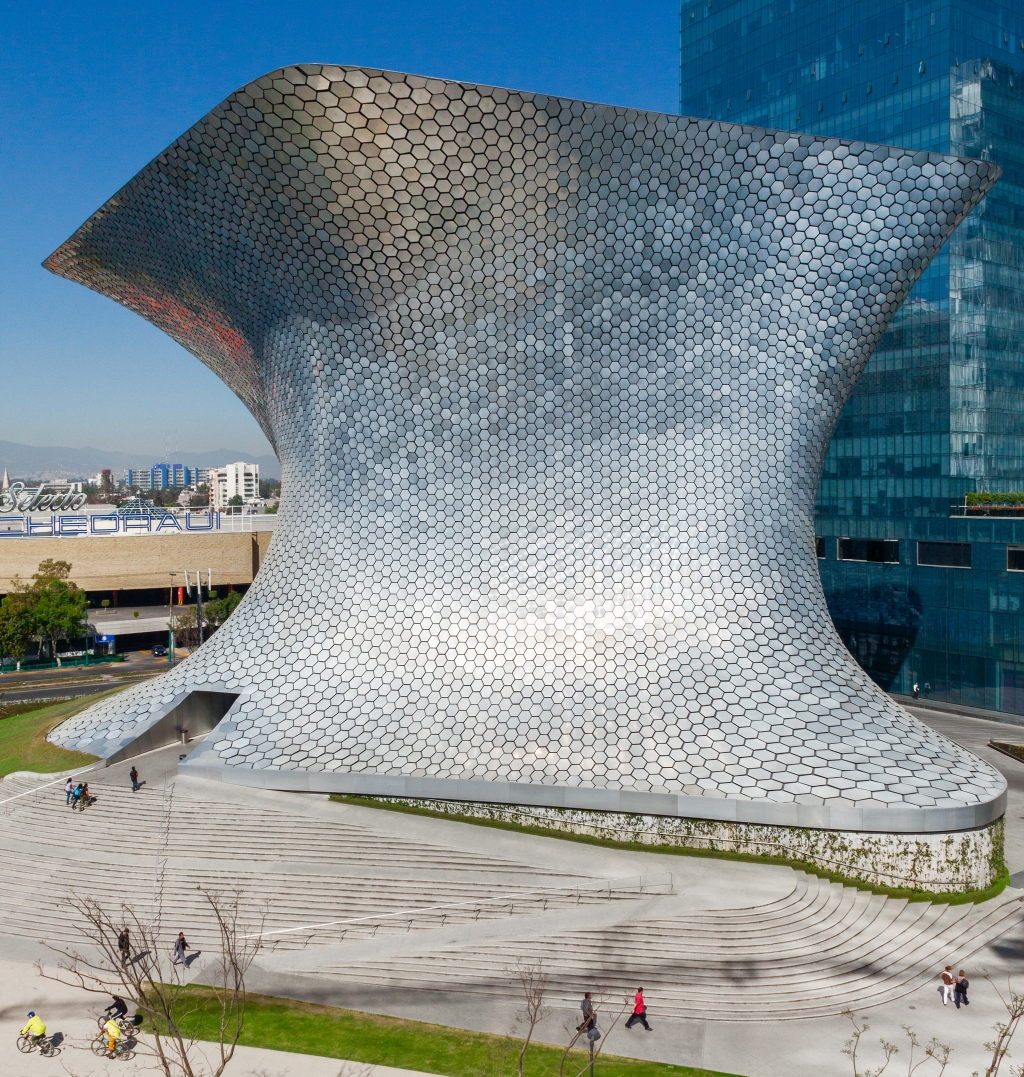
Museum buildings tend to be conceived either for maximum functionality – acting as neutral containers for art – or as iconic structures that represent a city at a particular historic moment. The Museo Soumaya was designed as both: a sculptural building that is unique and contemporary, yet one able to house a collection of international paintings, sculptures, and decorative objects dating from the fourteenth century to the present.The exterior of the building is an amorphous shape perceived differently from every angle, reflecting the diversity of the collection inside. The building’s distinctive façade is made of hexagonal aluminum modules facilitating its preservation and durability. The shell is constructed with steel columns of different diameters, each with its own geometry and shape, creating non-linear circulation paths for the visitor. The building encompasses 20,000 square meters of exhibition space divided among five floors, as well as an auditorium, café, offices, gift shop, and multipurpose lobby. The top floor is the largest space in the museum, with its roof suspended from a cantilever that allows in natural daylight.

MIKE PELLETIER

МАЙК ПЕЛЛЕТЬЕ
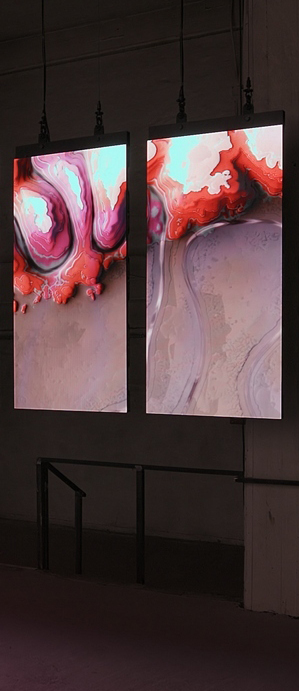
Peristaltic Skin
Questo era un progetto di collaborazione con Lucy McRae creato per il Transnatural Festival nel 2010. La Peristaltic Skin Machine è una sperimentazione sul corpo con liquido, aria, velocità e colore.

asif khan

Radiant Lines

“People are naturally drawn to light, It’s intuitive. What I want people to feel is a sense of familiarity even though they haven’t seen it before. There’s a sense that it’s pseudo-natural, which I think is why people are drawn to it. It uses crazy technology – there’s a lot of stuff happening – but it doesn’t show it and the result is more humanistic and almost biological.” asif khan

Marte Marte Architekten

State Gallery

Like a dancing cube shimmering in titanium, the new State Gallery of Lower Austria is placed between the picturesque inner cities of Krems and Stein, and links these with the surrounding natural and river landscape. The spherical curvature and the strongly outward-projecting external walls presented a challenge: titanium shingles and glass panes were individually produced, having been calculated in 3D. Inside, light-flooded areas alternate with daylight-free levels that can be used as required. The project is a strong illustration of the capabilities of the Vorarlberg architectural practice of Marte.Marte.

Tezi Gabunia

Breaking News: Flooding of the Louvre
Natural disaster increasingly linked to a climate change has arrived to the museum of Louvre, which responds to the flooding of Paris in 2018. The artwork also respresents the issue of cultural leftover. Recycling is the main value of the process. By destruction of model that was a part of previous project Put Your Head into Gallery, the leftovers are reconstructed and new meanings and possibilities are created. The flooding of the Louvre Museum speaks about news culture and our fluctuating perception of disasters as it is seen through media. The scale of the disaster is often difficult to assess from news coverage. In the work “Breaking News” flood goes slowly into the room of the Louvre, letting the viewer to gradually watch the destruction of interior. it brings the viewer shochinkly close to what has not happened but easily could have, viewer sees the before and after effect in a highly visualized manner, which is as convincing and threatening, as fake.

Joris Strijbos

DARK ECOLOGY

IsoScope

IsoScope is a kinetic audiovisual outdoor installation, a sensorial experience in which the audience wanders through rotating lights and an ever-changing sonic cloud. This new work by Dutch artist Joris Strijbos consists of multiple robotic wind objects interacting with each other and with their surroundings. Strijbos aimed at creating a human-constructed phenomenon, an abstract entity which, like most natural phenomena, can only be experienced in certain weather conditions. IsoScope can be seen as a proposition for a new kind of machinic and artificial lifeform. IsoScope was commissioned by Sonic Acts for the second Dark Ecology Journey (2015) and realised in collaboration with Jeroen Molenaar, Daan Johan and Erfan Abdi.

Kouichi Okamoto

Re Rain
“Re-rain” is a sound installation expressing non-visible elements such as gravity, magnetic force, and sound as physical elements. This installation is created with the sound of rain sampled in Japan early spring of 2016.The sound of raindrops hitting an umbrella are recorded, and is then played back from a speaker. The umbrella is set on top of a speaker, and the vibration of the speaker is transmitted through the umbrella to make a sound. For example, an umbrella cannot vibrate if the magnetic force of the speaker is small or if the rain hitting the umbrella is either too high or too low in pitch extent. For this reason, this is a device picking out a state in which the magnetic force of the speaker, weight of the umbrella, and pitch extent of sound are all in a balanced state. Natural phenomena such as rain travels through an object and is emitted as sound to the air..

Jennifer Steinkamp

EON
“I considered the first life forms on Earth and how we came to be as a way to refer to the Natural Sciences. I looked at fossil records of the first multi cellular organisms of the Ediacaran Period, 555 million years ago for inspiration. I was struck by the theory of symbiosis in evolution; our DNA ancestors are the resultant fusion of single cellular organisms and bacteria. The millions of bacteria in our bodies are our foremothers. EON is a speculative fiction, a depiction of early life forms underwater. The Universe was formed 13.7 billion years ago. The Earth is 4.543 billion years old. Cyanobacteria or blue-green algae were the first microbes to create oxygen on Earth via photosynthesis 3.5 billion years ago. First humans 200,000-300,000 years ago.” Jennifer Steinkamp

lauren dimaya krystal li heidy cordero arias

every time the stars align
FILE LED SAO PAULO 2018
“Every Time the Stars Align” fuses different natural elements of crystals, plasma and flowers in a lava lamp environment. Red crystals freeze with rigid edges and thaws into a relaxing mood. Plasma liquid rises and falls reflecting a lava-like quality. Flowers fluctuate between a spectrum of color symbolizing intense human affections. Contradicting and uniting flat and deep spaces, the three elements compose and decompose.

Quintessenz

Lingering Summer
“Lingering Summer” is a site-specific installation created for the 2019 West Bund Art Fair. The gradation of colors from yellow to lime green, and indigo to cerulean blue, is reminiscent of the dynamics of changing colors from early to mid-summer. The ascending and descending of layers create a natural and comforting rhythm, as if forming a virtual space to preserve the summer scene inside the steel and concrete architecture, mesmerizing the audience by breaking them away from reality.

Heatherwick Studio

Zeitz MOCAA
The Zeitz Museum of Contemporary Art Africa

Heatherwick Studio au inaugurat în data de 22 septembrie 2017 un nou Muzeu de Artă Contem­porană în Africa de Sud – Zeitz MOCAA. Muzeul este amplasat în Cape Town în lungul celebrului V&A Waterfront. Frontul la apă, denumit cu sens istoric Victoria and Albe­­­rt, atrage zilnic peste 100 000 de oameni. Este amplasat la baza Muntelui Table, în golful natural al fostului port istoric, beneficiind de o deschidere superbă spre ocean, pe de o parte, şi spre vârfurile muntoase, pe de alta.

ALEJANDRO JODOROWSKY

Алехандро Ходоровский
La Montaña Sagrada (holy mountain)

Não é fácil digerir o cinema de Alejandro Jodorowsky. Menos ainda talvez seja escrever qualquer coisa a respeito de seus filmes. E a situação pode ficar ainda mais complicada quando tratamos de A Montanha Sagrada. Pode-se dizer que o filme representa o auge da confluência criativa entre Jodorowsky, o cineasta e Jodorowsky, o mago. Nunca antes um filme fora tão bem sucedido ao capturar a poderosa essência imagética dos símbolos místico e religiosos. E vale notar aqui que religioso não tem nada a ver com crenças institucionalizadas, mas com o aspecto humano que lida com tudo o que é misterioso, invisível e sobrenatural.

cinema full

Oliver Laric

Betweenness
“Installed in the main gallery is Betweenness (all works 2018), a video montage that sorts the natural world, including a few humans, into simple, line-drawn motion graphics. There’s a frolicsome quality to the animations: when the animals move, grow, shift, and, quite literally, evolve, the scenes appear to follow a playful intuition, rather than exhibiting any scientific fact.”more

PAULINE VAN DONGEN

wearable solar

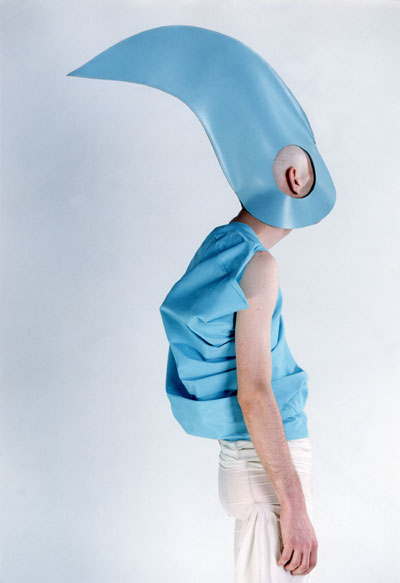
There is nothing natural in nature; technology makes our humanness giving form to our surroundings. The human habitat reveals a techno-morphed structure that can no longer be hidden behind the vestiges of a natural world: technology has to be naturalized. Pauline van Dongen researches the body in a technologically textured space. After graduating from ArtEZ, Academy of the Arts in Arnhem, the Netherlands, she started her own womenswear label in 2010. Pauline operates a meticulous research of the behaviour of experimental and high-tech materials, combining new technologies with traditional techniques to constantly renovate craftsmanship. Working closely with companies from the field of science and innovation, Pauline aims to merge fashion and technology giving life to scientific creations.

Elizabeth Ogilvie

the liquid room

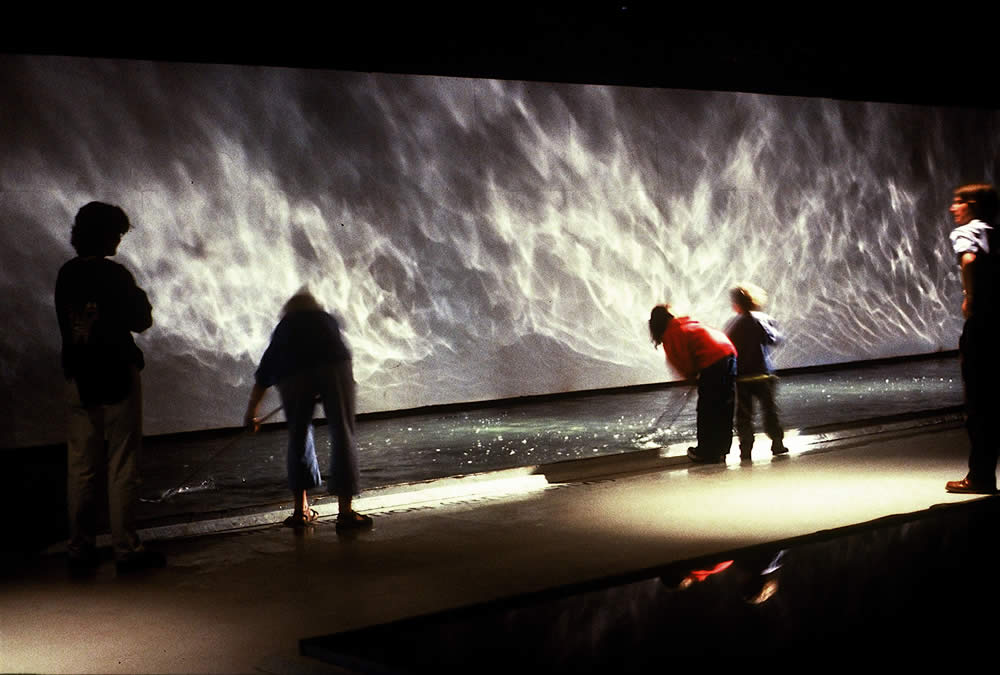
Elizabeth Ogilvie is a Scottish artist who uses water as a medium and as a research focus. Water is the obsession which returns in most of her works and it becomes experience through the use of installations and videos. Her work embraces universal and timeless concerns, offering her public an innocent pleasure and at the same time underlining philosophical and ecological issues.
Through her installations, the artist isolates water inside an artificial state, creating a process which highlights its fundamental qualities in order to return to its place of origin which is the natural habitat. Among her most important works there is Liquid Room realized in 2002. Inside a derelict warehouse the artist created basins with water which were crossed by a footbridge. By linking art, architecture and science, she realized an interactive installation where the visitor, walking on the footbridge, can touch the water, whose movement is reflected on the walls of the installation. In 2006 she created Bodies of Water, whose operation took over from her previous work.
Once again, through a series of installations, the public was able to share the experience of sensorial involvement within an environment dominated by water.

threeASFOUR

Human Plant 1

ThreeASFOUR (anteriormente conhecido como ASFOUR) foi criado em 2005 pelos designers Gabi, Ange e Adi. Inspirado pelo mundo natural e com uma visão de encontro entre moda e arte em mente, threeASFOUR emprega uma abordagem tridimensional para cortar e construir coleções que redefinem a alfaiataria clássica. O trabalho da threeASFOUR está nas coleções permanentes do Metropolitan Museum of Art Costume Institute e do Cooper Hewitt Design Museum em Nova York, bem como no Victoria & Albert Museum em Londres e no Musée de la Mode et du Costume Palais Galliera em Paris.

REYNALD DROUHIN

РЕЙНАЛЬД ДРУХИН
LANDSCAPE MONOLITH

MONOLITH is the title of French multimedia artist Reynald Drouhin’s latest art project which consists of a series of digitally manipulated images of stunning natural landscapes. In the middle of picturesque sunsets and serene Arctic landscapes, Drouhin pastes a mysterious prismatic shape and then flips it, thus creating a mind-boggling visual effect of an otherworldly transparent object hovering in desolate locations. The entire project is an ingenious appropriation of the famous monolith from Stanley Kubrick’s film ”2001: A Space Odyssey” where mysterious dark rectangular objects (dubbed as monoliths) were scattered across the solar system by an unknown alien civilisation which seemed to guide humans along a risky interplanetary journey. Reynald Drouhin’s MONOLITH series captures exactly the double nature of Kubrick’s monoliths: the inverted shapes in the photographs seem to be a window to another dimension, a physical anomaly which distorts the nature around it, and is both menacing and inviting.

SONICE DEVELOPMENT

emerging colorspace
Julian Adenauer and Michael Haas
Emerging Colorspace was a robotic drawing installation, realized by the Berlin based duo of artists, designers and inventors Julian Adenauer and Michael Haas, aka Sonice Development, as part of the Red Never Follows exhibition the Saatchi Gallery in London last summer. A new version of the studio’s Vertwalker, a machine with the ability to move on vertical surfaces, walking on buildings, and crawling on interior walls. The machine autonomously applied paint to the wall using a marker, referencing the vertical streets in Minority Report, the flying cars in Bladerunner and 5th Element, or Spiderman, the Silver Surfer and the Green Goblin – just to name a few sources of inspiration that expressed the supernatural. Thousands of lines drawn with different colors gradually formed an increasingly dense colorspace that emerged during the more than 200 exhibition hours, while the wandering behavior of the machine followed simple algorithmic rules with random elements. The result was a web that constantly changed, and never looked the same, exploring new territories and the future in a way ordinary mortals can’t.

REYNALD DROUHIN

Рейнальд Друхин

Der 1969 geborene zeitgenössische Künstler Reynald Drouhin lebt und arbeitet in Paris und unterrichtet Multimedia an der School of Fine Arts in Rennes. Er studierte Bildende Kunst an den Beaux-Arts de Paris (DNSAP und Masters in Hypermedia Multimedia, 1998) und an der Universität Paris 1 (Maîtrise, 1994). Seine Praxis umfasst digitale Werkzeuge, Fotografie, Video, Installation und Skulptur. Er ist nicht zufrieden mit einem dedizierten Raum (dem des Internets, einer Projektionsfläche oder der Räumlichkeit einer Galerie), sondern erfasst wiederum verschiedene Möglichkeiten und versucht so, etwas anderes als das Sichtbare zu enthüllen, wie einen parallelen Raum, gespenstisch, seltsam, oder er hat sich aus kodifizierten Daten ergeben. Er hat an Veranstaltungen teilgenommen, die von Digital Arti (2011), auf der Rennes Biennale (2010), beim File Festival (2013) Media Art, organisiert wurden. Ghost Walk “(2009) und„ Es war einmal… “(2007) in der Galerie der schönen Künste in Lorient („ Ohne Titel “, 2006) in der Galerie Biche de Bere („ Natural / Digital “, 2005), bei Confluences (2003), in der Public Gallery (2001), beim Belfort International Urban Multimedia Arts Festival (2000), auf der Montreal Biennale und bei der von Champ Libre organisierten internationalen Veranstaltung Video & Electronic Art (Montreal, 2000 und 1999) und bei ISEA (Chicago, 1997).

OLAFUR ELIASSON

オラファー·エリアソン
اولافور الياسون
奥拉维尔·埃利亚松
אולאפור אליאסון
Олафур Элиассон
The cubic structural evolution
Al centro del lavoro di Eliasson c’è la considerazione di come percepiamo e viviamo il mondo. Spesso fabbrica fenomeni dall’aspetto naturale (come la luce del sole, l’acqua corrente o la nebbia) in ambienti artificiali come una galleria d’arte. Questi fenomeni fabbricati coinvolgono direttamente i sensi del suo pubblico e sollecitano riflessioni su come viviamo le cose. Eliasson ha descritto questo effetto come la capacità di “vedere se stessi vedendo”. Il progetto di evoluzione strutturale cubica 2004 è un’opera d’arte partecipativa in cui gli spettatori contribuiscono alla costruzione di un mondo Lego. È un lavoro in cui Eliasson incoraggia un livello di coinvolgimento molto diretto. Gli spettatori sono in grado di guidare attivamente la loro esperienza del lavoro mentre prende forma organicamente per tutta la durata della sua installazione.

LORENZO OGGIANO

Quasi-Objects

ll works are printed using pigment-based inks on Hahnemühle archival paper, variable dimensions, edition of 3+1 ap.
“Quasi-Objects” is an art project consisting of 3d generated videos and prints, a practice of “organic re-design” – started in 2003 and still in progress – that aims to stimulate thought and dialogue on the progressive relativisation of natural forms of life as a result of techno-biological evolution.“Quasi-Objects” regards data actualization, the production of biologically non-functional organisms and ecosystems as transient output of an operative practice: aesthetics of process.
“Life is a real and autonomous process independent from any specific material manifestation.”

REVITAL COHEN

Artificial Biological Clock

Revital Cohen’s Artificial Biological Clock (2008) is a clock-like device that responds to online information from a woman’s doctor, therapist and financial advisor. It is designed to remind modern women when they are fertile and emotionally and economically ready to conceive. It is an examination of how contemporary life can disconnect us from our instincts and the natural rhythms of our bodies.

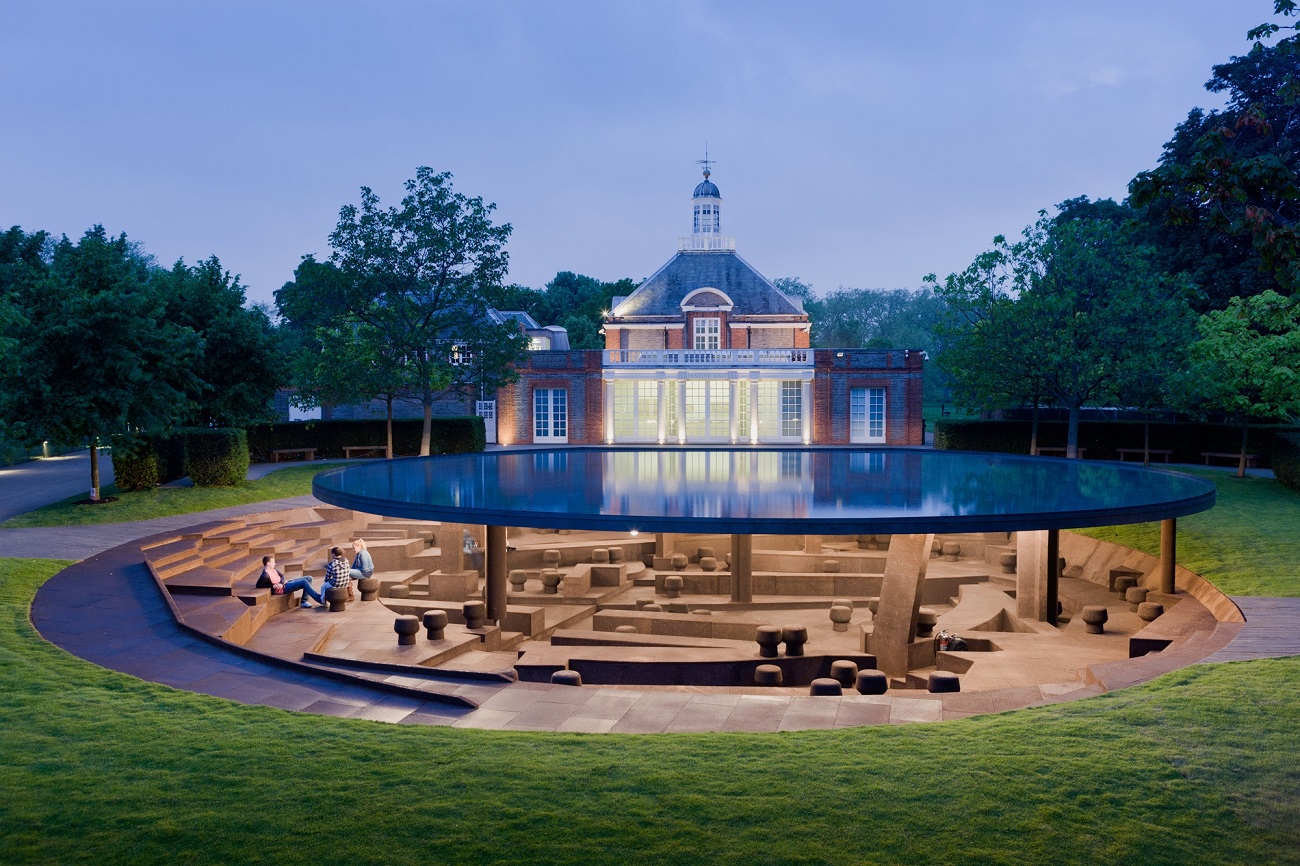
HERZOG & DE MEURON AND AI WEIWEI

THE SERPENTINE GALLERY PAVILION 2012

Segundo já anunciado pela Serpentine, o pavilhão deste Verão proporcionará uma viagem aos projectos dos anos anteriores. “Seguindo uma abordagem arqueológica, os arquitectos criaram um design que vai inspirar os visitantes a olhar para baixo da superfície do parque assim como a olhar para trás no tempo através dos fantasmas das estruturas antigas”, lia-se no comunicado da galeria londrina, que explicava que através da recuperação dos vestígios de intervenções de outros anos, vão ser construídas doze colunas, uma para cada edição. Apoiarão uma plataforma flutuante, a 1,5 metros acima do chão.

A cortiça surge como o elemento estruturante da obra por ser, segundo a dupla de arquitectos Herzog & de Meuron, um “material natural, com fortes mais-valias aos níveis do tacto e do olfacto, de grande versatilidade, permitindo ser facilmente esculpido, cortado, moldado e formado”.

Em comunicado, António Rios de Amorim, presidente da CA, escreve que esta “é uma oportunidade ímpar de demonstrar ao mundo que a cortiça não é apenas um produto único, criado pela natureza, mas também um material tecnologicamente relevante para o século XXI”. Carlos Jesus não tem dúvidas de que para esta aposta terá contribuído o sucesso do Pavilhão de Portugal na Expo 2010, em Xangai. “O pavilhão, todo revestido com cortiça, foi um dos mais visitados e acabou premiado”, disse Jesus, explicando que desde então a empresa se tem dedicado também a promover “estas particularidades técnicas”.