highlike

FILE SÃO PAULO 2025: SYNTHETIKA – Hsujing

XENO: UNDERTOW

Hsujing

FILE SÃO PAULO 2025: SYNTHETIKA – Arte e Tecnologia – Videoart
Festival Internacional de Linguagem Eletrônica


XENO: UNDERTOW – China / England

XENO: UNDERTOW is an experimental short film that employs stream-of-consciousness narration and AI-generated surreal visual art to explore the identity struggles and inner turmoil of cross-cultural migrants in mainstream society. Through metaphor, the film depicts a whale forcibly displaced from the boundless azure sea, cast into a desert of shifting sands. This imagery symbolizes the challenges cultural migrants face in adapting to dominant cultures and the profound sense of identity loss.

BIO

Hsujing is a contemporary artist and digital artist & director. His primary research focuses on the integration of technology and art, as well as speculative creative outputs. He is skilled in combining diverse techniques for artistic creation. His works blend elements of classicism with science fiction, not only envisioning future landscapes but also revealing persistent realities.

FILE SÃO PAULO 2025: SYNTHETIKA – ChrisLee

Robot Journey: Part 1, 2 & 3

ChrisLee

FILE SÃO PAULO 2025: SYNTHETIKA – Art and Technology – Cine SYN
Electronic Language International Festival


Robot Journey: Part 1, 2 & 3 – China

In a future where Earth’s environment has become uninhabitable, a lone robot sets out in search of a new home for humanity. After decades of travel, it discovers a planet strikingly similar to Earth — but it’s not alone. In The Last Explorer, the robot encounters mysterious presences and begins to develop emotions while exploring the unfamiliar world. Confronted with challenges, it must make choices that reflect its growing sense of awareness.

BIO

Chris Lee is a visual artist and independent creator from China. Trained in industrial design, he worked as a visual designer before turning to independent filmmaking. A lifelong passion for drawing now drives his ambition to develop an original series that blends animation with live action, showing that small teams and independent creators can produce powerful, high-quality stories.

Música: Karol Skowronek

FILE SÃO PAULO 2025: SYNTHETIKA – Frederik De Wilde

Hunter and Dog

Frederik De Wilde

FILE SÃO PAULO 2025: SYNTHETIKA – Art and Technology – Installations
Electronic Language International Festival

Hunter and Dog – Belgium

Genetic and evolutionary algorithms reinterpret an existing artwork. De Wilde uses digital scans and custom genetic and evolutionary algorithms as a deconstruction technique to reinterpret and update the nineteenth-century work Hunter and Dog from sculptor John Gibson R. A. (1790–1866).

Frederik De Wilde’s Hunter and Dog interrogates the intersections of human evolution, genetic engineering, and the hybridization of technology and biology. De Wilde reinterprets the historical sculpture through the lens of post-evolutionary theory, engaging with contemporary debates on CRISPR, synthetic biology, and the implications of human-directed genetic modification. CRISPR, the revolutionary gene-editing technology, has introduced an unprecedented rupture in the trajectory of evolution. No longer constrained by the slow mechanisms of natural selection, humans now possess the ability to intervene directly in their own genetic blueprint, marking a shift toward a post-Darwinian paradigm. This technological power, however, is not neutral; it emerges from a historical lineage of scientific inquiry deeply entangled with colonialism. The history of genetic manipulation is inseparable from colonial bioprospecting, eugenics, and exploitative medical experimentation on marginalized populations. Colonial regimes treated bodies—both human and non-human—as sites of intervention, control, and optimization, a logic that persists in contemporary biotechnological frameworks. Post-colonial discourse reveals how genetic engineering risks perpetuating these legacies, reinforcing power asymmetries between those who wield biotechnological control and those subjected to its consequences. CRISPR, while offering the promise of eradicating disease and expanding human potential, also raises ethical concerns about genetic stratification, bio-capitalism, and the commodification of life itself. De Wilde’s work visualizes these tensions, making visible the processes of cell division and morphogenesis—the very biological mechanisms now subject to human intervention. Hunter and Dog does not merely depict the transformation of a neoclassical form but speculates on the future of the human body as a site of engineered evolution. From a decolonial perspective, the artwork questions who has the authority to edit life and to what ends. It challenges the techno-utopian narratives that frame genetic modification as an inevitable progress while obscuring its social, ethical, and ecological implications. By hybridizing art, science, and technology, Hunter and Dog compels us to confront the uncertainties of a CRISPR-driven future: Will genetic editing reinforce existing inequalities, or can it be decolonized and democratized? How do we navigate this post-natural frontier without losing the human—and more-than-human—dimensions of our existence? De Wilde’s work invites us into this speculative space, where the hunter, the dog, and the algorithm coalesce into a vision of a world where biology is no longer destiny, but a site of contested agency.

Where are we going from here? 

BIO

Frederik De Wilde fuses art, science, and tech. Known for his Blackest-Black works that inspired Kapoor’s Vantablack, he has shown at Venice Biennale, BOZAR, MAAT, Pompidou, and ZKM, winning awards like Ars Electronica.

QUBIT AI: Arnaud Weber

NNY 43 – New York 43

FILE 2024 | Aesthetic Synthetics
International Electronic Language Festival
Arnaud Weber – NNY 43 – Nouvelle New-York 43 – Switzerland

In this short created with Midjourney, Runway and DaVinci Resolve, a futuristic megacity sprawls across an exoplanet, reflecting humanity’s limitless expansion. This fascinating and immense city of tomorrow explores the challenges and wonders of a civilization that goes beyond the limits of human habitation. The work offers a captivating reflection on the future of our societies and the impact of our growth in new and unexplored worlds.

Bio

Arnaud Weber, creative director and founder of Le Village Design has been a pioneer in generative digital art since the 2000s. Educated at École Boulle, his work ranges from Parisian design agencies to international recognition, especially through art and films generated by AI. His projects exemplify the fusion between technology and creativity, questioning the future of organic creativity in the digital age.

Breakfast

Portraits in Black and Silver
Portraits in Black and Silver is an interactive kinetic artwork that uses BREAKFAST’s custom-engineered Flip-Disc medium. This computer-controlled installation invites you to become a part of its history. As you engage with the piece, it will record a brief clip of your interaction and play it back at a later time, cycling through all of the portraits captured. Flip-Discs are small dime-size circles that can rotate 60 times per second using electromagnets, creating abstract images of black and silver portraits. The artwork challenges your perception of what art can be and pushes the boundaries of traditional mediums.

UVA UNITED VISUAL ARTISTS

Present Shock
Present Shock confronts the viewer with a barrage of statistical clocks representing real-time information about the world—from life-changing global events to the banal trivia of everyday existence—highlighting how the speed and volume of data in the Information Age present new challenges to our limited cognitive apparatus. Many of the statistics presented occur at timescales and spatial horizons that similarly defy our perception or comprehension. Disturbing the inertia of the here and now, they reveal the fluctuating state of dynamic transformation that characterizes life on earth.

Oyler Wu

Active Inlays

Oyler Wu Collaborative approaches architecture with a critical and rigorous intent that challenges the typical vision of the built environment. The office relies on the constant exchange between large architectural proposals and small architectural installations..

WERNER REITERER

Вернер Рейтерер
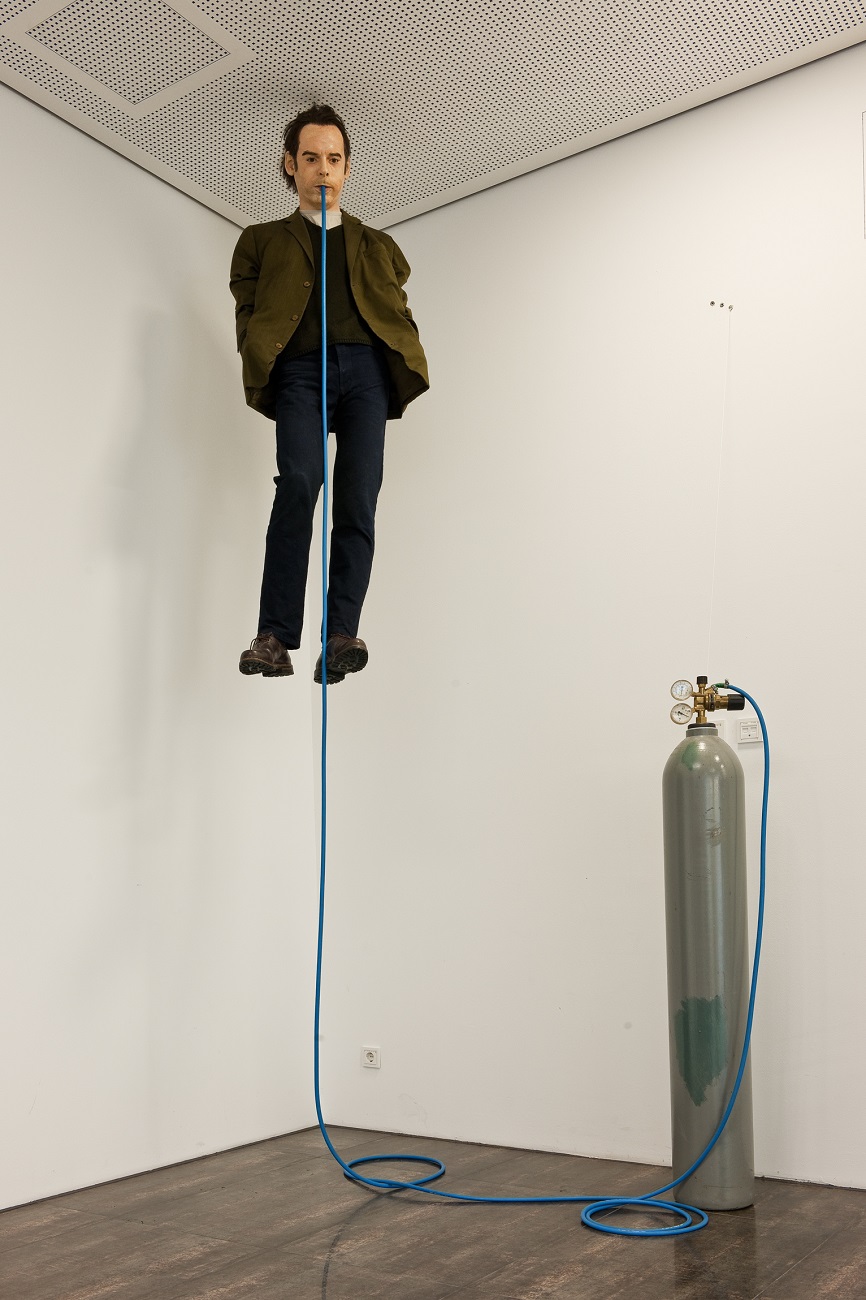
The Beginnings of Space Travel

Should art make us laugh? Styrian artist Werner Reiterer certainly challenges us to ponder on the sense and nonsenses of our world, but the noir humour and irreverent handling of reality in his approach mean that our first reaction is to laugh out loud. What we make of it afterwards is the long finish, as it were.

Denis Villeneuve

Arrival

“Arrival’s narrative plays out in four languages: English, Mandarin, Russian and Heptapod. Though they are not spoken in the film, we learn that Louise is also fluent in Farsi, Sanskrit and Portuguese (and possibly others). The language learning process and the growing translingual bond between Louise and the heptapods forms the film’s narrative arc and the majority of its plot. Thus language, and specifically the mechanics of ←215 | 216→multilingualism, is Arrival’s central theme. Within this context, the ability to communicate across language barriers is an asset, and the flexibility to navigate new linguistic challenges is invaluable. The heptapods are pure science fiction, but serve a powerful metaphorical function. As Emily Alder (2016) writes in The Conversation, “ultimately, Arrival is less about communicating with the aliens than with each other – internationally but also individually […] The film’s message is that difference is not about body shape or colour but language, culture and ways of thinking. It’s not about erasing that difference but communicating through it”. Gemma King

.

语言学习过程以及路易丝与七足动物之间越来越多的跨语言联系形成了电影的叙事弧线和大部分情节。 因此,语言,尤其是←215的机制| 216→使用多种语言是到达中心的主题

.

Процесс изучения языка и растущая межъязыковая связь между Луизой и гептаподами составляют повествовательную дугу фильма и большую часть его сюжета. Таким образом, язык и, в частности, механика ← 215 | 216 → многоязычие – центральная тема Арривала.

Leonhard Lass and Gregor Ladenhauf

DEPART
The Entropy Gardens
.
The Entropy Gardens is an artistic VR experience that explores one of humanity’s most archetypical artforms – garden making. It challenges its myths, aesthetics and modes of perception. Like a garden, The Entropy Gardens attempts to become a spatiotemporal poem — a poetic organism. In the form of a sprawling journey it constructs a hermetic, virtual garden as a poetic ecosystem — a psychic landscape that is foremost a complex audiovisual experience. It admits the visitor into a place that is equally challenging and contemplative (and of course profoundly weird).

Gwyllim Jahn & Cameron Newnham +Soomeen Hahm Design +Igor Pantic

Steampunk Pavilion
Steampunk is a pavilion constructed from steam-bent hardwood, designed by Gwyllim Jahn, Cameron Newnham (Fologram), Soomeen Hahm Design and Igor Pantic for the 5th edition of Tallinn Architecture Biennale.
“Steampunk explores a path to rethink applications and traditions of craft in pursuit of their evolution.” Soomeen Hahm Design
“The structure challenges the idea of the primitive hut –showing how, by using algorithmic logic, simple raw materials can be turned into a highly complex and inhabitable structure”.Gilles Retsin

Minimaforms

Emotive city
Emotive City is a framework to explore a mobile and self-organizing model for the contemporary city. Models of the past are limited and should not operate, as blueprints for our urban future, a new generation of design enquiry by necessity must address the challenges of today. The fixed and finite tendencies that once served architecture and urbanism have been rendered obsolete. Today the intersections of information, life, machines and matter display complexities that suggest the possibility of a much deeper synthesis. Within this context, architecture is being forced to radically refactor its response to new social and cultural challenges with an environment of accelerated urbanization. We propose a framework that participates and engages with the information-rich environments that are shaping our lives through a model of living that we call an adaptive ecology.

Urbanscreen

Spektrum
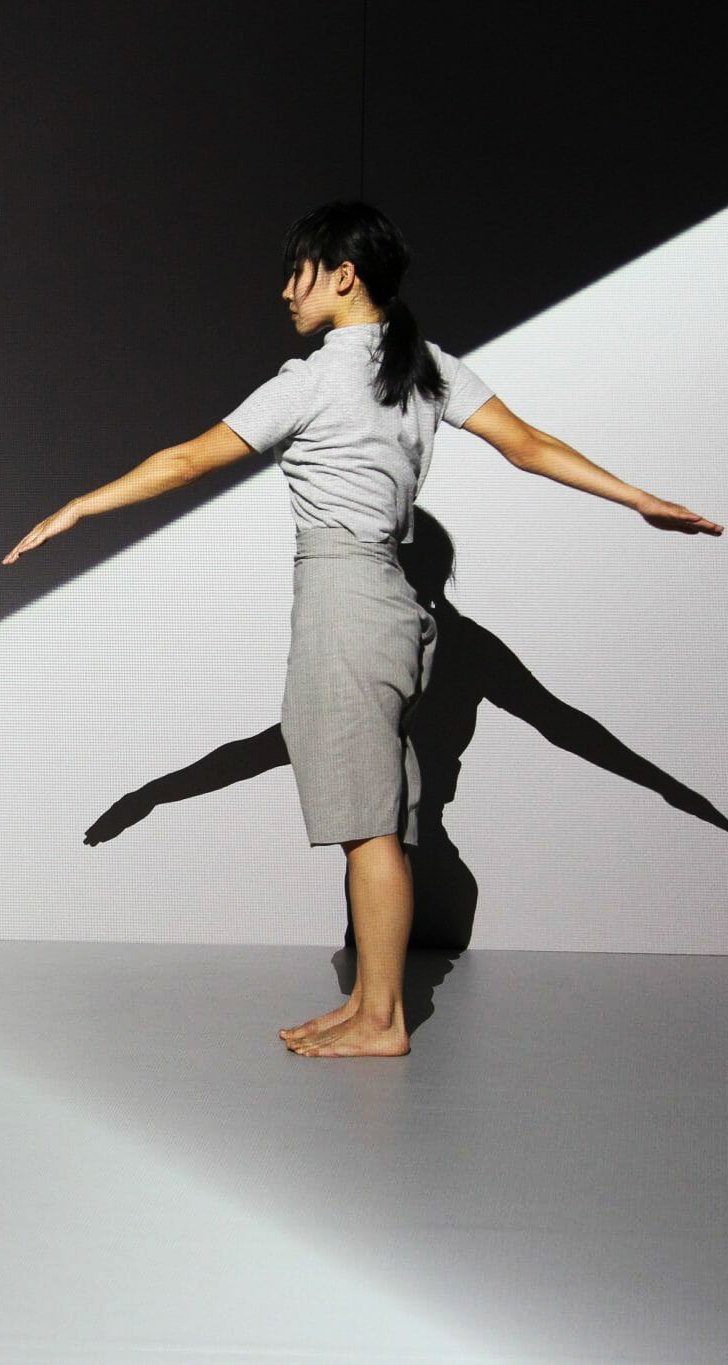
SPEKTRUM is an interplay of light, music and the performers. The use of projections in a theatrical context was a very pleasant experience for us, for when projections are used indoors, they can be controlled so precisely that amazing changes of perspective are possible. Once the stage is perceived as a platform, once as a white cube, once the spatial perception itself is completely challenged. As the three different elements of the performance merge into one unified language, SPEKTRUM is able to be many things at once: playful and yet fierce, touching and yet disturbing. Less a narrative than an emotional and sensory experience SPEKTRUM challenges the mind of the spectator in a quite a poetic way.

Refik Anadol

Quantum memories
Quantum Memories is Refik Anadol Studio’s epic scale investigation of the intersection between Google AI Quantum Supremacy experiments, machine learning, and aesthetics of probability. Technological and digital advancements of the past century could as well be defined by the humanity’s eagerness to make machines go to places that humans could not go, including the spaces inside our minds and the non-spaces of our un- or sub-conscious acts. Quantum Memories utilizes the most cutting-edge, Google AI’s publicly available quantum computation research data and algorithms to explore the possibility of a parallel world by processing approximately 200 million nature and landscape images through artificial intelligence. These algorithms allow us to speculate alternative modalities inside the most sophisticated computer available, and create new quantum noise-generated datasets as building blocks of these modalities. The 3D visual piece is accompanied by an audio experience that is also based on quantum noise–generated data, offering an immersive experience that further challenges the notion of mutual exclusivity. The project is both inspired by and a speculation of the Many-Worlds Interpretation in quantum physics – a theory that holds that there are many parallel worlds that exist at the same space and time as our own.

minD

Vortexture
Vortexture puts forward an architecture that is agile, activity-based and challenges our ideas of organization and static typologies. Materializing permeant physical form – it is a space that is constant fluctuation. There is no final typicality; it’s an architecture in a process that regenerates and adapts with the change in space and time. Vortexture is a proposal for a new work environment simulated and tested via agent models and developed as a new kind of the urban district as a creative industry hub. Vortetute is time-sensitive. Vortexture is season sensitive. On weekdays, the office orients itself to create a user interface that is productivity-based, while during the weekend, the floor plan reshuffles itself to enhance creativity-based plan allowing more communal areas and meeting zones.

Superflex

One Two Three Swing!
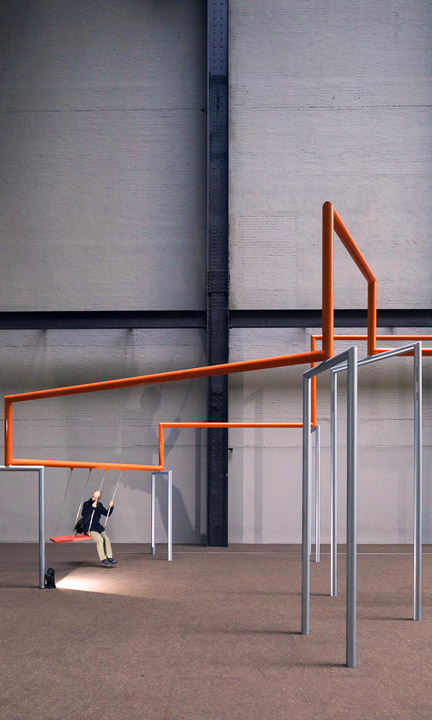
One Two Three Swing! challenges society’s apathy towards the political, environmental and economic crises of our age. The installation is experienced in three states: apathy, production and movement. The state of apathy compromises a large pendulum suspended by a 20 metre cable from ceiling and swinging above a 770 square metre carpet in a colour scheme inspired by British currency. Occupying the far end of the hall is the state of production, a factory station where swing seats are assembled, stamped and stored prior to distribution and use. Emerging from the state of production, an orange line formed of sets of interconnected, three-seated swings invite and frame the movements of users.

Eliška Sky

WOMANEROES

“Eliška Sky’s tribe of ‘womaneroes’ stand bold and bright, their bodies and heads adorned in vibrant shapes, colours, and textures. Beneath the wigs and paint are women of all ages, shapes and ethnicities, photographed with a large-format camera to capture every detail, rough or smooth, with the intention for the images to eventually be printed and exhibited life-size. “It started as visual play, but transformed into a series that challenges depictions of women’s bodies,” explains the London-based Czech photographer. “In light of my own experience of working in the fashion industry, I felt the need to portray the body in new ways and forms, with an element of playfulness and humour in opposition to western media advertising”.” Marigold Warner

UVA UNITED VISUAL ARTISTS

Harmonics
Harmonics challenges our perception of light and sound unfolding at great speed, an illusion of time blending. As the two kinetic sculptures speed up, rotating beams of light blend to form volumes of colour, while multiple discrete sounds become a major chord. Unable to process extremely fast information, our brain reads sequential sensory inputs as a single event in time. A disconnected reality perceived as a continuum, a harmonious whole.
VIDEO

Bill Vorn

Prehysterical Machine

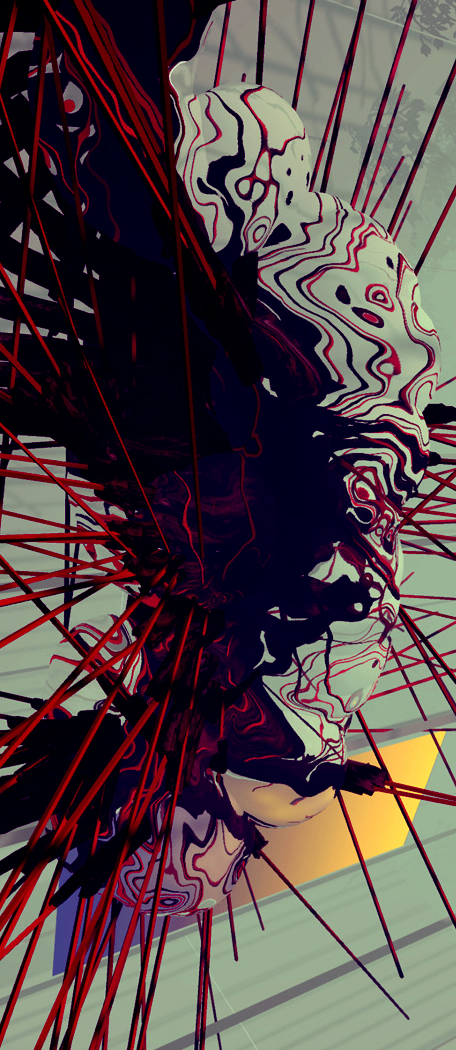
The Prehysterical Machine has a spherical body and eight arms made of aluminum tubing. It has a sensing system, a motor system and a control system that functions as an autonomous nervous system (entirely reactive). The machine is suspended from the ceiling and its arms are actuated by pneumatic valves and cylinders. Pyroelectric sensors allow the robot to detect the presence of viewers in the nearby environment. It reacts to the viewers according to the amount of stimuli it receives. The perceived emergent behaviors of this machine engender a multiplicity of interpretations based on single dynamic pattern of events.The aim of this project is to induce empathy of the viewer towards a “character” which is nothing more than an articulated metal structure. The strength of the simulacra is emphasized by perverting the perception of the creature, which is neither animal nor human, carried through the inevitable instinct of anthropomorphism and projection of our internal sensations, a reflex triggered by any phenomenon that challenges our senses.
FILE FESTIVAL

bernd hopfengaertner

BELIEF SYSTEMS
Facial micro expressions last less than a second and are almost impossible to control. They are hard wired to the emotional activity in the brain which can be easily captured using specially developed technological devices. Free will is now in question as the science exposes decision-making as an emotional process rather than a rational one. This ability to read emotions technologically result in a society obsessed with their emotional reactions. Emotions, convictions and beliefs which usually remain hidden, now become a public matter. “Belief systems” is a video scenario about a society that responds to the challenges of modern neuroscience by embracing these technological possibilities to read, evaluate and alter peoples behaviours and emotions.

Peng Di

dementia simulator
This Dementia Simulator headset designed by Central Saint Martins graduate Di Peng lets wearers experience symptoms of the disease for themselves (+ movie). The helmet affects each of the senses, in an attempt to replicate many of the challenges faced by dementia sufferers. The translucent, egg-shaped device sits over the wearer’s entire head, and includes a mouthpiece, earpiece and screen that covers the eyes.

LAURA WAGNER

selfportrait with tongue
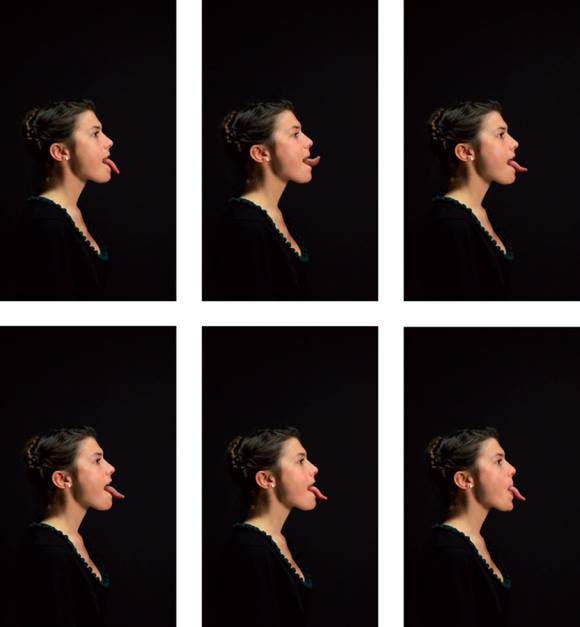
Selbstportrait mit Zunge is a video portrait that shows the artist in profile, wearing the traditional dress and hairstyle of her homeland, stretching out her tongue and moving it slowly. Mirroring the non-durational aspect of painting, a conventional means of portraiture, the work isn’t marked by beginning or end points. Selbstportrait mit Zunge challenges the notion of temporality as an essential component of video, a medium that is normally defined by the presence of durational elements.more

KATY HEINLEIN

Snake Eyes
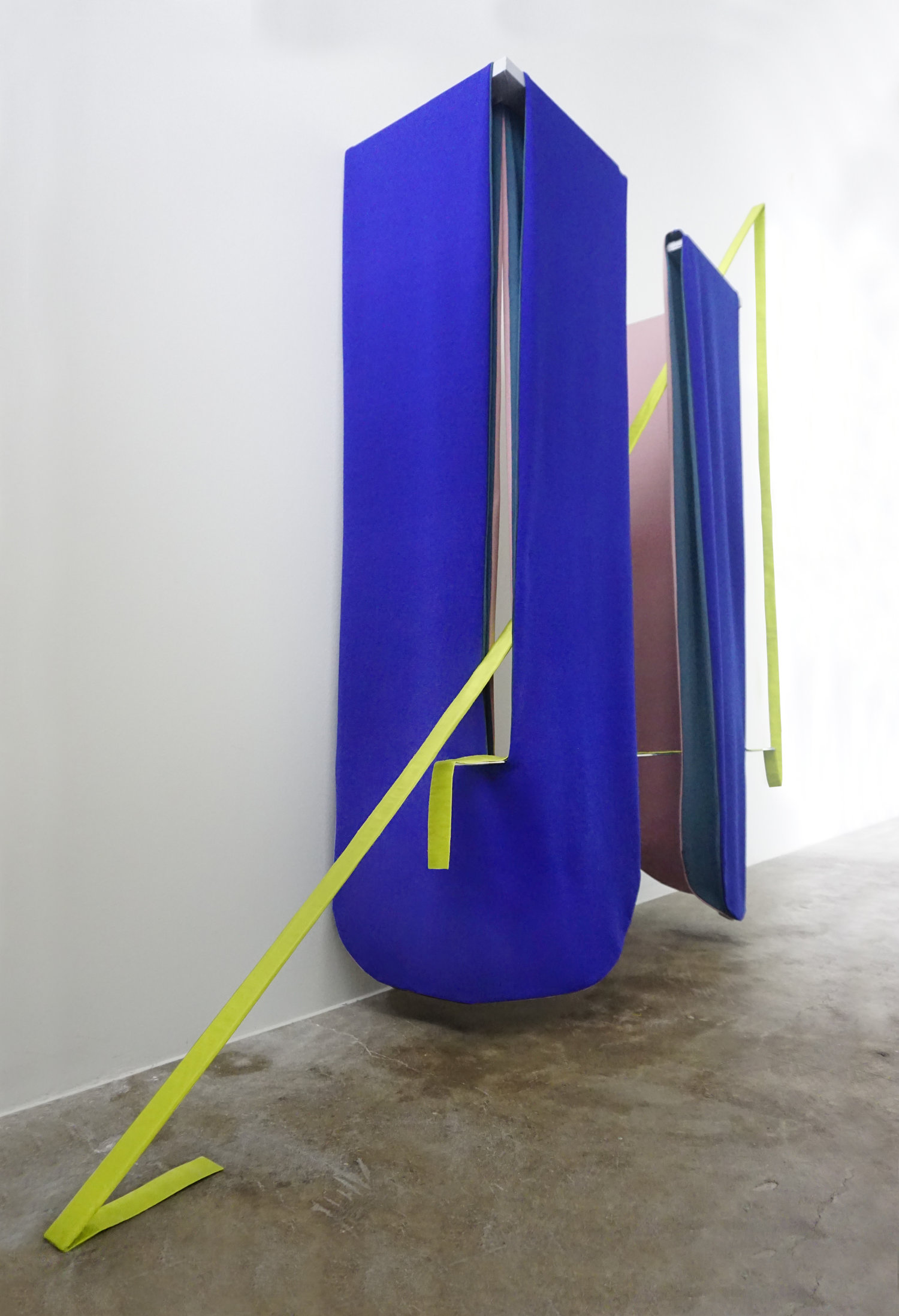
Katy Heinlein’s exhibition Snake Eyes challenges the sublime possibilities of symmetry, and indulges in the humor, awkwardness, and flustered physicality that comes with disrupting that symmetry. Heinlein fashions pragmatic materials like wood and aluminum into nimble structures, ready to be wrapped and draped in costumes of brightly colored cloth. Like dressing for a night out, the works take on a very human folly: the effort to conceal, emphasize and seduce.

Austin Houldsworth

Walden Note Money
The project imagines a payment system that challenges the established monetary function of ‘a store of value.’ Creating a new method of exchange that encourages people to actively destroy their money during a transaction. The process positively reinforces this behaviour through the creation of music, produced from the burning money within the transaction machine.

Loop.pH

The Chronarium
The Chronarium is a public sleep laboratory presented as an immersive audiovisual environment that totally transforms its location into a restorative, calm and contemplative experience, responding to the Smart Nation’s need to tackle the challenges of the healthcare system.

Keith Lemley

Keith Lemley is a sculpture artist whose work focuses on creating an informative relationship between object and space and challenges the physicality of material presence. Many of his works are made up of opposing forces of ephemeral light and structural woodblocks that unite in a metaphorical existence of natural systems. His background in science and engineering is reflected in the unique synthesizing of media that portray scenes from nature and memory and inspire a sense of exploration for the viewer.

csilla klenyánszki

PILLARS OF HOME
A SEARCH FOR BALANCE WITH A PROBLEM SOLVING ATTITUDE CHARACTERISES MY WORK. WITHIN MY CURRENT PRACTICE I CAREFULLY EXAMINE AND DECONSTRUCT PERSONAL CHALLENGES SUCH AS PARENTHOOD, GENDER, AND THE MALLEABILITY OF SELF IDENTITY THROUGH THE PASSAGE OF TIME.

OTA+

Taipei Museum of Contemporary Art
This building proposal challenges the traditional definition of a museum and the conventional relationship between building and site. The ground floor of the building is reduced to a nominal footprint, enclosing only enough space for basic services, structure and ticketing functions. The ground plane is primarily reserved for exterior public space, including an art park, Hall of Fame, and garden walk. The bulk of the program and building mass are split by the open ground floor. Half of the building is coupled with the earth while the other half hovers in the air. The purpose is twofold; to minimize the damaging effects of extreme local weather by harnessing environmental flows toward productive outcomes and to re-conceptualize the identity of a modern art museum. The manicured roof plane of the below ground program is pocketed with water absorbing vegetation and catchment systems, while the hovering museum above expands to form open atriums, allowing diffuse light to brighten the space and passive airflow to comfortably condition the building.The program of the museum is interconnected. The Contemporary Museum of Art, Children’s Museum of Art and Administration are located within the floating mass. The lecture hall, parking, art resource center, library and classrooms are located below ground. The programs below ground are easily accessible and directly connected through vertical circulation tubes, providing both structural support for the floating mass above and space for movement systems, such as escalators, stairs and elevators between levels. All of the below ground programs are flooded with diffuse light passing through skylights that penetrate the landscape.

ROBERT WILSON

بوب ويلسون
鲍伯·威尔逊
בוב וילסון
ロバート·ウィルソン
밥 윌슨
Боб Уилсон
Bertold Brecht
Kurt Weill
Berliner Ensemble
Die Dreigroschenoper

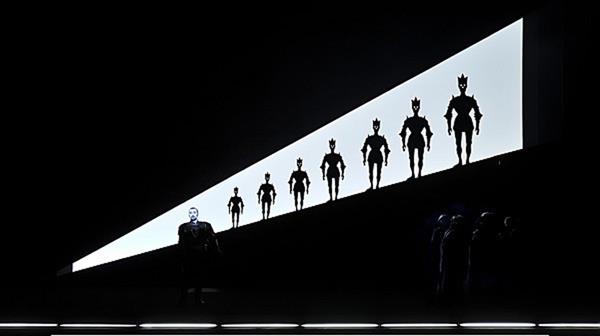
Revel in this 30-strong ensemble of actors and musicians performing one of the most familiar scores in musical theatre today. Be warned, with a strictly limited engagement in Perth and following sellout seasons in New York, Hong Kong and Berlin, you need to be quick. In 1928, Bertolt Brecht and Kurt Weill created a masterwork that would change the shape of theatre forever. Eighty-five years later, visionary director Robert Wilson leads Brecht’s own company, the Berliner Ensemble, to perform in Australia for the very first time. Mack the Knife is the original city crim who’s never met a law, a woman or a cop he couldn’t seduce – but when he challenges the supremacy of the Beggar King and his empire of manufactured woes, the fallout threatens to tear the town apart.
.

Tim Coe

Perfect face
FILE FESTIVAL

The viewer is confronted with a face on the screen that is constantly, almost imperceptibly changing. The perfect hair and make-up give rise to the expectation of a beautiful model, but this is not always fulfilled. The starting point is super-model Claudia Schiffer, however, the facial features are in a state of flux, ‘mutating’ every few seconds to a new configuration. Our reaction to the face changes accordingly between attraction and repulsion. Beauty has long established itself as a commodity that can be sold and bought. ‘A PERFECT FACE’ constantly tests and challenges our idea of what beauty is.

LOUIE RIGANO

CLOCK

About-Time is a clock that challenges our power of perception and intuition. Featuring a constantly changing composition, through both color and form, it invites us to view the idea of time from a fresh perspective. Three translucent circles, which possess a logical visual hierarchy (the largest circle tells the hour, the smallest tells the second), pivot atop a larger white circle. The locations of the circles’ outer most points refer to the time. Traditional clocks, utilizing written numbers, rely on reading the information. This clock relies solely on visual information in the form of varying colors and shapes. Time is manifested into a new and purely visual language

BRIGITTE NIEDERMAIR

女权艺术家 摄影作品
the antidote

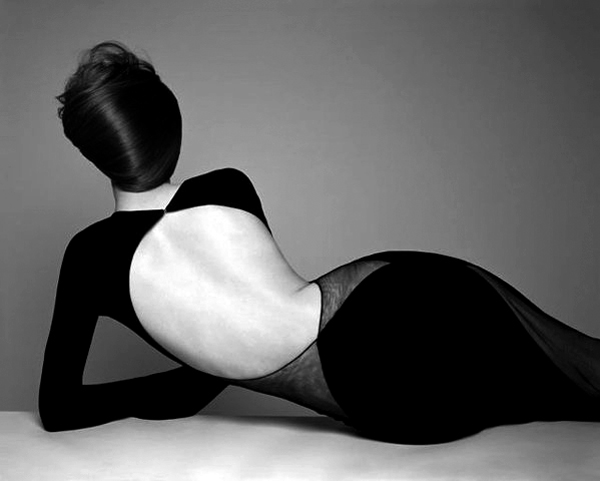
Brigitte Niedermair is an artist who expresses herself through photography. At the same time, she is a photographer who ventures deep into the disciplinary challenges of art. This cross-fertilisation between two worlds, an osmosis that she performs with great determination, has become the characteristic feature of all her work. The poetic content of her art has always found ideal form through her great mastery of the medium of photography. But never more so has the compositional balance and iconic component of her work been executed in such a lean and essential manner. They almost dissolve before the eye of the viewer, allowing the work to appear in its most subtle and immaterial dimension. Extending far beyond the subjects they portray, the photographs we see directly communicate Niedermair’s thoughts, feelings and personal inner journey. The concepts emerge with great power and immediacy, making space for themselves within the substance of photography. The abstraction creates figures which are authentic portraits.

JULIE COCKBURN

Incognito
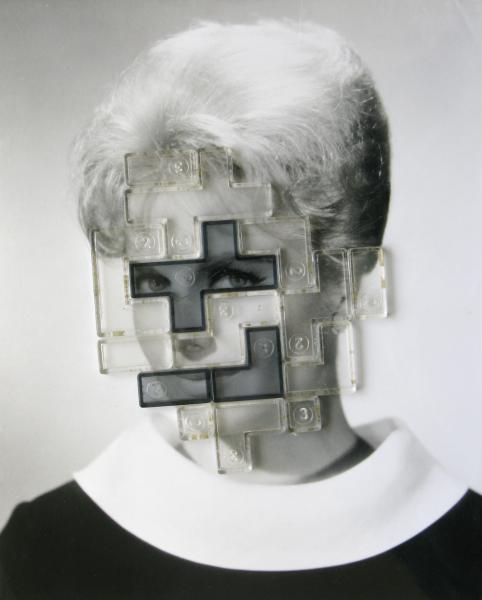
Julie Cockburn is a London based collage artist who manipulates and redefines anonymous found portraits. Employing collage techniques, painting and embroidery, she challenges the audience’s idea of identity and personality.