highlike

IMMATERIALS

Light painting WiFi
Wireless networks are everywhere these days, creating invisible layers that we cannot see. This unique light painting project seeks to change that by mapping the signal strength of Wifi networks in a variety of environments. The light painting is made using a WIFI signal strength detector and a bar of LED lights. They used a long exposure camera to capture the fluctuations in signal strength as they walked across a street, campus, etc.

FILE 2026 – Registration Open for Installation Festival – Art and Technology

FILE 2026

Art and Technology Festival | Installations: artistic systems, indoor  or  outdoor , in which the aesthetic experience emerges from the dynamic relationship between interface, data, environment, and body.  Digital technologies, technologies with artificial intelligence, metamaterial technologies, random technologies, sensors, algorithms, and responsive systems are employed by the artist as structural elements of the work, which is completed in the encounter between the work and the participant.

Applications were open until February 19, 2026. Access  the application form.

FILE 2026 | GENERAL REGULATIONS

FILE 2026 – Registration Open for AR, VR and XR Festival – Art and Technology

FILE 2026

Augmented and Virtual Reality Festival: brings together immersive practices in simulated three-dimensional environments and expands the perception of reality through the superimposition of digital layers onto physical space.  The works use mobile devices, glasses, and spatial interfaces to insert virtual objects, narratives, and data into the real world or transport the public to sensory and interactive digital universes. These languages ​​challenge the boundaries between the material and the informational, exploring subtle or monumental interventions, creating multidimensionality in the environment. Issues of presence, body, narrative, memory, surveillance, and technological mediation are central, configuring a fertile field of aesthetic and critical investigation into contemporary ways of inhabiting and perceiving space.

Applications were open until February 19, 2026. Access  the application form.

FILE 2026 | GENERAL REGULATIONS

FLORIAN HECKER

فلوريان هيكر
フロリアン·ヘッカー
Sound Installation

Event, Stream, Object

In his installations, live performances and publications, Florian Hecker deals with specific compositional developments of post-war modernity, electroacoustic music as well as other, non-musical disciplines. He dramatizes space, time and self-perception in his sonic works by isolating specific auditory events in their singularity, thus stretching the boundaries of their materialization.
Their objectual autonomy is exposed while simultaneously evoking sensations, memories and associations in an immersive intensity. Some of his works incorporate psycho-acoustic phenomena, disorienting listeners’ spatial perceptions and expanding their conception about sound. Hecker’s most recent recording, Speculative Solution ( Editions Mego, 2011), brings together Hecker’s sonic practice and psychoacoustic experimentation with philosopher Quentin Meillassoux’s concept of ‘hyperchaos’ – the absolute contingency of the laws of nature.
During his residency at MIT, Florian Hecker will research a new sound piece that takes the concept of the “auditory chimera” as point of departure. Originally developed at MIT by Bertrand Delgutte, senior research scientist at the MIT Research Laboratory of Electronics, the concept of the auditory chimera inspires an exploration of the relationship between pitch perception and sound localization. Hecker will create a text and sound piece that incorporates the recordings of material read by students. Using an anechoic chamber he will work with students to explore the experiential nature of psycho-acoustic practice.

COMPAGNIE MARIE CHOUINARD

Мари Шуинар
BODY REMIX GOLDBERG VARIATIONS
Durante los primeros pasos de esta creación, los bailarines y yo trabajamos sobre las Goldberg Variations de Bach, tal y como las interpretó Glenn Gould en 1981, así como la voz del pianista, con sus cadencias orales durante una entrevista de radio dedicada a esta particular interpretación.
Emprendí el trabajo con una mezcla de los cuerpos de los bailarines, a través del uso de varios elementos de apoyo: muletas, picos, arneses, etc. Una barra de ballet fue trasformada en un material musical. Pedí también al compositor Louis Dufort que usara un “apoyo”, concretamente una interpretación de Gould y su voz, y a proponer variaciones sobre las Variations. Diez de las treinta variaciones, así como las dos Arias, fueron remezcladas o incluso recompuestas (1, 2, 4, 11, 15, 16, 21, 23, 25 and 29). Otras tres variaciones (5, 6 y 8) se ofrecerán en su versión original.

JURG LEHNI

moving picture show


The current migration from analogue to digital film projection in cinemas across the globe is slowly rendering the medium of 35mm motion picture film obsolete, along with the technical equipment used to produce and screen such films.

In Moving Picture Show, a scenario of animated drawing and text production is created by reappropriating a process normally used by the film industry to etch subtitles into the emulsion layer of 35mm film using a high-powered precision laser. By etching away the emulsion, only the clear base of the film remains. Projected onto the screen, the lines appear bright and clear.

Changing the working range of the laser and replacing the software interface for such a machine leads to new possibilities: animations and full-frame drawings can be realised on top of film. The film can either consist of existing material, film created purely for this purpose, or black, non-developed film.

During the 23rd International Poster and Graphic Design Festival in Chaumont, the Jesuit chapel was transformed into a workshop, a scenario of conception, production and projection of a series of short films produced in this way.

Several contributing designers have been invited to engage with the production facility and collaborate on the contents of the show, producing films that were projected repeatedly during the festival. Meanwhile the laser machine, also present in the chapel, is slowly producing new films for future screenings.

ADRIEN MONDOT

cinematique
An invitation to journey, daydream and idle away, while rediscovering the childhood fantasies hidden in each one of us. An invitation to shake up the rational principles that guide us today in our modern existence. Afloat a raft voyaging across virtual materials and through landscapes. Lines, points, letters and digital objects projected on plain surfaces weave through poetic surfaces, marrying body and gesture.

KAZUHIRO KOJIMA LABORATORY

MOOM TENSEGRITIC MEMBRANCE STRUCTURE


This pavilion was created with a grant from the Nommura Foundation for the Promotion of Membrane Structure Technology in search of new possibilities for membrane structures. The tent membrane is Taiyo Kogyo’s Shadeasur. The membrane acts as a tensile material, creating unevenness, so that the aluminum pipes, which are compressive materials, do not touch each other and form a tensegrity structure.

MARK JEFFERY AND JUDD MORRISSEY

The Precession 2011
via highlike submit

Judd Morrissey and Mark Jeffery are a collaboration merging live art and digital literary practices. The work, which is visual, textual and choreographic, evolves through context-specific research and practice and always considers the constraints of a given venue or occasion. Site responsive considerations include the performance/exhibition space as well as the local community and online textual activity happening within the locale. A given piece is a body of material that may have no singular fixed form but is alternately presented as internet art, durational live installation, an ongoing activity, or a performance of fixed length.

FILE SÃO PAULO 2025: SYNTHETIKA – Parceria IED

Surfaces

IED Partnership

FILE SÃO PAULO 2025: SYNTHETIKA – Art and Technology – LED SHOW
Electronic Language International Festival
 

Surfaces – Brazil

Concrete beams, glass, brick walls, cement… Buildings are built to last, to withstand time. LED screens, on the other hand, thrive on the light they emit—they turn on, blend, and fade. They are ephemeral. When a building is clad in LEDs, the permanent and the transient meet, between what already is and what might become. In the iconic FIESP building on Avenida Paulista, surface design transforms architecture into a field of experimentation. There, students from IED SP explore new possibilities for this building’s existence, redefining the structure through animated light and design.

BIO

Students of the Bachelor’s degree in Graphic and Digital Design at the Istituto Europeo Di Design (IED SP) have come together to create a collective work of animations inspired by surface design, its redefinition, and media materialization, seeking to explore language for visual communication projects. IED is an international training and research network in Design, Fashion, Visual Communication, and Creative Management.

FILE SÃO PAULO 2025: SYNTHETIKA – Vitoria Cribb

 //:Are you observing or being observed?

Vitoria Cribb

FILE SÃO PAULO 2025: SYNTHETIKA – Arte e Tecnologia
Festival Internacional de Linguagem Eletrônica


 //:Are you observing or being observed? – Brasil

Nesse curta-metragem criado para a Bangkok Art Biennale 2022, são explorados temas como vigilância, desvio de atenção, corpos digitais versus presença digital, e os limites entre materialidade e imaterialidade na contemporaneidade. A artista utiliza áudio e animação em CGI para expressar suas sensações e reflexões sobre esses temas. A obra propõe uma reflexão sobre o ato de consumir conteúdos online enquanto somos simultaneamente observados por algoritmos que coletam nossos dados — um jogo entre observar e ser observado. O trabalho encarna essa grande entidade anônima que nos cerca e nos vigia na internet.

BIO

Formada pela Escola Superior de Desenho Industrial da Universidade do Estado do Rio de Janeiro. Em 2025, participou da 16ª Bienal de Sharjah e da 14ª Bienal do Mercosul. Participações anteriores incluem: a 3ª Bienal Mayrit; a 22ª edição do Videobrasil – Festival SESC de Arte Contemporânea; Frieze Film Seoul 2024; Arteônica, no Museum of Latin American Art; e Shifting Horizons, no Pylon-Hub L.

FILE SÃO PAULO 2025: SYNTHETIKA – CRUDE_CASTIN

Leonardo Da Vinci Project: Neo-Renaissance

CRUDE_CASTIN

FILE SÃO PAULO 2025: SYNTHETIKA – Art and Technology – CGI VIDEOS
Electronic Language International Festival


Leonardo Da Vinci Project: Neo-Renaissance – China

Neo-Renaissance uses the protagonist and Leonardo da Vinci as clues to tell the story of people’s prosperous lives in the “cloud,” the emergence of a latent crisis, and the connection of digital subjects in the context of decentralization in the near future. The film makes extensive use of artificial intelligence-generated materials (AIGC), interweaving the Renaissance and Web 3.0 into a single narrative, aiming to reflect on the fading of popular power in the lower echelons of various social processes and on imaginations for the future.

BIO

CRUDE_CASTIN is a creative collective of young artists. Their focus is on revealing the hidden power structures behind technology and using diverse methods to explore the tension between technology and humanity. Their work combines art and technology, reflecting on the dilemmas of today’s technological society through themes such as technology and power, history, and nature.

FILE SÃO PAULO 2025: SYNTHETIKA – Gabriel KÖI e Sabato Visconti

Motherboard

Gabriel KÖI e Sabato Visconti

FILE SÃO PAULO 2025: SYNTHETIKA – Art and Technology – Shorts Films AI
Electronic Language International Festival


Motherboard – Brazil

Motherboard is an experimental film that dives into the intersection between tech nology and consciousness, exploring the delicate boundary between the human and the digital. On this journey through the circuit, reality merges with the digital, challenging the understanding of existence. The contrast between the human and the artificial is revealed in the intertwining of both, echoing the voice of this emerging consciousness.

BIO

Sabato Visconti is a Brazilian digital artist. His works interrogate con temporary and historical practices of digital imagery, manipulating the inherent materialities of production and distribution. Gabriel Böing (KÖI) is an artist born and raised in São Paulo, who explores narrative and dreamlike stories materialized through mediums like 3D, AI, and video, heavily influenced by internet culture.

FILE SÃO PAULO 2025: SYNTHETIKA – Edwin van der Heide

Spiral of Time — Amazonas Brazil — UFAM

Edwin van der Heide

Interact with Spiral of Time — Amazonas Brazil — UFAM via FILE ARCHIVE


FILE SÃO PAULO 2025: SYNTHETIKA – Art and Technology – Installations
Electronic Language International Festival


Spiral of Time — Amazonas Brazil — UFAM – Netherlands

Spiral of Time captures and stages the diverse soundscape of a specific location over the course of several years. By documenting the unique natural, cultural, spatial, and temporal dynamics of a place, the work honors the contributions of all its actors. Every hour, a one-minute recording is made, resulting in a vast sonic archive over time. It is accessible online through a spiral-shaped interface, allowing listeners to explore the cyclical patterns revealed by navigating the material across different time intervals. 


Since July 17th, 2024, the artist has been recording the sounds of the square in front of MACBA (Museum of Contemporary Art of Barcelona). It is a very interesting, diverse, and vibrant urban space. The work is accessible online via https://www.macba.cat/en/spiral-of-time-placa-dels-angels/ and will also be presented physically in the museum starting July 10th, 2025.


Edwin is expanding the project to include other recording locations around the world—not only in urban contexts (dominated by humans) but also in areas governed by nature. The artist dedicated himself to a recording site in the Amazon region. Since February 11th, 2025 Spiral of Time has been installed at the Amazon Rainforest surrounding The UFAM (Federal University of Amazonas) in Manaus. It is home to one of the world’s largest urban forest fragments. Completely surrounded by the dense urban matrix of Manaus, this forest has been isolated since the late 1980s. The forest retains rich ecological features, including areas of mature terra-firme forest, late-stage secondary vegetation, and small patches of white-sand forests. This unique setting offers a rare opportunity to study tropical forest dynamics within a metropolitan environment. 

Spiral of Time-UFAM immerses the listeners in the acoustic life of one of the most biodiverse ecosystems on the planet. This contrast between the natural rhythms of the forest and the human-made patterns of the city enriches the broader narrative of the Spiral of Time, offering a deeper reflection on coexistence, change, and continuity across different environments.

BIO

Edwin van der Heide is an artist, composer, and researcher focused on sound, space, and interaction. His work pushes the boundaries of musical composition toward spatial, interactive, and interdisciplinary directions. He creates installations, performances, and immersive environments where the audience is placed at the center, encouraged to engage sensorially and investigatively.


Vincent Leroy

Echo Lens
Emerald Lake, Canada
Hybrid, Vincent Leroy’s work oscillates between the real and the virtual, the natural and the artificial, drawing its inspiration from both nature, which often sites his work, and from the digital world. Whether its kinetic sculptures, immersive installations or monumental works, movement is almost always Vincent Leroy’s raw material. The kind of movement that inspires life, amazement, and a permanently shifting viewpoint.

Ying Gao

2526
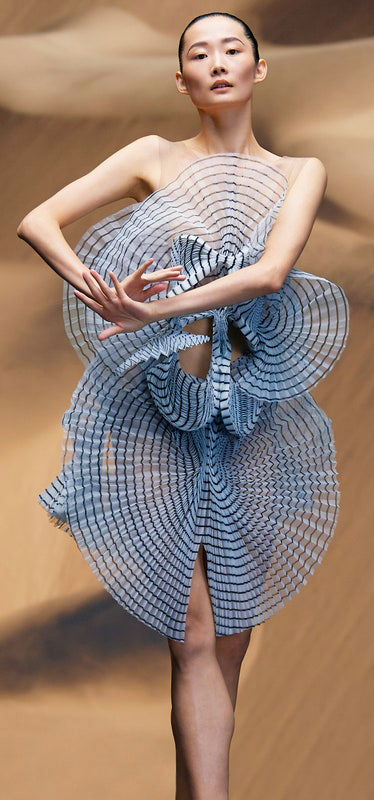
Polymorphic Robotic Garments
2526 refers to the number of hours invested in the creation of the two polymorphic robotic garments, from ideation to the finish, from the first line of drawing to the last stitch. The two polymorphic outfits of the 2 5 2 6 project are very real: woven, hand-screened, and consolidated materials have been specially designed to create these clothes. They are not virtual at all. However, they simulate the effects of virtual clothing: a surreal undulation generates a play of volume and transparency; their polymorphic movement, as well as their reflectivity, are results of an entirely new flexible material that combines glass, precious metals and silicone.

Clara Daguin

Oracle Collection
The performance centered around ORACLE, a digital palm reading given by model and iconic muse Axelle Doué. The surrounding luminous dresses embodying the four elements— air, earth, water, and fire—come alive during the reading, with mirrors reflecting them into infinity. The pieces are crafted from diverse materials, both natural and synthetic. Well beyond typical textiles, Clara Daguin implements optical fibers, pleating, embroidered circuits, addressable LEDs, sculpted resin, home-grown alum stone crystals, Swarovski Elements, silk organza, microcontrollers and radio frequency modules.

Craig Green

Spring/Summer 21
The spring 2021 collection reflects that mentality, and highlights the more commercial offerings of the brand, which are normally buried underneath his over-the-top runway styling. Carryover styles — such as quilted jackets, padded vests, parkas, shirts and hoodies with cutout hole and lace trim details — are available in pine green, beige, raisin purple, and midnight blue, and take center stage in the look book. Even Green’s signature frame-like constructions around the body have been toned down. Instead of using experimental and colorful materials, Green has hung deconstructed parts of a shirt or a jacket on metal frames. The effect is of two people interacting in one sculpture.

SHAI LANGEN

Jo Goes Hunting – Run Away

Amsterdam material designer Shai Langen made sculptural headpieces and covered models in hand-painted patterns for Jo Goes Hunting’s Run Away music video.Langen was approached by the Dutch artist’s manager with a brief for “something less conventional”, and was given complete artistic freedom in his approach.The video opens with a close up of a gleaming paint-covered black and white surface, which is gradually shown to be the form of a person.

KUNIHIKO MORINAGA AND MAMORU HOSODA

DIMENSION
Mamoru Hosoda collaborated with Morinaga to create this great collection film. It begins with the formation of the clothes as Morinaga designed them, not through cut and drape but via cut and paste, and we see the garments as digital toiles made up of fractal contours true to the representation of futuristic facades stretching back to Metropolis and Tron. Then the dresses form more tangibly, but still in 2D, filling those vectored spaces with the angled jigsaw of reclaimed denim, chino cotton, and gabardine, plus reflective material (all seamlessly bonded) from which they are made. It slowly becomes kind of clear that we are seeing a fashion show in U, the virtual world which Belle’s heroine inhabits—and that it is also being streamed on U’s equivalent of YouTube. There are rooms within rooms within rooms.

.

仮想世界は二次元。非日常の世界。現実世界は三次元。日常の世界。仮想とは、現実にはない世界を仮にあるものとして考えてみること。現実とは、事実として目の前にあらわれている世界そのもの。2022年春夏コレクション「DIMENSION」は二次元と三次元を越境する。画面の中の世界は二次元。細田守監督最新作「竜とそばかすの姫」のアニメーションの世界。劇中に存在する仮想空間’’U’’でコレクションが幕を開ける。CGアバターモデルが、宙に浮くガラスのランウェイを歩く。画面の外の世界は現実。‘’U’’が投影された真っ白な空間を、実在のモデルが歩く。コロナ禍がもたらしたデジタルのファッションショーは、軽々と世界の距離を縮め、すべてをフラットにした。画面の中では、立体と平面の区別はなくフラット。画面の中と外の境界もまた、消えていく。画面の外で纏うだけでなく、画面の中でも纏うことができる。

Hassan Ragab

AI conceptual architecture

Over the past few months, Hassan Ragab has been posting his Midjourney conceptual architectural work on LinkedIn and is clearly enjoying exploring the nuances of refining the AI output, mixing free flowing architectural styles with biomimicry materials such as feathers and plant structures.


Neri Oxman

MAN-NAHĀTA
Computational growth across material and urban scales offers a framework for design through self-organization, enabling the generation of vast, diverse forms exhibiting characteristics like those that emerge through the biological growth processes found in Nature. In this project, we construct an oriented volume spanned by surface normals of the shape at every point. The value of the oriented volume drives the iterative deformation of the shape. Depending on the parameterization of this process, we can obtain distinctly different growing forms. Importantly, the emergence of these forms is driven only by the time evolution of a geometric operator acting on the shapes iteratively, thereby connecting geometry and growth through an algorithm. To form the Man-Nahata landscape, the buildings of the urban landscape are transformed through repeated morphological closing operations, where the field of influence follows a gradient from the center to the outskirts of a circular region.

Heavy Duty Love

Lucy Mcrae
HEAVY DUTY LOVE
A cautionary narrative in an uncomfortable, complex debate on the scientific acceleration directing our evolutionary path —from gene-edited babies to CRISPR to AI — Heavy Duty Love is a mental health prop existent as a tactile mechanical structure, asking, “As we head toward a life designed from scratch, will we seek new types of intimacy?”. Realised as a speculative domestic device compensating for a lack of human touch in early life, Heavy Duty Love sandwiches the body between layers of soft, dampening materials normally used in contemporary camping or construction.

Glosopeda

Glosopeda
Barbara Lanzarote, Rachel Lamot, Kim Rosario
.

The Ontology that Never Was
Glosopeda herontdekt het verleden vanuit een neotoekomstig perspectief. The Ontology that Never Was herschept een archeologische context in zijn natuurlijke omgeving waarin wordt ingegrepen door digitale materialisatie, en doet denken aan de visie van Gavin Lucas op de materiële wereld als een archief van het proces van (de)materialisatie: de spanning tussen de krachten van het verzamelen van materialen en artefacten en de tegengestelde kracht van verspreiding. De ontologie van de objecten versus de verspreiding, uitwissing en verplaatsing van hun oorspronkelijke setting.

Studio Above&Below

Aquateque
Aquateque è un cortometraggio che esplora il fiume Ruhr attraverso una varietà di nuove tecnologie multimediali. Il progetto combina strumenti AI e AR per esplorare modi sostenibili di creare materiali digitali che fondono natura e calcolo. Il variegato ecosistema circostante viene catturato attraverso strumenti di programmazione audio, visivi e 3D e trasformato in uno spazio aumentato generativo.

Camille Legrand & Bart Hess

Epistēmē
Titled with the Ancient Greek word for knowledge and understanding, the installation is born of the belief that we absorb knowledge through the senses, with the skin acting as an interface between the body and the world around us. ‘To illustrate the skin in states of transformation, I imagined it as a canvas for sensations felt and information absorbed. The digital manipulation in each film melds body and sensation, skin and material, reality and virtuality to express the effects of each product,’

bohyun yoon

БОХЬЮН ЮН
윤보현
To Reverse Yourself

FILE FESTIVAL

My work poses the question: how does reality becomes exquisitely animated by certain social control systems such as politics, mass media, technology, science, and etc. It is my artistic goal to reveal how human beings are fragile and delicate in these social environments. By living in Korea, Japan and the U.S, I have first-hand experience in diverse social systems and have come to view my life experiences as raw material for my research. With my research in mind, my art utilizes the body as the tool for an intensive investigation of the public and private; examining the relationship between how people understand their body and how this understanding represents themselves in the greater context.
Currently, I am curious about human perception developing parallel with the ever-evolving progression of technological world. Thus, I question technology’s relationship to reality and illusion; asking what is reality? My work takes advantage of illusion to explore and answer this question, and often my artistic materials consist of the body and mirrors. I use mirrors for integrating reality and illusion.

Philip Vermeulen

Fanfanfan
Philip Vermeulen toont de installatie Fanfanfan in het Kunstenlab, waarin hij natuurkundige verschijnselen als licht, geluid en beweging manipuleert. Het kinetische ‘hypersculptuur’ beweegt met zo’n hoge snelheid dat de fysieke eigenschappen van de materialen voor je ogen lijken te vervormen.

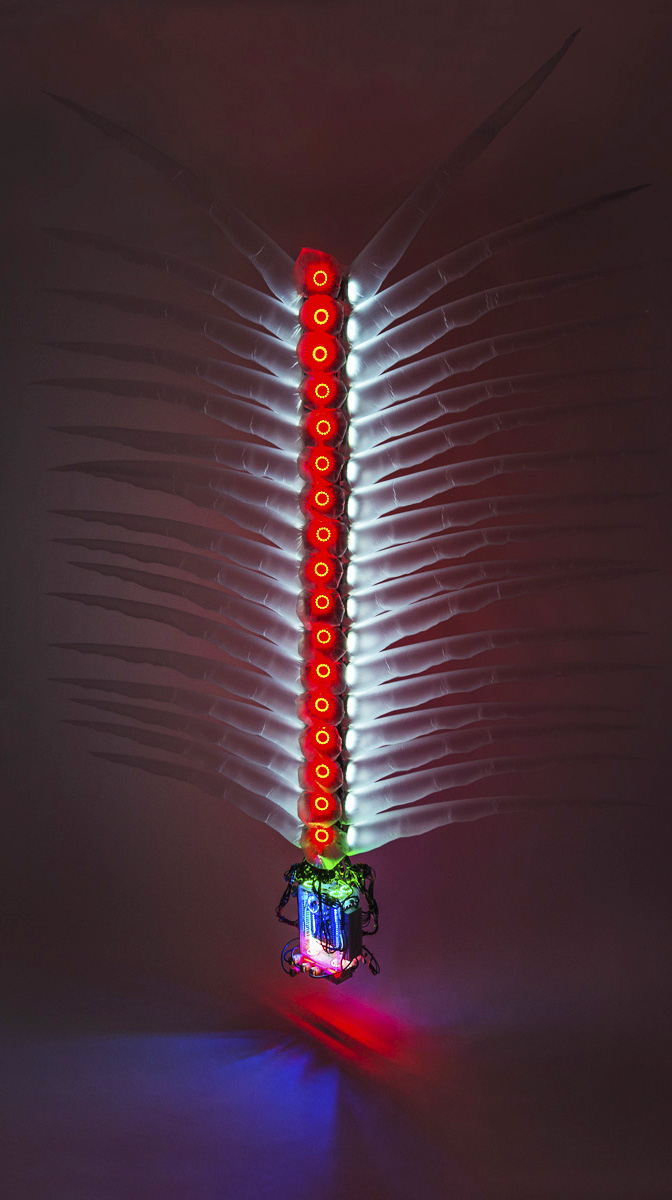
Shih Chieh Huang

REUSABLE UNIVERSES
Shih Chieh Huang combineert zijn jarenlange fascinatie voor technologie en de materialen van het moderne leven om alledaagse gefabriceerde objecten om te zetten in nieuwe en opmerkelijk complexe sculpturale vormen. Huang verheft het bouwen van circuits, het opnieuw bedraden van transistors en andere hardwarebewerkingen tot een kunst die niet alleen onze zintuigen verbindt, maar ook ons ​​gevoel van menselijkheid tussen het virtuele en analoge bestaan ​​van vandaag.

Bruce Nauman

Nature Morte
Nature Morte focuses on Nauman’s long relationship to his own studio, a variation on his four unique multi-projection videos, Mapping the Studio (2001). Three viewing stations, each consisting of an iPad linked to a wall-sized projection, provide an interactive exploration of the 3D studio space. Only now the artist is absent, and the participant becomes performer as he/she manipulates the large scale video projections on an iPad using touch control. The participant is free to navigate anywhere throughout the space, selecting broad vistas or individual objects. Using a hand-held 3D scanner, Nauman recorded hundreds of images that allow participants to select an object and locate close-up anything found there, and further reorient the image to see an object from above and below, and at times inside-out. The resulting mobility intensifies the experience of the viewer/performer. Presenting a static, but immersive re-creation of his studio space, Nauman’s pieces once again play at the tenuous lines between the body and space, perception and physical material.

Jennifer Townley

Inverta
A circular axle is able to rotate by the use of 36 universal joints hanging from perspex rods and transmitting their rotary motion onto the next. In between the joints, 36 stainless steel objects are attached that rotate at the same speed as the axle. One of the objects has a slightly thinner body, making room for two integrated timing pulleys and thin cogged belts that connect it with the drive mechanism situated on the upper circular frame. The objects are made from thin sheet material and are carefully balanced by placing several counterweights inside their hollow bodies and by perforating their tails, reducing the amount of material furthest away from the axle. During the entire revolution their centre of gravity perfectly aligns with the position of the axle so that a stable rotation is ensured.

Iris van Herpen & Dutch National Ballet

Biomimicry
For the ‘Biomimicry’ film, Iris van Herpen and Dutch National Ballet explore the symbiotic relationship between the metamorphic force in which fashion and dance interlace. The film, directed by Ryan McDaniels, sees the mesmeric dancer JingJing Mao undulating into liquescent shapes and transcending into graceful figures that reflect her myriad of movements. The concept of the creation stems from the notion of biomimicry — the design and production of materials and systems that are modelled on biological processes. In line with Iris van Herpen’s continuous pursuit to materialise the invisible forces that structure the world, the film focusses on the bond between humanity and nature.

MICHAEL HANSMEYER AND BENJAMIN DILLENBURGER

Digitale Grotesk
Digital Grotesque is de eerste volledig meeslepende, solide, gesloten structuur op menselijke schaal die volledig 3D-geprint is uit zand. Deze structuur van 16 vierkante meter is gematerialiseerd met details op de drempel van de menselijke waarneming. Elk aspect van deze architectuur is samengesteld door op maat ontworpen algoritmen.

Lu Yang

The Great Adventure of Material World
FILE FESTIVAL

The Great Adventure in Material World/Material World Knight is the most adventurous video game artwork that Lu Yang has created. The Great Adventure in Material World/Material World Knight has combined all the protagonists in Lu Yang’s artworks from the past and created an alliance of these heroes. In this video game, the world can be indefinitely explored by players. It has also incorporated several other elements created in various works from the artist before”. Once players enter the video game, they will transform into knights in this Material World. As protagonists of the alliance of heroes in the Material World, they will explore the Universe, absorb energy, be destroyed and achieve rebirth. They will fight all sorts of emotions, desires and eventually with themselves.

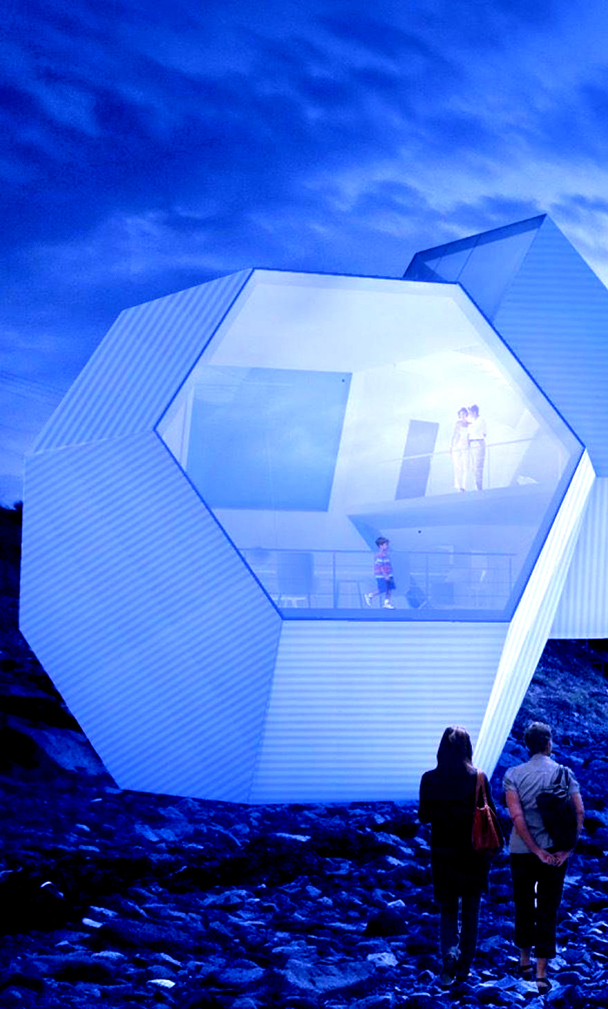
STUDIO FUKSAS

Matilda Home
The idea to bring design also in common life attracted us. This is a new concept of habitat of house. It’s a mobile home it can be everywhere around the world; everybody can be a client. It’s a modular unit so many of them can be added together like a cloud. It can even be a city .This is not an object, it is a concept, it can be a city, a landscape or simply an home. Easy to build, it can be done in different materials more or less expensive. Matilda is a completely different space since nowadays we don’t need so much storage space, you just need to have a screen. The only thing is important is to have a nice place to eat, to seat and to sleep but also this can be done with something you close when you don’t need

Bernd Lintermann and Peter Weibel

YOUR:R:CODE
Il titolo può essere letto in due modi diversi: l’interpretazione »your code« indica che nell’installazione i visitatori sperimentano diversi tipi di trasformazioni digitali di se stessi. Mentre entrando, un visitatore vede ancora il suo riflesso familiare in uno specchio – la rappresentazione virtuale più reale che possiamo immaginare – l’immagine speculare si trasforma gradualmente in un corpo di dati digitale finché, infine, il visitatore è ridotto a un codice leggibile industrialmente. Alla fine si libera dalla rappresentazione virtuale e si materializza in un display flip-dot. Il secondo modo di leggere il titolo del pezzo, »tu sei codice«, sottolinea che noi stessi siamo costituiti da codice, che tra l’altro si manifesta nel codice genetico.

soft lab

behance

The stair became the ideal site to produce an installation that extends to both floors and can be seen from anywhere in the office. The design of the office is very clean and contains a lot of white materials and finishes so we decided to create an installation that acts as a kind of three dimensional stained glass window that casts colored light throughout the space.


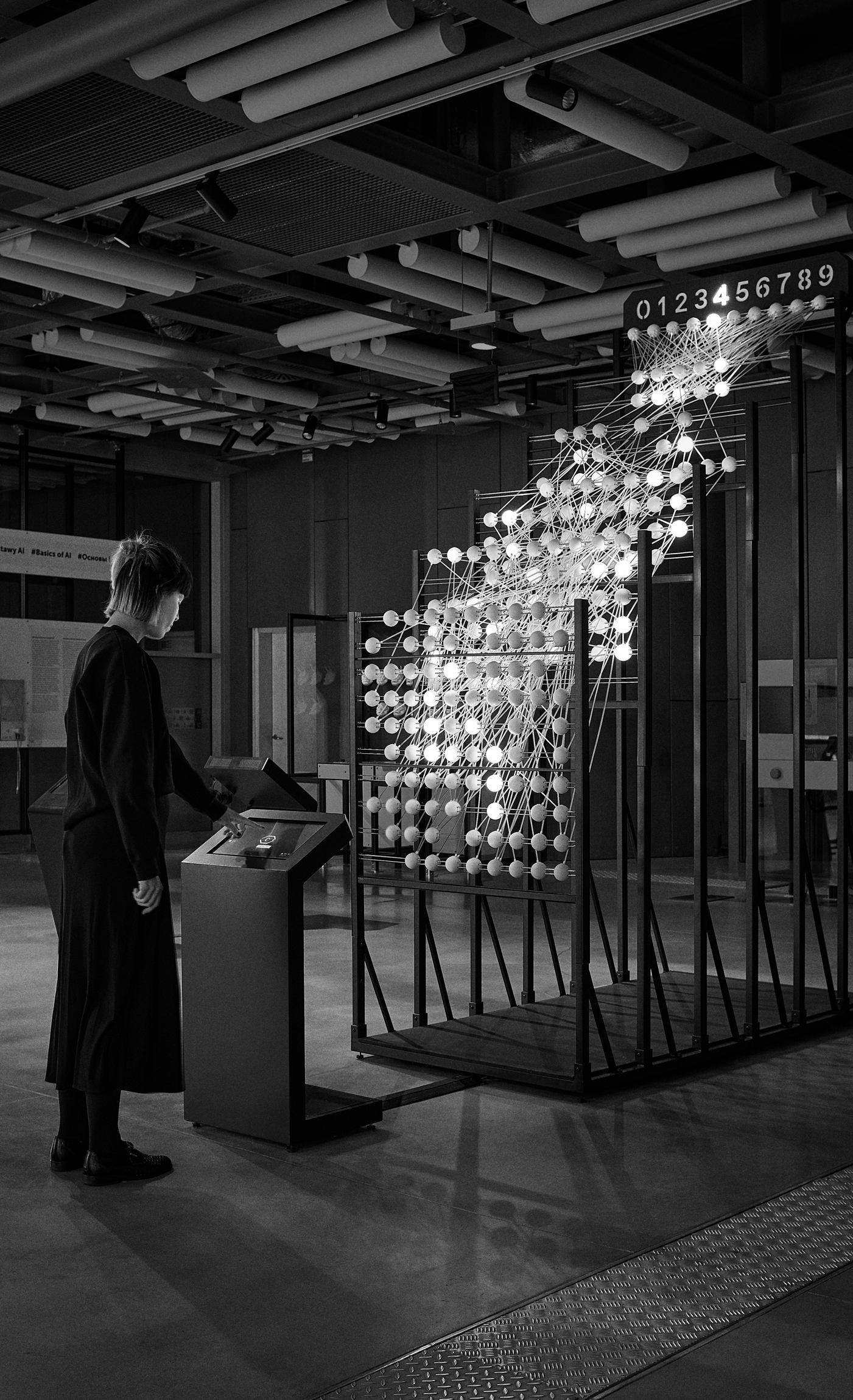
Pangenerator

The abacus
THE ABACUS is probably the first ever 1:1 interactive physical representation of real, functioning deep learning network, represented in the form of a light sculpture. The main purpose of the installation is to materialise and demystify inherently ephemeral nature of artificial neural networks on which our lives are becoming increasingly reliant on. As the part of new permanent exhibition devoted to the Future the installation aims to engage and educate the audience in artistically compelling ways being the manifestation of art and science movement goals.

Nicole Hone

Hydrophytes
Hydrophytes is a series of futuristic aquatic plants created with multi-material 3D printing. The project explores the design and choreography of movement to bring objects to life through 4D printing. The film is true to life with no effects added in post-processing.

IRIS VAN HERPEN & DUTCH NATIONAL BALLET

Biomimikry
Für den Film “Biomimicry“ untersuchen Iris van Herpen und Dutch National Ballet die symbiotische Beziehung zwischen der metamorphen Kraft, in der sich Mode und Tanz verflechten. Der Film unter der Regie von Ryan McDaniels zeigt die hypnotisierende Tänzerin JingJing Mao, die sich in flüssige Formen verwandelt und in anmutige Figuren übergeht, die ihre unzähligen Bewegungen widerspiegeln. Das Konzept der Kreation basiert auf dem Begriff der Biomimikry – dem Entwurf und der Herstellung von Materialien und Systemen, die biologischen Prozessen nachempfunden sind. In Übereinstimmung mit Iris van Herpens kontinuierlichem Bestreben, die unsichtbaren Kräfte, die die Welt strukturieren, zu materialisieren, konzentriert sich der Film auf die Verbindung zwischen Mensch und Natur.

VINCENT LEROY

TOKYO METACLOUD
.
Vincent Leroy onthult ‘Tokyo Metacloud’, een gigantische zwevende wolk die door de straten van de japanse metropool trekt. De installatie, bestaande uit dunne gebogen bladen, speelt met de balans tussen materiaal, lucht en transparantie om een ​​indruk van extreme lichtheid te creëren. Nogmaals, het poëtische en contemplatieve universum van Leroy maakt kijkers los van de echte wereld en nodigt hen uit om te genieten van een meeslepende, dromerige ervaring.
.
Vincent Leroy unveils ‘Tokyo Metacloud’, a gigantic floating cloud that sweeps through the streets of the Japanese metropolis. The installation, consisting of thin curved blades, plays with the balance between material, air and transparency to create an impression of extreme lightness. Again, Leroy’s poetic and contemplative universe detaches viewers from the real world and invites them to enjoy an immersive, dreamlike experience.

Akiko Nakayama

Lebendige Malerei
Ich male gerade. Ich möchte eine Szene zeichnen, die in Bewegung bleibt. Ich habe mit “ALIVE PAINTING” angefangen, mit Liquidität eine sich ständig verändernde Figur zu zeichnen. In “ALIVE PAINTING” zeichnen wir Bilder, indem wir mit Materialien mit unterschiedlichen Eigenschaften miteinander reagieren. Auf diese Weise versuche ich, die ästhetischen Freuden hervorzuheben, die durch den Fluss und die Farbe der Elemente und den rohen Fluss entstehen. Zusätzlich zu den chemischen Eigenschaften des Materials treten durch äußere Faktoren wie Wind, Schwerkraft und Vibration unerwartete Reaktionen auf, so dass die nicht reproduzierbare Szenerie langsam wieder erscheint und das Erlebnis selbst mit dem Betrachter geteilt wird.

Skylar Tibbits

Aerial Assemblies
Self-Assembly is a process by which disordered parts build an ordered structure through local interaction. We have demonstrated that this phenomenon is scale-independent and can be utilized for self-constructing and manufacturing systems at nearly every scale. We have also identified the key ingredients for self-assembly as a simple set of responsive building blocks, energy and interactions that can be designed within nearly every material and machining process available. Self-assembly promises to enable breakthroughs across every applications of biology, material science, software, robotics, manufacturing, transportation, infrastructure, construction, the arts, and even space exploration.

THOMAS FEUERSTEIN

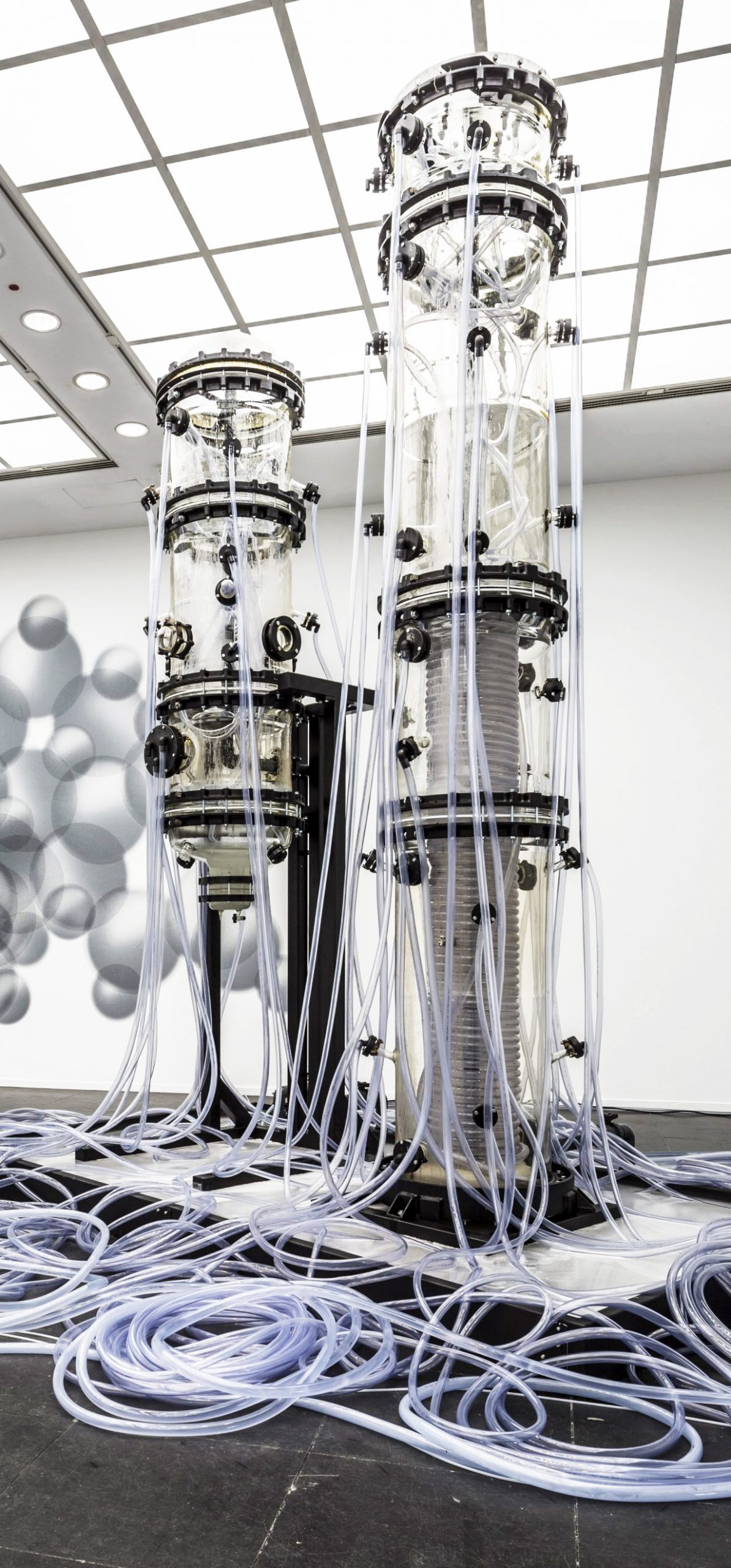
Psychoprosa
La exposición PSYCHOPROSA se centra en el moco como sustancia bioquímica y material escultórico. La producción de moco se lleva a cabo como un proceso real dentro de los espacios de exhibición, transformando el Frankfurter Kunstverein en un conjunto interconectado de invernadero, laboratorio, refrigerador, cine y fábrica. A través de tubos conectados entre sí, los equipos y objetos producen y transforman sus sustancias interiores, los refrigeradores se abren y cierran automáticamente y los hilos transparentes de moco gotean de las esculturas de vidrio expansivas.

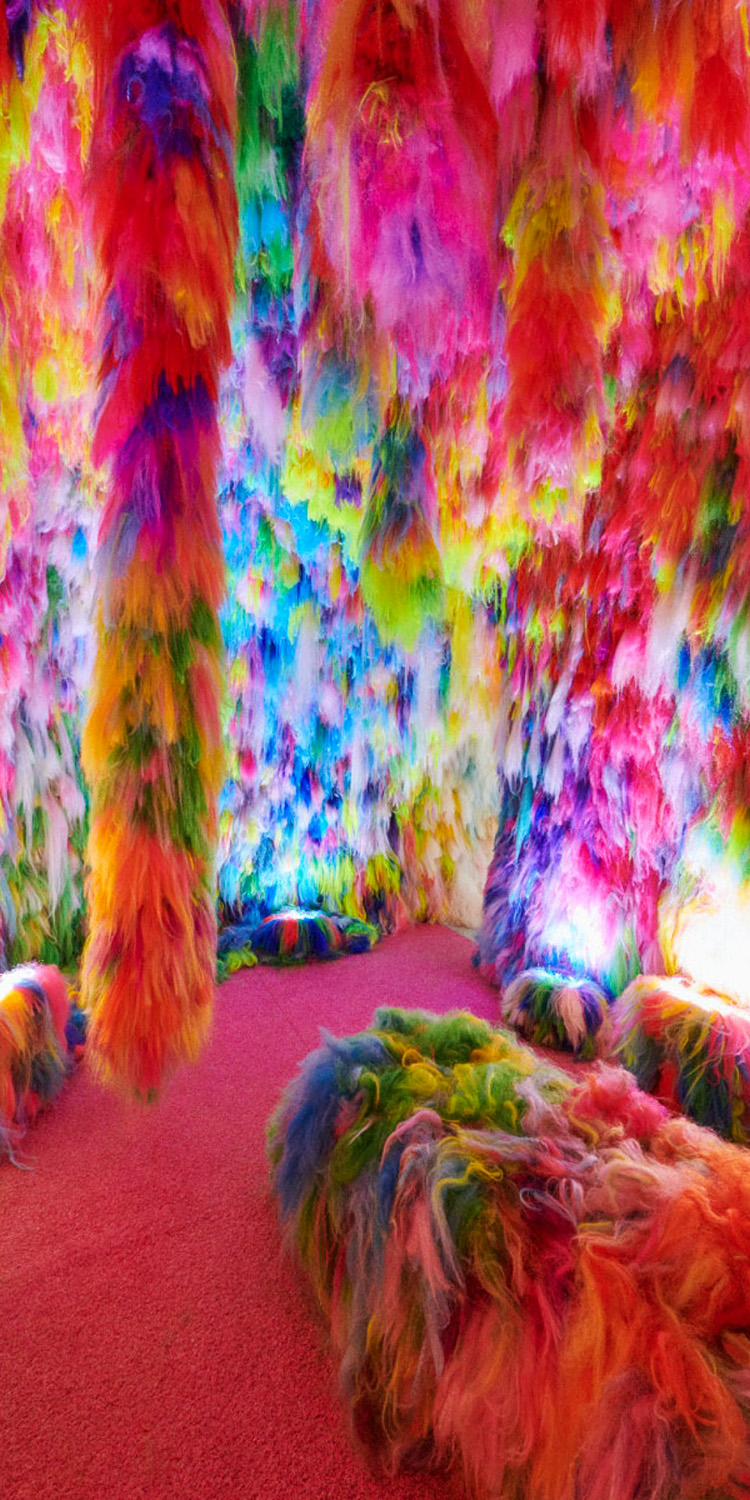
HRAFNHILDUR ARNARDÓTTIR

cromo sapiens
La artista islandesa Hrafnhildur Arnardóttir / Shoplifter ha transformado un almacén en Giudecca en un entorno cavernoso multisensorial con una cantidad cacofónica de su material característico, cabello sintético. Color, sonido y texturas irresistibles guían a los visitantes a través de tres cámaras distintas provocando una experiencia inmersiva de estímulos visuales y auditivos.

YING YU

Morfologias do Ar
Os humanos, como seres sociais, usam a linguagem para se comunicar. A voz humana, como um mecanismo de autenticação biométrica, é constantemente usada em aplicações da vida diária, como reconhecimento de voz, verificação de alto-falante e assim por diante. Atualmente, as comunicações baseadas em idioma se enquadram principalmente em duas categorias: voz sobre o ar e voz sobre o protocolo da Internet. Podemos adicionar uma nova dimensão para a comunicação de voz, como um material vestível? Se sim, como poderíamos moldar a matéria a fim de fisicalizar as informações vocais? Morfologias do Ar é uma instalação interativa que usa materiais suaves, como silício, tecido e ar, para realizar essas fisicalizações. A voz humana controla a atuação de uma estrutura macia vestível, mudando a aparência do corpo humano.

Daniel Widrig

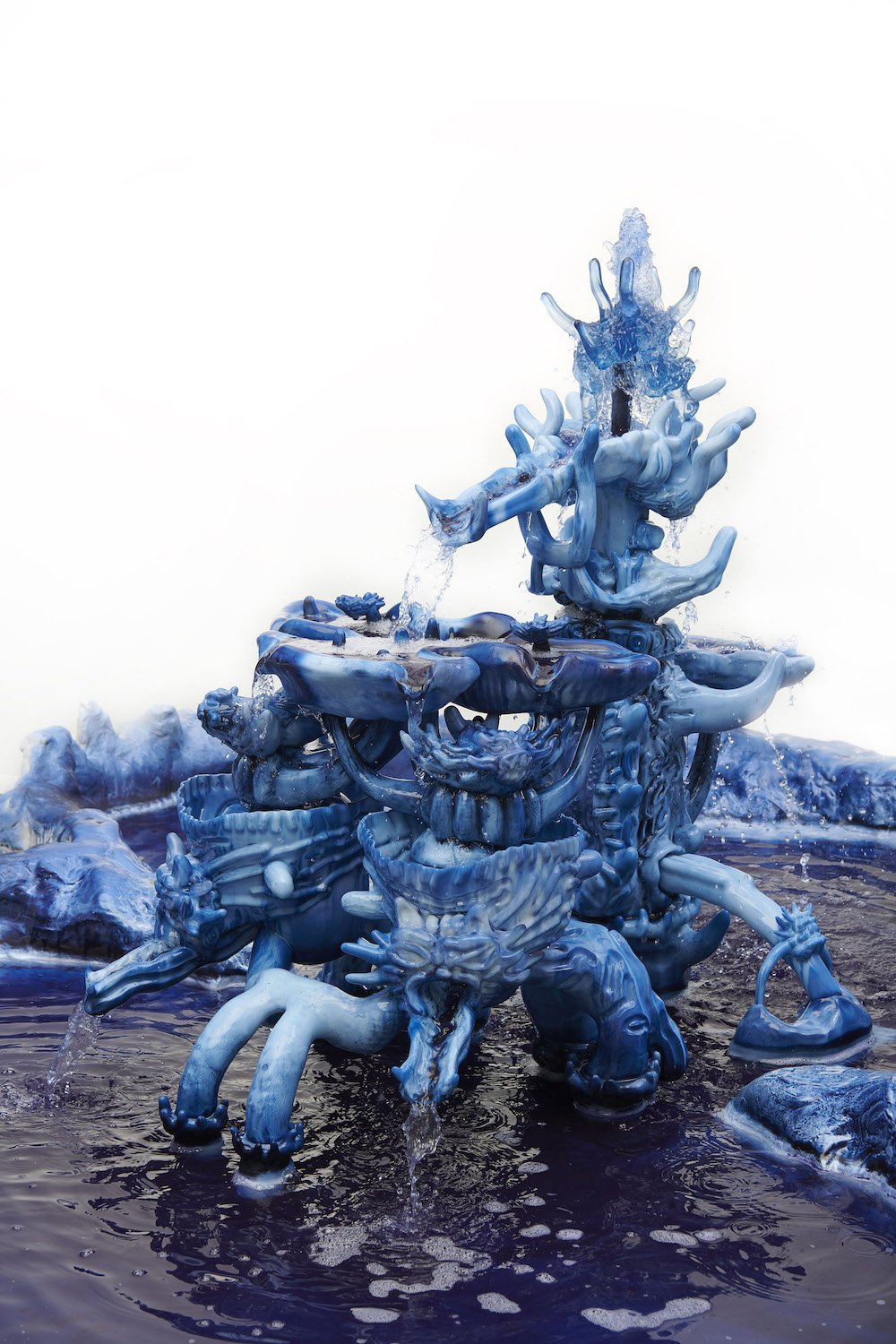
‘SnP’, 2018, recycled plastic, injection moulded

“Widrig’s art breaks down the boundaries between disciplines; borrowing tools traditionally associated with one industry and using them in other fields, in often unanticipated and exciting ways. Widrig uses computer simulation processes and advanced technologies adopted from the special effects business to create sculptural 3D-printed craftwork—digital designs materialize into intricate sculptures in glass or recycled plastic and furniture pieces with impeccable undulated thin surfaces,” Devid Gualandris

Audrey Large

Audrey Large is a French designer based in the Netherlands. By bridging animation techniques with digital-to-material manufacturing processes, her work explores the potential of digital image manipulation as applied to the design of our material surroundings.

ANDREW KUDLESS

P_wall (the self-organization of material)
P_Wall (2009) was commissioned by the SFMOMA Architecture and Design Curator Henry Urbach for the exhibition Sensate: Bodies and Design. The wall, part of a series started with P_Wall (2006), is an evolution of the earlier work exploring the self-organization of material under force. Using nylon fabric and wooden dowels as form-work, the weight of the liquid plaster slurry causes the fabric to sag, expand, and wrinkle.

Baumgartner + Uriu Architecture

Supermassive Black Holes
Supermassive Black Holes is an acoustic ceiling installation for the main lobby of the Los Angeles Chamber of Commerce. The design is part of a series of projects in which we work with small primitives that are aggregated into a larger whole. In this case, there are over 10,000 felt cones stitched together into three gigantic, 20’ tall, hanging felt vortexes that that absorb sound through its materiality and geometry. The thousands of cone shape parts trap and disperse sound waves while softening the overall acoustic quality of the space.