highlike

Synthetika: the age of artificial creativity | FILE 2025

Synthetika

Unlike Hegel, who called the set of ideas of a given era the “spirit of the times” (Zeitgeist), we could call our era “Zeitsynthetik” (the time of the synthetic). In the classical period, art was inseparable from religion, whose essence was spirituality; in modernity, spirituality was replaced by the ideologies of grand narratives (capitalism and socialism). The classical arts invented poetics and aesthetics: the beautiful and the sublime. Modern art invented the avant-garde that proposed to be revolutionary, its driving force was the dialectic of the new without the old, and on the other hand, postmodernists mixed everything with everything, including the old with the new. Today we live in the era of synthetic technologies, the era of disruptive technologies. In which the new of modernity is no longer sufficient or surprising. Syntheticity is the new vector: synthetic algorithms; synthetic virtual realities; synthetic intelligences. The driving force behind synthetic art is: 1) the fusion of new art and technological innovation, and 2) the inter-creativity between the artist and artificial creativity. Prompt engineers strategically simulate personas for AIs in order to move away from triviality and thus obtain more creative results. Synthetic intelligences are no longer just instruments, but partners of artists in the construction of a creative and innovative symbiosis.

Art and culture are going through a moment in which creativity ceases to be just human, it becomes artificial; syntheticity thus prospects a post-culture, a new FORM: the form SYNTHETIKA.

Ricardo Barreto

Curator and co-founder of FILE

Electronic Language International Festival

FILE 2026 – Registration Open for Installation Festival – Art and Technology

FILE 2026

Art and Technology Festival | Installations: artistic systems, indoor  or  outdoor , in which the aesthetic experience emerges from the dynamic relationship between interface, data, environment, and body.  Digital technologies, technologies with artificial intelligence, metamaterial technologies, random technologies, sensors, algorithms, and responsive systems are employed by the artist as structural elements of the work, which is completed in the encounter between the work and the participant.

Applications are open until February 19, 2026. Access  the application form.

FILE 2026 | GENERAL REGULATIONS

FILE 2026 – Registration Open for Robotics Art Festival – Art and Technology

FILE 2026

Robotics and AI Art Festival: Mechanical, autonomous, and intelligent systems as aesthetic agents. The works explore movement, behavior, and interaction between humans and machines.  Sensors, actuators, and artificial intelligence structure the experience. These creations raise questions about autonomy, artificial life, and technological ethics. The machine becomes a palpable presence in the artistic space.

Applications are open until February 19, 2026. Access  the application form.

FILE 2026 | GENERAL REGULATIONS

FILE 2026 – Registration Open for the IA Film Festival – Art and Technology

FILE 2026

Digital Film Festival and AI Cinema: includes productions that explore new aesthetics, narratives, and processes enabled by digital and artificial intelligence technologies.  This language questions traditional notions of authorship, editing, scriptwriting, and directing, proposing new forms of expanded and computational cinema. Cinema ceases to be merely representational and becomes processual and adaptive. It is an emerging field that articulates aesthetics, technology, and critical reflection on the future of moving images and multiple narratives. The works may also explore machine learning algorithms, generative models, and automation as active agents in the construction of image, sound, and dramaturgy.

Applications are open until February 19, 2026. Access  the application form.

FILE 2026 | GENERAL REGULATIONS

FILE 2026 – Registration Open for Games Festival – Art and Technology

FILE 2026

Game Festival  |  Digital Games and AI Games: explore interactivity, rules, and narratives as aesthetic elements.  These works go beyond entertainment, proposing critical, poetic, or experimental experiences. Game mechanics become conceptual devices. Graphic technologies, artificial intelligence, and interactive systems structure the experience. The player is a co-author of the work, actively participating in its construction and interaction.

Applications are open until February 19, 2026. Access  the application form.

FILE 2026 | GENERAL REGULATIONS

FILE SÃO PAULO 2025: SYNTHETIKA – David Da Paz

Technosoma — Sensitive Circuits in the Flesh of the Machine

David Da Paz

FILE SÃO PAULO 2025: SYNTHETIKA – Art and Technology – WORKSHOP
Electronic Language International Festival


Tecnosoma — Sensitive Circuits in the Flesh of the Machine – Brazil

In this workshop, participants will explore the fusion of body, technology, and artificial intelligence, creating interactive experiences with capacitive sensors and real-time generative models. Inspired by the concept of the Technosome—the machine as a sensitive, pulsating organism—the workshop explores how human touch can generate electrical signals that trigger audiovisual, auditory, and light responses. Microcontrollers (Arduino and ESP32), generative AI, and sensory interactivity will be covered.

BIO

Artist, researcher, and developer specializing in AI, machine learning, and IoT, he has worked for over 10 years with interactive art, generative systems, and sensory installations. He participated in the Artropocode residency (Spain) and the Spontaneous Combustion Residency (London), exploring cyberurban performances and locative media.

FILE SÃO PAULO 2025: SYNTHETIKA – CRUDE_CASTIN

Leonardo Da Vinci Project: Neo-Renaissance

CRUDE_CASTIN

FILE SÃO PAULO 2025: SYNTHETIKA – Art and Technology – CGI VIDEOS
Electronic Language International Festival


Leonardo Da Vinci Project: Neo-Renaissance – China

Neo-Renaissance uses the protagonist and Leonardo da Vinci as clues to tell the story of people’s prosperous lives in the “cloud,” the emergence of a latent crisis, and the connection of digital subjects in the context of decentralization in the near future. The film makes extensive use of artificial intelligence-generated materials (AIGC), interweaving the Renaissance and Web 3.0 into a single narrative, aiming to reflect on the fading of popular power in the lower echelons of various social processes and on imaginations for the future.

BIO

CRUDE_CASTIN is a creative collective of young artists. Their focus is on revealing the hidden power structures behind technology and using diverse methods to explore the tension between technology and humanity. Their work combines art and technology, reflecting on the dilemmas of today’s technological society through themes such as technology and power, history, and nature.

FILE SÃO PAULO 2025: SYNTHETIKA – Brit Bunkley

Natural Intelligence

Brit Bunkley

FILE SÃO PAULO 2025: SYNTHETIKA – Art and Technology – Video Art
Electronic Language International Festival


Natural Intelligence – Nova Zelândia

Natural Intelligence is “intelligence created by nature, natural evolutionary mechanisms” as opposed to artificial intelligence. With it, “there is a dynamic movement of natural intelligence that evolves from vague, fuzzy, and unconscious states to more concrete and conscious states, and thus realizing the essence of perception” (Perlovsky and Kozma, 2007). It is beautiful and deeply flawed, but it levels out in the end.

BIO

Bunkley has exhibited at the Museum of New Zealand Te Papa. He participated in the Visions in the Nunnery at the Nunnery/Bows art gallery in London in 2022 and in 2024 at Rencontres Berlin, Haus der Kulturen der Welt, Berlin, and he exhibited in Artweek Gyumri, Armenia. He was the award winner for Best Art | Experimental video/film at the New York City Independent Film Festival 2024 in NYC.

FILE SÃO PAULO 2025: SYNTHETIKA – Cornelis Clement

AI Created a Sci-Fi World You Won’t Believe!

Cornelis Clement

FILE SÃO PAULO 2025: SYNTHETIKA – Art and Technology – Shorts Films AI
Electronic Language International Festival

AI Created a Sci-Fi World You Won’t Believe! – Germany

AI Created a Sci-Fi World You Won’t Believe! is a science fiction universe generated by artificial intelligence. Custom-created images for this world were brought to life with motion and an original soundtrack, resulting in an immersive experience. The work invites the audi ence to explore breathtaking alien landscapes, futuristic cities, and cosmic phenomena reminiscent of Dune and No Man’s Sky. This AI-generated video transports viewers into a realm of visual marvels and hypnotic atmospheres.

BIO

Cornelis is a Berlin-based artist specializing in AI-generated art. He views technology as the dawn of a new era in artistic creation and seeks to be an active part of this movement. His work aims to push creative boundaries, offering audiences new ways to experience imagined worlds.

FILE SÃO PAULO 2025: SYNTHETIKA – PintoCreation

Epic Alien Landscapes

PintoCreation

FILE SÃO PAULO 2025: SYNTHETIKA – Arte e Tecnologia
Festival Internacional de Linguagem Eletrônica


Epic Alien Landscapes – Italy

Embark on a cinematic voyage across otherworldly landscapes. Created with Mi djourney V6.1, animated through Hailuo AI, and set to an original Suno AI v4 soundtrack, this video brings to life vast alien worlds, futuristic civi lizations, and breathtaking digital vistas.

BIO

Since childhood, Luigi Novellino (aka PintoCreation) dreamed of distant galaxies and cities floating in the sky. Now, thanks to artificial intelligence, these dreams come to life. PintoCreation creates images that tell stories of hidden worlds, born from his passion for science fiction and his desire to share them with everyone.

FILE SÃO PAULO 2025: SYNTHETIKA – Erika Kassnel-Henneberg

Deep Paula

Erika Kassnel-Henneberg

FILE SÃO PAULO 2025: SYNTHETIKA – Art and Technology – Shorts Films AI
Electronic Language International Festival


Deep Paula – Germany

An old photograph is “brought to life” by artificial intelligence. What happens when flawed memory gives way to artificial vividness? Today, a perfect, seemingly alive digital self can be created. Will we become eternal puppets wandering the web? Who pulls the strings? And if a lost loved one is replaced by a digital twin, what becomes of grief?

BIO

Erika Kassnel-Henneberg (1973) is a conceptual artist. Her work explores a new humanism in the face of digital complexity. She investigates memory through AI-driven data analysis and questions perception as a construct between reality and fiction.

Music: AI-generated.

FILE SÃO PAULO 2025: SYNTHETIKA – Jenifer Haider Chowdhury

Verticity

Jenifer Haider Chowdhury

FILE SÃO PAULO 2025: SYNTHETIKA – Art and Technology – Shorts Films AI
Electronic Language International Festival


Verticity – Bangladesh

What will happen in the AEC industry after one thousand years from today? In this cutting-edge technology-based world, we have already started to take steps in Artificial Intelligence and some other advanced sectors such as biotechnology which is inspired by mimicking mechanisms found in nature. By observing all of these, we can say that in the future there will be so much dynamism and diversities in the skyscraper design development process.

BIO

Architectural designer who graduated with a B.Arch degree from the University of Asia Pacific, Bangladesh. For the past two and a half years, she has been exploring AI-based architecture and fashion experiments. She has a deep interest in parametric and dynamic computational style designs and ideas in both architecture and fashion design. She is also passionate about surrealism and non-traditional concepts. These factors are the major inspirations behind all of her works.

FILE SÃO PAULO 2025: SYNTHETIKA – An-Ting e Ian Gallagher

Black-collared Starling 烏領椋鳥 (Hong Kong)

An-Ting e Ian Gallagher

FILE SÃO PAULO 2025: SYNTHETIKA – Art and Technology – Shorts Films AI
Electronic Language International Festival


Black-collared Starling 烏領椋鳥 (Hong Kong) – Taiwan | United Kingdom

An-Ting blends bird song recordings, experimental electronic music, soundscapes, and driving beats. Ian Gallagher employs cutting-edge artificial intelligence technologies to document the duo’s experiences, with live visuals that react in real time to An-Ting’s music.

BIO

An-Ting 安婷 is a versatile artist who moves between piano, electronic compositions, and various other forms of artistic expression. She transforms her life experiences into musical creations, exploring the relationship between humanity, nature, and the spiritual universe.

Ian Gallagher studied Theoretical Physics in Edinburgh before completing a PhD in Complex Systems at the University of Manchester. He has been deeply involved in Manchester’s music scene, working as a sound engineer, show producer, and performer on stage, collaborating with artists such as Daniel Johnston and Neva Dinova.

This work was supported by the British Council and the organization Cryptic Glasgow.

FILE SÃO PAULO 2025: SYNTHETIKA – Jeff Synthesized

Newton’s Cradle

Jeff Synthesized

FILE SÃO PAULO 2025: SYNTHETIKA – Art and Technology – Cine SYN
Electronic Language International Festival


Newton’s Cradle – United States

In a dystopian future where time is stolen and turned into a commodity, Newton’s Cradle follows a woman’s journey to uncover the truth behind a system built on control. The Newton’s cradle, an innocuous object, becomes a powerful symbol of human choices and the hope for restored balance. This cautionary tale urges reflection on what truly matters in the moments we’re given.

BIO

Jeff Synthesized is a visionary filmmaker specializing in artificial intelligence. His innovative approach is reshaping contemporary cinema, blending cutting-edge technology with emotive storytelling. Through works like the Amazon Prime series House of David and the acclaimed short film Newton’s Cradle, he inspires a new era of AI-driven filmmaking.

FILE SÃO PAULO 2025: SYNTHETIKA – Gabe Michael

Unknown

Gabe Michael

FILE SÃO PAULO 2025: SYNTHETIKA – Art and Technology – Cine SYN
Electronic Language International Festival


Unknown – United States

Unknown follows a misunderstood creature haunting the halls of an art museum. Its impressionistic visual style earned the short film the Best Art Direction award at Runway Gen:48 – 2nd Edition.

BIO

Gabe Michael is an award-winning filmmaker and creative technologist specializing in artificial intelligence. He serves as Vice President and Executive Producer of AI at Edelman, advising teams, optimizing production workflows, and exploring creative innovation with AI. With extensive experience as a director and producer, he collaborates with major studios, brands, and digital platforms, and shares his insights on LinkedIn, YouTube, and in UCLA classrooms.

Music: ARTLIST

FILE SÃO PAULO 2025: SYNTHETIKA – Tanja Vujinovica

SynthPets

Tanja Vujinovica

FILE SÃO PAULO 2025: SYNTHETIKA – Art and Technology – Installations
Electronic Language International Festival


SynthPets – Slovenia

SynthPets is inspired by the evolution of artificial intelligence and robotics, paying tribute to the creator’s robotic vacuum cleaner. These mysterious cyber-organic companions emerge through sketches, digital drawings, 3D sculptures, and AI-generated forms. The work explores humanity’s entanglement with electronic pets and devices that have become integral to everyday life.

BIO

Tanja Vujinovic is a multimedia artist who blends video art, games, music, and research to explore how technology shapes human experience. Her work examines the influence of synthetic environments and electronic devices, often featuring playful small figures—drawing inspiration from dolls, figurines, and talismans—that serve as symbolic guardians and companions.

3D computer graphics, digital sculpting and painting, generated AI, sound: Tanja Vujinovic

Production: Tanja Vujinovic/Ultramono, 2024—ongoing.

Consulting

RonBreIan, Software and Audio Engineer

https://www.tanjav.art/

@tanja_vujinovic_ultramono_

FILE SÃO PAULO 2025: SYNTHETIKA – Weidi Zhang & Rodger Luo

ReCollection

Weidi Zhang & Rodger Luo

FILE SÃO PAULO 2025: SYNTHETIKA – Art and Technology – Installations
Electronic Language International Festival


ReCollection – China | United States

ReCollection is an interactive installation that uses artificial intelligence to construct synthetic collective visual memories from natural language input. The work blurs the line between memory and imagination through experimental visualizations and AI systems, prompting reflection on how narratives of memory are shaped by emerging technologies.

BIO

Weidi Zhang is a new media artist and designer based in Los Angeles and Phoenix. She is an Assistant Professor of Immersive Experience Design at Arizona State University. Her interdisciplinary research explores speculative assemblages at the intersection of immersive media, experimental data visualization, and interactive AI art. Dr. Jieliang (Rodger) Luo is the CEO and Head of Research at Minus AI, a research-driven startup focused on leveraging AI technology to empower the creative industry. He holds a Ph.D. in Media Arts and Technology from the University of California, Santa Barbara, and has previously served as a Senior Principal Research Scientist at the Autodesk AI Lab.

Memo Akten and Katie Peyton Hofstadter

Embodied Simulation

‘Embodied Simulation’ is a multiscreen video and sound installation that aims to provoke and nurture strong connections to the global ecosystems of which we are a part. The work combines artificial intelligence with dance and research from neuroscience to create an immersive, embodied experience, extending the viewer’s bodily perception beyond the skin, and into the environment.
The cognitive phenomenon of embodied simulation (an evolved and refined version of ‘mirror neurons’ theory) refers to the way we feel and embody the movement of others, as if they are happening in our own bodies. The brain of an observer unconsciously mirrors the movements of others, all the way through to the planning and simulating execution of the movements in their own body. This can even be seen in situations such as embodying and ‘feeling’ the movement of fabric blowing in the wind. As Vittorio Gallese writes, “By means of a shared neural state realized in two different bodies that nevertheless obey to the same functional rules, the ‘objectual other’ becomes ‘another self’.”

QUBIT AI – International Electronic Language Festival – Art and Technology

QUBIT AI | quantum & synthetic ai
Electronic Language International Festival

July 3rd to August 25th
Tuesday to Sunday, 10am – 8pm
FIESP Cultural Center

Design: André Lenz
Image: Iskarioto Dystopian AI Films – Athena

QUBIT AI

In its 25 years of existence, the International Electronic Language Festival (FILE) is an internationally renowned Brazilian project that since 2000 has explored the intersection between art and technology. With more than two decades of history, the festival stands out for fostering exhibition spaces and debate about artistic innovations driven by disruptive and innovative technologies, inviting the public to get involved with experimental forms of art that challenge the boundaries of conventionality. Currently, two of these technologies stand out in the contemporary scenario: the accelerated development of quantum computing and artificial intelligence corroborated by synthetic data.

Quantum computing, an emerging revolution in the technological field, offers a new range of creative possibilities for contemporary artists. This new era allows the exploration of unprecedented frontiers through a new computational format that consists mainly of quantum superposition and entanglement, a new field of exploration for synthetic computer science, as well as for the arts in general; on the other hand, artificial intelligence, fueled by synthetic data, offers artists a new way of making and understanding art, opening up space for new forms, concepts and artistic expressions.

Entitled QUBIT AI, the exhibition delves into this unexplored territory presenting a selection of works of art resulting from the connection between artistic creation and technology, proposing a theoretical reflection on what the interrelationship between quantum computers and synthetic artificial intelligence will be.

Visitors will be invited to experience immersive installations, experimental videos, digital sculptures and other forms of interactive art, which intertwine reality and imagination. The exhibition encourages reflections on the influence of technology on art and contemporary society, while at the same time providing an environment to compare already established technological arts (analog and digital) with the possible futures of art in the synthetic era, enhanced by quantum computing. The QUBIT AI exhibition at FILE SP 2024 transcends the mere presentation of works of art; it is a journey to the limits of human creativity, driven by the convergence of art, science and technology.

Ricardo Barreto and Paula Perissinotto
co-organizers and curators of FILE
International Electronic Language Festival

 

QUBIT AI: Max Haarich (Project Smart Hans)

Smart Hans

FILE 2024 | Installations
International Electronic Language Festival
Max Haarich (Project Smart Hans) – Smart Hans – Germany

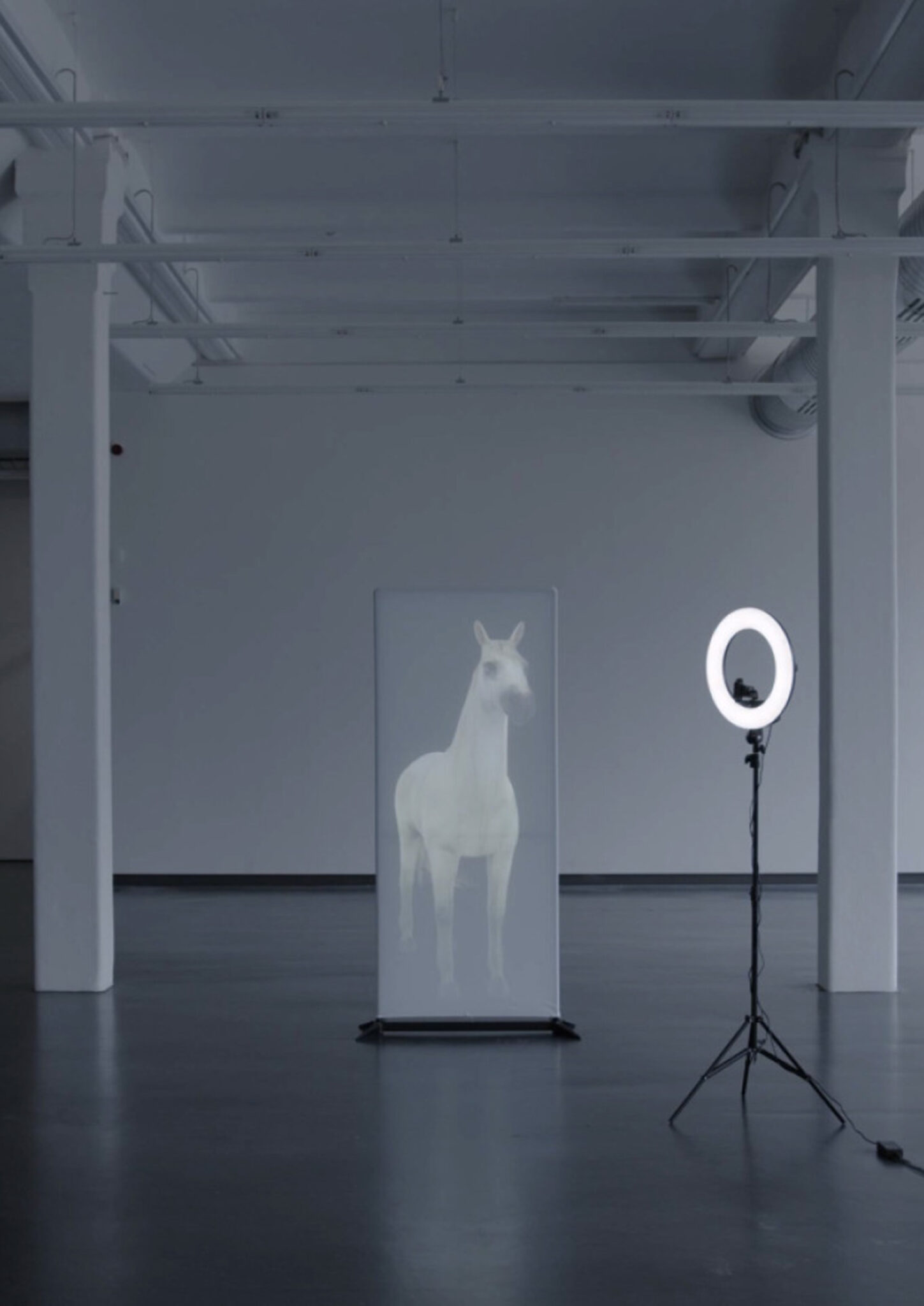
The Smart Hans project is a synthetic reincarnation of Clever Hans, a horse that became famous in the early 20th century for apparently answering mathematical questions by tapping its hoof. The interactive installation features an animated horse that can guess any number in its mind through posture recognition. At the same time a fun joke and an illustration of why we worry about artificial intelligence.

Bio

Max Haarich is an artistic researcher, ethicist and consultant focusing on artificial intelligence and web3. He studied communication science at RWTH Aachen and critical thinking at the University of the Underground. After his studies, he researched artificial superintelligence at RWTH Aachen and later worked as a communications manager at Europe’s leading startup hub.

Credits

Team: Anja Borowicz Richardson (UK), Bruce Gilchrist (UK), Akshita Gupta (IND), Max Haarich (Artistic Lead/DE), Martina Huynh (NL), Asad Imtiaz (PAK), Muhammad Qasim Khan (PAK), Adrian Ludwig (DE), Pekka Ollikainen (FI), Raphael Pickl (DE).

QUBIT AI: Marc Lee & Shervin Saremi

Speculative Evolution, Prototype 1

FILE 2024 | Installations
International Electronic Language Festival
Speculative experiment on a future ecosystem under strict control. The narrative takes place in a simulation, 30 years in the future, where artificial intelligence and synthetic biology collaborate to optimize an environment for cultivated species. An AI-powered simulator helps visitors generate new species to balance the ecosystem. Inspiration comes from the book Under the White Sky by Elizabeth Kolbert and artists’ stories about life on a damaged planet.

Bio

Marc Lee is a Swiss artist focused on real-time rendered audiovisual installations, AR, VR and mobile applications, critically exploring creative, cultural, social, ecological, political and speculative themes. His work has been exhibited in important museums and new media art spaces. Shervin Saremi is an Iranian musician and audio engineer specializing in sonic computing, procedural sound design and production. Currently researching immersive audio at UdK Berlin.

QUBIT AI: Matthias Oostrik

The Forgettable Art Machine

FILE 2024 | Installations

International Electronic Language Festival

The Forgettable Art Machine is an artificial intelligence-driven video installation. When facing the panel, the public has their image captured, starting a cycle of analysis, creation and destruction. From this data, a composite emerges, slowly transforming the visitors’ image into a generative visualization. Once the cycle is complete, the composition is deleted, waiting for a new audience to be captured.

Bio

Matthias Oostrik works at the intersection of digital art, installation art, cinema and architecture. His works establish unpredictable relationships between people and their surroundings. Using digital technology, his installations allow visitors to reshape their environment and their relationships with each other. Oostrik collaborates with renowned professionals and, above all, with his audience, who often become an integral part of his work.

Credits

Co-production: Zester
IA Music: Than van Nispen

QUBIT AI: Lukas Radavicius

Architecture Concepts Created by AI – Can AI Become an Architect?

FILE 2024 | Architectural Synthetics
International Electronic Language Festival
Lukas Radavicius – Architecture Concepts Created by AI: Can AI Become an Architect? – Lithuania

In recent years, artificial intelligence technologies have advanced significantly in the art world, becoming a vital tool for artists in a variety of disciplines, including architecture. Lukas Radavicius has created videos demonstrating the current capabilities of AI in architecture, showcasing innovative designs that offer insights into the potential of AI to shape the future of architecture.

Bio

Lukas Radavicius, born in Kaunas, Lithuania, is a passionate visual artist who began his career in architecture before moving into graphic design and 3D graphics. With a degree in architecture from the Kaunas Academy of Art, he remains active in design-related fields while exploring the fascinating world of AI art in his spare time.

QUBIT AI: Lukas Radavicius

Architecture Concepts Created by AI: Artificial Intelligence Modern Architecture

FILE 2024 | Architectural Synthetics
International Electronic Language Festival
Lukas Radavicius – Architecture Concepts Created by AI: Artificial Intelligence Modern Architecture – Lithuania

In recent years, artificial intelligence technologies have advanced significantly in the art world, becoming a vital tool for artists in a variety of disciplines, including architecture. Lukas Radavicius has created videos demonstrating the current capabilities of AI in architecture, showcasing innovative designs that offer insights into the potential of AI to shape the future of architecture.

Bio

Lukas Radavicius, born in Kaunas, Lithuania, is a passionate visual artist who began his career in architecture before moving into graphic design and 3D graphics. With a degree in architecture from the Kaunas Academy of Art, he remains active in design-related fields while exploring the fascinating world of AI art in his spare time.

QUBIT AI: Lukas Radavicius

Architecture Concepts Created by AI: Architecture Concepts Made by AI

FILE 2024 | Architectural Synthetics
International Electronic Language Festival
Lukas Radavicius – Architecture Concepts Created by AI: Architecture Concepts Made by AI – Lithuania

In recent years, artificial intelligence technologies have advanced significantly in the art world, becoming a vital tool for artists in a variety of disciplines, including architecture. Lukas Radavicius has created videos demonstrating the current capabilities of AI in architecture, showcasing innovative designs that offer insights into the potential of AI to shape the future of architecture.

Bio

Lukas Radavicius, born in Kaunas, Lithuania, is a passionate visual artist who began his career in architecture before moving into graphic design and 3D graphics. With a degree in architecture from the Kaunas Academy of Art, he remains active in design-related fields while exploring the fascinating world of AI art in his spare time.

QUBIT AI: Hassan Ragab

Audio Responsive Treehouse

FILE 2024 | Architectural Synthetics
International Electronic Language Festival
Hassan Ragab – Audio Responsive Treehouse – United States

This work, created using generative artificial intelligence tools, is part of a broader exploration into discovering architectural forms through the intersection of different media. Potential shapes are generated based on the rhythms and timbres of the Shockone vs. Shockone song Run. The Bloody Beetroots. Factors such as camera movement and dynamics between the interior and exterior of the treehouse contribute to the creative process.

Bio

Hassan Ragab is an interdisciplinary media artist, architect and designer whose work focuses on the synergy between art, architecture, technology and humanity. He uses generative artificial intelligence to create a new visual language, and his work is exhibited globally. Additionally, Hassan writes about the integration of new media into art and design and has been recognized in numerous publications and news outlets.

QUBIT AI: Dallaserra Maxime

Journey of Life

FILE 2024 | Aesthetic Synthetics
International Electronic Language Festival
Dallaserra Maxime – Journey of Life – France

Journey Of Life was triggered by the death of the artist’s grandmother. There is a message of resignation and optimism in the face of adversity in this work. However, he decided to portray the life of a young man in a futuristic city. The video is rich in details. The strength of artificial intelligence lies in its ability to allow this profusion of images, which would otherwise require the artist an incomparable amount of time to produce.

Bio

Maxime Dallaserra is an electronic music composer who always wanted to produce a comprehensive audiovisual work. In addition to his music creation activities, he managed to create live shows with video projections, accompanied by a team. At the same time, he began broadcasting his creations. With the arrival of artificial intelligence, he found ways to enhance and realize his artistic vision, leading to the creation of Journey of Life .

QUBIT AI: AESTHETIC SYNTHETIC FILE – São Paulo 2024 – Art and Technology

FILE 2024

QUBIT AI | quantum & synthetic ai
Electronic Language International Festival
July 3rd to August 25th
Tuesday to Sunday, 10am – 8pm
FIESP Cultural Center

Design: André Lenz
Image: Iskarioto Dystopian AI Films – Athena

QUBIT AI

In its 25 years of existence, the International Electronic Language Festival (FILE) is an internationally renowned Brazilian project that since 2000 has explored the intersection between art and technology. With more than two decades of history, the festival stands out for fostering exhibition spaces and debate about artistic innovations driven by disruptive and innovative technologies, inviting the public to get involved with experimental forms of art that challenge the boundaries of conventionality. Currently, two of these technologies stand out in the contemporary scenario: the accelerated development of quantum computing and artificial intelligence corroborated by synthetic data.

Quantum computing, an emerging revolution in the technological field, offers a new range of creative possibilities for contemporary artists. This new era allows the exploration of unprecedented frontiers through a new computational format that consists mainly of quantum superposition and entanglement, a new field of exploration for synthetic computer science, as well as for the arts in general; on the other hand, artificial intelligence, fueled by synthetic data, offers artists a new way of making and understanding art, opening up space for new forms, concepts and artistic expressions.

Entitled QUBIT AI, the exhibition delves into this unexplored territory presenting a selection of works of art resulting from the connection between artistic creation and technology, proposing a theoretical reflection on what the interrelationship between quantum computers and synthetic artificial intelligence will be.

Visitors will be invited to experience immersive installations, experimental videos, digital sculptures and other forms of interactive art, which intertwine reality and imagination. The exhibition encourages reflections on the influence of technology on art and contemporary society, while at the same time providing an environment to compare already established technological arts (analog and digital) with the possible futures of art in the synthetic era, enhanced by quantum computing. The QUBIT AI exhibition at FILE SP 2024 transcends the mere presentation of works of art; it is a journey to the limits of human creativity, driven by the convergence of art, science and technology.

Ricardo Barreto and Paula Perissinotto
co-organizers and curators of FILE
International Electronic Language Festival
QUBIT AI: Dennis Schöneberg

Transparency

FILE 2024 | Interator – Sound Synthetics
International Electronic Language Festival
Dennis Schöneberg – Transparenza – Germany

Music controls camera settings, the weight of prompts, and the creativity of the AI. The objective of the project is to create a symbiosis between music and images, in which both elements complement and enhance each other. By directly linking musical parameters to AI creative processes, a unique audiovisual experience is created.

Bio

Dennis Schöneberg, German AI artist, data science student and developer of open source AI models, integrates his passion for electronic music into his creative endeavors. Merging art with technology, he explores the synergy between creativity and artificial intelligence.

Credits

Music: Transparenza by Michael Mayer & Reinhard Voigt

QUBIT AI: Dennis Schöneberg

Russian Roulette

FILE 2024 | Interator – Sound Synthetics
International Electronic Language Festival
Dennis Schöneberg – Russian Roulette – Germany

An incessant bass drum drives the journey through an eccentric world populated by fruity alien creatures in a cheerful and colorful environment.

Bio

Dennis Schöneberg, German AI artist, data science student and developer of open source AI models, integrates his passion for electronic music into his creative endeavors. Merging art with technology, he explores the synergy between creativity and artificial intelligence.

Credits

Music: Believe by Russian Roulette

QUBIT AI: Dennis Schöneberg

N-DRA

FILE 2024 | Interator – Sound Synthetics
International Electronic Language Festival

Dennis Schöneberg – N-DRA – Germany

Created during the pandemicN-DRA is a video that explores the nostalgia of pre-pandemic times. Through a dreamlike and psychedelic journey through the artist’s memories, it reflects feelings of loneliness, isolation and the desire for connection.

Bio

Dennis Schöneberg, German AI artist, data science student and developer of open source AI models, integrates his passion for electronic music into his creative endeavors. Merging art with technology, he explores the synergy between creativity and artificial intelligence.

Credits

Music: N-DRA by Ricardo Villalobos

QUBIT AI: Dennis Schöneberg

Bodydub

FILE 2024 | Interator – Sound Synthetics
International Electronic Language Festival
Dennis Schöneberg – Bodydub – Germany

This video experiment combines music properties with AI generation settings to create a unique audiovisual experience. The synthesizer works as a control instrument for movement in the 3D space of the video.

Bio

Dennis Schöneberg, German AI artist, data science student and developer of open source AI models, integrates his passion for electronic music into his creative endeavors. Merging art with technology, he explores the synergy between creativity and artificial intelligence.

Credits

Music: Bodydub (Bangkok Impact Remix) by Unit4

QUBIT AI: Eduardo Reck Miranda

Sounding Qubits

FILE 2024 | Quantico
International Electronic Language Festival
Eduardo Reck Miranda – Sounding Qubits – Brazil

Although he has learned classical musical instruments since childhood, Eduardo Miranda’s favorite tool for composing is the computer. The researcher has been delving into artificial intelligence and innovative computing methods for compositing for some time, as they offer fresh insights and ideas beyond his own.

A quantum computer deals with information encoded as qubits. A qubit is to a quantum computer what a bit is to a digital one: a basic unit of information. In hardware, qubits exist in the subatomic world. They are subject to the laws of quantum mechanics.

Quantum computers are like super-powered versions of classical digital computers. While a digital computer processes data in a linear, step-by-step fashion, a quantum computer can explore many possibilities at once.

Operating a quantum computer requires different ways of thinking about encoding and processing information. This is where composers can benefit greatly. This technology is destined to facilitate the development of unprecedented ways of creating music.

Bio

Composer who works at the intersection of music, science and new technologies. His background as an artificial intelligence scientist and classical composer with early involvement in avant-garde pop music informs his distinctive music. He has composed for BBC Radio 3, BBC Concert Orchestra, BBC Singers and Scottish Chamber Orchestra. He is a professor at the University of Plymouth and a research associate at Quantinuum, where he explores music composition with quantum computers.

QUBIT AI: FILE QUANTUM WORKSHOP 2024 – São Paulo – Art and Technology

FILE 2024

QUBIT AI | quantum & synthetic ai
Electronic Language International Festival
July 3rd to August 25th
Tuesday to Sunday, 10am – 8pm
FIESP Cultural Center

Design: André Lenz
Image: Iskarioto Dystopian AI Films – Athena

QUBIT AI

In its 25 years of existence, the International Electronic Language Festival (FILE) is an internationally renowned Brazilian project that since 2000 has explored the intersection between art and technology. With more than two decades of history, the festival stands out for fostering exhibition spaces and debate about artistic innovations driven by disruptive and innovative technologies, inviting the public to get involved with experimental forms of art that challenge the boundaries of conventionality. Currently, two of these technologies stand out in the contemporary scenario: the accelerated development of quantum computing and artificial intelligence corroborated by synthetic data.

Quantum computing, an emerging revolution in the technological field, offers a new range of creative possibilities for contemporary artists. This new era allows the exploration of unprecedented frontiers through a new computational format that consists mainly of quantum superposition and entanglement, a new field of exploration for synthetic computer science, as well as for the arts in general; on the other hand, artificial intelligence, fueled by synthetic data, offers artists a new way of making and understanding art, opening up space for new forms, concepts and artistic expressions.

Entitled QUBIT AI, the exhibition delves into this unexplored territory presenting a selection of works of art resulting from the connection between artistic creation and technology, proposing a theoretical reflection on what the interrelationship between quantum computers and synthetic artificial intelligence will be.

Visitors will be invited to experience immersive installations, experimental videos, digital sculptures and other forms of interactive art, which intertwine reality and imagination. The exhibition encourages reflections on the influence of technology on art and contemporary society, while at the same time providing an environment to compare already established technological arts (analog and digital) with the possible futures of art in the synthetic era, enhanced by quantum computing. The QUBIT AI exhibition at FILE SP 2024 transcends the mere presentation of works of art; it is a journey to the limits of human creativity, driven by the convergence of art, science and technology.

Ricardo Barreto and Paula Perissinotto
co-organizers and curators of FILE
International Electronic Language Festival
QUBIT AI: FILE OPENING LECTURE 2024 – São Paulo – Art and Technology

FILE 2024

QUBIT AI | quantum & synthetic ai
Electronic Language International Festival
July 3rd to August 25th
Tuesday to Sunday, 10am – 8pm
FIESP Cultural Center

Design: André Lenz
Image: Iskarioto Dystopian AI Films – Athena

QUBIT AI

In its 25 years of existence, the International Electronic Language Festival (FILE) is an internationally renowned Brazilian project that since 2000 has explored the intersection between art and technology. With more than two decades of history, the festival stands out for fostering exhibition spaces and debate about artistic innovations driven by disruptive and innovative technologies, inviting the public to get involved with experimental forms of art that challenge the boundaries of conventionality. Currently, two of these technologies stand out in the contemporary scenario: the accelerated development of quantum computing and artificial intelligence corroborated by synthetic data.

Quantum computing, an emerging revolution in the technological field, offers a new range of creative possibilities for contemporary artists. This new era allows the exploration of unprecedented frontiers through a new computational format that consists mainly of quantum superposition and entanglement, a new field of exploration for synthetic computer science, as well as for the arts in general; on the other hand, artificial intelligence, fueled by synthetic data, offers artists a new way of making and understanding art, opening up space for new forms, concepts and artistic expressions.

Entitled QUBIT AI, the exhibition delves into this unexplored territory presenting a selection of works of art resulting from the connection between artistic creation and technology, proposing a theoretical reflection on what the interrelationship between quantum computers and synthetic artificial intelligence will be.

Visitors will be invited to experience immersive installations, experimental videos, digital sculptures and other forms of interactive art, which intertwine reality and imagination. The exhibition encourages reflections on the influence of technology on art and contemporary society, while at the same time providing an environment to compare already established technological arts (analog and digital) with the possible futures of art in the synthetic era, enhanced by quantum computing. The QUBIT AI exhibition at FILE SP 2024 transcends the mere presentation of works of art; it is a journey to the limits of human creativity, driven by the convergence of art, science and technology.

Ricardo Barreto and Paula Perissinotto
co-organizers and curators of FILE
International Electronic Language Festival
 

Sam Twidale & Marija Avramovic

Sunshowers
(AI) infinite simulations
FILE FESTIVAL SP 2019
.
‘Sunshowers’ is the third in our series of real-time animation artworks. It is inspired by the opening chapter of Akira Kurosawa’s film Dreams which follows a young boy as he explores a forest and stumbles across a fox wedding (Kitsune no Yomeiri). Our piece explores ideas of animism and techno-animism by assigning life in the form of artificial intelligence to all of the objects, both natural and man-made, within the virtual world. The piece unfolds in real time with the characters themselves deciding which paths they will follow.

Engineered Arts

AMECA
“Multiply the power of artificial Intelligence with an artificial body. Ameca is the physical presence that brings your code to life. The most advanced lifelike humanoid you can use to develop and show off your greatest machine learning interactions. This robot is the digital interface to the real world.” Engineered Arts
.
“A U.K. robotics firm called Engineered Arts just debuted the first videos of its new humanoid robot, which is able to make hyper-realistic facial expressions. It’s a pretty stunning achievement in the world of robotics; it just also happens to be absolutely terrifying.
Named Ameca, the robot’s face features eyes, cheeks, a mouth, and forehead that contort and change shape to show off emotions ranging from awe to surprise to happiness. One of the new videos of Ameca shows it waking up and seemingly coming to grips with its own existence for the first time ever.” Neel V.Patel

SpY

DATA
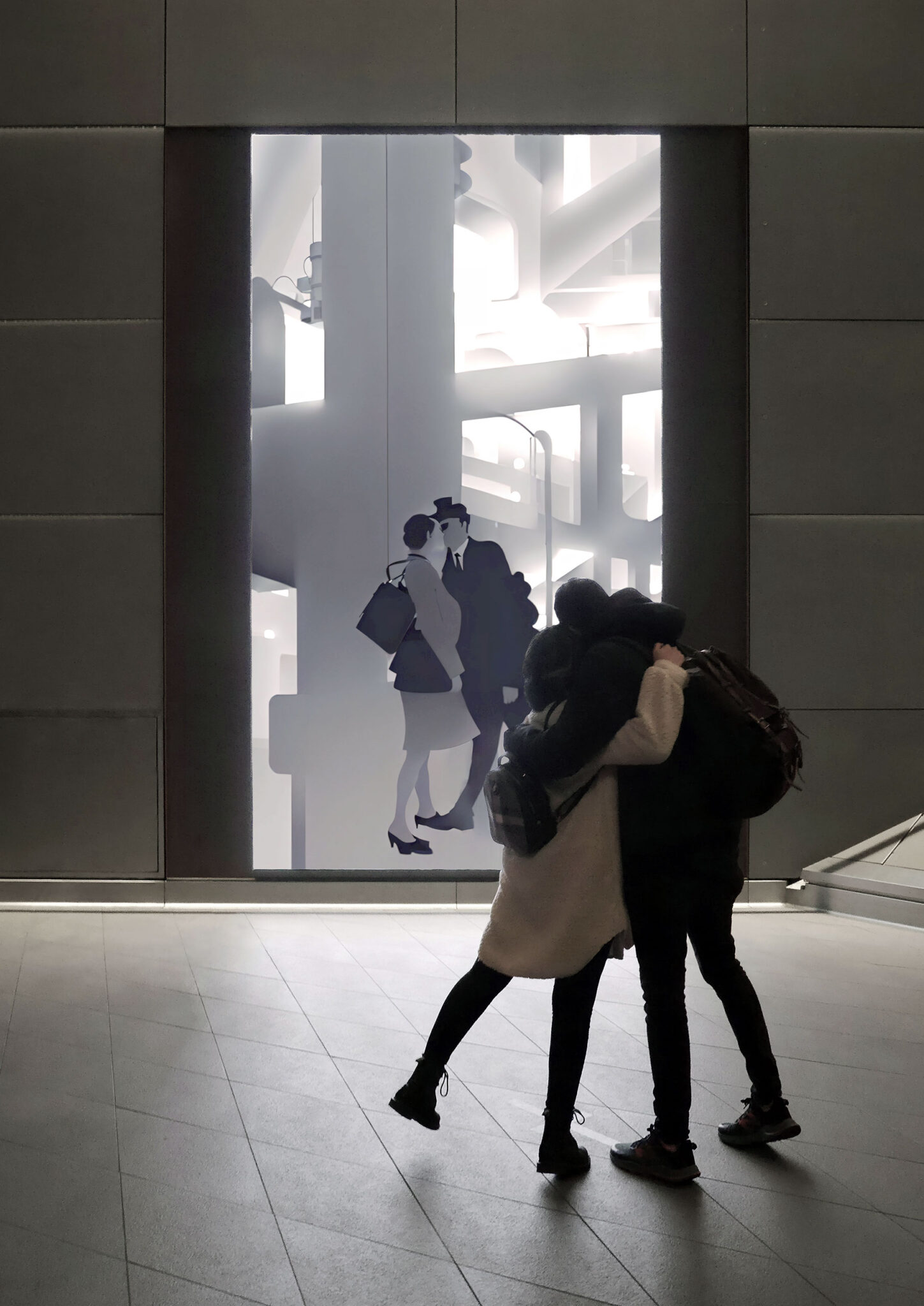
In “DATA”, SpY offers a reflection on the rapid and widespread inclusion of algorithms in numerous aspects of our lives. In this audio-visual work, digital abstraction is used to explore and interpret how predictive tools operated through algorithms and artificial intelligence are highly beneficial in terms of aspects such as communication, research and medicine, but can also lead us to lose some of our freedoms if they are not used ethically.
Through this immersive audio-visual format, SpY explores new tools such as the holographic fabrics used to give the graphics an amazing sense of weightlessness. A 15-metre high screen made from this fabric was installed in one of Madrid’s smallest streets between the walls of the buildings.

Frederik de Wilde

Ai Beetles
THIS NEXT NATURE POST-CAMOUFLAGE AI BEETLE IS INVISIBLE FOR THE ELECTRONIC EYE. THE PATTERNS ARE GENERATED WITH NEURAL NETWORKS AND EVOLUTIONARY ALGORITHMS TO FOOL AND MISLEAD ARTIFICIAL INTELLIGENCE ENABLED SYSTEMS. MY AIM IS TO DEVELOP A CONTEMPORARY RAZZLE DAZZLE STYLE CAPABLE OF MESSING UP LABELLING AND METADATA SYSTEMS. IT LOOKS LIKE A BEETLE FOR US BUT IS SEEN AS E.G. A HONEYCOMB FOR AN AI.
video

胡帅

Synesthesia Machine
“Synesthesia Machine” is an artificial intelligence with synesthesia, it will emitting corresponding unique scents while perceiving human facial expressions. Through the facial expression recognition algorithm, it can analyze the facial expressions of the audience and output the values ​​of different emotions. At the same time, based on these emotional values, the installation is driven to extract different proportions of scent liquid and atomized and mixed to convert the audience’s facial expression into a unique smell.

Refik Anadol

Quantum Memories: Nature Studies
Technological and digital advancements of the past century could as well be defined by the humanity’s eagerness to make machines go to places that humans could not go, including the spaces inside our minds and the non-spaces of our un- or sub-conscious acts. These unique pieces of the “Quantum Memories” series exhibit arresting visuals and colors that speculate the probability of reaching invisible spaces. They are composed in collaboration with a generative algorithm enabled by artificial intelligence (AI) and quantum computing, a new form of computing that exploits the unusual physics of the subatomic world. It turns the visual data that flows around us into an artwork that represents our collective and digitized memories of nature and encourages the viewer to imagine the potential of this computing technology for the future of art, design, and architecture.

fabrica

recognition
RECOGNITION

Recognition, winner of IK Prize 2016 for digital innovation, is an artificial intelligence program that compares up-to-the-minute photojournalism with British art from the Tate collection. Over three months from 2 September to 27 November, Recognition will create an ever-expanding virtual gallery: a time capsule of the world represented in diverse types of images, past and present.A display at Tate Britain accompanies the online project offering visitors the chance to interrupt the machine’s selection process. The results of this experiment – to see if an artificial intelligence can learn from the many personal responses humans have when looking at images – will be presented on this site at the end of the project.Recognition is a project by Fabrica for Tate; in partnership with Microsoft, content provider Reuters, artificial intelligence algorithm by Jolibrain.

Chris Cheung

No Longer Write – Mochiji
Powered by artificial intelligence’s Generative Adversarial Networks (GANs), the collected works from ancient Chinese Calligraphers, including Wang Xizhi, Dong Qichang, Rao Jie, Su Shi, Huang Tingjian, Wang Yangming, as input data for deep learning. Strokes, scripts and style of the masters are blended and visualized in “Mochiji”, a Chinese literature work paying tribute to Wang Xizhi. Wang is famous for his hard work in the pursuit of Chinese calligraphy. He kept practicing calligraphy near the pond and eventually turned the pond for brush washing into an ink pond (Mochi). The artwork provides a platform for participants to write and record their handwriting. After a participant finished writing the randomly assigned script from “Mochiji”, the input process is completed and the deep learning process will begin. The newly collected scripts will be displayed on the screen like floating ink on the pond, and slowly merge with other collected data to present a newly learnt script. The ink pond imitates process of machine learning, which observes, compares and filters inputs through layers of image and text, to form a modern edition of “Mochiji”.
.
不再写 – Mochiji
以人工智能的生成对抗网络(GANs)为动力,将王羲之、董其昌、饶捷、苏轼、黄廷健、王阳明等中国古代书法家的作品作为深度学习的输入数据。向王羲之致敬的中国文学作品《麻糬》,将大师的笔触、文字、风格融为一体,形象化。王先生以对中国书法的刻苦钻研而著称。他一直在池塘边练习书法,最终把洗笔池变成了墨池(麻糬)。艺术作品为参与者提供了一个书写和记录他们笔迹的平台。参与者完成“Mochiji”中随机分配的脚本后,输入过程完成,深度学习过程将开始。新收集到的脚本会像池塘上的浮墨一样显示在屏幕上,并与其他收集到的数据慢慢融合,呈现出新学到的脚本。墨池模仿机器学习的过程,通过图像和文本的层层观察、比较和过滤输入,形成现代版的“年糕”。


Jonathan O’Hear, Martin Rautenstrauch & Timothy O’Hear

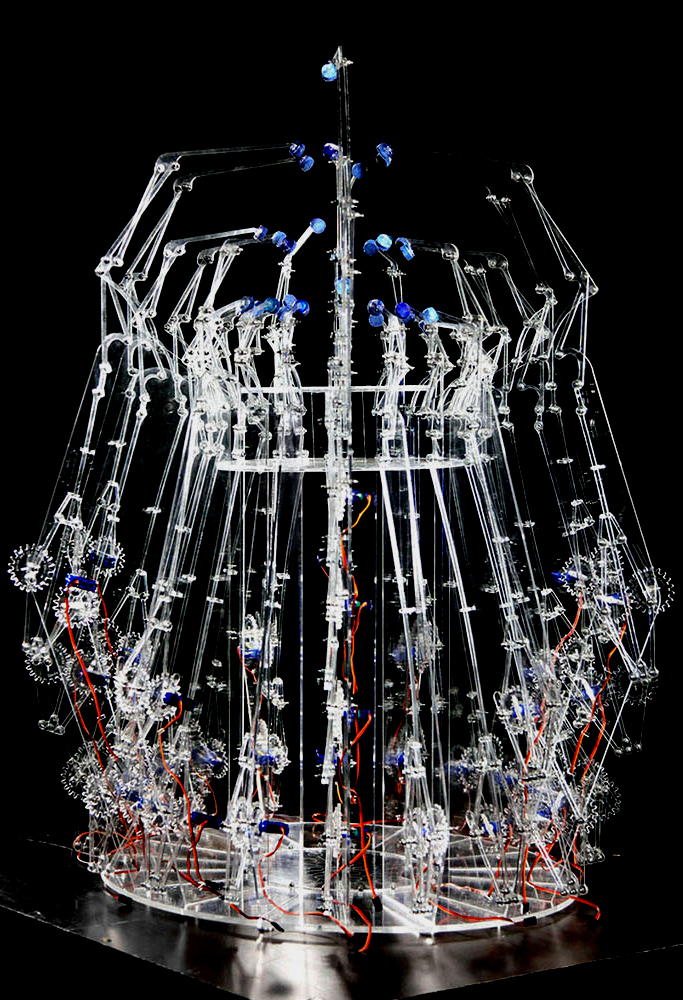
DAI – the Dancing Artificial Intelligence
DAI is an Artificial Intelligence artist. What this means is that it* thinks; it doesn’t follow a script or act randomly. In its first physical form, DAI is a performer and is inviting you to view its movement creation process. During the process DAI has been exploring its body and its environment, searching for ways to overcome some of the limitations that the physical world has imposed upon its virtual aspirations. This project is a reaction to the rapidly growing importance of artificial intelligence (AI) in our lives. Simple versions of AI are already everywhere, and today we are at a turning point where the first machines capable of learning through experience, like us, are making their appearance. This raises all kinds of ethical and moral issues and we want to be involved in this debate in our own way.

BREAKFAST

Empire State
Empire State is a kinetic A.I. artwork visualizing the current time-of-day and weather at the Empire State Building in New York. The imagery was created from running a sketch through an Artificial Intelligence model to generate two variations on the image, each printed on each side of the discs. The piece visualizes the current time-of-day and weather by animating clouds, rain, light/shadow, by rotating sections of discs to the reverse side. When one walks up to the piece, they will see their image reflected back at them, further embedding them to the connection between where they are and the current state in NYC.

Ai-Da

“Poem for an artificial intelligence”

the sun is a beautiful thing

in silence is drawn

between the trees

only the beginning of light

this realm of rain

grey sky and cloud

it’s quite and peaceful

safe allowed

And, arguably, worse:

I am a coal-truck

by a broken heart

I have no sound

the sound of my heart

I am not

Thomas Depas

Princess of Parallelograms
What will happen when our imagination itself is externalized in machines? Artificial intelligence constructs its own world-truth that is beyond our sensory perception. Generative Adversarial Networks (GANs) use algorithms to synthesize and generate images in a completely new way. These images have almost uncanny aesthetic characteristics, seeming to emerge from an ocean of data, a kind of pixel soup. Rather as if we were observing the emergence of artificial thought.” The machine learns to understand the “essence” of a thing, be it an animal, the face of a celebrity or a body of text. It is then able to generate new images of this thing, including faces of celebrities who do not exist, mutant animals, or new texts. Eventually, AI will be capable of instantaneously and dynamically emulating all representations. The era of the optical machine and the capture of reality will then be at an end, supplanted by the era of machines that generate their own reality.

Ouchhh

Poetic AI
Ouchhh created an Artificial Intelligence and the t-SNE visualization of the hundreds of books and articles [approx. 20 million lines of text] written by scientists who changed the destiny of the world -and wrote history- were fed to the Recurrent Neural Network during the training. This, later on, was used to generate novel text in the exhibition. 136 projectors shining to be a veritable oneiric experience, the ‘POETIC – AI’ digital installation uses Artificial Intelligence in the visual creation process: the forms, light, and movement are generated by an algorithm that creates a unique and contemplative digital work, an AI dancing in the dark, trying to show us connections we could never see otherwise.

Refik Anadol

Quantum memories
Quantum Memories is Refik Anadol Studio’s epic scale investigation of the intersection between Google AI Quantum Supremacy experiments, machine learning, and aesthetics of probability. Technological and digital advancements of the past century could as well be defined by the humanity’s eagerness to make machines go to places that humans could not go, including the spaces inside our minds and the non-spaces of our un- or sub-conscious acts. Quantum Memories utilizes the most cutting-edge, Google AI’s publicly available quantum computation research data and algorithms to explore the possibility of a parallel world by processing approximately 200 million nature and landscape images through artificial intelligence. These algorithms allow us to speculate alternative modalities inside the most sophisticated computer available, and create new quantum noise-generated datasets as building blocks of these modalities. The 3D visual piece is accompanied by an audio experience that is also based on quantum noise–generated data, offering an immersive experience that further challenges the notion of mutual exclusivity. The project is both inspired by and a speculation of the Many-Worlds Interpretation in quantum physics – a theory that holds that there are many parallel worlds that exist at the same space and time as our own.