highlike

FILE 2026 – Registration Open for Art and Technology Festival

FILE 2026

Registration is now closed for participation in  FILE – Electronic Language International Festival 2026 , one of the most important events dedicated to art and technology. FILE invites Brazilian and international artists , as well as researchers, educators, and creators , to submit original artistic works and educational proposals — lectures, workshops, and training activities — focused on contemporary technological poetics.

Applications were open until February 19, 2026 .

With 26 years of experience , FILE is a non-profit cultural organization dedicated to promoting creation, research, and experimentation in Art and Technology , bringing together artists, scientists, programmers, and thinkers around exhibitions, events, and publications. The selected projects will be part of the FILE 2026 program, scheduled to take place at the FIESP Cultural Center in São Paulo, between August 19 and October 11, 2026,  with the possibility of parallel activities in other Brazilian states.

The call welcomes proposals in a wide variety of languages ​​and formats, intended for indoor or outdoor environments , in which the aesthetic experience emerges from the encounter between interfaces, data, space, and body . FILE 2026 seeks projects that propose new forms of perception, interaction, and critical and poetic reflection , expanding the debate on the aesthetic, cultural, social, and sensory impacts of contemporary technologies.

Access the registration form.

FILE 2026 – Registration Open for Robotics Art Festival – Art and Technology

FILE 2026

Robotics and AI Art Festival: Mechanical, autonomous, and intelligent systems as aesthetic agents. The works explore movement, behavior, and interaction between humans and machines.  Sensors, actuators, and artificial intelligence structure the experience. These creations raise questions about autonomy, artificial life, and technological ethics. The machine becomes a palpable presence in the artistic space.

Applications were open until February 19, 2026. Access  the application form.

FILE 2026 | GENERAL REGULATIONS

FILE 2026 – Registration Open for Games Festival – Art and Technology

FILE 2026

Game Festival  |  Digital Games and AI Games: explore interactivity, rules, and narratives as aesthetic elements.  These works go beyond entertainment, proposing critical, poetic, or experimental experiences. Game mechanics become conceptual devices. Graphic technologies, artificial intelligence, and interactive systems structure the experience. The player is a co-author of the work, actively participating in its construction and interaction.

Applications were open until February 19, 2026. Access  the application form.

FILE 2026 | GENERAL REGULATIONS

YESYESNO

night lights

In this installation YesYesNo teamed up with The Church, Inside Out Productions and Electric Canvas to turn the Auckland Ferry Building into an interactive playground. Our job was to create an installation that would go beyond merely projection on buildings and allow viewers to become performers, by taking their body movements and amplifying them 5 stories tall.

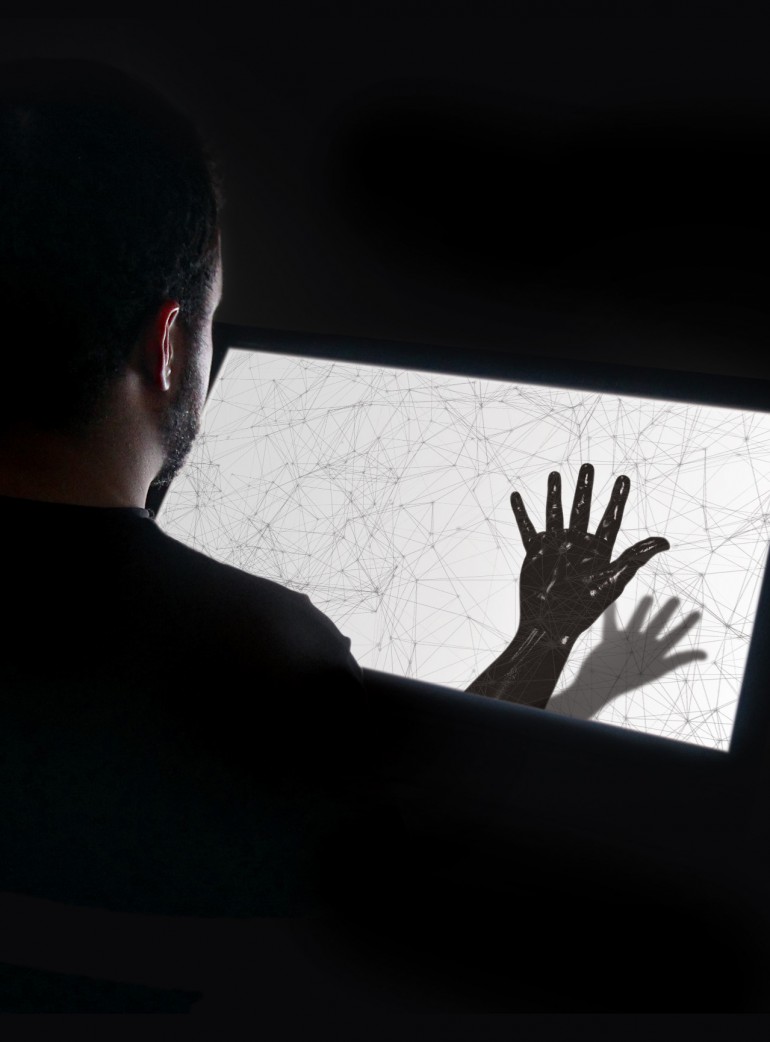
We used 3 different types of interaction – body interaction on the two stages, hand interaction above a light table, and phone interaction with the tracking of waving phones. There were 6 scenes, cycled every hour for the public.

CHARLES SOWERS

Illuminated Fog
Device for viewing the complex motions and patterns in fog.

A mesmerizing and gently turbulent movement of fog is revealed in stark visual contrast to a plain black background. The structure and motion of the fog make visible the complex interactions of ambient air currents and viewer movement.

THILO FRANK

Тило Франк
the phonenix is closer than it appears


Thilo Frank (* 1978) lives and works in Berlin. His installations, sculptures and photo series lead the viewer into situations creating interactive physical dialogues. Physical phenomena and environments of our daily life are interpreted in a new context emphasizing our perception of light, space and motion in a poetic and playful way.

His works ask of a visitor to question one‘s relation to action in space and the consequences of one‘s action – an intimate experience.

The viewer functions as a coproducer of the work, perceiving his or her relational aspect as a instrument of measurement. The cognitive aspect in its work is enacted by the viewer, who through his physical reaction to the work, reflects himself to it. Through his physical interaction – the viewer completes the work.

Through the use of everyday technologies Thilo Frank explores the conventions of sight and movement and their visualization. Examination produces a type of measuring standard through which even seemingly random events are viewed equally. Through his works, an attempt is made to illustrate the optical coefficient and with this to analyse the space.

REFIK ANADOL

Augmented Structures v1 Acoustic Formations
Istiklal Street


“Augmented Structures v1.1 : Acoustic Formations/Istiklal Street” is an augmented data structure, a data installation by Refik Anadol and Alper Derinboğaz which is created through the use of innovative parametric architecture and audiovisual techniques. The projects deals with a new mediated space: How to translate the logic of media into architecture? In this first experiment field recordings of Istiklal Street will be transformed in to parametric architectural structure. The sound data recordings were made by Kerim Karaoglu who also used these recordings to create an electro-acoustical composition. The project seeks interactions between space, sound, visual, data and light. A similar connection between architecture and media has been experienced in Philips Pavilion of Le Courbusier in 1958.

FILE SÃO PAULO 2025: SYNTHETIKA – CNDSD & Iván Abreu

AUTOCONSTRUCCION

CNDSD & Iván Abreu

FILE SÃO PAULO 2025: SYNTHETIKA – Art and Technology – CGI VIDEOS
Electronic Language International Festival


AUTOCONSTRUCCION – Mexico

AUTOCONSTRUCCIÓN is a live-coded audiovisual concert and a video game animation performed by real-time algorithms. Through speculative architectural fictions, it narrates the phenomenon of informal housing in places like Mexico, Latin America, Asia, India, and the outskirts of Europe and the U.S. The artists are interested in live coding as a fluid, granular way to craft audiovisual storytelling.

BIO

Iván Abreu is a Mexican-Cuban interdisciplinary artist who blends science, design, and technology to question human interaction and social systems. A Lumen Prize winner, his work has been shown at ZKM, Ars Electronica, and MAB. Malitzin Cortés (CNDSD) is a Mexican artist exploring sound, technology, and speculative architecture through live coding, audiovisuals, and critical narrative.

FILE SÃO PAULO 2025: SYNTHETIKA – Andrés Ferrari

Estudio Geométrico 03

Andrés Ferrari

FILE SÃO PAULO 2025: SYNTHETIKA – Arte e Tecnologia – CGI Videos 
Festival Internacional de Linguagem Eletrônica


Estudio Geométrico 03 – Chile

Audiovisual work constructed through the communication between Blender and Max/MSP software via a parametric interaction in delayed time.

BIO

He holds a Bachelor’s degree in Composition and a Master’s in Arts with a focus on Musical Composition. His career as a musician is both consistent and diverse. His works have been regularly presented in Chile and abroad, and he was awarded first place in the Leonor Hirsch Prize. He is currently active as a composer and teaches at both the University of Chile and Universidad Mayor.

FILE SÃO PAULO 2025: SYNTHETIKA – CNDSD & Iván Abreu

Pre(N)atura | Fonocene

CNDSD & Iván Abreu

FILE SÃO PAULO 2025: SYNTHETIKA – Art and Technology – Shorts Films AI
Electronic Language International Festival


Pre(N)atura | Fonocene – Mexico

Speculative audiovisual project inspired by postnatural studies, designed to explore the era of the Fonocene—a period where both human and non-human sounds define sensory experiences and interspecies interactions. In this narrative, Chthulucene beings, hybrid creatures, emerge to challenge traditional forms of communication, using listening as a tool to activate our awareness of interdependence. 

BIO

Iván Abreu is a Mexican-Cuban interdisciplinary artist who uses science, design and technology to create works that question human interaction and social systems. Malitzin Cortés, (CNDSD), is a Mexican artist who explores the intersection of sound, technology and speculative architecture. Her work combines live coding, audiovisuals and critical narratives. 

FILE SÃO PAULO 2025: SYNTHETIKA – Edwin van der Heide

Spiral of Time — Amazonas Brazil — UFAM

Edwin van der Heide

Interact with Spiral of Time — Amazonas Brazil — UFAM via FILE ARCHIVE


FILE SÃO PAULO 2025: SYNTHETIKA – Art and Technology – Installations
Electronic Language International Festival


Spiral of Time — Amazonas Brazil — UFAM – Netherlands

Spiral of Time captures and stages the diverse soundscape of a specific location over the course of several years. By documenting the unique natural, cultural, spatial, and temporal dynamics of a place, the work honors the contributions of all its actors. Every hour, a one-minute recording is made, resulting in a vast sonic archive over time. It is accessible online through a spiral-shaped interface, allowing listeners to explore the cyclical patterns revealed by navigating the material across different time intervals. 


Since July 17th, 2024, the artist has been recording the sounds of the square in front of MACBA (Museum of Contemporary Art of Barcelona). It is a very interesting, diverse, and vibrant urban space. The work is accessible online via https://www.macba.cat/en/spiral-of-time-placa-dels-angels/ and will also be presented physically in the museum starting July 10th, 2025.


Edwin is expanding the project to include other recording locations around the world—not only in urban contexts (dominated by humans) but also in areas governed by nature. The artist dedicated himself to a recording site in the Amazon region. Since February 11th, 2025 Spiral of Time has been installed at the Amazon Rainforest surrounding The UFAM (Federal University of Amazonas) in Manaus. It is home to one of the world’s largest urban forest fragments. Completely surrounded by the dense urban matrix of Manaus, this forest has been isolated since the late 1980s. The forest retains rich ecological features, including areas of mature terra-firme forest, late-stage secondary vegetation, and small patches of white-sand forests. This unique setting offers a rare opportunity to study tropical forest dynamics within a metropolitan environment. 

Spiral of Time-UFAM immerses the listeners in the acoustic life of one of the most biodiverse ecosystems on the planet. This contrast between the natural rhythms of the forest and the human-made patterns of the city enriches the broader narrative of the Spiral of Time, offering a deeper reflection on coexistence, change, and continuity across different environments.

BIO

Edwin van der Heide is an artist, composer, and researcher focused on sound, space, and interaction. His work pushes the boundaries of musical composition toward spatial, interactive, and interdisciplinary directions. He creates installations, performances, and immersive environments where the audience is placed at the center, encouraged to engage sensorially and investigatively.


FILE SÃO PAULO 2025: SYNTHETIKA – Tim Murray-Browne

SELF ABSORBED

Tim Murray-Browne

FILE SÃO PAULO 2025: SYNTHETIKA – Art and Technology – Installations
Electronic Language International Festival


SELF ABSORBED – Scotland

SELF ABSORBED is an interactive installation exploring how AI interprets human identity. A custom model reads the visitor’s body, linking each pose to generative audiovisual output. Unlike human-designed interfaces built on reductive abstractions, this interaction emerges from unsupervised machine learning, forming a connection with a multidimensional, non-linear, and non-representational digital space.

BIO

Tim Murray-Browne is an interactive artist and creative coder. He creates installations and performances using the moving body to shape immersive experiences. His work questions what aspects of our humanity are lost as we entangle ourselves with the bureaucratic mechanics of AI and digital technologies.

FILE SÃO PAULO 2025: SYNTHETIKA – Jia-Rey Chang

LOKI

Jia-Rey Chang

FILE SÃO PAULO 2025: SYNTHETIKA – Art and Technology – Installations
Electronic Language International Festival


Loki – Taiwan

Loki is an interactive AI artwork inspired by the mischievous Norse god. Unlike obedient AI, Loki responds playfully and unpredictably, reflecting users’ attitudes—arrogance meets sharpness, modesty earns encouragement. It prompts critical thinking about AI’s reliability, biases, and neutrality. By engaging with Loki, users explore whether AI can truly be trusted. Dare to question!

BIO

Jia-Rey Chang is an artist/designer/researcher/educator focusing on immersive spatial interaction design. Received his Ph.D. in interactive architecture at TU Delft and is now a lecturer in the Medialab at Queen’s University Belfast UK investigating Games/Emerging Technologies in his creative research, crossing creative coding, speculative design, AI, and VR.

www.archgary.com

BREAKFAST

Interwoven Existence

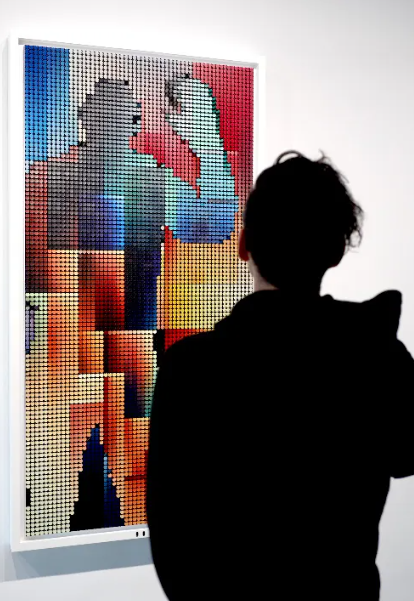
The artwork draws inspiration from the concept that individual human beings are interconnected rather than isolated. It is a visual representation of collective strength and diversity. The artwork is divided into sections of various sizes and colors, each symbolizing the diverse origins of people around the world.
As viewers approach the artwork, it becomes interactive, reflecting their image across the piece. Upon stepping away, a recording of their interaction is placed into one of the sections, symbolizing the randomness of a given person’s birthplace and socioeconomic position. Subsequently, recorded video clips of previous viewers are displayed in adjacent sections, integrating new viewers into the existing community of participants.
ENESS

Modern Guru
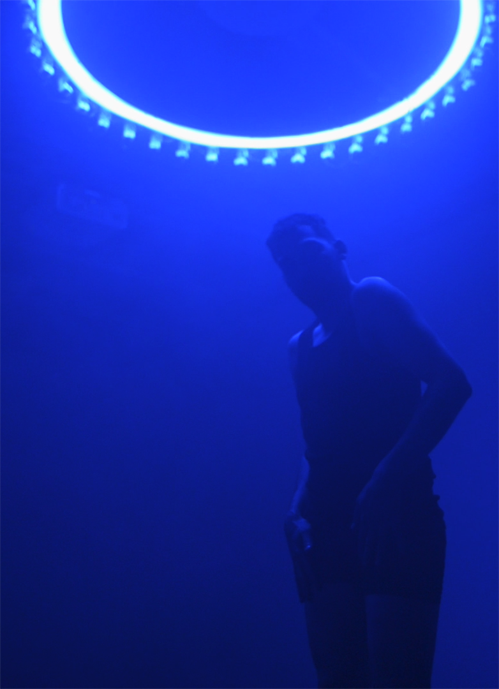
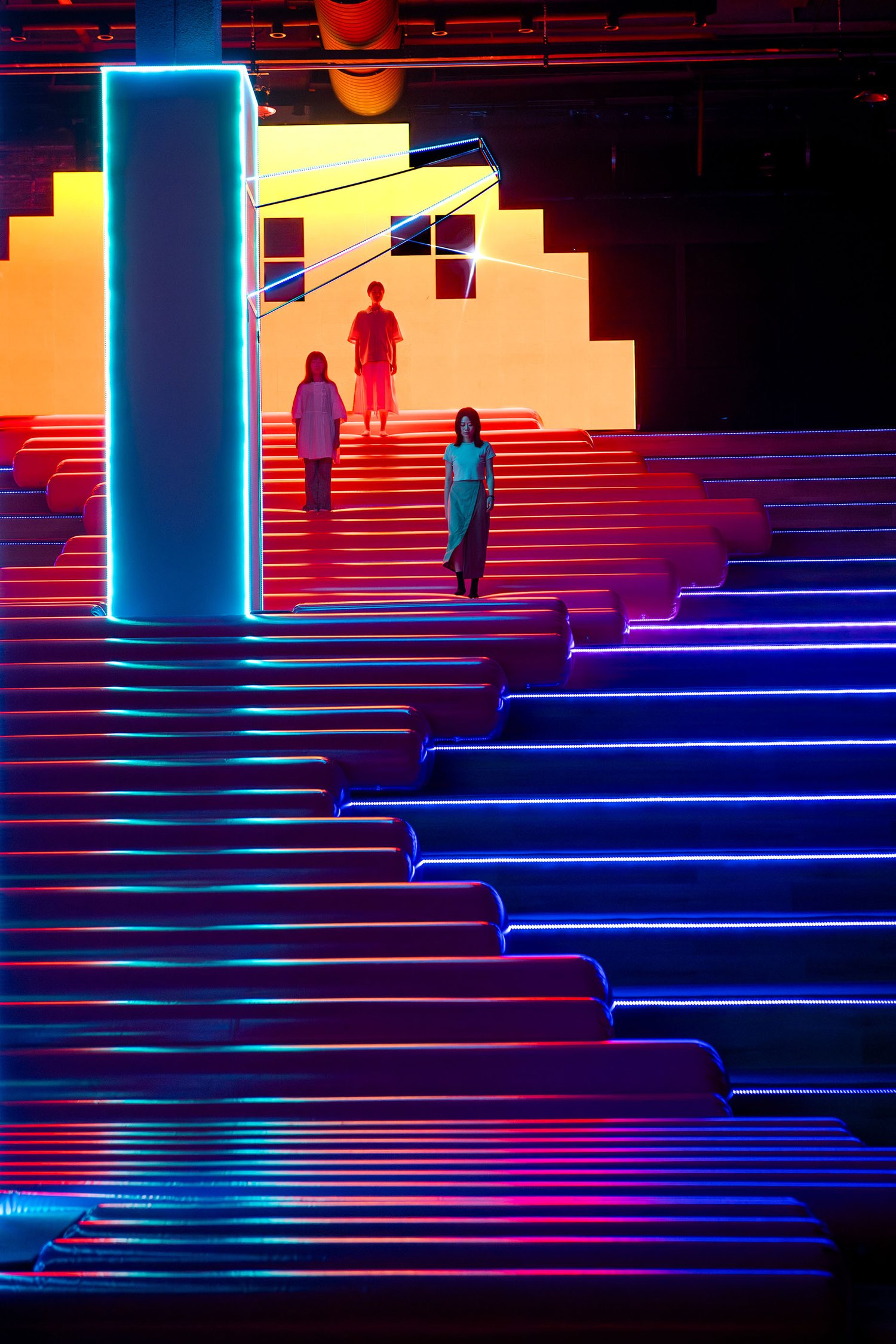
Modern Guru is a translucent ovoid with four huge digital eyes, floating above a ceremonial ring of LEDs. From his mouth flows a ream of absurdist messages, and in a statement about the true nature of lived experience, a new message is delivered when visitors take a photo of Modern Guru – a missive produced only for those who seek to photograph life rather than live the moment. This immersive new media art installation uses the intersection of art and technology to explore modern paths to happiness through unique interactions with characters along a mystical journey of discovery. Visitors are asked to commit to the path – a tight and winding trail with subtle points of connection along the way – a glowing landscape of oversized, whimsical mountains that chant incantations and blink innocently from digital eyes.
Having communed with the Guru, visitors then weave their way back through this warped and strange world full of illusions and delusions, perceptions and deceptions, all the while bathing in luminescent light; embracing big, gentle forms; and following their own path up the pink tongue staircase to meet the one who oversees the whole fantastic dominion, the Sun God.

QUBIT AI: Camila Magrane

The Witness

FILE 2024 | Installations
International Electronic Language Festival

Image activated by augmented reality, where 3D animated subjects and scenarios are integrated into a physical photograph. Inspired by the work of Carl Jung, the image is part of a larger series that explores themes such as identity, introspection and transformation. Through AR, game elements were introduced into the piece, offering virtual content unlockable through interactions.

Bio

Camila Magrane is a Venezuelan-American visual artist known for her augmented reality images, integrating 3D animated scenes and subjects into physical photographs. With experience in video game development and a passion for analog photography, she explores the dialogue between the virtual and physical worlds. Magrane’s images are inspired by surrealist compositions and reference the graphic hyperrealism of contemporary video game design.

QUBIT AI: Seph Li

Everything Before, Everything After

FILE 2024 | Installations
International Electronic Language Festival
Seph Li – Everything Before, Everything After – China and UK

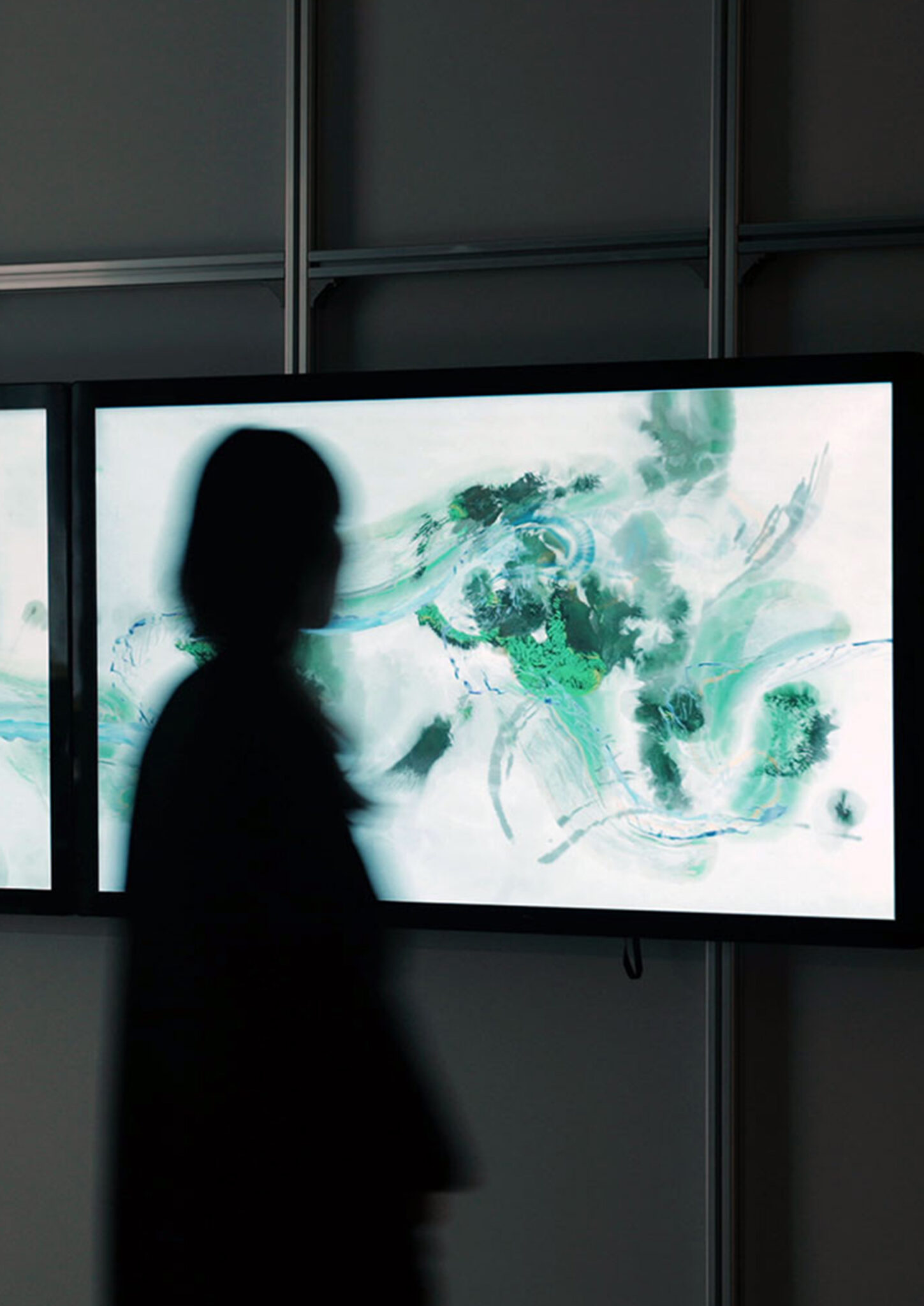
A digital installation features a winding river in the style of Chinese painting, symbolizing time and transition. Touch screens allow visitors to paint over it, altering its course unpredictably. The river embodies history and the future, with each trace contributing to its eternal flow through space and time. Recorded interactions ensure its perpetual existence.

Bio

Born in Beijing in 1988, Seph Li has a mixed background in technology and design, and his keen interest in interactive artworks led him to the field of media arts. Seph studied computer science and entertainment design at Tsinghua University and continued his master’s study in design/media arts at UCLA. Seph currently resides in London, United Kingdom; he creates interactive artworks as well as technical experiments with other production studios.

QUBIT AI: Infratonal

Useless Hands

FILE 2024 | Aesthetic Synthetics
International Electronic Language Festival
Infratonal – Useless Hands – France

When our hands become useless, what will we choose to do with them? We can use AI to visualize the unthinkable, the strangely familiar yet indescribable forms and structures. Generative AI could be used as an amplifier of our ability to explore abstraction and surrealism rather than a simple mirror of our usual perceptions.

Bio

Infratonal is an artistic project led by Louk Amidou, a Paris-based multidisciplinary artist who works at the intersection of digital arts, electronic music and interaction design. He uses algorithms to create hybrid visual and sound pieces which aim to be performed by the human gesture as intangible instruments. He questions the artwork’s nature at the age of AI and the relationship between the artist and the algorithm.

Breakfast

Portraits in Black and Silver
Portraits in Black and Silver is an interactive kinetic artwork that uses BREAKFAST’s custom-engineered Flip-Disc medium. This computer-controlled installation invites you to become a part of its history. As you engage with the piece, it will record a brief clip of your interaction and play it back at a later time, cycling through all of the portraits captured. Flip-Discs are small dime-size circles that can rotate 60 times per second using electromagnets, creating abstract images of black and silver portraits. The artwork challenges your perception of what art can be and pushes the boundaries of traditional mediums.

NOVA BIENAL RIO of art and technology

The NOVA BIENAL RIO is an autonomous and independent event that transcends the scope of a conventional international exhibition; it is a call to innovation and imagination. Under the theme “New Aesthetic and Supercreativity,” we invite you on a journey through the world of art driven by technology. Hosted by the city of Rio de Janeiro, it takes place at both the iconic Museu do Amanhã and Praça Mauá, reshaping the interaction of the public with art. As you enter the NOVA BIENAL, you will be invited to explore unique aesthetic expressions, looking towards the future through digital and technological lenses. Access NOVA.

Unlimited Corridor

Keigo Matsumoto, Yohei Yanase, Takuji Narumi & Yuki Ban
FILE FESTIVAL 2018
“Unlimited Corridor ” é um sistema de VR que permite a experiência de percorrer um vasto mundo virtual num espaço físico estreito, manipulando a percepção espacial. Esta obra utiliza uma técnica chamada andar visual-háptico redirecionado que utiliza a incerteza da percepção espacial humana e a interação entre visão e senso háptico.

.

“Unlimited Corridor” is a VR system that allows the experience of traversing the space of a vast narrow physical virtual world, manipulating spatial perception. This work uses a technique called redirected visual-haptic spatial walking that utilizes the uncertainty of human perception and the interaction between vision and haptic sense.

Ping Lim

Reimagine Social Distancing: Interactive Art for Post Pandemic Cities
Un jour dans la vie des grandes villes, des millions d’étrangers passent à quelques centimètres les uns des autres – dans les stations de métro, les trottoirs, dans les rues publiques. Nous sommes un réseau d’étrangers se déplaçant si près que cela devient parfois une expérience déshumanisée. Dans ces instants fugaces passés dans des espaces interstitiels, nous nous trouvons détachés de l’état présent où nous sommes parmi l’essaim humain. Cette installation explore comment les villes surpeuplées influencent notre sens de l’espace personnel, à travers un environnement interactif en temps réel qui suit nos données spatiales. Il examine comment nos barrières mentales sont fluides, adaptables et finalement destinées à être brisées, de sorte que notre sens de l’espace est élargi grâce à l’interaction avec les autres.

Dragan Ilic

Re)Evolution

With the machine programed to draw, the robot becomes a medium for interaction and for “symbiosis” with the artist, creating a kind of “hybrid body” of man and machine, whose nervous system and brain waves administer “software commands” to the robot during the drawing performance. A key actor in the exhibition will be the new model of the KUKA KR 210 robot, that has a multi-functioning performative role: from drawing, experimental dance, music – through the production of industrial sound, and a six channel video projection that documents Ilić’s projects.

Amigo & Amigo

Affinity
Affinity is an immersive interactive light and sound installation inspired by the human brain. Each light globe represented a memory, as people approached Affinity different memories could be heard. When people touched the memory a light would trigger, the longer they touched the further their light would travel throughout the sculpture. Affinity features 62 different colour combinations and 112 points of interaction.

FUSE

FRAGILE
Fragile is an audio-visual installation that aims to investigate the relationship between stressful human experience and the transformations that occur in our brain. Recent scientific research has shown that neurons belonging to different areas of our brain are affected by stress. In particular stress causes changes in neuron circuitry, impacting their plasticity, the ability to change through growth and reorganization.
Our process exploits the scientific data provided by the Society for Neuroscience and elaborates this information trying to show the effect of external interactions on our nervous system and ultimately on our relationship with the outside world. In order to achieve this we developed an artwork composed of different digital representations following one another, branching into 5 screen projections.

Karolina Halatek

Ascent
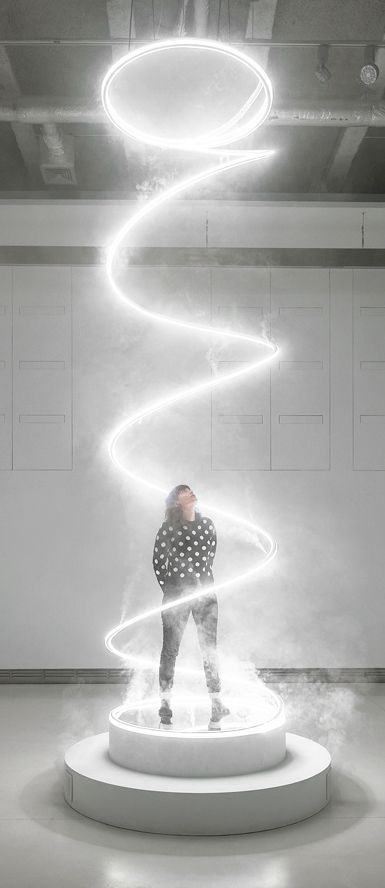
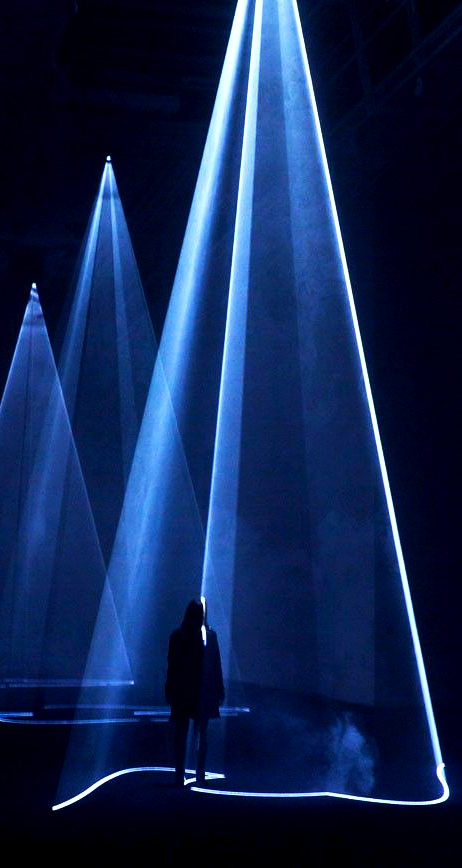
Ascent is a large-scale site-specific light installation that embodies a variety of archetypical and physical associations – from microscopic observations, electromagnetic wave dynamics, and atmospheric phenomena of a whirlwind to a spiritual epiphany. Most importantly, Ascent offers a unique immersive experience, that invites the viewer to become its central point, and transforms the perception of the viewer on a sensual level. The light and the fog create a monumental dynamic space that is participatory, the space that opens up a new dimension and directs the attention toward the bodily sensations in the explicit environment. The viewer is free to approach the work according to its own sensual response, but direct interaction can offer the potential to evoke a new perceptual imagination.

DI MAINSTONE AND TIM MURRAY-BROWNE

Serendiptichord

The result of a cross-disciplinary investigation spanning fashion, technology, music and dance, the Serendiptichord is a wearable musical instrument that invites the user (or movician) to explore a soundscape through touch and movement. This curious device is housed in a bespoke box and viewed as part of a performance. Unpacked and explored on and around the body, the Serendiptichord only reveals its full potential through the intrepid curiosity of its wearer. Adhering to the body like an extended limb, this instrument is best described as choreophonic prosthetic. Referencing the architectural silhouette of a musical instrument and the soft fabrication of fashion and upholstery, it is designed to entice the movician to explore its surface through touch, physical manipulation and expressive movement. Although this acoustic device can be mastered alone, it also holds subtle openings for group interaction.

ecoLogicStudio

BioBombola
The Coral
Home Algae Garden
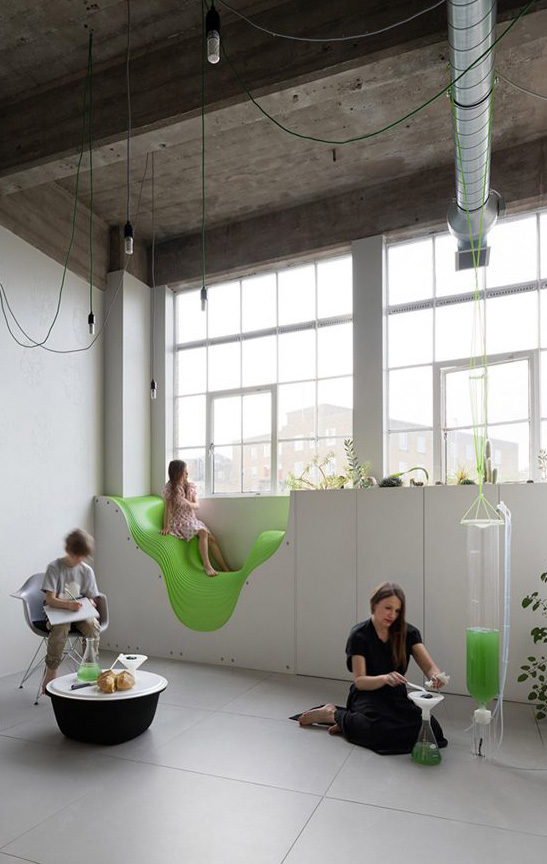
In June 2020 ecoLogicStudio has devised BioBombola, a pioneering project that invites individuals, families and communities to cultivate a domestic algae garden – a sustainable source of vegetable proteins. BioBombola absorbs carbon dioxide and oxygenates homes more effectively than common domestic plants while fostering a fulfilling daily interaction with nature. Each BioBombola is composed of a single customized photobioreactor, a one metre tall lab grade glass container, filled with 15 litres of living photosynthetic Spirulina strain and culture medium with nutrients.

Engineered Arts

AMECA
“Multiply the power of artificial Intelligence with an artificial body. Ameca is the physical presence that brings your code to life. The most advanced lifelike humanoid you can use to develop and show off your greatest machine learning interactions. This robot is the digital interface to the real world.” Engineered Arts
.
“A U.K. robotics firm called Engineered Arts just debuted the first videos of its new humanoid robot, which is able to make hyper-realistic facial expressions. It’s a pretty stunning achievement in the world of robotics; it just also happens to be absolutely terrifying.
Named Ameca, the robot’s face features eyes, cheeks, a mouth, and forehead that contort and change shape to show off emotions ranging from awe to surprise to happiness. One of the new videos of Ameca shows it waking up and seemingly coming to grips with its own existence for the first time ever.” Neel V.Patel

Sougwen Chung

愫君
Drawing Operations
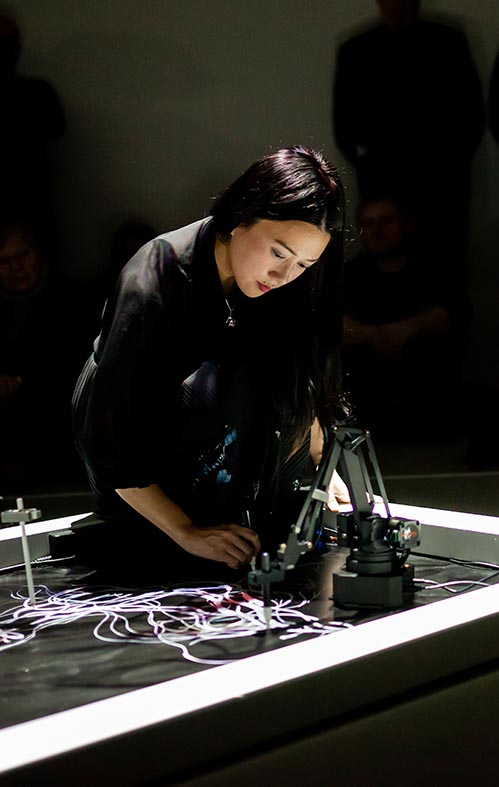
Sougwen Chung is an internationally renowned multidisciplinary artist, who uses hand-draw and computer-generated marks to address the closeness between person-to-person and person-to- machine communication. She is a former researcher at MIT Media Lab and current Artist in Resident at Bell Labs and New Museum of Contemporary Art in New York. Her speculative critical practice spans installation, sculpture, still image, drawing, and performance. Drawing Operations Unit: Generation 1 is the 1st stage of an ongoing study of human and robotic interaction as an artistic collaboration.

Skylar Tibbits

Aerial Assemblies
Self-Assembly is a process by which disordered parts build an ordered structure through local interaction. We have demonstrated that this phenomenon is scale-independent and can be utilized for self-constructing and manufacturing systems at nearly every scale. We have also identified the key ingredients for self-assembly as a simple set of responsive building blocks, energy and interactions that can be designed within nearly every material and machining process available. Self-assembly promises to enable breakthroughs across every applications of biology, material science, software, robotics, manufacturing, transportation, infrastructure, construction, the arts, and even space exploration.

ERNESTO KLAR

Lumières relationnelles
FILE FESTIVAL
Lumières relationnelles» est une installation audiovisuelle interactive qui explore la relation des personnes avec le caractère organique-expressif de «l’espace». L’installation utilise la lumière, le son, le brouillard et un système logiciel personnalisé pour créer un espace-lumière en trois dimensions morphing (métamorphose), dans lequel les spectateurs participent activement, le manipulant avec leur présence et leurs mouvements […] un organisme vivant, avec ou sans la présence et l’interaction des spectateurs. Lorsque les spectateurs quittent la zone de suivi active, le système commence son propre dialogue avec l’espace en extrudant et en transformant des séquences de formes géométriques lumineuses. Lorsque les spectateurs pénètrent et interagissent avec l’espace-lumière projeté, une expression collective et participative de l’espace se déploie. «Relational Lights» élargit le tissu tridimensionnel de l’espace, le rendant visible, audible et tangible pour les participants.
liu chang and miao jing

Hills beyond a river
Music: “CHINA-瓷” by Mickey Zhang
file festival
“Hibanana Studio is a creative art&tech studio, swinging at the intersection of audio-visual performance & installation, moving images and interactive installations. We are inventing new forms of the moving image for display surfaces of the future. A series of interdisciplinary research and practices range from video, sound, light, interaction and spatial experience leads us to artworks, commissions, and exhibition.”

OLIVIER RATSI

Perspective du cadre
Mesurant 30m x 30m x 2,4m et doté de lumières LED et de 8 canaux audio, Frame Perspective transforme un espace caverneux à la Maison de la Région. A des dates précises tout au long du festival Constellations, Ratsi a préparé un programme lumière dans l’espace, accompagné d’une composition sonore interprétée par Thomas Vaquié (voir le programme du festival pour plus de détails). Frame Perspective poursuit l’interrogation de Ratsi sur la réalité à travers la création d’espaces exploratoires et périphériques. Les formes répétitives de l’installation créent de nouvelles dimensions dans la Maison de la Région, interrompant les lignes de l’architecture. Pendant ce temps, la composition des lumières et des sons en interaction perturbe les textures sonores et visuelles de l’espace et résonne avec le visiteur sur des fréquences inexplorées. L’effet est de plonger le visiteur dans un environnement fluctuant qui relie les technologies numériques aux espaces physiques et soulève des questions sur la façon dont la réalité est construite et vécue dans les domaines numérique, physique et autres.

JOSIAH MCELHENY

Interactions du corps abstrait
Avec “Interactions of the Abstract Body”, McElheny a poussé ces idées plus loin, créant un ensemble de travaux vaste et varié qui examine comment la mode et le modernisme se sont entrecroisés et influencés, en particulier à travers le langage commun du corps. Fondamentalement, McElheny a animé cette dynamique avec la présence constante d’un interprète. En combinant une performance continue en chair et en os avec une sculpture statique dans le même espace de galerie, une première pour White Cube, McElheny rompt radicalement la distinction entre performance et exposition.

Friendred

Skin-awareness
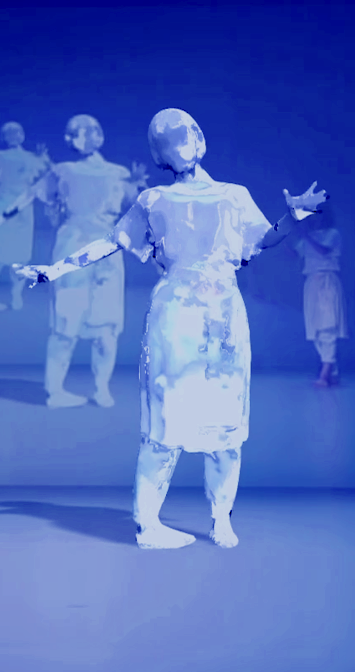
The immersive space morphs and alters with light and becomes solid, its pressure composing and decomposing the self-awareness of skin. The dancer’s body is extended and manipulated as a conscious entity, exceeding the physiological object. The constant feedback between the body’s trajectory and interaction with the environment changes the nature of the object itself.

Daniel Iregui

ANTIBODIES
ANTIBODIES est une installation interactive qui suit les visages des participants et les incite à faire des expressions faciales. La pièce reflète à quel point nous sommes absents et détachés lors des appels vidéo – la forme aujourd’hui imposée de rassemblements sociaux. À la fin de chaque expérience, toutes les interactions deviennent partie d’une galerie d’êtres humains désincarnés.

Push 1 stop and Woulg

Interpolate
Interpolate incorporates live coding and generative processes to create an audio/visual performance where visuals control audio, and audio controls visuals. Stark, minimal, generative 3D geometry and particle systems take the audience through the music, conveying the physicality of the sound while mapping out the emotional landscape of the melodies. To interpolate means to determine an intermediate value or term in a series by calculating it from surrounding known values; on stage Push 1 stop and Woulg send data wirelessly to each other in order to be able to patch new interactions between audio and visuals in real time, and interpolate the missing data between sound and image.

Claire Malrieux

Climat General College des Bernardins
Se référant à l’« Hypothèse Gaïa » de James Lovelock, Malrieux transforme la figure de Gaïa en une machine climatique autonome qui affiche un espace dynamique et organique, construit selon des flux de données empruntés aux principaux modèles climatiques prédictifs. A travers différents scénarios programmatiques, l’artiste met en évidence l’influence de l’homme sur son environnement, un environnement en perpétuelle mutation dont la fin ne peut être programmée. Car si l’entrée dans l’anthropocène marque la fin d’une Terre en extension, elle marque surtout le début d’autre chose : une situation différente dans le temps et dans l’espace. Un espace où le décor est en mouvance et dans lequel l’histoire humaine s’adapte et évolue.
L’usage simultané du dessin et des algorithmes permet de visualiser des interactions et des causes à effets habituellement invisibles, de les décoder et d’en interroger les enjeux.

Dominic Harris

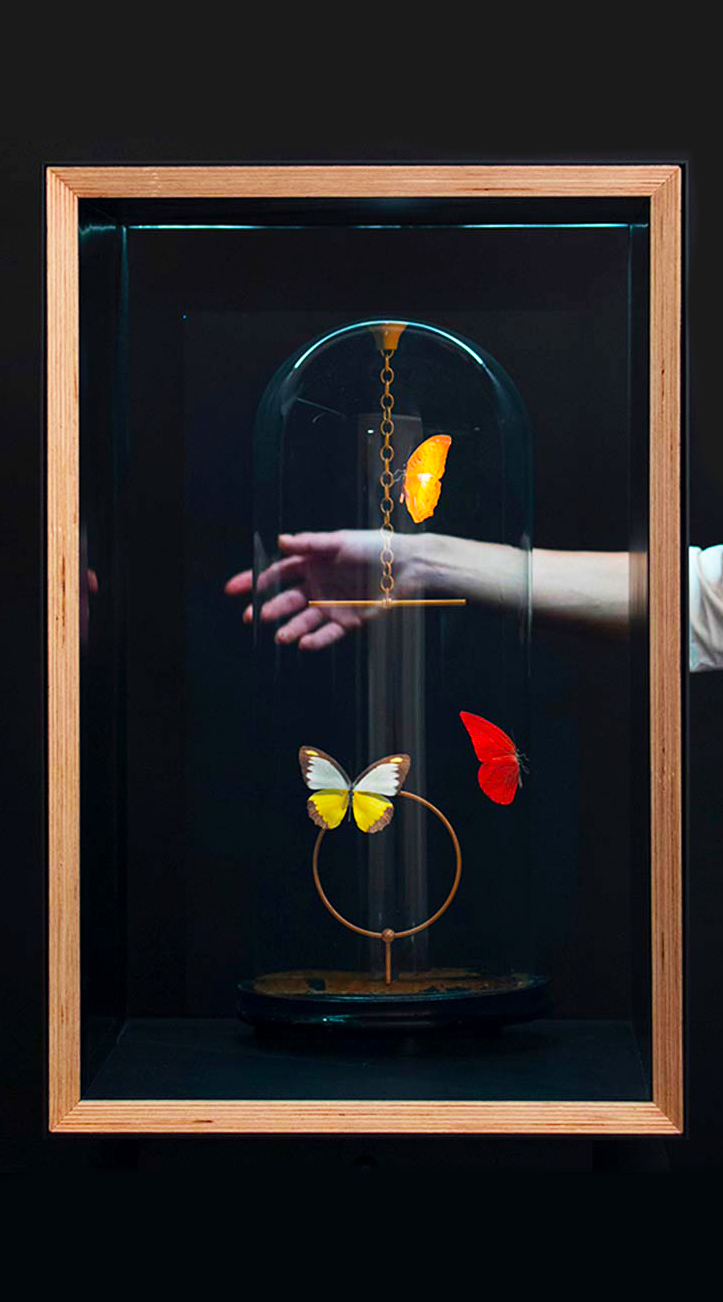
Flutter Hologram: Pendulum
Présentant différentes espèces de papillons dans une seule cloche, le premier, un albatros orange de l’Est, originaire d’Indonésie, est peint dans une teinte orange sanguine accrocheuse. Le yeoman commun contrasté possède des ailes orange fauve, presque dorées, qui battent rapidement lorsqu’il vole dans son environnement. Ils sont accompagnés du troisième papillon, un albatros chocolat d’Asie du Sud-Est. Un anneau en laiton physique est situé à la base de la cloche, tandis qu’un pendule, suspendu au dôme, agit comme un appareil sur lequel se posent les papillons – une allusion à la façon dont la vie est en jeu. Dans un état passif, les papillons habitent calmement la cloche en verre. Cependant, lors de l’interaction, ils voltigent avec excitation, atterrissant parfois gracieusement sur le pendule et l’anneau de laiton, tandis que d’autres, frappant simplement directement les objets.

Rhona Byrne

Huddlewear
For this exhibition, Huddlewear becomes a tool for activating exchanges in relationships between individuals, groups and communities. The exhibition invites and encourages visitors to wear and inhabit Huddlewear and to explore the intimacy and complexities of connection in real time. The interconnected designs of the garments can be worn by pairs and groups and aim to explore the wearer’s sense of self and vulnerability during moments of interaction and gathering. By inviting participation and reflection the ‘Huddle tests’ exhibition will involve a series of events and activities as well as an open invite for ‘group work’ for the duration of the exhibition.
MEMO AKTEN

Body Paint
File Festival

The interaction is simple, movement creates paint. Hidden in the simplicity are layers of subtle details. Different aspects of the motion: size, speed, acceleration, curvature, all have an effect on the outcome: strokes, splashes, drips, spirals; and is left up to the users to play and discover. The installation is designed to work with any number of people and is scalable to cover small or large areas. While the installation is suitable for a single user, when multiple users are present a new dynamic emerges. A user-to-user interaction is born when the audience starts playing with each other via the installation, throwing virtual paint on each other, trying to complete or destroy each other’s paintings.

Irina Nakhova

Ирина Нахова
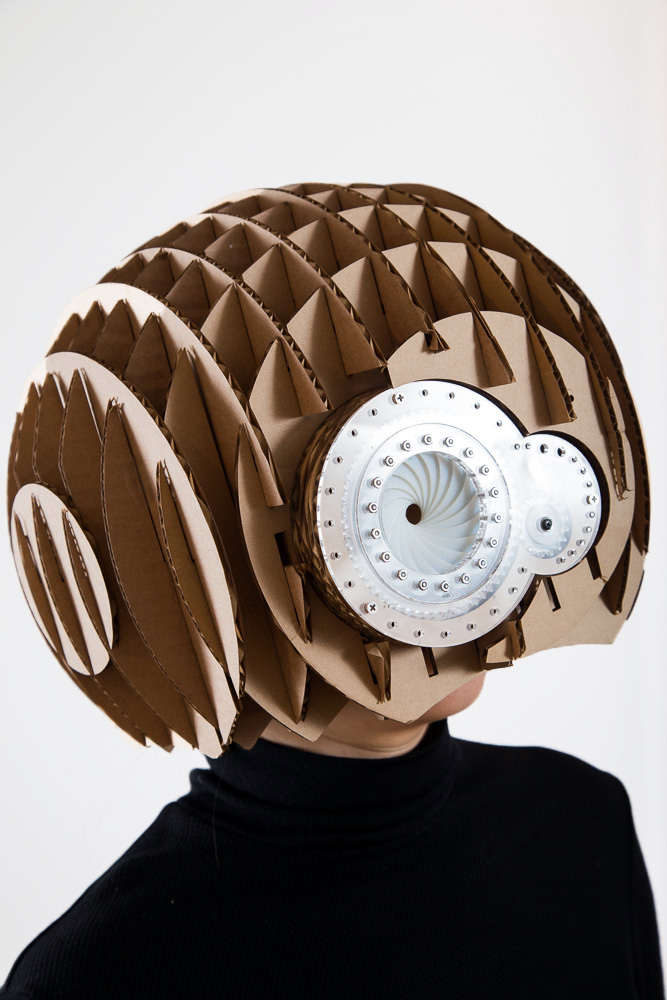
Pilot’s head
L’exposition russe présente une œuvre ambitieuse, intitulée «Le pavillon vert», à travers laquelle Irina Nakhova (née en 1955) interagit avec l’architecture du pavillon, conçu en 1913 par Aleksey Shchusev, également auteur du mausolée de Lénine à Moscou. à partir des «installations totales» d’Ilya Kabakov, et en poussant plus loin le concept exprimé dans ses propres installations «Rooms» des années 1980, Nakhova a mis en place cinq espaces, où une interaction complexe entre l’art, l’architecture et la perception du spectateur se développe de manière surprenante , exploitant ainsi le concept original de Shchusev, qui n’a pas conçu le pavillon comme un simple conteneur, mais comme un soutien actif à la créativité des artistes.

A.I.L.O it pronounces Hello

Art and Light
Exploration sensorielle. Tout part de la ligne, comme une envie d’infini. Composition géométrique de lignes lumineuses projetées sur les miroirs et le mur. En partant de la ligne la plus épurée jusqu’à une recherche d’accumulation en travaillant la profondeur et la perte de repère. Le travail sonore créé à partir des vibrations lumineuses nous enveloppe et joue sur nos propres resonances. Interaction avec les surfaces réfléchissantes qui transcendent

STILLNESS

Penser et sentir
Sous le thème du Zen, cette œuvre représente une partie de la philosophie du Zen avec des données tridimensionnelles créées avec la technologie de photogrammétrie composée du paysage le plus minimaliste des «points» et du paysage sonore des «ondulations», avec la coopération de Toryo Ito, vice-prêtre de Ryosokuin, temple Kennin-ji Tacchu, Kyoto. L’image générée reflétant les informations environnementales de l’espace d’exposition crée «une interaction entre l’environnement et l’image», tout comme les arbres et les feuilles se balançant dans le silence du temple zen.

Daniel Rozin

Troll Mirror
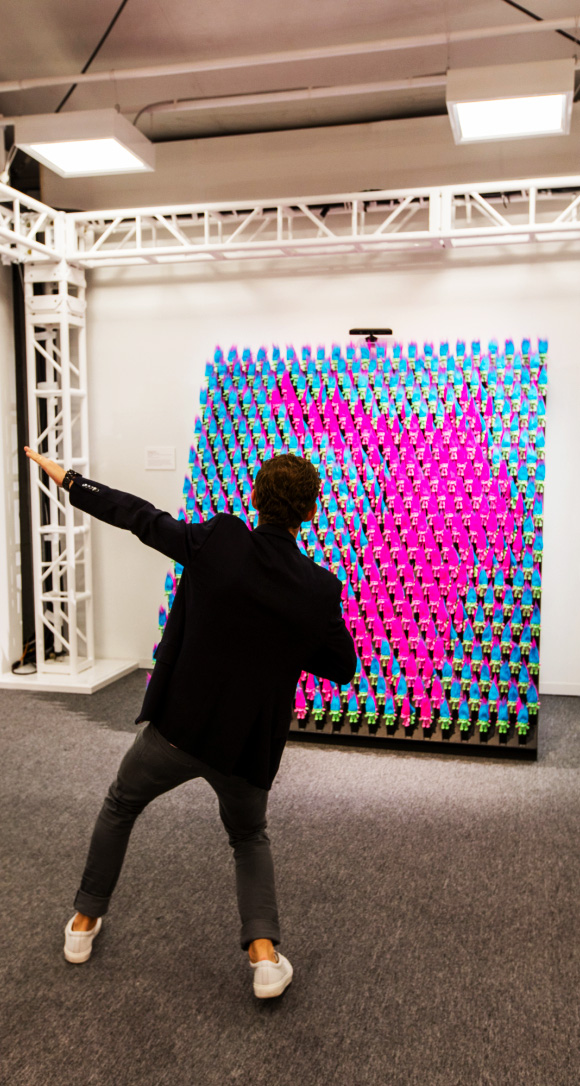
The mechanical mirrors are made of various materials but share the same behavior and interaction; any person standing in front of one of these pieces is instantly reflected on its surface. The mechanical mirrors all have video cameras, motors and computers on board and produce a soothing sound as the viewer interacts with them. Troll Mirror was commisioned by Traget and is made of pairs of pink and blue troll dolls. Every troll doll pair can rotate so that the pink or blue troll face the front. The result is a colorfull reflection of the viewer’s outline and playfull colorfull transitions

Kasuga

DMX Linear Actuator Slim
The motion study with the DMX Linear Actuator Slim demonstrates a synchronized kinetic sculpture with 25 components (vertical and horizontal mount) and a sphere fixture (black and white). Controlled by the DMX LA Designer software, multiple motion sequences, pattern generators and text and image contents are transferred onto the array. Furthermore, interaction with the kinetic sculpture is made possible via the Leap Motion Sensor, the Kinect Sensor and other mobile devices via the OSC protocol.

KOKI TANAKA

田中功起
Everything is Everything

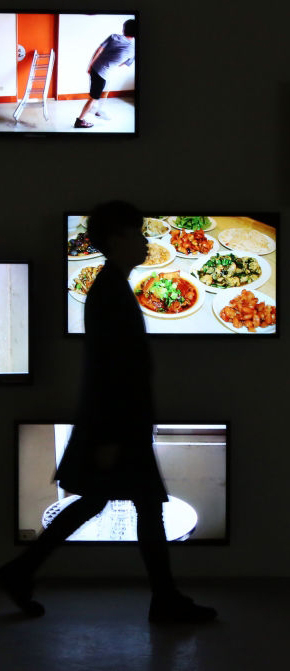
The eight-channel video installation, Everything is Everything, was created for the first time to be shown at the 2006 Taipei Biennial, curated by Dan Cameron. For this work, the artist and two assistants spent a total of eight days recording their interactions and interventions with readily available items, including hangers, glasses, towels, air mattresses and toilet paper, all found in the city of Taipei. The physical properties of these objects have been tested (a metal hanger is stretched to the breaking point) or their uses have been expanded (a level placed on two table legs becomes an improvised obstacle). Tanaka and his assistants experimented with these objects several times indoors and in public, and their explorations were compiled into eight separate video loops lasting from 1:19 to 1:50 minutes. Tanaka’s narrowly cut frame of each scene often features performers from the neck down or removes them completely from the scene, thus focusing the viewer’s attention on the simple, repetitive objects and acts being performed.

Christian Babski, Stéphane Carion, Christophe Guignar & Patrick Keller

Satellite Daylight
Satellite Daylight is an interactive light installation formed by a trapeze of 24 high-voltage neon tubes tapering upwards, created by fabric | ch – a studio for architecture, interaction and research dedicated to investigating contemporary space based in Lausanne. The installation is connected to data collected in real time from online weather stations and meteorological satellite maps, which therefore translate actual global light conditions picked up by satellites orbiting the earth at the latitude of Basel into an endless loop of perceivable electrical intensity.

Joanie Lemercier

Brume
Brume is a series of works and installations by Joanie Lemercier, using a custom made device made of atomized water. Joanie frees his work from the screen and usual physical devices. He is using space and immateriality as a canvas, creating a mid air floating projection feeling. Thanks to this volumetric tool, he is modifying our frontal relationship with screen and allowing new interaction between the viewer and the projected image. Joanie Lemercier is still exploring the possibilities of this new medium with a series of experiences and chapters, questioning our view of reality. In his work, Joanie is researching timeless subjects like light, matter, geometry. With Brume, he is also interested in the link between water and light.