highlike

Gerald Trimmel – GARGANTUA (20250302) – Austria

GARGANTUA (20250302)

Gerald Trimmel


FILE SÃO PAULO 2026: Inter-creativity – Art and Technology – VIDEO ART SHORT
Electronic Language International Festival


GARGANTUA (20250302) – Austria

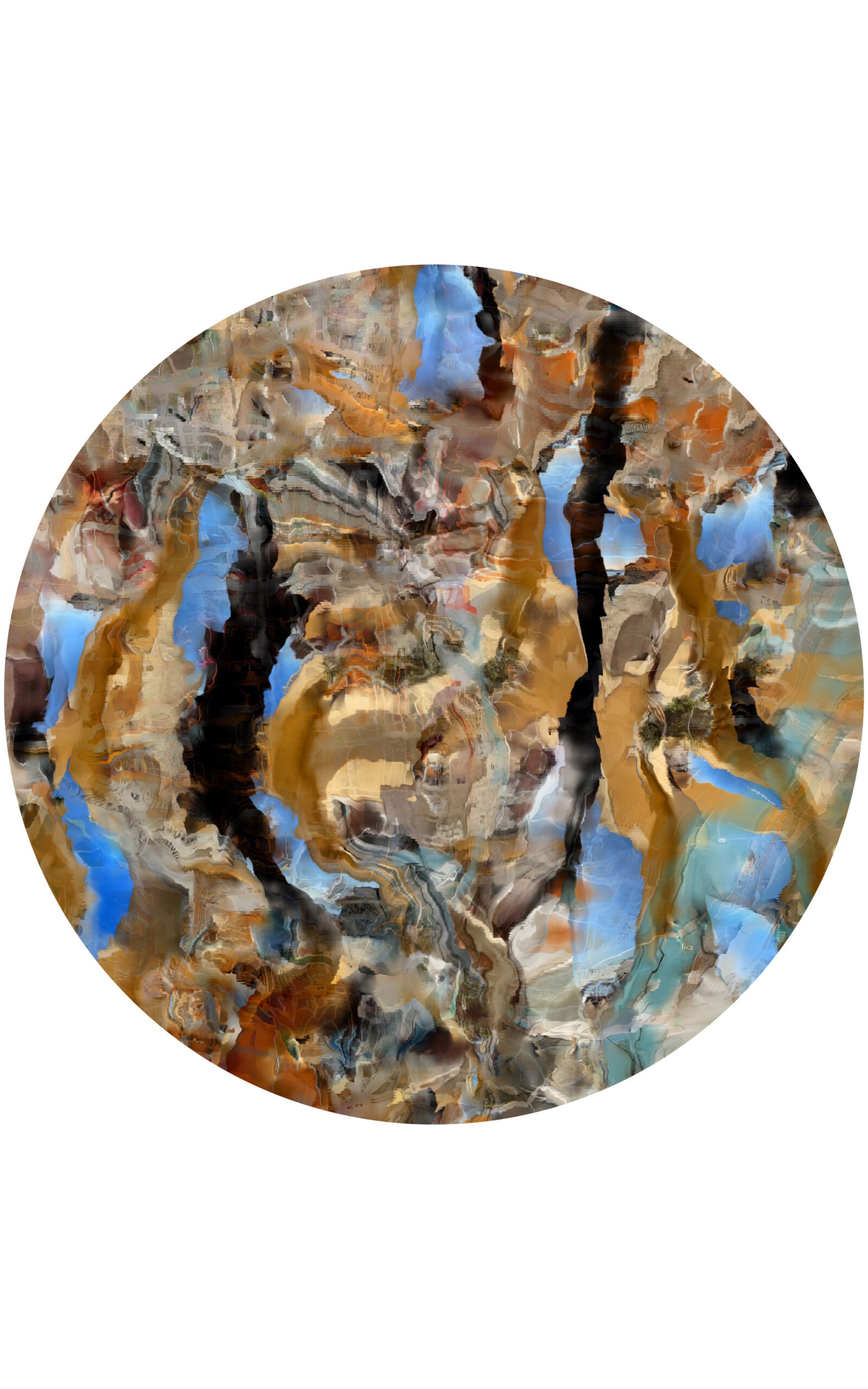
GARGANTUA (20250302) is a dynamic Cybernetic Canvas exploring AI-based image transformation as a metabolic process. Hybrid source materials—osmotic paintings, scans, chemical micro-scenarios, and dismantled diagrams—are processed through algorithmic recombination into a continuously shifting circular field. The work stages an unstable dialogue between visual matter and electroacoustic sound, forming a dense system of feedback, drift, and perceptual unrest.

BIO

Gerald Trimmel is a Vienna-based media artist, composer, and art therapist. His work explores transformation processes between analog material, digital systems, and AI-based image generation, often in circular audiovisual formats (Cybernetic Canvas). Recent presentations include Chongqing (China), ArteScienza Festival (Rome), and The Wrong Biennale (São Paulo | online).

KRIS VERDONCK

A Two Dogs Company
END

In the performance END artist Kris Verdonck shows the possible final stages of a human society in ten scenes. Melting glaciers, burning forests, cities under water, ubiquitous screens and cameras spying on us, the uncontrolled availability of weapons of mass destruction, and so on. END starts out from the images the media project onto our retinas all day and every day. The ten scenes are linked by a monologue spoken by a single character: the witness who sees it all happen. While this survivor – like the messenger in Greek tragedy – talks unceasingly, a series of ‘Figures’ appears on stage: machines and people or a combination of the two. They go from one side of the stage to the other, all in the same direction. Are they fleeing something? If so, what?

YESYESNO

night lights

In this installation YesYesNo teamed up with The Church, Inside Out Productions and Electric Canvas to turn the Auckland Ferry Building into an interactive playground. Our job was to create an installation that would go beyond merely projection on buildings and allow viewers to become performers, by taking their body movements and amplifying them 5 stories tall.

We used 3 different types of interaction – body interaction on the two stages, hand interaction above a light table, and phone interaction with the tracking of waving phones. There were 6 scenes, cycled every hour for the public.

FILE SÃO PAULO 2025: SYNTHETIKA – Edwin van der Heide

Spiral of Time — Amazonas Brazil — UFAM

Edwin van der Heide

Interact with Spiral of Time — Amazonas Brazil — UFAM via FILE ARCHIVE


FILE SÃO PAULO 2025: SYNTHETIKA – Art and Technology – Installations
Electronic Language International Festival


Spiral of Time — Amazonas Brazil — UFAM – Netherlands

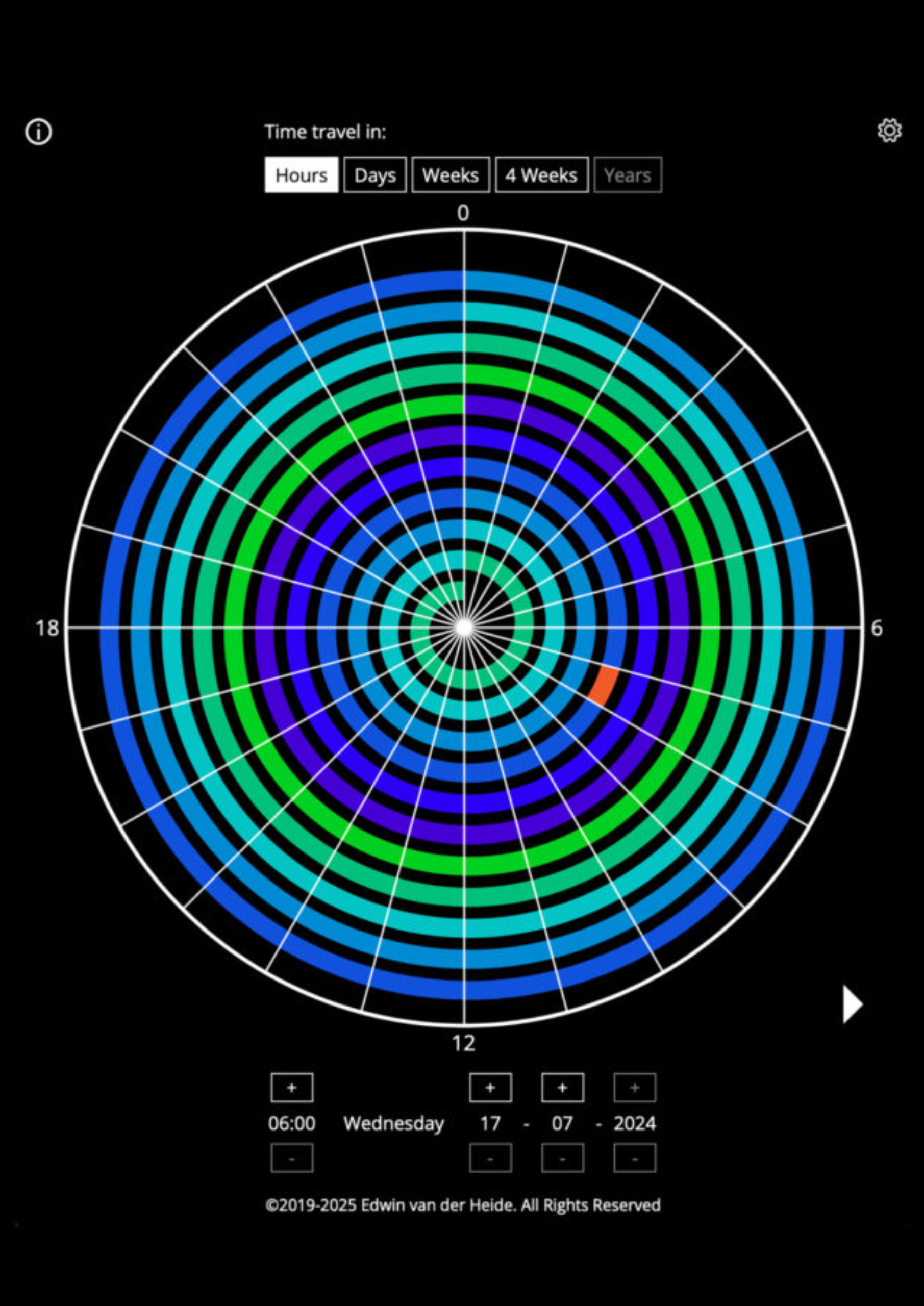
Spiral of Time captures and stages the diverse soundscape of a specific location over the course of several years. By documenting the unique natural, cultural, spatial, and temporal dynamics of a place, the work honors the contributions of all its actors. Every hour, a one-minute recording is made, resulting in a vast sonic archive over time. It is accessible online through a spiral-shaped interface, allowing listeners to explore the cyclical patterns revealed by navigating the material across different time intervals. 


Since July 17th, 2024, the artist has been recording the sounds of the square in front of MACBA (Museum of Contemporary Art of Barcelona). It is a very interesting, diverse, and vibrant urban space. The work is accessible online via https://www.macba.cat/en/spiral-of-time-placa-dels-angels/ and will also be presented physically in the museum starting July 10th, 2025.


Edwin is expanding the project to include other recording locations around the world—not only in urban contexts (dominated by humans) but also in areas governed by nature. The artist dedicated himself to a recording site in the Amazon region. Since February 11th, 2025 Spiral of Time has been installed at the Amazon Rainforest surrounding The UFAM (Federal University of Amazonas) in Manaus. It is home to one of the world’s largest urban forest fragments. Completely surrounded by the dense urban matrix of Manaus, this forest has been isolated since the late 1980s. The forest retains rich ecological features, including areas of mature terra-firme forest, late-stage secondary vegetation, and small patches of white-sand forests. This unique setting offers a rare opportunity to study tropical forest dynamics within a metropolitan environment. 

Spiral of Time-UFAM immerses the listeners in the acoustic life of one of the most biodiverse ecosystems on the planet. This contrast between the natural rhythms of the forest and the human-made patterns of the city enriches the broader narrative of the Spiral of Time, offering a deeper reflection on coexistence, change, and continuity across different environments.

BIO

Edwin van der Heide is an artist, composer, and researcher focused on sound, space, and interaction. His work pushes the boundaries of musical composition toward spatial, interactive, and interdisciplinary directions. He creates installations, performances, and immersive environments where the audience is placed at the center, encouraged to engage sensorially and investigatively.
 

Lisa Park

Blooming
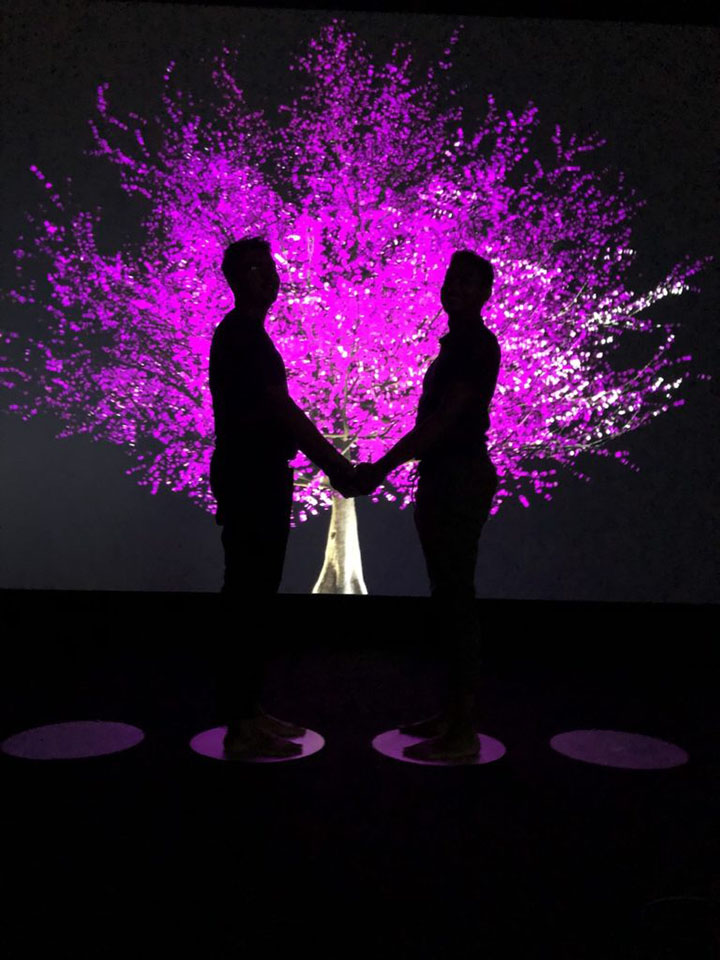
“Blooming” is an interactive audiovisual installation that highlights the importance of human connection. It takes the form of a life-size 3D Cherry blossom tree, which is a common symbol of social ties and transience of life in East Asian culture. As a response to participants’ skin-to-skin contacts, heart rate, and gestures, “Blooming” blossoms according to their intimacy. As audience members hold hands or embrace, the digital Cherry tree flowers bloom and scatter. When they let go off their physical contacts, the flower return to its pre-bloom state. The color of the flowers turns white or red based on participants’ heart rate as they interact with each other. (the faster the heart rate, the redder the tonality; the slower the heart rate, the whiter the tonality). In addition to the visual responses, sounds are also modulated according to the tree’s different stages: pre-bloom, blooming, petals falling.

POULENC

פולנק
プーランク
Karen Vourc’h
La Voix Humaine

La Voix humaine is the first “lyric tragedy” to take place entirely over the telephone. The argument is simple: this is a woman’s last conversation with the man she loves, as he prepares to marry another. Story of a suicide attempt, distressing cuts, interference: so many stages in this modern telecommunications ordeal where passionate love follows
new ways and deviations.“If you don’t like me and if you were clever,” the woman said to the man, “the phone would become a scary weapon. A weapon which leaves no traces, which does not make noise … “

Raven Kwok

1194D^3
Initially started as a tweak of 115C8 in 2013, one of Kwok’s Algorithmic Creatures based on finite subdivision, 1194D is an experiment on multiple geometric creatures co-existing within a tetrahedron-based grid environment. In 2017, The project was improved and revised into an immersive triple-screen audiovisual installation as 1194D^3 for .zip Future Rhapsody art exhibition curated by Wu Juehui & Yan Yan at Today Art Museum in Beijing, China. The entire visual is programmed and generated using Processing. All stages are later composed and exported using Premiere.

Bart Hess

바트 헤스
巴特·赫斯
בארט הס
БАРТА ХЕССА
Heart to Mouth
Sheath your arrows: the voluptuous red heart, international symbol of love, is reimagined in this a visceral new short by genre-defying Dutch artist Bart Hess. With echoes of high-tech fetish fashion and Jeff Koons’ contemporary pop art classic “Hanging Heart,” Hess’ latest video stages a Sapphic encounter from within crimson latex balloons.

Selgascano

Selgascano Pavilion
architectural photographer: Henry Woide
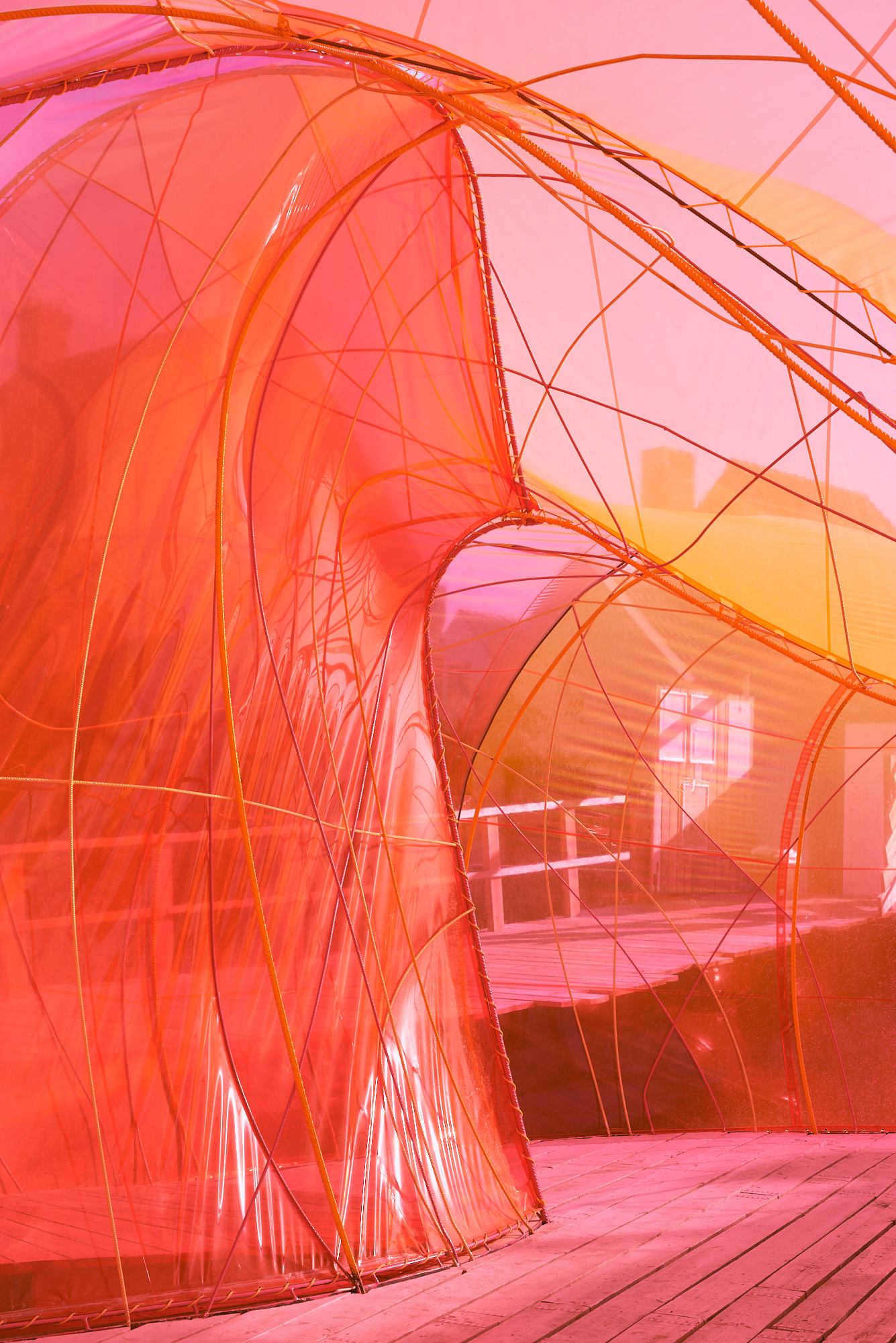
“Der 2015 Serpentine Gallery Pavilion wurde heute in London offiziell eröffnet und zeigt zum ersten Mal eine farbenfrohe und verspielte Struktur, die vom spanischen Büro SelgasCano entworfen wurde. Mit einer minimalen Metallstruktur, die von farbigen ETFE-Platten und Bändern umgeben ist, besteht das Projekt aus” geheime Korridore “, die den Zugang zum Hauptinnenraum ermöglichen, der vom chaotischen Londoner U-Bahn-Netzwerk inspiriert ist.
Bekannt für seine Arbeit mit synthetischen Materialien, verleiht die Wahl von SelgasCano durch das farbige ETFE der Struktur “Bewegung und Leichtigkeit”, da sich der Kunststoff ein wenig verdrehen kann, um den metallischen Elementen zu entsprechen. Der gemeinsam mit Ingenieuren von Aecom und David Glover entwickelte ETFE-Kunststoff wurde in 19 Farben gedruckt, um die Vielfalt der von Architekten gewünschten Farbtöne zu gewährleisten.
Die Architekten José Selgas und Lucía Cano, die im Jahr 2000 mit einer Struktur von Zaha Hadid anlässlich des 15. Jahrestages des Serpentinenpavillons eingeweiht wurden, erklärten, dass der neue Pavillon, obwohl das Projekt nicht wie etwas aussieht, das zuvor vor Ort durchgeführt wurde, dennoch “eine Hommage an” ist alle anderen und eine Hommage an alle Geschichten, die von diesen Projekten erzählt wurden”.” Rory Stott

ALMA HASER

Cosmic Surgery
Originally from Germany, Alma Haser is currently based in London, UK. She received her photographic degree from Nottingham Trent University in 2010[…] Her most recent series titled, Cosmic Surgery, combines the tangible photograph and the subject with the photograph itself. This facet of the images creates distinctive stages. Alma as the viewer of the subject, the origami construction, and then the reconstruction is then photographed thus creating a new aspect of the subject’s identity.

Anna Dumitriu

Cybernetic Bacteria

In the earliest stages of my work, I was intrigued by normal flora bacteria, the ubiquitous bacteria that live on us, in us, and around us. At the time this area was described as being of no commercial or medical interest – an ideal area for artistic research some might say! It threw into question for me the ways in which our scientific understanding of the world is limited by mundane things like finance, and how the limits of our understanding are drawn by factors other than curiosity.

video

JIRI KYLIAN – STEVE REICH

イリ·キリアン – スティーヴ·ライヒ
יירי קיליאן – סטיב רייך
Иржи Килиана – Стив Райх
Falling Angels
Falling Angels was created in 1989 as one Kylián’s Black and White Ballets. The Black and White ballets consisted of six pieces, with Falling Angel being dance 6. It is choreographed to Steve Reich’s Drumming (Part One) created in 1971, which was based on ceremonial ritual music from Ghana (West Africa). Throughout Fallen Angels there is the use of mesmeric choral movement and repeated phrases. Falling Angels is for 8 women and depicts female dancers in their aim to achieve perfection but succumb in various stages to the human female psyche and female events such as ambition, seduction, pregnancy, birth, death, motherhood and self-awareness. Kylián was influenced by surrealism and minimalism during the creation of this work and the ‘black and white ballets’. In this ballet we see the combination of classical lines and sharp percussive movements that give unpredictability to the piece as a whole